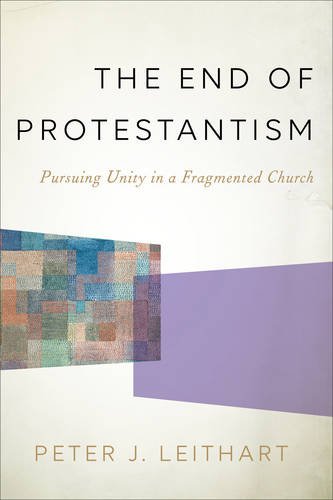
In preparation for a discussion group, I recently finished reading Peter Leithart's book,
The End of Protestantism. If this rings any bells, it's because it's based on a blog conversation and subsequent panel discussion that transpired a few years ago, right as I was working through my questions on the gospel and church unity. I later wrote a
post summarizing the conversation and offering a few brief responses, though I was already well on the road to Orthodoxy by that point. Now Leithart has developed his vision for a united "Reformational Catholic" church into a book, which I have read as a communing Orthodox Christian. So, is it any good?
Summary of the Book
The State of Our Disunion
Leithart begins his discourse with a biblical text to which he repeatedly returns, namely Jesus' "high priestly" prayer to the Father at Gethsemane for the unity of his disciples (emphasis added):
I do not pray for these [the Twelve] alone, but also for those who will believe in Me through their word; that they all may be one, as You, Father, [are] in Me, and I in You; that they also may be one in Us, that the world may believe that You sent Me. And the glory which You gave Me I have given them, that they may be one just as We are one: I in them, and You in Me; that they may be made perfect in one, and that the world may know that You have sent Me, and have loved them as You have loved Me. Father, I desire that they also whom You gave Me may be with Me where I am, that they may behold My glory which You have given Me; for You loved Me before the foundation of the world. (Jhn 17:20-24)
This is the unity Jesus wants for his church, but Leithart forcefully argues that it is not what his church is now. His first chapter is largely a comprehensive overview of all the ways in which Christianity is presently divided, and a critique of ways of handling this disunity that fall short of Jesus' vision, such as denominationalism, theories of the continuing "spiritual" unity of the visibly divided church, or saying that the "church" remains united as other groups falsely calling themselves churches have merely divided away from it. None of these "solutions" to the present division of Christianity are what Jesus prayed for, they are merely ways of making ourselves more comfortable with the division.
And, Leithart believes, this division runs wide and deep. Doctrinally, virtually every church has added to the basic creeds Christians have in common; we may affirm the same doctrines but understand them differently. To say we agree on the "fundamentals" of the Christian faith assumes we agree what these fundamentals are, but again this is not the case. Our worship practices are widely diverse; we cannot agree on the number or nature of the sacraments. Believers expelled from one church can easily find another to receive them, no questions asked.
Ever the optimist, Leithart believes that this division, not being an original part of the church, cannot last forever; it is in no way essential to the church. In many ways God is answering Jesus' prayer for the church before our eyes. To be a part of the solution, we must die to our currently churchly identities, insofar as they are rooted in our distinction from our Christian brethren. "If the gospel is true, we are who we are by union with Jesus in his Spirit with his people. It then cannot be the case that we are who we are by differentiation from other believers." (p. 6)
Church United
After laying out his basic vision for the book and the church, Leithart explains more of the theological basis for the unity to which it is called. Unity with himself and each other has always been God's plan for humanity, and though we have made a mess of it, God promises that sin and alienation will not get the last word. "Jesus came to fulfill this promise of reunification" (p. 13), to unite all of humanity together to himself in the church, breaking down every barrier between us (cf. Gal 3:28). The church is the fulfillment of this promise, breaking into the present.
If this is all true, what do we make of the division within the church that Leithart just described? He again calls out the common Protestant answer of saying the church is spiritually one even as it is institutionally divided: "The true church, it is said, is an invisible reality that can coexist with visible conflict, division, estrangement, and mutual hatred." (p. 18) Leithart contrasts this with Paul's great concern for unity in the churches he oversaw: "When the Corinthians divided their loyalties among their preferred apostles [1 Cor 1:11-13], Paul did not excuse them by saying that, despite it all, the church is still one. He was outraged that the Corinthians had divided Christ." (p. 18)
Leithart argues that the unity of the church, rather than a spiritual reality, is "a future reality that gives present actions their orientation and meaning." (p. 19) This unity is strongly eschatological; it will be consummated at the end of the age when God is "all in all" (1 Cor 15:28), but like so many other eschatological blessings we have a share in it now through Christ. We must not overrealize our eschatology and suppose that the church is already as united as it will ever be, nor underrealize it and come up with ways of making peace with divisions in the church. Leithart is unafraid to use the word "catholic" (i.e. universal) to describe this unity and the reunited church he envisions.
Reunion will be the titular "end of Protestantism", insofar as our "Protestantism" is defined by its differences from Roman Catholicism and other Protestant denominations; Leithart argues that it will also be the fulfillment of the original vision of the Protestant reformers, who (he argues) were not individualists but sought to restore catholicity to the church where it was lacking because of Roman abuses. "Some of the Reformers spoke of an 'invisible church', but that did not undermine concern for visible reform and visible unity. On the contrary, they spoke of an invisible church out an interest in reforming the visible." (p. 40) They viewed the Roman Catholic Church not simply as "un-Christian" but as a church of some kind, albeit unsound and in need of the reforms they were proposing. With the confessional era, in which "each church formulated its theology in responses to controversies with other branches of the Reformation" (p. 48), the early divisions in Protestantism solidified, but this was a departure from the intent of the early Reformers.
In chapter 3, Leithart boldly presents a vision of what this united, fully "catholic" church could look like. He strongly believes that this church will not simply be a continuation of any presently existing church, but a new church, the original apostolic church transformed and resurrected in a new form that reflects and contains the historical journey of division and reunion its members have traversed.
"The reformed, united church of the future will be a biblical church." (p. 27) In their study of the Bible, its ministers will draw from the whole of the Christian tradition, east and west, ancient and modern. Confessions and creeds will remain in play, but they will no longer be used as wedges to codify divisions between Christians, and will be open to correction from the Scriptures. The whole Bible will be taught, without favoritism of books; theologians will be open to the truth on both sides of formerly divisive controversies. The future church will not be perfectly united in belief (when has the church ever been?), and indeed there will be more theological battles once division is no longer an acceptable way to relieve disagreement. Expulsion from this church will plausibly be seen as expulsion from the church, without the easy option of simply joining another one.
This future reformed catholic church will be sacramental and liturgical, its services each beginning with confession and absolution of sin and reaching their climax with the Lord's supper. Worship will truly be "the work of the people" (the meaning of "liturgy"), not a performance put on by the ministers with the laity as spectators. Worship will be biblically rooted as well as passionate and charismatic, with music again drawn from the whole tradition, though not from commercialized pop music. The government of this church will not be a World Council of Churches-style bureaucracy, but a local and global communion of pastors and overseers exercising discipline with gentleness. All pastors will recognize the ordination and authority of all others; they will coordinate the church's mission to the world; they will speak with a united voice instead of a cacophony of small voices, many of them outraged.
Leithart concludes, "To achieve anything resembling this vision, every church will have to die, often to good things, often to some of the things they hold most dear." Every church will have to change, to lay aside the things they claim to in order to distinguish themselves from other Christians, the ways they "normalize" division or try to somehow justify it.
Church Divided
In his second part, Leithart offers an in-depth critique of denominationalism, which he considers a false union, the "institutionalization of division" (p. 4). He first explains more what denominationalism is: A denomination is a religious structure that is adapted to a pluralistic society, in which religion is a voluntary activity, an individual choice between different options courteously competing for peoples' affiliation on a level playing field. This competition resembles a free market in economics, except that it is a market of ideas rather than goods and transactions. It has no coercive power, and doesn't want
anyone to have it where religion is concerned. "A denomination is not a
disestablished church. Denominationalism is the
established church of pluralism." (p. 59, emphasis the author's) Denominationalism, he points out, was not the meta-structure of Christianity in the immediate aftermath of the Reformation.
Before critiquing it, Leithart first tries to appreciate the ways God has providentially worked in and through denominationalism in spite of its shortcomings: first, it allows Christians of different convictions to coexist peacefully and in a limited sort of union, while preserving freedom of conscience. It is arguably an improvement over the narrow-minded confessionalism that arose in the more immediate aftermath of the Reformation, in which theological disagreements could and sometimes did lead to ugly verbal and even physical conflict. The atmosphere of free competition between denominations has helped keep American Christianity more vibrant and resistant to secularization than European Christianity, much as a free market tends to be healthier than a tightly-controlled one.
With that said, Leithart has plenty to say against denominationalism. Even at its best, "denominationalism is an
alternative to the one church that the Father promised....In its
essence, denominationalism falsifies central Christian truths about the church and her members." (p. 71, emphasis the author's) The denominational names by which we call ourselves—Lutheran, Reformed, Baptist, Methodist, and so on—serve to divide us from other Christians, define us by our differences from them, when the only name we are supposed to be named with is the name of Jesus. Denominationalism institutionalizes these divisions, makes them seem "normal" or "the way things are", when (historically and theologically) they are anything but normal.
In a competitive religious landscape such as exists in America, it's easy for denominations to reinforce peoples' existing biases. Congregations tend to become internally homogeneous, both ethnically, racially, and socioeconomically as people find it easier to associate with others like themselves. "The problem is not that the church fails to meet some external standard of diversity. It is that the church mimics and mirrors the world's own divisions" (p. 75)—when it is supposed to transcend them.
Denominations also tend to become
theologically homogeneous, as Christians self-segregate into denominations that share their particular beliefs. This creates even bigger problems. It makes long-standing theological disputes impossible to resolve as Christians can coexist peacefully
without resolving or even talking about their differences. It makes believers ambivalent about their own theological commitments, which seem to be serious enough to keep us from sharing in church life or the sacraments with those who disagree, but not serious enough to keep us from freely acknowledging them as fellow believers. Denominationalism also makes identifying or prosecuting heresy almost impossible; one denomination's heresy may be another denomination's fundamental belief. Denominations feel no responsibility for the false teaching or misdeeds of other denominations, another betrayal of catholic unity. Ultimately, "the marketplace analogy [for religion] is itself an accommodation to worldly patterns of society" (p. 79); it reduces faith from a matter of absolute truth to an individual preference.
The same boundary-forming process that makes denominations internally homogeneous also deepens and perpetuates schisms between denominations. Denominations need defined boundaries to justify their continuing existence, and these boundaries invariably involve reasons for
not being some other denominations. The original reasons for a schism may be largely personal or political, but they are cloaked in theological rationale and doctrinal distinctives. The generous spirit of denominationalism, which acknowledges other denominations as fully "Christian" and denies that any one denomination has an exclusive claim to the truth, lowers the barriers to schism; small differences can escalate to schisms, and then harden into denominational identities. Denominational theologies develop in order to justify their continuing existence, and biblical texts that call these theologies into question are minimized.
Leithart also believes denominationalism has contributed to the secularization of American society. Following Will Herburg, by "secularization" he means a gap between
conventional religion (whaqt is actually practiced by religious adherents) and
operational religion ("public religion", the set of beliefs, rituals, and values that shape public life and binds society together). In traditional societies (and, to a lesser extent, in European countries with established churches) there is no distinction between the two, but "in a denominational society,
no conventional religion is the operational religion. None is
permitted to be." (p. 83) By definition, then, denominational societies like that of America are secularized. "One might also say that America has not been secularized because it started out
pre-secularized." (p. 82)
The operational religion that prevails in American society is "a religion thoroughly secularized and homogenized, a religion-in-general that is little more than a civic religion of democracy, the religionization of the American Way." (p. 84, quoting Herburg) Any prophetic voice of religion that may be raised against America is reduced to a matter of private opinion, subordinated to this prevailing civil religion. The result is that the Christian witness of churches that accede to the denominational system is greatly compromised; the voice of the church is fragmented into thousands of little, contradicting voices that are easily ignored. In his next chapter, Leithart enumerates two historical failures which demonstrate the failings of American denominationalism: the treatment of African-Americans (and the formation of black denominations as they found themselves no longer welcome in white ones) and the history of Protestant prejudice against Catholics.
Intermezzo: From Glory to Glory
Leithart turns to biblical history for several examples of the pattern of creation, corruption, and recreation-anew which he is seeking to apply to modern Christianity. During the creation week God creates something, separates it into pieces, and rearranges those pieces in a new, harmonious way (seen especially with the creation of man, then his division into male and female) We see this pattern repeatedly in God's dealings with his people, with the element of judgment added. The world became corrupt, so God separated Noah out of it and preserved him through the flood to a world purified and restructured. He scattered the builders at Babel after they became united against him and called Abram out of the diaspora. Centuries later, God passed judgment on Egypt and brought Israel out to be a people to himself. When Israel later divided against itself and fell back into sin, God preserved a remnant through exile and eventually brought them back to the promised land. And, of course, "the church came into being as another, final revolution in Israel's history" (p. 112), again separated out from the larger Jewish community. To summarize this pattern: "A system is established, sanctioned by God. Human beings sin and corrupt the world, and so the Lord comes to dismantle it and erect something new." (p. 111)
At each chapter in this story, the conditions of God's relationship with his people are reshaped; God gave Noah and Moses new laws after delivering them; second-temple Judaism took on quite a different shape than before. "At each juncture, God calls his people to shed old ways and old names, to die to old routines and ways of life, including ways of life God himself has previously established." (p. 103) This insight resembles a less-systematic version of dispensationalism, but Leithart's point is that this pattern should continue to apply to the church, especially in our present state of disunity. "Though we have come to the final covenant order, the pattern of death and resurrection that characterized the history of Israel continues within the history of the church." (p. 113) Paul, Constantine, the rise of Islam, the Great Schism, the Reformation, have all reshaped the church in their own ways. And we cannot assume that the church reached its final form with
any of these past developments; we cannot be complacent about its current state. "Division
cannot be the final state of Christ's church. The names we now bear
cannot be our final names." (p. 114) We must remain open to God working something new in the church to restore its original unity, and even to being part of this work.
Divided Church Dissolving
In the next part Leithart looks at some possible ways in which this "something new" may be springing forth in the present, in which the prevailing denominationalism is breaking down. The standard division of Christianity as Protestant, Catholic, or Orthodox is becoming increasingly outdated, especially as new Christian movements in developing countries like the Evangelical Church of Congo,
Aladura, and the explosive growth of Pentecostalism in China refuse to fit cleanly under any of these three heads. Leithart suggests that Pentecostalism itself, a new but rapidly growing form of Christianity, may be a new, fourth basic category of Christianity rather than merely a form of Protestantism. Meanwhile relations between the three traditional Christian communions have changed in their shape over the last century or so: the Roman Catholic Church has adopted a nicer, more open outlook towards Protestantism and modernity (especially since Vatican II), and the trend of Orthodox theologians studying in the west (originating with the Turkish conquest of the Byzantine Empire) has opened up new avenues of dialogue between east and west where there was once cold distance. "The restructuring of the global church offers an occasion to overcome the painful divisions of centuries. It opens an opportunity for Reformational Catholicism." (p. 122)
Leithart next looks for signs of renewal and change in contemporary American denominationalism, which he hopes may signal the breakdown of its institutionalized divisions. Nondenominational churches are becoming increasingly large and common, and denominational churches are free to draw from various nondenominational resources for worship, instruction, and ministry, blurring the lines between churches of different denominations. It's becoming more common to switch churches, denominations, or even communions (case in point: the present author); it is no longer the norm to remain in one church for one's entire life. And in the era of the "culture wars", the widening division between conservative churches and those influenced by secular modernity is becoming much more significant than the old confessional divisions; churches on the defensive against secularization are turning to each other for support and community. (A prominent theme of the other book I've been reading and hope to blog about, Rod Dreher's
The Benedict Option)
United Church Reborn
In his last chapter, Leithart reiterates his call for Christians to pursue Catholic unity and "die to our divisions" (p. 165), offering some practical ways to do so from our present situation. He offers the idea of "federative" ecumenism (common action without the expectation of doctrinal uniformity or intercommunion) as a stepping stone on the way to full communion. Also needed is "receptive ecumenism", an "acknowledgement that we do not know or possess everything we need in our own branch of the church" (p. 167), and a willingness to receive from other traditions to fill what is lacking in our own as we move toward unity. By doing so we do not betray our own Christian tradition, but see it transformed and completed as what was destroyed or distorted by division is restored.
He then offers a response to Catholics and Orthodox who hold that the path to unity consists of all other Christians rejoining their "mother church", as well as to Protestants considering converting to one of these churches. The united church of the future will not be a simple extension or continuation of any existing church, at least if the biblical pattern he outlined holds. The Reformation recovered some central, biblical truths which ought not to be sacrified, Leithart believes; Catholics and Orthodox have their own forms of tribalism that they need to get past, such as their refusal to partake in eucharistic fellowship with other Christians. He considers this distancing of oneself from other Christians to be "uncatholic", leading to the quotable line that he is "
too catholic to be Catholic".
Finally, Leithart offers some ideas for how Christians can become "reformational catholics" in their own lives, to embody his vision for church unity. Theologians, while continuing to insist on the importance of doctrinal truth, can adopt the way of humility, opening themselves to correction and remaining willing to move outside denominational barricades. He uses the Protestant-Catholic debate on soteriology and the Lutheran-Reformed one on sacramental theology as two in-depth examples of what this doctrinal rapprochement could look like, without making rigid prescriptions. Pastors, meanwhile, can rediscover the theological and liturgical resources of the shared Christian tradition and aim for closer relationship and cooperation both with other churches and the wider society. Lay Christians can pray, minister, or even worship with Christians of other denominations, and seek to move beyond the "agree to disagree" stage of theological dialogue toward more constructive conversation, greater mutual understanding, and ultimately harmony.
Response
Though I have moved out of the target audience for this book since I first watched the discussion between Leithart, Sanders, and Trueman at Biola, I greatly enjoyed reading it and appreciated several of Leithart's points. His concern for the unity of the church reminds me of my own years ago when I was searching for a truer faith, though of course much more eloquently expressed and biblically supported. I appreciate his maximalistic interpretation of Jesus' prayer in John 17, and his refusal to be content with the "solutions" to divisions in the church put forward by other Protestants like invisible-church theology and denominationalism. Like I did, Leithart perceives that the "unity" preserved in these schemes is only a shadow of the unity for which Christ prayed, which is supposed to be a symbol or representation of the indescribable unity of the Trinity, the unity of a single body, all the parts living and working together in harmony. I also appreciated his understanding of this unity as something Christ prayed for, that God promised and will reestablish, not merely something for us to work towards; this almost prophetic vision is the basis for the infectious hope that pervades the book.
I also appreciated his warnings against defining yourself by what you are not, or using labels to needlessly differentiate yourself from others. In my reflections on the
gospel I glimpsed the danger of defining yourself by negation; this is a danger for Orthodox (especially those undergoing "conversion sickness" as I did) as well as for Protestants. Orthodoxy is much more than simply not-western-Christianity, not-modernity, not-ecumenism, as it is sometimes caricatured to various degrees both by its proponents and detractors. To the extent that we get our Christian identity from
not being something or someone else, we have to die to this identity in order to be one.
As might be expected, though I appreciated the general spirit of Leithart's book, I do have some significant disagreements with his vision of Christian unity. Before beginning my critical response, I should mention that Robert Arakaki on the Orthodox-Reformed Bridge blog has written a fairly thorough
review of the book, which is at least as worth reading as this one and to which I'll be referring in my response.
Future Church
One of the first things that jumped out at me in
The End of Protestantism, literally from the first page, was the fact that Leithart has a fairly unique understanding of what "the church" really is (though not without precedent, as Arakaki points out). Consider this quote:
The church is divided. It is not that the church has remained united while groups falsely calling themselves churches have split off. It is not that we are spiritually united while empirically divided. (p. 1)
Leithart here specifically rejects the characteristic ecclesiologies of both historical
and Protestant Christianity. He rejects the notion that the continuing unity of the church is merely spiritual in nature, but also the notion that the church remains one while schismatic groups may separate from it. He would thus directly deny Bishop Kallistos Ware's saying that "There can be schisms
from the Church, but no schisms
within the Church." No, Leithart seems to be saying,
all schisms are schisms within the church.
We cannot exonerate the church by treating division as extra-ecclesial, ecclesiologies that imply that "the 'Church as such' is never divided." (p. 22, quoting Ephraim Radner)
Leithart's ecclesiology is most similar to the
branch theory which holds that the Christian churches of today are all "branches" that have split off from the original, apostolic church, except that he believes that this condition is
not God's will; it
is sinful division and needs to be overcome. He believes that "the church
as such is a historical community and thus
as such is both sinful and divided." (p. 23) In my journal I contrasted these three ecclesiologies with a simple diagram of three propositions, each of which is accepted by two ecclesiologies and rejected by the third.
 |
| Pick two. |
Specifically:
- Catholics and Orthodox believe that the church is visibly one, and identify that church (i.e. the "One, Holy Catholic and Apostolic Church" of the Creed) with their particular communion.
- Most Protestants believe that "the church" includes Christians of all communions and confessions with authentic, saving faith in Jesus Christ, and that this church, not to be identified with any institutional church, is one in a spiritual sense, through believers' saving union with Christ, rather than in a visible sense.
- Leithart himself continues, in the Protestant fashion, to define the "church" broadly, as encompassing Christians of all confessions and communions, but he distinctly rejects both the Protestant understanding of its unity as merely spiritual and the Catholic/Orthodox identification of the church with their particular church. He reconciles these by instead denying that the unity of the church is a present reality; the church is really divided. Rather, he views unity as an eschatological, "now but not yet" reality.
Leithart intentionally contrasts this eschatological view of church unity with the spiritual one of most Protestants: "The unity of the church is not an invisible reality that renders visible things irrelevant. It is a
future reality that gives present actions their orientation and meaning." (p. 19) He applies the "now and not yet" sense in which God's promises are realized in Christ and the church, yet awaiting complete fulfillment in the eschaton, to church unity. He isn't afraid to describe this in language that seems contradictory: "[The church] is one now because it
will be one in the consummation, in the last day. We are what we will be. And we strive to be what we will be. What the church
will be is one catholic church. And we strive to be what we will be." (p. 21) In much the same sense that Luther declared the sinner to be "simultaneously just and a sinner", the church is simultaneously one and divided. We live now as we will be, but the paradox will not be fully resolved on this side of eternity.
Is all division within the church?
I'm not sure Leithart fully realizes how radical this ecclesiology is, especially if we try to apply it historically. The significant matter is his flat-out denial of the traditional view of schism. In the Orthodox (and Catholic) understanding, those who consciously break with the teaching of the Church (or continue promulgating a teaching after it has been condemned by the Church) are considered to be heretics (from the Greek meaning "choice" or "preference", highlighting the intentionality of the break from the received teaching) and are excommunicated, i.e. barred from partaking in the Eucharist with the Church until they accept her teaching and faith. Excommunication is not viewed as an act of disunity in itself, but as a sadly necessary response to the heretic's divisiveness; he is understood to have removed himself from the unity of the Church and gone into schism, and excommunication merely makes tangible this reality. The Church itself remains one and undivided, as Ware and others have said, though she has lost a member, whose reconciliation is to be earnestly desired.
Leithart seems to be claiming that this never happens. He outright rejects the practice of excommunication for false teaching, reserving it only for flagrant, impenitent acts of sin (p. 181). As previously mentioned, he denies that there can be schisms
from the church. Rather, despite the reality of the schism, both parties somehow go on as part of the church, which has now taken another step away from the unity for which the Lord prayed. And he also says that both parties to schisms are changed by it; neither is to simply be identified with the united church that preceded the schism:
[After listing a number of turning points in church history] At each of these transition points, the church was transformed in its liturgy, in its internal structures, and in its relation to political power. ... The division between East and West created two churches where there had been one. Orthodoxy and Roman Catholicism were both created by the schism, just as Catholicism was formed by the split of the Western Church at the Reformation. (p. 114)
Because no church has escaped Christianity's damaging history of division, no church fully "gets it right"; no church has the right to claim the right course is for everyone else to become just like them. This is the basis for his repeated statement that the united church of the future will not be continuous with any presently existing church (pp. 26, 170), and that "no tradition has been spared the desolation of division.
Every Christian tradition is distorted insofar as it lacks, or refuses, the gifts that other traditions have.
Every Christian tradition must be as ready to receive as to give." (p. 167) Thus, "in receiving from others, we are enriched as the particular kinds of Christians we are. ... Catholics become more fully Catholic as they become appropriately Anglican, Lutheran, Methodist, Orthodox." (p. 168) Though this mutual enrichment and reception of truth, what were once divided churches grow together into one, united catholic church.
I wonder, how far one can take this relativization of Christian churches' claims to truth; if the universal language of the last two quotations is any indicator, Leithart doesn't seem to set any limits. In the segment I was quoting from, he seems to implicitly deny that any of the doctrinal differences that divide Christian traditions are really absolute—no one is "just wrong" about anything. Merely backtracking and repenting of one's errors is never the way forward; . We become more, not less, of whatever we are—Catholic, Orthodox, Lutheran, Presbyterian, Baptist—as we tear down our walls and receive the treasures of other forms of Christianity from which we were separated.
To be blunt, I think Leithart downplays the seriousness and depth of the doctrinal issues that divide Christians. The Great Schism did not occur simply because east and west lost a spirit of charitability or stopped receiving truth from each other, but because (from our perspective) the west embraced errors that struck at the heart of ecclesiology and theology proper. What could "receiving" things like papal supremacy and the
filioque from them entail if not the abandonment of our Orthodox faith in favor of the Roman Catholic one? The question is even starker if we think of early Christian heretics: the Judaizers, the Gnostics, the Arians. Was the Church right to condemn and separate from such teachers, or was this another instance of the disunion Leithart laments? Did the excommunication of teachers such as these really constitute a division
within the Church, transforming it and depriving it of something we need to recover? Do I really stand to become more Orthodox by becoming more Arian? I think not.
This kind of thinking, that both sides in an intractable dispute are partly right but incomplete and need to accept what is lacking in their views in order to harmonize them, sounds good and I would
broadly agree with it in my own approach to Christian disunity, but it is not a universal rule. Sometimes (though, I grant, certainly not all the time), it is possible for one of the parties in a theological dispute to simply be right, and the other wrong. The correct course of action in such cases is not for each of the schismatic parties to remain open to receiving or learning from the other, but for the party which has departed from the truth to repent and return to it.
Ironically, Leithart seems to agree with this point, albeit mostly implicitly. In one place he denies the possibility of excommunication over doctrinal error (p. 181), yet mentions that in the future church "some opinions and teachers will be judged a threat to the gospel itself, and impenitent teachers will be expelled from the church." (p. 29) Later he writes that "we cannot assume that every church that calls itself Christian is in fact Christian. Some movements ... have abandoned fundamentals of Christian faith—adherence to Scripture or confession of God as Father, Son, and Holy Spirit—and are not Christian." (p. 128) Yet in the beginning he says that "Virtually every church has added to the early creeds and made those additions fundamental to the church." (p. 2) Yet from the perspective of such churches (such as the Orthodox Church), Leithart has abandoned central truths of the faith just as he calls out other movements for doing.
What Leithart seemingly fails to see is that in standing up for basic Protestant orthodoxy he is still doing the same kind of boundary-keeping which he elsewhere laments as divisive. Leithart
is, in fact, adopting a particular stance on which doctrinal disagreements are to be allowed within the united reformational catholic church, and which are serious enough to place someone outside the bounds of this church. Yet he seems to decry
all division over doctrine and says
every church must "come and die", must become more fully itself by receiving the riches of estranged Christian traditions.
In fact, beneath his calls for catholic unity, Leithart remains unapologetically Protestant.
The Reformation recovered central biblical and evangelical truths and practices that Protestants ought not to sacrifice. Even after Vatican II and the ecumenical movement, even after the joint Lutheran-Catholic statement on the doctrine of justification, many of the traditional Protestant criticisms of Catholicism and Orthodoxy (of the papacy, of Marian doctrines, of icon veneration, of the cult of the saints) hold. (p. 169)
He assumes that Protestant distinctives like
sola scriptura and emotive, pietist worship will be part of the reformational catholic church of the future, and doesn't consider "dying" to these things. Meanwhile, he also assumes that this church will have no appeals to Mary and the saints, no icons (pp. 32, 169), and no bishops. Following after Luther, he considers the veneration of saints, relics, and religious images to be idolatry, deeply opposed to the communion of saints (pp. 42-43), whereas for Orthodox these things are inseparable from each other. In his overarching ecclesiology he still assumes something very much like the theory of a "great apostasy" in the church's history, presumably dating back to when the first division made two churches out of one previously whole. By clinging to innovations such as these, Leithart ironically echoes the sort of stubborn insistence on the rightness of one's own reading of things that produced so many of the post-Reformation schisms in the first place. He presumably expects Catholics and Orthodox to receive and be perfected by such teachings; in the future church, he says, "enhanced by exchanges with low-church, biblicist evangelicals, Orthodoxy will not remain the same." (p. 168)
Me genoito! (May it never be!)
So I think Leithart greatly overstates the revolutionary nature of his position. Explicitly (in his talk of denominations needing to throw off the divisive tenets they have adopted and be open to receiving the treasures of other traditions, of no one church being able to claim it has preserved the truth perfectly that that others should just join them) it resembles the old-school ecumenical movement (as Arakaki points out in his critique). Implicitly (in his continued willingness to make judgments about what is essential, permissible, or forbidden and refusal to relinquish "central...truths and practices") he continues to resemble other conservative Protestants—and, indeed, Catholics and Orthodox. This common insistence on received truths, different though those truths may be, is a potentially fruitful avenue for real ecumenical dialogue.
A wound on the body of Christ
It is this continued underlying resemblance to those he considers "uncatholic" or "divisive", while calling his audience to renounce divisiveness, that I think makes Leithart's critiques of Orthodoxy fall flat. He holds somewhat of a strawman view of our attitude toward divisions between churches:
We must utterly reject ecclesiologies that imply indifference to visible division. We cannot exonerate the church by treating division as extra-ecclesial, ecclesiologies that imply that "the 'Church as such' is never divided." ... Orthodox think that the church is the Orthodox Church and therefore any division is happening to something other than the church. We should have no patience for such cheap solace, which only makes us complacent in the face of disunity. (pp. 22-23)
This is rather uncharitable; he doesn't make much of an effort to understanding what lies behind our ecclesiology (this is an area in which Leithart seems unwilling to budge, after all). At the risk of covering
well-trodden ground, Orthodox ecclesiology starts with the Lord's founding of the Church on the witness the original twelve apostles, and the promises he made: that the Holy Spirit guides the Church into all truth (Jhn 16:13), that the gates of Hades will never prevail against her (Mat 16:18) are two of the most prominent ones. The Fathers understood Paul's language of the Church as the "body of Christ" (1 Cor 10:16, 12:27) to mean that the Church is not just an institution, but more truly an
organism, essentially one and whole. This preunderstanding is the basis for the affirmation of the Creed that "We believe in one holy catholic and apostolic Church".
Perhaps Leithart would agree with all of this. Where Orthodox part ways from his position is our belief that this Church still exists; it has continued from the first century to the present day, and that it is the worldwide communion of Orthodox churches. We do not believe that heresies and schisms in the Church have destroyed its faith or its intrinsic unity, as Leithart seems to, for to accept this would be to admits that the Lord's promises have failed. Indeed, the Lord and the apostles expected such troubles to arise (see Mat 24:10-12,23-24, 2 Peter 2), and the Church to survive them, albeit as a remnant. By Leithart's logic, the
original Church was destroyed in its infancy when it split into Judaizing and gentile-accepting factions, a split well-documented in the New Testament (cf. Acts 15, Galatians 2), each defining themselves over against the other. Given the short lifetime (in his terms) of a church founded and led by those who had directly heard from the risen Christ himself, one can't help but wonder at Leithart's optimism regarding the unity of the reformational catholic church of the future.
In the Orthodox understanding, heretics have gone out from us; they have forsaken the deposit of faith with which they were entrusted. (see 1 Jhn 2:18-25) Their departure (or excommunication) does not destroy the essential, organic unity of the body of Christ. It is true that we don't consider them to be part of the Church, for "what communion has light with darkness?" (2 Cor 6:14) But this
in no way precludes sorrow over our division from the heterodox, or a concern for reunion with them. In a recent
episode of a podcast by Fr. Andrew Stephen Damick, he had a quote by St. Gregory the Theologian, about theological disagreements with heretics, that grabbed my attention as I was preparing this post: "For we
are not seeking victory, but to gain brethren, by whose separation from
us we are torn." (
Orations 41.8; it is at around 30:00 in the podcast for those interested)
The Russian Orthodox Church has published a fairly extensive document,
Basic Principles of Attitude to the Non-Orthodox, which explains it better than I can. While affirming that "The Orthodox Church is the true Church of Christ established by our Lord and Saviour Himself" (1.1) and that "Every division or schism implies a certain measure of falling away from the plenitude of the Church" (1.14, as opposed to constituting a division within the Church), it laments the currently divided state of Christianity and affirms the importance of restoring its unity: "Due to the violation of the commandment of unity which has led to the
historical tragedy of schism, divided Christians, instead of being an
example of unity in love in the image of the Most Holy Trinity, have
become a source of scandal. Christian division has become an open and
bleeding wound on the Body of Christ." (1.20)
The document rejects a merely spiritual understanding of church unity (2.4), the branch theory (2.5), some common assumptions of the twentieth-century ecumenical movement (2.6, 9, 10), and something like Leithart's understanding of division as the tribalistic addition of additional criteria for membership to distinguish ourselves from each other (2.8). Nonetheless it affirms, citing from the same passage of Scripture that Leithart keeps returning to, that
The essential goal of relations between the Orthodox Church and
other Christian confessions is the restoration of that unity among
Christians which is required of us by God (Jn. 17:21). Unity is part of
God’s design and belongs to the very essence of Christianity. ... Indifference to this task or its rejection is a sin against god’s commandment of unity. (2.1, 2)
This document is, I think, an example of how a concern for Christian unity not unlike Leithart's can coexist with a belief in the visible, organic unity of the Church and that "genuine unity is possible only in the bosom of the One, Holy, Catholic and Apostolic Church." (2.3) It combines concern for the healing of Christian divisions with an equal or greater (and much-needed) concern for the preservation and proclamation of the apostolic deposit of faith.
Orthodoxy as Denomination
The misunderstandings don't end there. Leithart tends to group Orthodoxy (and Roman Catholicism) in with Protestant denominations during his calls for those denominations to set aside their walls of division. "When unity is realized, individual congregations and groups of
congregations will no longer identify themselves by denomination. There
will be no Roman Catholic, Orthodox, Presbyterian, Reformed, Methodist,
Baptist, Lutheran, or other churches. Churches will erase theologically
exclusive names from their signs." (p. 26) And later: "If our name is "Father, Son, and Spirit", then our name
cannot be Lutheran, Reformed, or Orthodox." (p. 72)
Similarly, he lumps our claim to be the authentic continuation of the apostolic Church with those of Protestant denominations, in order to dismiss them all: "Catholics, Orthodoxy, Anglicans, Presbyterians, Lutherans, Baptists—we
all think that the church will be perfected when everyone else is
enlightened enough to become like us." (p. 167) And he considers Orthodox (and, again, Roman Catholics) to be defining their religious identities just as negatively as Protestant denominations: "Despite claims to the contrary, Roman Catholicism and
Orthodoxy, as much as Protestantism, are defined by their differences
from one another and from other parts of the church." (p. 38) He assumes our doctrinal distinctives are unnecessary additions to the faith which serve only to divide us from other believers:
our theological and practical differences must be serious enough to keep us from giving up our identities and uniting as a single church. Sometimes we consider our differences serious enough to keep us from sharing the Lord's Supper together or acknowledging each other's baptism. Ultimate and necessary truths must be at stake. Inevitably, this means that we are adding to the gospel. It is not enough that someone profess that Jesus is Lord and live the life of a disciple; if she was not baptized by immersion, or if she does not affirm a Lutheran view of the real presence, or if she does not acknowledge the bishop of Rome as the head of the church, she is not in full fellowship. What makes us a community is not what we hold in common with other believers. but what we hold together against other believers. (pp. 76-77)
My disagreements here mostly go back to our differences in ecclesiology. To Leithart, schisms mean both parties have added to their prior, common faith in mutually exclusive (and equally unnecessary) ways; I have already shown both my reasons for disagreeing with this, and how he is not willing to apply this theory to question certain Protestant
sine qua nons. Again, trying to apply it historically raises difficult questions: was the use of the term "Nicene" to define catholic Christians over against the Arians unconscionable? When Gnostic heresies started appearing as early as the late first century, did the self-definition of the Church change from its proclamation of the incarnate, crucified, and risen Christ to a denial of esoteric, philosophical systems of cosmology and salvation? Was the use of the term "Orthodox" to differentiate the faith of the Church from what the Fathers viewed as grievous mutilations of that faith "uncatholic"?
If, as I suspect, Leithart would side with the Orthodox church in these historical instances, I would ask: how are the divisions he decries so different, except for the fact that they persist to the present day (and that his church is a product of them)? There is certainly no need to go to the lengths some of the Fathers (and the apostles Peter and Jude) did in their denunciations of false teachers, and indeed I applaud the "soft ecumenism" of twentieth-century Orthodox authors like Georges Florovsky as a welcome change from centuries of relative insularity, but if Leithart hopes that Orthodox will set aside the faith they have received in favor of a minimalistic gospel stripped of "divisive alterations" for the sake of "catholic unity", he is sure to be disappointed.
Too Orthodox to be Catholic?
On page 170 (in the section where he calls himself "too catholic to be Catholic"), Leithart poses a series of questions to "Protestants considering a move into Catholicism or Orthodoxy". Having done just this, I thought it would be a helpful exercise to go through answer them.
What are you saying about your past Christian experience by moving to Rome or Constantinople?
The same thing I felt implicitly even as a Protestant—that it was incomplete, dysfunctional in ways I couldn't quite explain, always missing something. I was always awaiting some new revelation, not so much new information as a new hermeneutical insight or "aha moment" that would finally make the pieces fit together and make sense of my questions. Now, in the light of the Orthodox tradition, I can actually see what my faith was missing.
Also, from a historical perspective, that my old faith was the product of a series of schisms, reforms, simplifications, and reformulations; countless offshoots and branches away from the true source, a derivative of a derivative. Now I have found that source, and I feel blessed and privileged to be able to draw from it.
In all of this I am not claiming any sort of special holiness or moral status simply by being Orthodox. Right belief is good and necessary, but unprofitable on its own. "Even the demons believe—and tremble!" (Jas 2:19) Knowing the truth only brings greater condemnation unless I abide in it, follow it, love it. Fr. Andrew Stephen Damick has a saying I really like that gets this point across: "Orthodoxy is true, but not because of me."
Are you willing to start eating at a table where your Protestant friends are no longer welcome? How is that different from Peter's withdrawal from table fellowship with gentiles?
Here and in the paragraph after the one with his questions, Leithart shows his commitment to the Protestant understanding of the Eucharist as a mere sign of Christian goodwill and fellowship.
When I attend Mass and am denied access to the table of my Lord Jesus, I cannot help but wonder what is the difference between Catholics and the Wisconsin Synod Lutherans or the Continental Reformed who practice closed Communion. ... Size and history apart, how is Catholicism different from a gigantic sect? Does not Orthodoxy come under the same Pauline condemnation [Gal 2:11-14] as the fundamentalist Baptist churches that close the table to everyone outside? To become Catholic I would have to contract my ecclesial world. The communion I acknowledge would become smaller, less universal. I would have to become less catholic—less catholic than Jesus.
His allegiance to open communion is understandable in a way, since it is a distinctively Protestant practice that he is no doubt loath to rethink. But it is baffling in another way, since open communion is a very tangible expression of the Protestant ecclesiology he deplores, which holds that the Church remains spiritually one (and its members are thus able to commune with each other) despite its visible divisions. The reality of these divisions and the doctrinal disagreements and historical schisms that produced them is minimized, pushed to the background, without actually being addressed; intercommunion makes it easy to believe we are already "united enough" in what really matters. This seems counterproductive to the kind of open, mutually receptive dialogue to which Leithart summons Christians. (It is worth noting that open communion is a new practice, dating back no more than a century even among Protestants)
The Catholic and Orthodox churches (and the few Protestant churches that still practice closed communion) approach the matter differently. We
are divided from each other, as Leithart insists elsewhere, so we can no longer partake in the Holy Eucharist (historically the celebration and supreme fulfillment of our unity with Christ and each other) together. To do so, from the Orthodox perspective, is to endorse a fiction, to pretend we are something we are not, to lie before God and each other. To offer the bread and cup to those who do not confess the Orthodox faith is to allow them to partake in an unworthy manner, which Paul sternly warns against (1 Cor 11:27-30). And again, there is the historical dimension to consider: modern differences between Protestants, Catholics, and Orthodox don't seem to matter enough to be worth breaking communion over, but what about historical heresies? Should the Church have continued offering the Body and Blood of the Lord to people who denied his divinity, his humanity, or that the elements really are his body and blood? For Orthodox, Holy Communion is much more than a mere gesture of Christian good will; it is our actual, tangible, sacramental, mystical participation in the body and blood of Christ.
Ultimately, closed communion is different from Peter's separation from table fellowship with gentiles because the truth of the faith is worth standing up for in a way that Jewish identity is not. I would liken it more to Paul's opposing Peter to his face: Paul did not merely ignore Peter's actions or suppose that their disagreement wasn't a problem because they both still "loved Jesus"; he confronted and corrected what he knew to be wrong.
Are you willing to say that every Protestant or Pentecostal saint you have known is living a sub-Christian existence because they are not in churches that claim apostolic succession, no matter that they live lives fruitful in faith, hope, and love?
This is a surprisingly uncharitable caricature. The many loving, godly Protestants I have known throughout my life (especially my grandma Louise) prevent me from saying any such thing, and Orthodox teaching does not lead to such a conclusion. In general, while Orthodox are willing to make strong doctrinal statements where Holy Tradition is clear, there is a blessed reluctance to make similar statements about the state of anyone's spiritual life (and, by extension, of their salvation). Exchanging the truth of the apostolic faith for errors cannot help but have
some kind of effect on spirituality, but discerning what that effect is in a specific person requires a strong, deep relationship with the person and a healthy dose of humility. Just after the quote related by Fr. Damick above, St. Gregory the Theologian continues, addressing non-Orthodox Christians and displaying a willingness to critique doctrine but not spiritual practice:
This we concede to you in whom we do find something of vital truth, who are sound as to the Son. We admire your life, but we do not altogether approve your doctrine. (Oration 41.8)
In relationships with non-Orthodox, we are encouraged to focus on recognizing and affirming what is true about their beliefs, and building on that towards the Orthodox faith. We look for what Justin Martyr called "seeds of the word" in other faiths, for no other faith is entirely devoid of truth. And while we affirm, from the promises made by the Lord, that the Orthodox Church is the temple and dwelling-place of the Holy Spirit (1 Cor 3:16), we don't make bold pronouncements about the work the Spirit may (or may not) be doing in other faiths. So St. Philaret of Moscow, a prominent 19th-century bishop whose adherence to the Orthodox faith did not preclude a charitable attitude toward non-Orthodox or a hope for reconciliation not unlike Leithart's:
I do not presume to call false any church which believes that Jesus is the Christ. The Christian Church can only be either purely true, confessing the true and saving Divine teaching without the false admixtures and pernicious opinions of men, or not purely true, mixing with the true and saving teaching of faith in Christ the false and pernicious opinions of men. ... You expect now that I should give judgment concerning the other half of contemporary Christianity, but I do no more than simply look out upon them; in part I see how the Head and Lord of the Church heals the many deep wounds caused by the old serpent in all the parts and limbs of this body ... In such wise I attest my faith that in the end the power of God will evidently triumph over human weakness, good over evil, unity over division, life other death. (Philaret of Moscow, Conversation between the Seeker and the Believer Concerning the Orthodoxy of the Eastern Greco-Russian Church, 27-29, 135; quoted in Orthodoxy and Heterodoxy 2nd Edition, Fr. Andrew Stephen Damick, 358-359)
The document on relations with non-Orthodox published by the Russian Church, to which I linked above, is unsurprisingly in agreement with Philaret. One way in which the Church affirms the partial truth of other Christian faiths is in its willingness to receive converts from them (such as myself) without the baptism ordinarily given to converts (Oriental Orthodox are received simply by confession, and Roman Catholic clergy can be received by re-ordination):
The orthodox Church, through the mouths of the holy fathers, affirms that salvation can be attained only in the Church of Christ. At the same time however, communities which have fallen away from orthodoxy have never been viewed as fully deprived of the grace of God. Any break from communion with the Church inevitably leads to an erosion of her grace-filled life, but not always to its complete loss in these separated communities. This is why the orthodox Church does not receive those coming to her from non-orthodox communities only through the sacrament of baptism. In spite of the rupture of unity, there remains a certain incomplete fellowship which serves as the pledge of a return to unity in the Church, to catholic fullness and oneness. (1.15)
The existence of various rites of reception (through baptism, through chrismation, through repentance) shows that the orthodox Church relates to the different non-orthodox confessions in different ways. The criterion is the degree to which the faith and order of the Church, as well as the norms of Christian spiritual life, are preserved in a particular confession. By establishing various rites of reception, however, the orthodox Church does not assess the extent to which grace-filled life has either been preserved intact or distorted in a non-orthodox confession, considering this to be a mystery of God’s providence and judgement. (1.17)
As I mentioned above, the Church clings to and proclaims the truth of the faith with which we are entrusted, but the state of someone's spiritual life is known only to that person and to God.
The ecclesial status of those who have separated themselves from the Church does not lend itself to simple definition. In a divided Christendom, there are still certain characteristics which make it one: the word of God, faith in Christ as God and saviour come in the flesh (1 Jhn 1:1-2;4,2,9), and sincere devotion. (1.16)
In other words, this statement is not willing to simply say that Protestants and Pentecostals are living a "sub-Christian existence". These Christians retain many tenets basic to the Christian faith which, while not a sufficient basis for full union as Leithart seems to think, provide many starting points for dialogue and fruitful relations as fellow believers.
To become Catholic or Orthodox, I would have to agree that I have never presided over a valid Eucharist. To become Catholic, I would have to begin regarding my Protestant brothers as ambiguously "separated" brothers rather than full brothers in the divine Brother, Jesus. Why should I distance myself from other Christians like that? Reformational Catholics are too catholic for that.
Quite simply, because doctrine matters, and truth excludes error. As Leithart pointed out in the first chapter of his book, we
are divided; we don't agree on the "fundamentals" of the faith or what they are; "every apparent point of unity is also a point of conflict and division." (p. 2) The distance is already real; sharing a watered-down form of the Eucharist doesn't make it go away. Why is simply recognizing this preeexisting division considered divisive? Does Leithart seriously think simply ignoring it will make it go away?
I find myself coming back yet again to the tension I see at the heart of this book. Leithart rejects the traditional Protestant attitude of relative complacency toward Christian divisions which supposes that people in all denominations still "love Jesus" and agree on the essentials; he deplores denominationalism as an unbiblical alternative to real unity—yet in this section he dismisses Catholicism and Orthodoxy's strong claims to absolute truth as divisive or "uncatholic" in favor of downplaying differences between camps, emphasizing "catholicity" (i.e. warm feelings of fellowship and goodwill), and a least-common-denominator gospel underlying the divisive tenets we have added as litmus tests. Yet even beneath this, Leithart continues to display the same behavior he criticizes as "uncatholic", holding tightly to Reformation doctrines which in turn distance him from Catholics and Orthodox. He is willing to make the same sorts of judgments about what is "Christian" or "orthodox" that we are, albeit with different criteria.
The Church of the Future...is the Church of the Past
Also in this section of the book, Leithart cautions that the united church of the future will not be continuous with any existing church: "if the biblical pattern holds, the church of the future is not continuous with the church of the present." (p. 170) This should be obvious by now: the reformational catholic church Leithart envisions will not be a continuation of any extant church because it is his personal dream church, resolutely Protestant with the best parts of various Reformation traditions and historic Christianity mixed in. His vision looks very different from anyone's vision of a united church before the Reformation.
I would ask: If the future church is not continuous with any church of the present, how can it possibly be continuous with the church of the apostles? How can the solution to discontinuity be more discontinuity? This gives credence to Arakaki's assessment that "Pastor Leithart has an evolutionary understanding of the Church in which doctrine, practice, and worship evolve over time." Like most Protestants, he seems less interested in finding the original Church than in assuming there is no need to rejoin it (not merely because it no longer exists, but also because of his thinking here on biblical and church history) and reinventing it in his own image.
Conclusion
I hope all the preceding criticism didn't obscure the fact that I enjoyed this book. For all its flaws and internal tensions, I really did appreciate its assessment of Christian divisions, its call to come out from complacency and seek reunion, and the practical wisdom and examples it gives on how this can be accomplished. I don't share Leithart's opinions on what a reunited Christendom will look like, but perhaps I can come to share his hope, his optimism that it is something worth pursuing, and his concern for manifesting the Christian unity for which Christ prayed in my own circles as I am able.
As regards the central tension I have pointed out, the confusion between liberal mushiness on doctrine and conservative insistence on Protestant tenets, I see two ways this book could be improved. Leithart could act consistently with the book's strain of implicit doctrinal relativism and espouse a willingness to question basic Protestant dogma—really lay everything on the table, question everything he holds sacred for the sake of reconciliation with other believers. (As, I would note, he seems to be calling Orthodox to do)
The second option, which I would much prefer to see, is to be admit his Protestant biases and sacred cows, that other Christian churches and communions have central beliefs mutually incompatible with his (adding things he denies or denying things he adds), and that they are no more willing to give these beliefs up than he is his. This approach would make it harder to blithely assume that the reunited church would be essentially Protestant, following patterns of teaching, worship and practice unknown for most of Christian history. It might make for a less dynamic and radically challenging book, but the result would also be more honest, more realistic, and more authentically hopeful for reunion.




#/media/File:Cathedral_of_the_Holy_Trinity_in_Jordanville_NY_USA.jpg)