Pages

Showing posts with label Doubt. Show all posts

Thursday, November 15, 2018

The Meaning of Scripture

My sister recently sent me an Email recalling my struggles with Bible-induced doubt:
I was talking to a friend about commandments on the New and Old Testaments that seem to contradict each other (for example, "an eye for an eye" vs "turn the other cheek"). We were discussing this when I mentioned that you wrote in your blog about having doubts related to seeming contradictions in the Bible. ... How can God/the Bible be perfect with these contradictions? And how can we still consider the Old Testament a sacred text?
For context, she was referring back to how my struggles with religious doubt, much of it originating from the Bible, ultimately led me to join the Orthodox Church—a tale I later told in retrospect on this blog. Though I still earnestly believe this was the right move, my spirituality has (unsurprisingly) still been far from perfect since then; as Fr. Andrew Stephen Damick likes to say, "Orthodoxy is true, but not because of me." But one of my hopes as I was thinking about converting definitely came true: in the past few years, I haven't really struggled with biblical doubt at all! It's a night-and-day difference from earlier, when such doubt was nearly an obsession. As an Orthodox Christian, I know and feel that the biggest obstacle to my continued growth in Christ is myself, not any contradiction or inconsistency in the faith itself.

But this does make answering my sister's question harder. It's surprisingly hard for me to think about why I no longer struggle with contradictions in the Bible or the Christian faith. And any advice I can give will now be based more on my memories and studies than any lived experience. Nonetheless, I'll do my best to sum up the conclusions I've come to.

She wasn't wrong to call the Bible "perfect". David the psalmist has high praise for the Scriptures:
The law of the LORD is perfect, reviving the soul; the testimony of the LORD is sure, making wise the simple;
the precepts of the LORD are right, rejoicing the heart; the commandment of the LORD is pure, enlightening the eyes;
the fear of the LORD is clean, enduring for ever; the ordinances of the LORD are true, and righteous altogether.
More to be desired are they than gold, even much fine gold; sweeter also than honey and drippings of the honeycomb.
Moreover by them is thy servant warned; in keeping them there is great reward.
But who can discern his errors? Clear thou me from hidden faults.
Keep back thy servant also from presumptuous sins; let them not have dominion over me! Then I shall be blameless, and innocent of great transgression.
Let the words of my mouth and the meditation of my heart be acceptable in thy sight, O LORD, my rock and my redeemer. (Psalm 19:7-14 RSV)
But it's worth asking, especially today, in what way is the Bible "perfect"? There are an array of explanations. For one interpreter, the Bible is infallibly true in every detail; for another, it is only infallible when speaking to "matters of salvation". For some Christians, its words are considered the very words of God, spoken/written through human intermediaries; for others, they are the testimony of godly and wise, but ultimately only human, witnesses to the God who transcends all description.

This question is important to ask because it strongly influences our expectations of the written word of God. And these expectations, in turn, determine the "biblical contradictions" we find.

Our expectations of the Bible tend to be different than those of the apostles and early Christians. This is partly because of differences in the Bible itself. For starters, because of how rare and expensive books were before the printing press, almost no one except serious (and wealthy) scholars would have had their own copy of the Scriptures. For nearly all Christians, the way they experienced them was by hearing them read publicly in church. The books that make up the New Testament (with the exception of Revelation) originated as the set of writings that were to be read in church. Having our own copies of the Bible separated out by book, chapter, and verse (and, more recently, searchable electronic Bibles) has produced new ways of interacting with it, not all of which are necessarily good.

And speaking of the New Testament, it didn't even exist for the first few generations of Christians. The books that make it up only began to be written in the second half of the first century, a few decades after Christ, and it took longer still for them to begin to be collected together. The gospels, Acts of the apostles, and some of the letters of Paul quickly became standard reading among the growing network of Christian churches, but other letters (like that to the Hebrews) and the book of Revelation took much longer to become commonly read, i.e. treated as "scripture". In the meantime, some other books, like the epistles of Clement and Ignatius, the Didache, and the Shepherd of Hermas were popular reading in various times or places but ultimately didn't gain universal acceptance. For the earliest Christians, "Scripture" was identical with what we now call the Old Testament. (Or rather the Greek version of the Old Testament, the Septuagint)

Our expectations are also different because of the enormous shifts in thought that have taken place between the first century and now. For most people today, truth is objective—that is, impersonal. Subjectivity is equivalent to "fuzziness", to unreliability. We have become interrogators of texts; we want "just the facts"; we want to know "what it means" (that is, the original intent of the author), or "what really happened". This approach to truth comes naturally to most of us; it's the water we've been swimming in all our lives. But it is quite different than how people thought and read when the books of the Bible were being written, and for most of the time since.

All of these factors make it easy, even natural for us (I'm not excepting myself here) to approach the Bible in a way very different from that of the apostles and fathers, and to get tripped up on questions and "contradictions" that never even occurred to them.

What I mean is that it's easy to treat the Bible as source material, full of "data points" to be fit into some kind of framework or system to help us make sense of the big picture. We feel a need to reorganize Scripture, to filter it through some kind of lens, to make sense of it. If ours is a system of doctrine, like Calvinism or dispensationalism, it can easily take on a life of its own and lead us to reasonings and conclusions increasingly remote from the gospel. If it is the broader, modern project of scientific truth, we are likely to spend a good deal of time wringing our hands over questions like what day of the week the Last Supper was held on or how the days of creation match up with what we know of cosmology and natural history—or conclude that the Bible is a bunch of fairy tales because it does not give ready or consistent answers to such questions. We may say that because it is inspired, the Bible isn't just "any other book", but what this can end up meaning is that we read it like any other book and then take the meaning we find in it as absolutely true and worth building our life on. Is this a fitting way to handle the Scriptures? I don't think so—and I think it's responsible for a good deal of the hangups people have with them.

The early Christians' approach to Scripture can almost be summed up by the fact that the phrase "the Word of God" did not, for them, refer primarily to any written text or texts but to Jesus Christ himself, and to the apostolic proclamation of his incarnation, death, resurrection, and lordship. (Behr 50) This concept is a part of the Orthodox faith that fascinated me almost from the beginning. For them, the meaning (in Greek, the logos or "word") of Scripture, the message it had to communicate, was not any doctrine or timeless truth, but Christ himself. In Luke 24, two of the disciples meet the risen Jesus on the road to Emmaus and, somehow, don't recognize him. Not only that, but despite spending years traveling with him and listening to his teaching, they still don't understand who he really is or why he's come. If this isn't enough to know Jesus, what is? It's not until they sit down and break bread with him, and listen to him expound on how "all the Scriptures" (v. 27) teach about him, that their eyes are opened and they recognize him. And then he immediately disappears from their sight.

This experience deeply informs how the Orthodox Church approaches the Bible. Christ is not known the same way we know historical events, through dispassionate research and objective analysis; despite being eyewitnesses his disciples were remarkably slow to "get it", and plenty of others who met him in person never did. Maybe living two thousand years after the Incarnation isn't as much of a handicap as we think. Instead, the Lord is known through the breaking of bread (understood to point to communion) and the opening of the Scriptures—the two focal points of how Christians worship every Sunday. Without denigrating the importance of what is today called a "personal relationship with Jesus Christ", this knowledge, this relationship, happens within the context of the Church. The liturgy, the doctrines, the traditions are not meant to be a substitute, much less a hindrance, to personal participation in Christ, but rather the fertile soil within which this participation can happen.

At the risk or repeating myself, the "Scriptures" from which Christ expounded himself in Luke 24 were what we now call the Old Testament. And to the disciples, it all really "meant" Christ. This is hard for us to imagine today with our emphasis on locating the "meaning" of a text in the original intent of the author. But this idea is a relatively recent one, and though some of the fathers practiced something like it, more popular among them (and, arguably, the apostles) was a typological approach that saw the whole of Scripture leading towards and finding its ultimate fulfillment in Christ. In the mind of the Church, God's resting on the seventh day of creation prefigured Christ's rest in the tomb on Holy Saturday; the burning bush through which God spoke to Moses was a type of the Mother of God, who bore the fullness of the Godhead within her and yet was not consumed; the telos ("end") to and about whom many of the Psalms are written (in the Greek) is none other than Christ himself. St. Irenaeus writes: "If anyone, therefore, reads the Scriptures with attention, he will find in them an account of Christ, and a foreshadowing of the new calling. ... The treasure hidden in the Scriptures is Christ, since He was pointed out by means of types and prophecies."

Hopefully I've offered a glimpse of how the inspiration of the Scriptures entails that they don't just mean more truly; they also mean differently than other texts. And though it's somewhat trite to say so, God can and does speak to us through them, reveal himself in a way that doesn't require us to analyze our way to the exact thoughts of the original author. But this brings me to one more difference: it's not enough to merely read the Bible; equally important is being read by it. We have become interrogators of Scripture; do we let it interrogate us? This is what the prayer in the second half of the above-quoted passage from Psalm 19 is about: opening ourselves to the Word of God; finding in and through the pages not just data points or puzzle pieces but a Person. The meaning of Scripture, the inspiration of Scripture are as much a matter of reading as of writing, of being guided by the same Spirit that guided its authors to communion with the Word of whom they wrote.

Postscript

I'm not claiming this approach is a panacea for all biblical doubt, an answer to every apparent contradiction. As I know well from experience, it's dangerous to claim that questions and doubts about the Bible always betray a problem with the interpreter and are better off not raised. But it is, I think, a better way than the more scientific approach to interpretation I used to follow, one that I need to keep learning to follow as well. The Bible is not primarily a knot to be untangled, a box full of puzzle pieces to be assembled, and it's unhealthy to dwell too much on "solving" apparent contradictions in it, forcing an artificial uniformity on the Scriptures that makes them into something other than what they are. The traditional approach to the Scriptures I sketched can go a long way toward reducing the confusion we can feel about the Bible as modern readers. In the next post, I'll apply this approach in more detail, particularly to some uniquely questions about the Bible. In the final post, I'll do my best to tackle some harder questions that aren't so easily dealt with, that the early church fathers often did notice and address.

Wednesday, April 8, 2015

My Journey, Part 16: Looking Back, Coming Home

This is the final part of my rebooted series on my journey from Evangelicalism to Eastern Orthodoxy. The full series can be found here:

1Back to the beginning
2Cracks appear
3Questions multiply
4Questioning the "gospel"
5The big question
6A better hermeneutic
7Explorations in epistemology
7.5Excursus on oversystematization
8Back to the gospel
9The new direction
10Ecclesiological foundations
11.1Sola scriptura
11.2The insufficiency of Scripture
11.25Addenda on sola scriptura
11.3Holy Tradition
12Bridging the cracks
13.1Orthodoxy and Genesis 1–3
13.2A Better Atonement (Against Penal Substitution)
13.3Faith Alone?
13.4The Colour and the Shape of the Gospel
14Worshipping with the Church
15Mary, Saints, Baptism, and Other Odds/Ends
16Looking Back, Coming Home

tl;dr

When I first started this series, I promised 35,000 words over "about 13 posts", "in relatively quick succession". What I instead produced ended up being about 112,000 words over 22 posts and eight months. I am terrible at estimating. To avoid forcing more people to read through them all, I'll summarize my trajectory here as briefly as I can.

Growing up in a Presbyterian church, I was apathetic about God for most of my life. When I first started caring about the faith I'd been raised in, I had picked up some misconceptions: the version of Christianity existing in my head was highly dualistic ("it's not about what I do, it's about what God has done", "all I can do is trust God and let him take care of the rest", etc.), rationalistic, inward-oriented, and reduced everything to the state of my all-important "relationship with God". It was a caricature of authentic Christianity, but I didn't know anything better at the time, and it was still an improvement from my former near-total apathy toward God.

In college I became more closely involved with evangelical Christianity, which placed a strong emphasis on "making your faith your own" and "living it out" through intentionally following the teachings of Jesus, discipleship, and missions. In the course of following this calling, I ran into my first serious doubts in my newly personalized faith. First, my dualistic thinking led to great discouragement and doubt in the authenticity of my faith when I felt unable to see my obedience bearing any "fruit". Due to the pressure of the ministry I was involved in, I set this doubt aside, thinking I had conquered it. But the next year, I began questioning the point of it all: why do we seek to grow in relationship with God and introduce him to others? When does this become more than an activity or exercise and pervade the whole life? My other two misconceptions about my faith had begun to catch up with me; I went through a difficult time of doubt and rethinking of the ways I applied my faith, trying to make the inside and outside match better.

Reassessing the ways I was living my evangelical faith out, I realized many were more because of external pressure than any deep conviction within me. Rather than simply dismiss my uneasiness and remind myself that Christian living doesn't depend on feelings, I sought to reassess and deepen my beliefs to help them to make more sense to me, so that I could live my faith out more authentically. I wanted to make my "internal faith" match my "external faith".  But, turning to the Bible in hopes that it would help me to do this, it instead ended up giving me stronger, deeper doubts. I encountered passages that seemed to depict God telling people to sin, or outright lying—what was going on? God's own word seemed to be calling his goodness into question. I took a biblical theology class at my church in hopes that it would help, but as it took me on a tour through the Bible from cover to cover I instead got even more questions. Amid all of these, a "meta-question" burned in my mind: why do I have to struggle with the Bible so much to get it to make sense?

I "knew" that the all-important gospel was the key to making sense of the story of Scripture, but around this time (in 2012 and 2013) the account of the gospel I had been taught so often from a Reformed evangelical background also stopped making sense. I questioned its assessment of the "big problem" the gospel solves (universal, endemic sin and just condemnation) and its origin; I questioned the sensicality of the proposed solution (penal substitutionary atonement); I questioned the strong evangelical focus on securing individual "decisions for Christ" and "getting saved". Though the authors and blogs I read offered tantalizingly ethereal alternatives to the teachings that gave rise to these questions, I was plagued above all by the problem of Paul: his writings, more definitive of the "gospel" I was trying to make sense of than any other part of the Bible, seemed to be irreducibly at odds with the Old Testament; it made the gospel appear to be a solution to a problem that God himself created. And if this was true (as it seemed to be, inescapably), the whole thing stopped making any sense.

Finally, I got tired of my attempts to push all these doubts aside for the sake of not making my faith about an "intellectual assent" rather than a "relationship". I realized that by refusing to deal with my doubts or thinking that they were "just me", I was allowing them to eat away at my faith until there was very little left. Finally I confessed to God that he had stopped making any sense to me and that his word had contradictions in it. But a funny thing happened: I didn't simply despair at losing my faith. I realized that I still had faith in God, that it ran deeper than what I could rationally make sense of. The trust I still had in God that led me to pray to him—I realized that is what faith really is.

My confidence renewed by this realization, I set out to reconstruct the edifice of beliefs and theology that my doubts had pulled down. Taking plenty of inspiration from "post-evangelical" types like Peter Enns, I sought new paradigms for thinking about the Bible, God, and truth itself. To address my doubts head-on, I learned to read Scripture in its original cultural and historical context, via something Enns (and others like Christian Smith) call the "incarnational hermeneutic". In search of a more humble epistemology that could see past all the denominational divisions between Christians (an area of increasing concern for me). I explored the implications of Jesus being the Truth (Jhn 14:6), and of truth therefore being bigger than what I can grasp with mere rationality. In my nerdier moments, I struggled to put into words the frustration I had with the tendency of evangelical theology to oversystematize things and pack weighty truths into convenient jargon. I looked for answers to my questions about the gospel, finding the idea of the New Perspective on Paul especially fruitful for reconciling Paul and the Old Testament. Yet I was frustrated by the individualism of my quest, the implicit relativism of trying in isolation to construct a theology that made sense to me, and the academic, idealistic nature of my search for truth: even if I did lay hold a vision of the gospel that had the ring of truth, where would I find a church that practiced it?

Then, through the master's program I was taking at the University of Northwestern, I stumbled upon both in the form of the Eastern Orthodox Church. The more I studied its teachings, the more I realized it was the church and the faith that I had been seeking for years, despite my initial misgivings. Unlike the traditions I'd been weighing, it has the historical backing to support its claim to be the Church holding the Faith that Jesus established on the apostles two thousand years ago, claims that are a dime a dozen within the Reformation tradition. (When they are considered possible at all) In its ecclesiology I saw the antidote to the metaphysical dualism, individualism, and divisions plaguing Protestant churches and their claims. In its approach to the Bible I saw the way past the doctrinal confusion and divisions sown by the ahistorical Protestant approach of sola scriptura; the answer is not Scripture alone, but Scripture at the center of the Holy Tradition of the Church, the body of Christ, reading, praying, and living the Scriptures together. Orthodoxy also exemplifies a more mystical, practical, incarnational approach to theology that is the perfect answer to the rationalism that divided my faith into interior and exterior dimensions and gave rise to my seemingly endless questions. It not simply a matter of believing the right things and then living or "applying" them; Orthodox spirituality is "real" (in the language of my doubts) to the core, and never simply heady.

But even as it has helped me see past the misconceptions that made my questions and doubts about evangelical Christianity seem so necessary and important, Orthodoxy has shown me a far better, more coherent, more intuitive, and more beautiful vision of the gospel than I had ever heard before, one which either makes my old questions unnecessary or replaces them with better ones. The Orthodox approach to Genesis is more compatible with modern science and makes clear that the "problem" of the gospel is not in any way God's doing, nor is it a total derailment of his purposes. The eastern telling of the gospel avoids the numerous problems of penal substitutionary atonement and instead offers a rich, multidimensional heritage of interpretations centering around Christ's defeat of sin, death, the devil, and all the spiritual forces that enslave and imprison humanity. It also offers an alternative to the various dichotomies (faith vs. works, law vs. gospel, human agency vs. divine agency) that contributed to my former confusion about how to "live out" the gospel, and the perhaps-excessive evangelical focus on "decisions for Christ" and the singular conversion experience. And finally, though it wasn't one of the reasons I initially felt drawn to Orthodoxy, I found its liturgical worship more beautiful, more historically grounded, and more consistently incarnational than a contemporary style.

Whither ecumenism?

Looking over previous posts (and even the previous iteration of this one), I keep noticing how I used to be much more concerned for the unity of the church than I am today. This is understandable, because I used to think that the church—the one, holy, catholic, and apostolic Church that Jesus founded—really is divided up into disparate denominations, communions, and confessions. I felt adrift in a sea of relativism, unable to find any solid answers to my questions of faith; whatever answer I preferred, there seemed to be a denomination, church, or (at least) theologian that supported and legitimated it. Though most claimed to be after this elusive beast called "biblical Christianity", I feared that it had been lost in the plurality of viewpoints.

But now I am blessed to see that the Church is not divided and biblical Christianity is not lost. God has not simply abandoned us to to try to derive the Christian faith for ourselves from first biblical principles. Rather, he is faithfully present with us through his Spirit which knits us together into the one, holy body of Christ, within which there can be no schism. Though the reunion of Christians is beneficial and highly desirable for many reasons, we do not "reunify" or "assemble" the Church by doing so. Protestants tend to consider it "arrogant" to claim to be the church that Christ founded, but consider the alternative! Such objections are little different from the relativist's argument that it is arrogant to make exclusive truth claims; I find it ironic that apologists who are so eager to defend "absolute truth" in epistemology are so reluctant to accept it when it comes to ecclesiology.

Moving forward, I face the challenge of continuing to be ecumenically-minded when when absolutely everything doesn't depend on it, as I used to think, and of pursuing unity humbly even while earnestly believing that this unity means everyone becoming Orthodox in some form. As I become more settled in the faith, I want to affirm it wherever I see it reflected in others, to learn to disagree constructively and charitably. Really, this has been my desire for years, but now I am called to do so even more and without compromising on my newfound certainty. In the end, I don't just want to cross over the gap between churches; I want to see it closed.

Looking back...

Through all of this transition, I've continued attending my old evangelical church and Bible study, which I consider a good thing. When I was just beginning to discover the riches of the Orthodox faith around a year ago, I was at risk of succumbing to "conversion sickness", becoming resentful of the tradition I was leaving and ignoring my own advice about not defining yourself by what you reject or disbelieve. I was not yet Orthodox, but I certainly felt "post-evangelical". Yet because of my continuing ties to it, I couldn't just fling criticisms at evangelicalism as from the outside. This was a tradition that many of my friends still belong to, that had been responsible for much of my own spiritual formation. How could I just step away and call it bankrupt? So as I continued to stay at least somewhat within the evangelical bubble, I felt called to make peace with my old tradition, albeit as an ecumenically-minded outsider to it: to affirm and encourage the good within it without feeling threatened or offended by the bad as I used to. So I started to think about things that evangelicalism does get right. Somewhat to my surprise, this list was not empty.

Engaging and redeeming culture. While I do prefer the traditional, liturgical, a capella worship of the Orthodox Church, this doesn't mean that more contemporary styles of music are outside the scope of the gospel. Though not always for the right reasons, evangelicals tend to be quite open to contemporary culture and seek to engage with it constructively. This is a truly scriptural impulse, based as it is on the universal scope of redemption, and in many ways better than the traditional Orthodox mentality which is content to let culture pass it by to preserve its traditions untouched. In their better, more creative moments, I think evangelical can teach Orthodox a thing or do about approaching and redeeming the culture around them from within.

Biblical/textual study. Even many Orthodox admit that Protestants, especially "Bible-believing" ones, tend to have a higher standard of biblical literacy for laypeople; all that emphasis on reading the Bible for yourself every day is really good for something. I've not sure how much background knowledge of the Bible I would have if I'd grown up Orthodox. A huge amount of academically solid biblical and theological studies go on in Protestant schools (again, their separation from the Church is unfortunate), and most textual criticism of the Bible is done by Protestants; English-speaking Orthodox mostly use Bible translations created by Protestant scholars, such as the RSV (which has also been approved for use by the Catholic Church). Of course this knowledge can be used to blaze your own path of personal interpretations away from the rest of the Church, maybe even taking others with you, but with the right attitude it is a precious resource.

Proselytizing/widespread willingness to go, even on missions. It's hard to deny that evangelicals take Jesus command to go in Matthew 28:19 very seriously. I had trouble going along with this constant push toward missions because a) it felt overwhelming at times, b) the main form of "evangelism" I heard about was walking up to strangers to start "spiritual conversations" with them, and c) the "gospel" I was supposed to be sharing didn't make sense to me. But the evangelical argument that you should be eager to share the best news of your life with people still holds. Even the prominent magician/atheist Penn Jillette acknowledges that if you really believe that the gospel is the best news anyone can ever hear, then you should be sharing it. As I've been taking in more of the Orthodox faith, I have started to notice myself really wishing that others could know it as well and for ways to share it—an impulse that was largely external in evangelicalism, but now comes from within.

An emphasis on personal, authentic, lived faith. If I had to pick the greatest strength of evangelicalism (and the greatest contribution of western individualism to Christianity), this would be it. Though language of Christianity as a "personal commitment/decision/relationship" is often used erroneously or reductionistically, the truth is that Christianity is all of these things, though it is also much more. If evangelical Christianity had not deeply impressed on me the importance of personal applicability, authenticity, and practical, ground-level application in my faith, it's likely I would never have found the Orthodox Church, or even looked for it.

I hope my continuing relationship with evangelical (and Protestant) Christianity is a long and fruitful one.

Coming home

"For everything there is a season, and a time for every matter under heaven", says the preacher. (Ecc 3:1),
a time to be born, and a time to die; a time to plant, and a time to pluck up what is planted;
a time to kill, and a time to heal; a time to break down, and a time to build up;
a time to weep, and a time to laugh; a time to mourn, and a time to dance;
a time to cast away stones, and a time to gather stones together; a time to embrace, and a time to refrain from embracing;
a time to seek, and a time to lose; a time to keep, and a time to cast away;
a time to rend, and a time to sew; a time to keep silence, and a time to speak;
a time to love, and a time to hate; a time for war, and a time for peace. (3:2-7)
To these I might add: "a time to doubt, and a time to put away doubt." When I stopped denying my doubt and started trying to truly address it, I adopted a very positive view of doubt, as something healthy, necessary, and normal. I also cautioned against excessive or "bad" doubt, and now I see this danger clearly. Doubt can be the chisel by which God carves away our unworthy beliefs, attitudes, and habits, or it can be our excuse for hesitating and ignoring our conscience. But while I still agree with all of this, it turns out I had my definitions reversed. Experiencing "good" doubt (uncertainty and skepticism) is actually a bad sign insofar as the thing you are doubting is worth doubting; experiencing "bad" doubt (hesitation and aversion) is actually a good thing insofar as the thing you are doubting is worth actively pursuing. (Jesus himself seemed to experience it; Mat 26:39) So I count it a blessing that I very rarely experience "good" doubt about Orthodox teaching; the challenge is no longer forcing myself to believe it or getting it to make sense to me, but consistently abiding by it, the test of every spiritual athlete.

In biblical studies, there is a literary technique called chiasmus in which a pattern is repeated in inverted order, which gives the text a concentric structure which (in some cases) can be quite elaborate. Looking back over my story, I can see this structure in it. When I first started to be intentional about my faith, I was concerned with matters of practice, with consistently living what I saw as the truth. But as my doubts grew, my faith turned more and more inward as I questioned what "the truth" really was. Now this questioning is very nearly over, and in many ways I'm back to where I started, with a lot more clarity and conviction. As I hoped and prayed, I have found a vision of the Christian faith which I can wholeheartedly believe, but this is only the starting point for the real journey it reveals stretching out before me—a path heavily trod by past generations of saints, leading ever upward to God.

Saturday, November 29, 2014

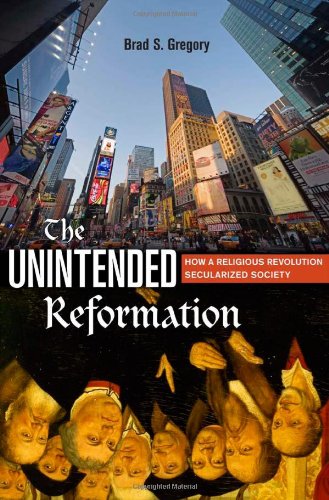
The Unintended Reformation

I recently finished a really interesting book I've been meaning to read for a long time, so now of course I'm going to tell you about it. The book is The Unintended Reformation: How a Religious Revolution Secularized Society by Brad Gregory, a professor of early modern history at Notre Dame. Professor Gregory's principal argument in this book is that "the Western world today is an extraordinarily complex, tangled product of rejections, retentions, and transformations of medieval Western Christianity, in which the Reformation era constitutes the critical watershed." In other words, as the subtitle suggests, he argues that the Reformation, a religious movement meant to revitalize and re-sanctify western Christianity, had an unintended but instrumental role in giving birth to the modern, secular society we live in today.

As an introductory point, he argues against the traditional, supersessionist view of modern history, in which "the distant past is assumed to have been left behind, explanatorily important to what immediately succeeded it but not to the present." Rather, he argues, much of the distant past has not been left behind, but continues to influence the present through its continuing ideas, values, worldviews, and institutions. "If this book's argument is near the mark," he says, "we cannot understand the character of contemporary realities until and unless we see how they have been and are still being shaped by the distant past."

Three Problems

Gregory sums up the argument of his book with three basic problems faced by early modern Christendom. First, late medieval Christianity was increasingly troubled by a gulf between the ethical prescriptions of the Christian faith and the actual practices of its followers, even (and especially) the clergy. This was a problem that reform-minded Christians hit on for centuries before the Reformation, but Luther and his contemporaries took the minority opinion that the church's problem was not simply moral, but doctrinal: the church was failing in its struggle against corruption and sin not simply because of personal or institutional failings to live up to its vision, but because of actual doctrinal error in its teaching. The solution, they thought, was to base the teachings and practices of the Church on Scripture alone, apart from manmade traditions which had led to the present muddle.

Yet this introduced a new problem: turning to the Bible as the sole authority for matters of faith and practice did not produce a renewed Christianity as the reformers hoped, but multiple, conflicting Christianities based on incompatible (but "authoritative") readings of Scripture, which fought with force of arms for more than a century and with words for far longer. In his second chapter Gregory expounds pretty exhaustively on the plurality of doctrinal claims that arose among the Protestants, even within ten years of the 95 theses. "From the early 1520s," he says, "those who rejected Rome disagreed about what God's word said. Therefore they disagreed about what God's truth was and so about what Christians were to believe and do." To list some of his examples:
  • In 1522, Andreas Karlstadt disputed Luther's disdain for the book of James as well as his views on the nature of the Old Testament, oral confession, the Eucharist, and the permissibility of religious images.
  • Luther and Melanchthon famously parted ways with Zwingli over the Real Presence of Christ in the Eucharist.
  • Between 1525 and 1527, nine different reformers published twenty-eight treatises against Luther's view of the Lord's Supper, leading to the Marburg Colloquy in 1529 and the split between Lutheran and Reformed Christianity.
  • Zwingli disagreed with his former Zurich colleagues Hubmaier and Grebel about the biblical basis for infant baptism. The early Anabaptists sharply denounced other reformers' practice of infant baptism, again on biblical grounds. In Grebel's words, "the baptism of children is a senseless, blasphemous abomination against all scripture."
  • Leaders behind the German Peasants' War repudiated Luther's distinction between "the Gospel" and social, economic, and political concerns, arguing for a stronger connection between the two. After the failure of the Peasants' War, by the late 1520s, the Anabaptists began dividing rapidly over a host of doctrinal issues.
  • Other attempts to distinguish true Christian teaching from false based on evidence of fruits of the Spirit, direct testimony from the Spirit, or reason were similarly unsuccessful; Protestants disagreed about what exactly the fruits of the Spirit looked like, how reason was to be used in formulating Christian truth claims, and what the Spirit was "saying" to them at the moment.
A few especially powerful summary statements from Gregory, again supporting the point that sola scriptura was (and still is) the source of a great deal of doctrinal pluralism among Protestants:
Christians who rejected the authority of the Roman church and its truth claims, notwithstanding certain alliances and reconciliations (such as the Lutheran Formula of Concord) among some of the constituent groups, never exhibited anything remotely resembling agreement about their own, alternative truth claims. It is thus misleading to say that "Protestantism itself splintered into rival denominations, or 'confessions,'", as if there ever was some point in the early Reformation when anti-Roman Christians had agreed among themselves about what scripture said and God taught. There wasn't. (p. 91)
Had Protestants simply disagreed about the interpretation of Scripture as such, their disputes would have remained much more circumscribed than they became. But more was sought—and needed—because the principle of sola scriptura itself did not yield the desired result. The would-be solution for reforming the late medieval church immediately became an unintended, enormous problem of its own, one different in kind from the problem of how to close the gap between the Roman church's prescriptions and late medieval Christians' practices. ... in addition to their continuous doctrinal disagreements with defenders of the Roman church before and after the Council of Trent, Protestants disagreed among themselves on multiple fronts. They disagreed about the meaning and prioritization of biblical texts, and the relationship of those texts to doctrines regarding the sacraments, worship, grace, the church, and so forth. They disagreed about the broad interpretive principles that ought to guide the interpretation of scripture, such as the relationship between the Old and New Testaments or the permissibility of religious practices not explicitly prohibited or enjoined in the Bible. They disagreed about the relationship among the interpretation of scripture, the exercise of reason, and God's influence in the hearts of individual Christians. And they disagreed about whether (and if so, to what degree) explicit, substantive truth claims were even important to being a Christian, with some spiritualists and alleged prophets radically relativizing the place of doctrines in Christian life. (pp. 109-110)
This problem of doctrinal pluralism among Christians and the resulting contentions (up to and including warfare and executions) that produced little progress towards resolving their differences gave rise to a third problem: "how was human life among frequently antagonistic Christians to be rendered stable and secure?" How could Europe be saved from completely fragmenting along confessional lines? How could future Thirty Years' Wars be prevented?

Gregory's chapters two through six follow the pattern of these questions pretty faithfully in five different areas of late medieval life: truth claims/answers to what he calls "Life Questions" ("serious questions about life, with important implications for life"), the institutional church and its relationship to the state, moral/ethical norms, the economy, and academia. Before the Reformation, each of these things was guided and shaped teleologically according to the faith and teachings of the late medieval Catholic Church. None were perfect, but all were unified and defined by the Church and its Christological vision of what constituted the "good" (virtuous) life.

The reformers, then, saw in the Church's failure to live up to its ideals in these things evidence not just of moral weakness, but systemic doctrinal error. Their goal was to replace human traditions and the false teachings of the Church that had accreted over the centuries with authentic Christianity as laid out in the Bible, the only ultimate ecclesial authority. Due to the unintended problem of Protestant pluralism, however, they did not succeed at this task, but instead added to Roman Christianity numerous Christianities that, because of their mutually contradictory claims, frequently clashed with each other in their visions for "biblically" transforming each of these areas of life.

By the mid-seventeenth century, weary from thirty years of confessionally-motivated bloodshed, many Europeans not at the front lines of their respective Christendoms began to look away from Christianity and its seemingly endless disagreements for a stabilizing principle that would produce societal unity rather than division. Despite their claims to the contrary, early modern Christians effectively excluded themselves from the discussion of what "Christendom" would look like because of their inability to agree on it. But increasingly, people realized that reason might be able to answer questions on life and ethics, that the liberal state could defuse religious conflicts by permitting freedom of worship and mandating tolerance, that modern capitalism and consumerism could meet peoples' needs and even make them quite happy with the "goods life", and that universities actually did much better when they were not protecting religious traditions from free inquiry. With little choice and plenty of motivation, early modern western society learned to function without the Church(es) at its center.

So answers to the "Life Questions", no longer based on Christian truth claims, are now highly pluralistic; the consensus of our culture is to believe whatever you like and live however makes you happiest, as long as you tolerate others' beliefs and lifestyles. The state has power over the churches (even if it uses that power to mandate religious tolerance and pluralism in the guise of "freedom of religion"), harkening back to the magisterial reformers' turn to secular magistrates for protection and civil enshrinement of their beliefs. "The consumerist cycle of acquire, discard, repeat now makes up the default fabric of Western life in the early twenty-first century, regardless of how one assesses it and whether or not one resists it." And knowledge, especially academic knowledge, is considered secular and academic by default, in contrast to religious "opinions". Gregory argues that this is so not because secularism somehow rose up and displaced Christianity as the ideological matrix of the modern western world, but because during the Reformation Christianity retreated from its central position in society into doctrinal controversies and polemicism. Much like how the Church itself rose to fill the space left by the fragmented Roman Empire, so now secular reason came in to take the place once occupied by a now-divided Christendom. Christianity is supposed to apply to and transform all of society, you say? Well, which Christianity?

Excluding God

Gregory's first chapter is different. In it, he explores the origins of the secular, scientific worldview that is so commonplace today as to make atheistic materialism virtually a given in many scientific and academic circles. In this way of thinking, science and religion are seen as being in conflict, with science having gained the upper hand since the Enlightenment. The idea of God is unnecessary and untenable because the advance of science has rendered him useless, "disenchanted" the world. The claims of religion are seen as antithetical to and disproven by the claims of science. He cites Max Weber for an example of this kind of thinking:
And today? Who today still believes—aside from certain big children whom one can indeed find in the natural sciences—that the findings of astronomy or biology or physics or chemistry have something to do with the meaning of the world or indeed could teach us something about it? By what path could one come upon the trace of such a "meaning", if any is there? If the natural sciences lead to anything and are suited to belief along these lines, it is to make the notion that there is a "meaning" of the world die out at its roots! And to conclude: science as a way "to God"? Science, this power expressly antithetical to religion? No one today in his heart of hearts is in doubt that science is antithetical to religion, whether or not he admits it to himself.
And this way of thinking its not today presented as one philosophy among many: it is widely taken as absolute bedrock truth in our culture, on the basis of which religious truth claims can be disregarded out of hand. Gregory says, "the assumptions about God, nature, and science that dominate contemporary intellectual life ... are widely regarded as ideologically neutral, obvious truths rather than seen for what they are: ideologically loaded, contestable truth claims based on unverifiable beliefs." In this chapter he traces the trajectory of western thought regarding the relationship between God and the "natural" world.

Western Christian thinkers up through Aquinas gave prominent place to what is known as an "apophatic" view of God: mysterious, transcendent, rationally, incomprehensible, beyond all of our attempts to describe him. Of course some knowledge of God is possible through what he has revealed to us, but "central Christian claims about God—the reality of his providence, the fact of his grace, the compatibility of his will and power with those of each human being—are unavoidably and irreducible mysterious." God existed in an entirely different, mysterious way than we flesh-and-blood creatures do, but rather than making him remote or totally unknowable, make possible his divine immanence and knowability through all things. Gregory refers to something like this as a sacramental view of reality. Apophatic theology is still alive and well in the Orthodox Church; the twentieth-century theologian Vladimir Lossky wrote of God's counterintuitive transcendence of being, knowledge, and everything else we know:
Now God is beyond all that exists. In order to approach Him it is necessary to deny all that is inferior to Him, that is to say, all that which is. If in seeing God one can know what one sees, then one has not seen God in Himself but something intelligible, something which is inferior to Him. It is by unknowing that one may know Him who is above every possible object of knowledge.
Later, he quotes St. John of Damascus:
God, then, is infinite and incomprehensible, and all that is comprehensible about Him is His infinity and incomprehensibility. All that we can say cataphatically [positively] concerning God does not show forth his nature, but the things that relate to his nature.
But in the west, two medieval Christian thinkers planted the seeds for the eventual end of the sacramental view of God in western culture. The first was John Duns Scotus, who believed that God had to share at least one predicate, namely existence, with everything else in order to be knowable at all. "Insofar as God's existence is considered in itself and in its most gradual sense, Scotus agreed [with Avicenna] that God's being does not differ from that of everything else that exists. ... Scotus's move made God, in Robert Barron's phrase, 'mappable on the same set of coordinates as creatures.'" According to Scotus, God belonged to a more encompassing reality along with his creatures and and does not "exist", but exists in it in the same way that do.

The second was William of Occam, who extended Scotus' idea of metaphysical univocity (applying the concept of "existence" to God in the same sense as to creatures) and more thoroughly rejected the views of Aquinas, who had still held to something like an apophatic approach to theology. In his nominalist theology, God is not an abstract essence or "the sheer act of to-be" but a discrete thing, however much he differed from every other entity. Occam also contributed his well-known principle of heuristic parsimony, "Occam's razor", the idea that explanations of natural phenomena "ought not to multiply entities beyond necessity." Scotus' metaphysical univocity and Occam's razor, Gregory argues, put in place the intellectual pieces for "the domestication of God's transcendence and the extrusion of his presence from the natural world." Again, these ideas are opposites of the classical Christian consensus even into the post-Schism west; continuing Lossky's quote of John of Damascus, "God does not belong to the class of existing things: not that He has no existence, but that He is above all existing things, nay even above existence itself."

Added to these major pieces were the Renaissance revivals of three major philosophical traditions, which were not adopted wholesale but partially and ended up contributing to the parting-of-ways of theology and science in the late medieval era through to the seventeenth century. From Platonism came the idea of mathematics as an explanatory language—for the physical world rather than the transcendent world of forms. From Stoicism came "a view of nature as homogeneous and deterministically governed by forces"—though without the pantheist underpinnings of "mutual sympathies". And from Epicureanism came a focus on the uniformity of efficient, natural causes with no reference to final causality—though with a physics based on Stoic determinism rather than random collisions between atoms.

But all of these philosophical and theological developments were largely confined to the academy. The central claims of Christianity were not based on any philosophy but on the testimony of God's salvific actions in history, reinforced by the familiar rhythm of the church and her traditions. These new philosophical ideas might have been assimilated into her thought as Aristotelianism had been, "so long as the church's teaching, preaching, worship, devotional practices, and prayer continued to convey and embody the faith's central truth claims."

But if the nature and meaning of God's actions, how Christians were to live, or Christianity itself were called into question, then these ideas might be able to transform the conversation about God's relationship with the world in unexpected and un-Christian ways. This is what happened in the Reformation. As in the other chapters, the continual doctrinal disagreements among Protestants and Catholics effectively made explicitly Christian claims about God and the natural world untenable; again, which Christianity? With little in the way of consensus in the foreseeable future, what was left were confessionally neutral ways of understanding the created world: empiricism and reason. The sidelining of Christian truth claims and the front-and-center inclusion of philosophy in this task turned out to be fertile ground for assumptions of metaphysical univocity and the principle of parsimony. In other words, science and reason did not "disprove" any theological claims, as is commonly supposed. Rather, incompatible views of different Christian confessions about the meaning of God's actions effectively removed theology from its place as, in Aquinas' words, "queen of the sciences". The tenuous alliance between science and theology was broken because "theology" was no longer a singular, coherent thing like the growing body of scientific knowledge.

The Protestant denial of Roman sacramentalism also had unintended consequences, since it tended to involve univocal metaphysical assumptions of which the reformers may not have been aware. As usual, Gregory says it better than I could (can you tell I enjoy his writing style?):
A "spiritual" presence that is contrasted with a real presence presupposes an either-or dichotomy between a crypto-spatial God and the natural world that precludes divine immanence in its desire to protect divine transcendence. But in traditional Christian metaphysics the two attributes are correlative: it is precisely and only God's radical otherness as nonspatial that makes his presence in and through creation possible, just as it had made the incarnation possible. (Otherwise, Jesus would have been something like a centaur—partly human and partly divine, rather than fully human and fully divine.) The denial of the possibility of Christ's real presence in the Eucharist, by contrast, ironically implies that the "spiritual" presence of God is itself being conceived in spatial or quasi-spatial terms—which is why, in order to be kept pure, it must be kept separate from and uncontaminated by the materiality of the "mere bread".
Some more quotes illustrating how the modern "conflict" between science and religion came to be, shaped by univocal metaphysics and Occam's razor:
Having sidelined theology, scripture, tradition, and religious experience as source of knowledge about God, the reason exercised by nearly all leading seventeenth-century thinkers, whatever its particular manifestations or emphases, assumed a univocal metaphysics. God existed—and thus, analogous to creatures, God was an individual ens, an entity within being, or God was in some way coextensive with the totality of being. The entire category of God's actions in history had been unintentionally paralyzed by doctrinal controversy. Hence reason—including observation and experiment—bore the full burden of the endeavor to understand God's relation to the natural world. Therefore all theology that sought to avoid confessional controversy had to be natural theology, based on reason alone.
To be sure, God remained important in the reflections and natural-theological theorizing of many scientists throughout much of the nineteenth century.  But whether individual scientists continued to insist on his integral relationship to the natural world, relegated him to a remote first cause, or denied his existence altogether, the combination of two ideas had rendered him expendable. The first was the metaphysically univocal conception of God as a highest being among others: this brought God within the same ontological and causal order as his creation. The second was Occam's razor: if God was unneeded to account for causal explanations of natural phenomena, there was no reason to invoke him. A clear corollary of this notion was methodological naturalism. God simply no longer had a place in the workings of the world, whether spatially or causally: if all natural events were adequately explained by natural causes, God was redundant. So however unrepresentative at the time was Laplace's famous quip to Napoleon in 1802 when asked about the place of God in his physics—"I have no need for that hypothesis"—the leading French physicist of his day proved to be prophetically prescient.
Despite cascades of (post-)Enlightenment propaganda to the contrary, the mathematization of ordinary natural processes could entail no exclusion of God's alleged, abiding, mysterious presence in and through them. That required metaphysical univocity and Occam's razor: if a natural cause explained a natural event, it was though, there was nothing supernatural about either. Therefore, as post-Newtonian deists believed, once all the regularities of nature were understood to have natural causes, God could be no more than a remote first cause. Nor, despite generations of (post-)Enlightenment polemics denouncing allegedly primitive superstitions, did the discovery of laws that explain natural regularities exclude the possibility of extraordinary actions by God. That, as we shall see, required a dogmatic, unverifiable belief that natural laws are necessarily and uniformly exceptionless, such that miracles as traditionally understood were impossible. But if, having absorbed and taken for granted metaphysical univocity, one imagined that God belonged to the same conceptual and causal reality as his creation, and if natural regularities could be explained through natural causes without reference or recourse to God, then clearly the more science explained, the less would God be necessary as a causal or explanatory principle.
The key point is not, as is commonly but wrongly believed, that the empirical investigation of the natural world made or makes a transcendent God's existence increasingly implausible. It is rather that this presumption depends historically and continues to depend on a conception of God as a hypothetical supernatural agent in competition with natural causality ... In diametric contrast, with the Christian conception of God as transcendent creator of the universe, it is precisely and only because of his radical difference from creation that God can be present to and through it. This is the metaphysics that continues to underlie and make possible a sacramental worldview, against supersessionist conceptions of history, in combination with any and all scientific findings.
But as with Newtonianism in the eighteenth century, (neo-)Darwinism can be troubling to Christians on scientific grounds only if they have a univocal conception of being and reject a sacramental view of reality. 

Reflections

After reading The Unintended Reformation, I have a new appreciation for Bishop Ware's statement in The Orthodox Church that "[Orthodox Christians] have known no Middle Ages (in the western sense) and have undergone no Reformations or Counter-Reformations; they have only been affected in an oblique way by the cultural and religious upheaval which transformed western Europe in the sixteenth and seventeenth centuries." Obviously to turn to Orthodoxy is not to simply rewind the clock five hundred years, for (at least in America) it exists within the religiously pluralistic society forged in the fallout of the Reformation. But it at least offers one Christianity among many that is unique in its freedom from the distorting influences on western faith unintentionally brought about by the Reformation.

This book powerfully confirmed several of the doubts about the basis of Protestantism that I already had confirmed by Orthodox teaching. Specifically, about the unsuitability of sola scriptura for producing a (single) rule of faith and the misguided, factious nature of attempts to recreate Christianity "from the ground up". Such methodologies are fertile ground for disagreement and controversy which, as Gregory shows time and again, can have disastrous effects that no one wanted.

The book was also very distressing. For though it expertly disagnoses the historical origins of modern, western secularism, it offers little idea of how, or if, the hundreds of Christianities out there can be reunited or how the secularization and pluralization of society can be reversed. Should Christians even desire these things? Even as I am increasingly able to believe in the unity of the Orthodox Church, The Unintended Reformation reminds me of a broader, ecumenical kind of unity among all Christians that has been missing for over a millennium before the Reformation, for which I still long and pray.

Tuesday, October 7, 2014

My Journey, Part 9: The New Direction

This is part 9 of my rebooted series on my journey from Evangelicalism to Eastern Orthodoxy. The full series can be found here:

1Back to the beginning
2Cracks appear
3Questions multiply
4Questioning the "gospel"
5The big question
6A better hermeneutic
7Explorations in epistemology
7.5Excursus on oversystematization
8Back to the gospel
9The new direction
10Ecclesiological foundations
11.1Sola scriptura
11.2The insufficiency of Scripture
11.25Addenda on sola scriptura
11.3Holy Tradition
12Bridging the cracks
13.1Orthodoxy and Genesis 1–3
13.2A Better Atonement (Against Penal Substitution)
13.3Faith Alone?
13.4The Colour and the Shape of the Gospel
14Worshipping with the Church
15Mary, Saints, Baptism, and Other Odds/Ends
16Looking Back, Coming Home

In the stories I've heard from countless others, there are a few typical outcomes when someone comes face-to-face with the shortcomings of the tidy view of the Bible, the gospel theology, and the tensions with science that have come to characterize much of evangelical Christianity—that is, when they have serious doubts about what they believe and don't find the usual pat answers satisfactory, like me. A regrettably common one is that they reject their faith and stop believing much of anything, glad to have left behind the mess of contradictions and fairy tales that was their faith. They may become agnostics or softspoken atheists, or they may become more outspoken critics of their former faith, like Dan Barker. How many of these apostates might have kept their faith if they hadn't been taught a fragile version of it that couldn't survive contact with truth and ideas from outside the evangelical enclave?

Another outcome is that doubters join the post-conservative, post-evangelical (if not liberal) camp. They recognize the shortcomings of their conservative upbringing, but conclude that they are not (or don't have to be) essential to what it means to be evangelical. So they deplore what was deplorable about their old tradition, and seek to rehabilitate the rest. They believe there is still plenty of good in the evangelical tradition if you can get past some of the unfortunate mistakes about God, the Bible, and the church that have gotten woven into it by misguided theologians and pastors. Writers like Rachel Held EvansAddie Zierman, Mike McHarguePeter EnnsBrian McLaren, and Rob Bell fall somewhere within this camp, at varying distances from what might be considered "orthodox evangelicalism". As I began to see beyond my own doubts, I began to identify with this group, thinking I was becoming one of them. By early 2014, I considered myself pretty much there; as I began my series of posts on the gospel, I sought to call out the false beliefs and preconceptions that had given rise to my doubts (and might be causing doubt in plenty of others!) and seek out a way to move past them to fuller, more authentic, more wholehearted belief.

Then God showed me the way, and the church, I was looking for—but not at all the one I expected.

The new direction

This was the genesis of the present, rebooted series, several months ago. As I was trying to figure out what I believed about the Bible, the Gospel, and truth itself (the usual), I was also in the midst of my master's program in theology at the University of Northwestern St. Paul. Specifically, I was taking my favorite course to date, on the history of the Church. For my final project, I was creating a curriculum for teaching a more abridged version of the course to a lay audience (if anyone wants a 8–16-session course on 2,000 years of church history, I'm open to suggestions on how to put it to use!).

Wanting to be comprehensive and aware of the possibility for a Protestant bias when studying other traditions (all our assigned texts were written from an Evangelical Protestant point of view), I ordered about $100 worth of church history books written from Catholic, Eastern Orthodox, Lutheran-to-become-Orthodox, and Anglican-secular perspectives to help me with my studies. In keeping with my desire for unity in the Church, I sought to remove my Protestant blinders that led me to see me see Catholics and Orthodox as saint-worshipping, tradition-bound, ritualistic, hopelessly old-fashioned and wayward Christians and to try to actually understand them on their own terms, which I had realized was pretty important for handling conflicts in a Christlike way.

Through my ensuing studies, I realized many of them, like many Protestants, are not simply sheep following the false religion they grew up with and waiting to be be shown the evangelical light, but consider themselves heirs to a rich, two-thousand-year-old faith. Conscientious Catholics and Orthodox can give some good reasons why they haven't converted to Protestantism already (or why they converted from Protestantism), and for the first time I started trying to understand these reasons. Since I knew especially little about Orthodoxy, I dove into Bishop Kallistos (Timothy) Ware's book The Orthodox Church eagerly, out of curiosity to know more about this forgotten (to me and many of my fellow evangelicals) part of Christianity. The more I read, the more fascinated I became by Orthodoxy's distinct way of approaching matters of faith. At some point, the realization hit me:

The Orthodox Church holds the answers I'd been blindly searching for about my faith and has been believing, praying, and living them since the first century.

What is the Orthodox Church?

In short, it is the church that Jesus Christ founded. (In a spiritual sense, Orthodox believe the Church extends back through the Old Testament saints and patriarchs) It has preserved the teachings of Jesus, the practice and worship of the first-century church, and the fullness of the apostolic faith for almost two millennia. In his classic book The Orthodox Church (the definitive source for anyone looking to learn about it), Bishop Kallistos Ware explains (emphasis the author's):
Orthodoxy claims to be universal—not something exotic and oriental, but simple Christianity. Because of human failings and the accidents of history, the Orthodox Church has been largely restricted to certain geographical areas. Yet to the Orthodox themselves their Church is something more than a group of local bodies. The word 'Orthodoxy' has the double meaning of 'right belief' and 'right glory' (or 'right worship'). The Orthodox, therefore, make what may seem at first a surprising claim: their regard their Church as the Church which guards and teaches the true belief about God and which glorifies Him with right worship, as nothing less than the Church of Christ on earth.
Due to a series of schisms, the Orthodox Church is largely unknown to most American Christians. The first schisms came in the fifth and sixth centuries as the Nestorian (Assyrian) Church of the East and the mono/miaphysite (Armenian, Syriac, Coptic, etc.) churches rejected the Christological decisions of several ecumenical councils. The "Great Schism" with the western (i.e. Roman Catholic) church had been brewing for centuries but became decisive in 1054, centering around the Pope's claim to monarchical authority over all the other bishops and the west's unilateral addition of the filioque (a clause specifying that the Spirit proceeds from the Son as well as the Father) to the Nicene Creed. It was sealed in the hearts and minds of Orthodox believers in 1204 when the Fourth Crusade took a detour to sack and conquer Constantinople, establishing a short-lived Latin empire and greatly weakening the Byzantine Empire. While the western church experienced developments like Scholasticism, the Renaissance, and the Reformation, the Orthodox Church followed its own separate trajectory, thriving in shrinking Byzantium (until the fall of Constantinople to the Turks) and Russia, surviving even through persecutions virtually unknown in the western church since before Constantine. There are over 225 million Orthodox Christians around the world today, though they make up only a small minority in western countries. Unfortunately, in America the Orthodox Church is administratively (but not doctrinally) fragmented due to numerous national churches sending their own missions here with ties to their parent churches rather than each other, which can be confusing for inquirers like me.

At least to my Protestant eyes, the Orthodox Church seems much more similar to Catholicism. It has priests, bishops, and apostolic succession (but no pope); its worship is strictly liturgical (though it still uses the liturgy written in the fourth century by John Chrysostom and has never had reservations about translating it into the vernacular); it uses a biblical canon that includes books not accepted by Protestants (though its Old Testament canon is also slightly different from the Catholic Deuterocanon, and it uses the Greek Old Testament rather than the Hebrew). But but to Orthodox eyes, Catholicism is actually closer to Protestantism, reflecting the differences between eastern and western ways of thought and worship that have been diverging since the early church as well as the intellectual developments that took place in the west. Again, Ware is very lucid about this (emphasis added):
...western Christians, whether Free Churchmen, Anglicans, or Roman Catholics, have a common background in the past. All alike (although they may not always care to admit it) have been profoundly influenced by the same events: by the Papal centralization and Scholasticism of the Middle Ages, by the Renaissance, by the Reformation and Counter-Reformation. But behind members of the Orthodox Church—Greeks, Russians, and the rest—there lies a very different background. They have known no Middle Ages (in the western sense) and have undergone no Reformations or Counter-Reformations; they have only been affected in an oblique way by the cultural and religious upheaval which transformed western Europe in the sixteenth and seventeenth centuries. Christians in the west, both Roman and Reformed, generally start by asking the same questions, although they may disagree about the answers. In Orthodoxy, however, it is not merely the answers that are different—the questions themselves are not the same as in the west.
These developments in the western church, it turned out, were at the root of many of the parts of evangelicalism that gave me misgivings and doubts. The Orthodox Church, then, offered a vision of the Christian faith untainted by all the destabilizing movements and problematic cultural assumptions that had developed in the west. I could barely believe it. Like the man in Matthew 13:44, I felt like I had found a priceless treasure. Of course, there were some things that came out of left field like the veneration of icons/saints/Mary and infant baptism (I'll get to those later), but in a very real and compelling way it felt like the realization of my hopes and wishes for what Christianity could be. In one sense I feel drawn to the Orthodox Church for the same reason many Protestants choose a certain church, that I share its beliefs and vision of the Christian faith (to an amazing degree, considering how I arrived at them independently). But there is more than this; it's not a simple matter of preference. I am convinced that the Orthodox Church is the true (or, at least, the truest) church, and that it has preserved the fullest expression of the Christian faith. And because I believe that, I can't help but be drawn to it, regardless of my personal opinions.

The third option

The first two typical outcomes of evangelical crises of doubt, nonbelief and post-evangelicalism, have in common the fact that they view evangelicalism as the most (or even only) viable representative form of Christianity out there. Apostates find it untenable and reject Christianity along with it; post-evangelicals would likely associate God preserving their faith with their remaining aligned with the gospel vision of evangelicalism, even as they seek to rework parts of it that they consider misguided. Again, this is what I thought I was doing and expected to keep doing for some time.

But as I investigated Orthodoxy further, it seemed that God was taking my journey of faith in an unforeseen direction. Rather than rejecting Christianity altogether or seeking to move further within evangelicalism and correct its mistakes, the real answer to my doubts was to move forward by looking back with a church that claims to be the representative of ancient Christianity in the modern world. I had discovered the third and least visible outcome of doubt: turning to an entirely different, older Christian tradition.

In the following few posts I'll unpack specifically how the Orthodox Church appeared to me as the answer to my doubts.

Thursday, September 25, 2014

My Journey, Part 8: Back to the Gospel

This is part 8 of my rebooted series on my journey from Evangelicalism to Eastern Orthodoxy. The full series can be found here:

1Back to the beginning
2Cracks appear
3Questions multiply
4Questioning the "gospel"
5The big question
6A better hermeneutic
7Explorations in epistemology
7.5Excursus on oversystematization
8Back to the gospel
9The new direction
10Ecclesiological foundations
11.1Sola scriptura
11.2The insufficiency of Scripture
11.25Addenda on sola scriptura
11.3Holy Tradition
12Bridging the cracks
13.1Orthodoxy and Genesis 1–3
13.2A Better Atonement (Against Penal Substitution)
13.3Faith Alone?
13.4The Colour and the Shape of the Gospel
14Worshipping with the Church
15Mary, Saints, Baptism, and Other Odds/Ends
16Looking Back, Coming Home

Through all of this thinking about the nature of the Bible and what we do with it, I never lost sight of the goal. I sought to understand what this all-important "gospel" was all about now that I'd acknowledged that the pat answers I'd been hearing weren't sufficient. I faced questions like "Why did Jesus have to die on the cross?", "How do faith and works relate for the Christian?", the simple question "What is salvation, really?", and the big one: "How do the Testaments fit together?". Everything seemed open to revision, but somehow this no longer bothered me. After all that God had brought me through, I was beginning to trust Him even without having neat answers at the moment. It was while searching for answers to questions like these that I began the present series on the Gospel.

Why did Jesus have to die on the cross?
This is the classic question of atonement, for which numerous theories have been advanced. I began searching for ways to think about the atonement that view sin, salvation, etc. in more of a "relational" way, whatever that meant (certainly not in the oversystematized way I described last time).
When we say Jesus destroyed sin on the cross, to avoid spiritual object thinking, we must consider 'sin' to mean 'separation from God of those united with Him.' (2013-6-9)
The penal substitutionary atonement theory seemed dependent on the juridical, spiritual-object definition of sin that I had grown quite tired of, and I instead began taking interest in the atonement theories held by the early church; Christus Victor and ransom theory seemed especially promising. Having learned about atonement only through the Reformed tradition, though, it was hard for me to fully shift my thinking to these new lenses.

Somewhat related to this, I was trying to see the cross as just one part of Jesus' redemptive work, alongside the resurrection and perhaps His whole life. I realized that emphasizing the crucifixion exclusively above these things was not pious, but a distortion of the true gospel, whatever it was. Part of putting it into perspective was acknowledging a fact that we forget surprisingly easily by fitting the cross into a theological system of salvation: God was dead. And we killed Him. Before my Good Friday post on the oft-forgotten tragedy of the cross, I journaled:
By making Jesus' death seem inevitable, fitting into my theology like a neat puzzle piece, I lessen the shock value of the cross. God not only became a man, but we killed Him horribly. ... The crucifixion was a defeat, not a victory. (2014-1-12)
I overstated my point here, since (as I would learn) the victory of the resurrection can't be separated from the defeat of the cross, but I was on the right track by seeking a theology that affirmed both.

How do faith and works relate for the Christian?
With somewhat more success, I sought to see past the dichotomy we had set up between human and divine agency, to see what role works could play in a Christian:
Faith is not simply a reduced cost of admission, it is an openness and desire to live as God's covenant people. The problem with salvation by works, basically, is not that it is intrinsically bad or prideful, but that it is impossible. The pride comes in if you delude yourself otherwise. In other words, faith doesn't simply replace works for us. Rather, the faithfulness of Christ fulfills in us what the law, weakened by the flesh, could not—He makes us righteous, just as the law commanded. Faith is not a soteriological substitute for works, but a recognition and acceptance of the supremacy of Christ, to do in us what we couldn't do ourselves. Works are still important—but because of our union with Christ our actions are also the power of God working through us. (Phil 2:12-13) (2014-1-30)
I was slowly coming to a more integrated view of faith and works as partners, not opponents. Taking up faith doesn't have to mean setting aside our own effort as if it were something bad. Faith does not simply mean ceasing to try to save ourselves and trusting in Christ's work instead; it is not simply an alternative to human effort, and the two are not opposite poles. Instead (as Paul describes in those verses which are the clearest description of synergism I knew of), by faith we recognize and trust in the mystery that because of the Holy Spirit, our own actions and decisions also become God's "willing and working" in us for His good pleasure. I started to see the perfect union of divinity and humanity that Jesus embodied as a pattern for the Christian life.

What is salvation, really?
Through this, though, I was still unsure about the nature of this salvation that we attained to through God's faithful working in us. I sought to thinking about it in a "relational" way, whatever that meant, not as a metaphysical "thing" that we simply need to get and defend.
I've been thinking about salvation as a spiritual object again, as something that God ties up with a proverbial bow and hands to us in exchange for either faith or good works. But again, this is a disconnected, non-relational way of thinking of it. (2014-1-30)
In our rush to "get in" (and to theologize about how "getting in" is easy and doesn't depend on us even though we have to make a decision, and about how once you're "in" it's impossible to come back "out"), could we be losing sight of just what "in" entails?
Protestants take a very minimalist view of salvation, like a student asking, 'what's the least I need to do to pass?' There are no right answers to wrong questions. (2014-1-24)
Admittedly, I was being unfair and overgeneralizing here. But I do think "salvation" is commonly thought of as something atomic, indivisible, all-or-nothing, devoid of degree, so we can slip into thinking that once we "have" salvation we're good and everything else is just icing on the cake, a little like how you can get a passing grade on that final exam and then forget everything you learned. It's the assumption behind "threshold evangelism". If this view of salvation is "minimalist" (in that we seek to reduce salvation to its essential essence and hold fast to that over everything else as what's truly important), I sought a "maximalist" understanding, whatever that looked like. I expected that it would do away with the distinction between salvation and sanctification and instead encompass both as part of the same process, and that it would not focus so much on individuals that it seemed to forget about the larger scope of God's redemptive purpose.

How do the testaments fit together?
The question of the testaments saw the most progress, partly because it was the number-one thing wreaking havoc on my faith so I spent the most time and attention on it. Presaging my entry on 2014-1-30 about how faith fulfills the law, I tried to see the law not as a list of dos and don'ts from which Christ sets us free, but as a covenant of God with a definite redemptive purpose, which Christ now fulfills.
Perhaps the law is not to be ultimately understood in terms of its provisions and requirements, but the kind of people and society it was meant to produce—perfectly bearing God's image, living in Shalom. So the 'righteous requirement of the law' in Romans 8:4 is not referring to doing all the rules, but the requirement to become this kind of people. And Christ's fulfilling it does not mean somehow checking all the boxes of the law, but enabling us to be transformed into His perfect, godly likeness. … In other words, what if the requirement of the law is not just to do certain things, but to be a certain people? (2013-8-25)
This helped to make sense of how Jesus could fulfill the law when he so cavalierly bent or broke the letter of it, and taught others to do the same. But more than this, what really helped answer my questions about how the covenants/testaments fit together was this wonderful thing called...

The New Perspective on Paul

Before I can define the New Perspective, I have to clearly define the "Old Perspective": it is the traditional (for Protestants) reading of Paul's letters (especially Romans, Galatians, and Philippians) as being, first and foremost, about how sinful people "get right with God" and go from the condemnation and death brought by sin to forgiveness and eternal life, which is considered to be the meaning of Paul's term "justification". In the Lutheran flavor of the Old Perspective, the law is something frightful and oppressive that constantly shows us our sin by contrasting it with God's impossibly high standards in order to drive us toward our savior Jesus, who fulfills this law on our behalf so that we can know God in His grace and receive Christ's "alien righteousness" by which alone we are justified. In the Reformed flavor, the law may serve this purpose, but we are not merely saved by Jesus from it but to it, to obey it not out of our dead, fallen sinful nature and feeble self-effort but by the life given to us by Christ and the empowering of the Holy Spirit, God working in us to do what we cannot do for ourselves. In this way "Christ is the end of the law for righteousness to everyone who believes". (Rom 10:4)

This reading of Paul should be highly familiar for evangelicals, lying close to the heart of the "Gospel". The New Perspective, in contrast, reads these parts of Paul as being "about" something quite different: the destruction of racial and ethnic barriers between Jew and Gentile, and the creation of one united people of God from both groups when they were formerly enemies. "Works of the law", then, is read not as shorthand for "human moral effort", "works righteousness", or "pulling yourself up by your spiritual bootstraps", but as "boundary markers" in the Torah (remember that "Torah" simply means "law" and both are expressed by the same Greek word, nomos) that were being used to mark out a distinctively Jewish identity for the early Christians that left Gentile believers out in the cold. "Justification" is read not so much metaphysically, as "getting right with God" spiritually, but sociologically, as being shown to be right with God, adopted into His covenant people.

A quick tour of the New Perspective

I first learned about the New Perspective through the writings of the former Anglican bishop of Durham, N.T. Wright, who I already knew and respected even before that. In his book
Justification (in which he responds to John Piper's critique and makes the case for his understanding of the New Perspective), Wright explains that first-century Jews (such as Jesus, His apostles, and His Pharisaic opponents) were not given to theologizing about what happens after you die or how to be accepted into heaven. Their concept of heaven was not otherworldly, but pointedly this-worldly. The narrative in which they saw themselves was not one in which all people are innately sinful and justly condemned to hell unless they could acquire some kind of salvific righteousness to cover their sins. All of these were concerns of Luther and the late medieval Catholic Church, but not of first-century Judaism.

Instead, their narrative was one in which they, the children of Abraham, had been chosen by God out of all the nations (ethnoi, also translated "Gentiles") to be His people, His treasured possession, given promises of divine blessing and favor and an unending line of Davidic kingship (1 Kings 2:4). This was drastically at odds with Israel's present situation, kingless and instead subjected to rule by one foreign power after another. In a very real sense, even though the Jews were back in the promised land with a rebuilt temple, their exile was still ongoing. The fulfillment of God's promises to them had still not come. So they eagerly hoped to see God prove true to His promises; some took a more passive, fatalistic view (especially the sectarian Essenes) while others (e.g. the Zealots) took a more active approach, seeking to overthrow the Romans and restore Israel's place by violent uprising. The Jews awaited the coming of the Messiah to bring about this fulfillment, though the person of the Messiah was actually not as essential as the promises themselves, however God chose to fulfill them. All clung jealously to "works of Torah", the signs of their election by God (especially circumcision and the law), to show that they belonged not to the ethnoi but were the chosen nation of God who would soon be vindicated (or justified) when He restored them.

What Paul was doing, then, was presenting Jesus was the fulfillment of God's promises, albeit in an unexpected way. (Hence the controversy among the Jews, messianic and non-) But he was not simply answering Israel's cries for national liberation and promised (tangible) blessings with a metaphysical system for salvation from sin and death through individual reconciliation with God. If that was what Jesus had come to inaugurate, He would not have been crucified because no one would have understood Him enough to be angry. Instead, Paul argued, God's promises had been fulfilled not at the end of the age but in the middle of it, and not for all of Israel but for one man, Jesus. What was the meaning of this? In particular, what was the meaning of Jesus' surprising acceptance of Gentiles? Had He forgotten to whom the promises had been made? In response, Paul takes a step back and reminds his readers that before the law had been given, even before circumcision, Abraham found favor with God—by faith. And God's promises to Abraham which he believed never promised some kind of exclusive blessing of Israel and Israel alone. Rather, God told him that "in you all the families of the earth shall be blessed." Israel was supposed to be the means by which God's promises and blessing would come to the whole world. Salvation of the Gentiles is not some unexpected development, argues Paul; it was the plan from the start. The law was given as a tutor and guide for Israel, but it was not meant to permanently separate her from the nations; it was supposed to shape her into God's blessing to them.

But because of Israel's misconception that God's promises were for her instead of through her, the promises had gotten "stuck" and did not come to fruition. Israel became part of the larger problem of sin and death rather than its solution. What was needed was a faithful Israelite who would lead the Jews to their intended obedience and bring God's blessing to the whole world. And this is just what Jesus came to do. So, trying to sum up, when Paul talks about justification, he is not referring to the process by which an individual is "made right" with God. Again, this would have been a total non-sequitur for Paul's audience. He is talking about who is part of God's covenant people, and how you can tell. Formerly the Gentiles had been excluded; now they were invited, apart from the law that had been used to exclude them. Paul's Judaizer opponents in Galatians, like many other Jews, believed that the law of Moses was what marked out those who would be vindicated/justified by God; it was not what "made them right" with God but simply how they stayed in His covenant and demonstrated their membership. But, Paul argues, the boundary marker of God's people is not obedience to the law, but faith in Jesus Christ, the one God has chosen to unite His people and fulfill His promises at last.

Later, I also read Paul, Judaism, and the Gentiles by Francis Wright, which offered an interesting attempt to move "beyond the New Perspective" (the book's subtitle). Watson very consciously calls attention to the immediate context and specific purpose of Paul's letters; he tries to show what, specifically, Paul was saying, addressing, and doing through them, in response to the tendency to read them as systematic theology. Specifically, he argues that Paul is trying to establish Christianity as a new religion and not simply a new sect of Judaism, hence his rejection of the Jewish law and embrace of the faith of Jesus Christ as its foundation. He is rightly wary of the possibility of overcompensating for the Old Perspective and understanding "justification" only sociologically. Watson does seem to go too far toward portraying Paul as opposing Judaism simply because it is not Christianity (rather than opposing it insofar as it has rejected and excluded itself from God's redemptive plan), but he offers an interesting and valuable counterbalance to Wright.

The value of the New Perspective

My study of the New Perspective on Paul was very helpful for understanding the gospel, more than anything else, for three main reasons:

First, the New Perspective reading of Paul is much more contextually sensitive than the Old—to both Paul's historical context and the literary context of his letters. I think Wright's criticism that the Old Perspective today is a result of reading Scripture with "nineteenth-century eyes and sixteenth-century questions" is accurate. We assume that Paul shared Luther's late medieval concerns with the metaphysical salvation of the soul, along with his heavily Catholic-influenced definitions of "works" and "merit". I began to become suspicious of this, and saw a possible key to resolving the seemingly inescapable tension between the Testaments:
The 'life' promised in Lev 18:5 can't be eschatological life. This wasn't anywhere on Israel's radar. (2014-2-3)
But I repeat the question I asked before: what if Paul is not simply laying down abstract doctrine for the church to believe at all times, but is writing contextually to particular churches facing particular problems? The New Perspective (especially as represented by Watson) takes this question seriously. It recognizes the historical realities of Paul's situation and his purpose in writing his letters and reads them through this lens, not our modern concerns about how one "gets saved". It recognizes that Paul was not writing systematic theology in his letters. Rather than taking people for a ride along the "Romans road" or calling a collection of prooftexts from all over Paul's letters "the gospel", the New Perspective sagely fits them into Paul's larger situation as the apostle to the Gentiles. It makes a serious, honest attempt to find what Paul was actually trying to say and do through his letters, getting beneath how we have interpreted him through the centuries.

Second, as I mentioned in my post on the impersonal gospel, the New Perspective recognizes that justification, and the gospel in general, is not about us. Of course any evangelical will be the first to stress that "it's not about us, it's about God"—but does the theology really show that? The "gospel" as commonly stated is about what God does—for us. It is too often seen, primarily, as a message of personal, metaphysical salvation. We view it as a sign of Jesus' great love for us that we can consider His sacrifice on the cross to have been "for" us, personally. As I expressed on 2013-1-10, I was getting tired of this kind of individualism.
How is the gospel usually stated in evangelicalism? 'God loves you and has a wonderful plan for your life, so He sent Jesus so that your sin could be forgiven and you can have a personal relationship with Him.' With such a personal understanding of the gospel—as being all about you and God—is it any wonder that so many American Christians have a self-centered faith? (2013-1-10)
I thought about all the historical narrative and Jew/Gentile language as if it were the backdrop to God's continuing mission of saving individual souls—which He doesn't always succeed at! (2014-2-25)
The grand gospel narrative, for Paul, is not metaphysical but historical. (2014-2-25)
The New Perspective, in contrast, doesn't just say that it's all about God, it demonstrates it. By situating Paul's message firmly in its historical context it reveals the historical and cosmic dimensions of salvation as well as the metaphysical, as something grand and epic that doesn't just boil down to you and Jesus. Rather than making the gospel somehow less personal, this change makes it into something superpersonal, that draws me up out of myself and my own life into an unimaginably vast and ongoing historical salvation plan for the whole world that I am called to take part in.

Third, and most obviously, the NPP alleviates most (if not all) of the confusion I'd been having about how the Old and New Testaments fit together. By showing how the Mosaic law was a gift in its original context, how the Jews could be called to obey it without this constituting a call to seek "works righteousness", what place deeds have in the life of Christian faith, and how Paul's opposition of "works of the law" and "faith of Jesus Christ" doesn't mean that the Mosaic law itself is a bad thing but that it had been misused, it effectively cured the confusion I was having about the gospel apparently being a God-given solution to a God-given problem.

In such possibilities I saw the seeds of a new, better theology, one that would be an effective answer to the doubts that had sprang up like weeds and would help me to live out the gospel more authentically than I had ever been able to before. But this vision of the gospel seemed like just that—a vision, an ideal, something expressed in airy theology that we can and should strive for but shouldn't expect to see consistently realized in the real Church, work in progress that she is. It seemed like I would have to work out this theology myself essentially from scratch. I didn't know of any church that demonstrated it, certainly not in the Twin Cities.