Pages

Showing posts with label Sola Scriptura. Show all posts

Wednesday, September 14, 2016

About all those denominations...

A Bible study I participated in recently began with 1 Corinthians 1:10: "Now I plead with you, brethren, by the name of our Lord Jesus Christ, that you all speak the same thing, and that there be no divisions among you, but that you be perfectly joined together in the same mind and in the same judgment." (NKJV) Responding to this, a friend remarked on the stark contrast between the vision of unity in this passage and the highly fragmented state of modern Christianity. Paul's words feel like a painful indictment of our disunity; how could we so completely fail to live up to them?

Pervasive interpretive pluralism

This question was very familiar to me, as I had just been rereading The Bible Made Impossible by sociologist Christian Smith, a book that was greatly influential on my journey through religious doubt (so much so that I bought a case of copies to give away, wanting others to read it). Its first half is a vigorous critique of an approach to the Bible which Smith calls "biblicism", which he characterizes as "a theory about the Bible that emphasizes together its exclusive authority, infallibility, perspicuity, self-sufficiency, internal consistency, self-evident meaning, and universal applicability". (p. viii) In making his case, Smith draws attention to the widespread doctrinal diversity among Christians (particularly evangelical Protestants), a phenomenon he calls "pervasive interpretive pluralism", and which he argues renders biblicism impossible in practice if not in theory:
The very same Bible—which biblicists insist is perspicuous and harmonious—gives rise to divergent understandings among intelligent, sincere, committed readers about what it says about most topics of interest. Knowledge of “biblical” teachings, in short, is characterized by pervasive interpretive pluralism. What that means in consequence is this: in a crucial sense it simply does not matter whether the Bible is everything that biblicists claim theoretically concerning its authority, infallibility, inner consistency, perspicuity, and so on, since in actual functioning the Bible produces a pluralism of interpretations. (17)
The import of pervasive interpretive pluralism is that for virtually any Christian doctrine, from the major to the minor, there exists a range of teachings on it held by various churches and denominations, all claimed to be based on the Bible. Zondervan's Counterpoints series of books walk the reader through the variance on many such doctrines. From Smith and other sources, I've compiled a fairly complete list of teachings for which there exists such pluralism:

Theology proper:
  • Christology (classical, kenotic, adoptionist...)
  • The Trinity (though modern Unitarians arguably base their theology more on "rational" thought than the Bible, other groups like Christadelphians, Jehovah's Witnesses, The Way International, and Oneness Pentecostals reject the trinity on biblical grounds, as did the early unitarians)
The Church:
  • Nature of the Church (not as much variance as between Protestantism and Catholicism/Orthodoxy, but there is still different weight placed on the institutional nature of the Church between, say, an Anglican and a Baptist)
  • Church polity (episcopal, presbyterian, congregational)
  • Legitimacy of ordained ministry (i.e. how the "priesthood of all believers" is understood)
  • Methods of church discipline
Worship:
  • Legitimacy and value of creeds and confessions
  • Styles of worship (traditional, contemporary, blended, choral or congregational singing, Psalms-only, use of instruments, regulative principle...)
  • Use of images or sensory aids in worship
  • Christian relation to the Sabbath
Sacraments and spiritual gifts:
  • Baptism (infant/adult, significance)
  • Real Presence in the Eucharist (the subject of the first division among the Protestant reformers)
  • Continuation of spiritual gifts in the present
  • Importance of the gift of tongues
Gender, marriage, and family:
  • Women's roles in the church and the home (patriarchalism, evangelical feminism, complementarianism, egalitarianism...)
  • Divorce and remarriage
  • Birth control
  • Corporal punishment of children
Societal issues:
  • Capital punishment
  • Slavery (there may be agreement today, but there was fierce disagreement between competing "biblical" views less than 200 years ago)
  • Homosexuality
  • Church-state relations
  • War
  • Ethics and use of wealth (private property, meaning of material success, tithing...)
  • Celebration of [religious] holidays
  • Christians' relation to culture
 Soteriology:
  • The nature of salvation
  • Nature/reality of total depravity and original sin
  • Significance of a "conversion experience"
  • Atonement theology (PSA, governmental, moral example, Christus victor...)
  • Justification
  • Role of good works in the last judgment (and the nature and number of the last judgment(s))
  • Sanctification and its relation to salvation
  • Eternal destiny of the unevangelized (exclusivism, inclusivism, universalism), and infants
Personal morality
  • Wearing of jewelry/makeup
  • Drinking
  • Gambling
  • Dancing
  • Swearing oaths
  • Asceticism and celibacy 
Eschatology:
  • Imminence of the Second Coming (putting a definite date to it, expecting and planning on it in the next few years/decades, or simply living in readiness)
  • Rapture and the Millennium (pre/post-tribulationist, premillennialist, postmillenialist, amillenialist)
  • Understanding of the "antichrist" (the papacy, a figure in current events, or yet to come?)
  • Role of the Jews in salvation history (a major distinctive of dispensationalism)
  • Understandings of apocalyptic prophecy (preterist, futurist, historical, idealist)
  • Nature of hell (eternal conscious torment, annihilationism, purgatorial universalism, C.S. Lewis' view...)
God's providence:
  • Free will/determinism and predestination (Calvinism vs. Arminianism)
  • Eternal security
  • Nature of God's foreknowledge (unconditional or based on foreseen faith?)
The Bible:
  • Bibliology; nature of the Bible itself
  • Perspectives on Paul
  • Relation between the Testaments
  • Biblical inerrancy/infallibility
  • Creation/Evolution
  • Nature of the divine image in humanity (and to what extent or in what way has it been lost?)
  • Historicity of Adam
  • Biblical literalism
  • Value of reason/rationality in faith
Pervasive interpretive pluralism is far from a recent problem. In a survey of other authors' takes on it, Smith quotes American theologian John Nevin, who lamented a similar situation in 1849:
It sounds well, to lay so much stress on the authority of the Bible, as the only text-book and guide of Christianity. But what are we to think of it, when we find such a motley mass of protesting systems, all laying claim so vigorously here to one and the same watchword? If the Bible be at once so clear and full as a formulary of Christian doctrine and practice, how does it come to pass that where men are left most free to use it in this way . . . they are flung asunder so perpetually in their religious faith, instead of being brought together? (19)
However they may differ among themselves as regard to what it teaches, sects all agree on proclaiming the Bible the only guide of their faith; and the more sectarian they are . . . the more loud and strong do they show themselves in reiteration of this profession . . . It will not do to reply . . . that the differences which divide the parties are small, while the things in which they are agreed are great, and such as to show a general unity after all in the main substance of the Christian life. Differences that lead to the breaking of church communion, and that bind man's consciences to go into sects, can never be small for the actual life of Christianity, however insignificant they may be to their own nature. . . . However plausible it may be in theory, to magnify in such style the unbound use solely of the Bible for the adjustment of Christian faith and practice, the simple truth is that the operation of it in fact is, not to unite the church into one, but to divide it always more and more into sects. (19-20)
Smith does not argue that biblicism creates pervasive interpretive pluralism, but rather that it is unable to account for it, tends to exacerbate it, and is ultimately rendered superfluous by it. How, then, are we to explain it?

The problem of authority

Here is where I must play my Orthodox card. Non-Protestant Christians, myself included, generally attribute the diversity of teaching Smith describes to the principle of sola scriptura, and the problem of authority inherent to it. I'll try to describe this problem differently and more clearly than I did in my critique of sola scriptura in the Journey to Orthodoxy series, focusing not so much on the teaching per se as on how it is applied in practice.

A common definition of sola scriptura goes something like this: the Bible alone is the highest and final authority in matters of Christian faith, teaching, and practice. More thoughtful definitions will be careful to note that it is not the only authority, ascribing some legitimacy, usefulness, and derived authority to traditional Christian teachings, hymns, or creeds—insofar as they are based on the Bible. Under sola scriptura, all such formulations are seen as fallible human creations with no authority of their own, no claim on my conscience, except what they gain by speaking truly with the backing of the authoritative teaching of Scripture.

It seems like a modest and cogent enough proposal: try to peer behind, or beneath, all the layers of extra stuff that has been added onto the teaching of the Church over the centuries to glimpse the pure, undistorted Gospel in the pages of Scripture. But hidden inside it is a radically new stance toward human authority, which is placed decisively lower than the "authority of Scripture". No mere man has authority over my conscience; no earthly power can take the place of God's word and tell me what to believe. Human teachers and traditions may be helpful resources and aids, but the Bible always gets the final say. This rhetoric sounds well and good, seemingly recognizing our human fallibility, and I don't doubt that it is meant that way, but what gets forgotten is the need to interpret Scripture, and the inescapable subjectivity of this task.

This became an especially serious issue as sola scriptura came to be applied less on the level of large, often national churches (as it was in the early days of the magisterial Reformation) and more on the individual level, spurred by developments like the Radical Reformation, Pietism, and the Great Awakenings. Seen in this light, what sola scriptura entails in practice is that the individual Christian's personal interpretation of Scripture becomes authoritative for that individual; no one else can tell him or her how to read or what to believe. "The teaching of Scripture" comes to be identified in practice with "my interpretation of Scripture". Obviously, this becomes a problem when two parties hold conflicting "biblical" views. As pervasive interpretive pluralism shows, the "plain meaning" of Scripture on a given matter is rarely plain to everyone. How to determine who (if anyone) is more correct?

This new stance towards human tradition and authority makes resolving disagreements of interpretation nearly impossible. As interpretive authority is shifted from a common body or tradition to Scripture itself and (in turn) the individual reader of Scripture, there is no longer any way to hold together individuals or factions who are inclined to see things differently and cannot come to agreement between themselves, or to determine who among them (if anyone) is in the right. There is then little recourse except schism. This is the problem of authority. In traditional Christianity such disputes are resolved by calling a council, as in Acts 15 or the succeeding centuries of Church history, but when Scripture alone is finally authoritative, councils are merely exercises of limited human authority and can again be rejected if they are thought contrary to Scripture. Each party may well start his own tradition, believing himself to be upholding the true teaching of Scripture and the other to be unwilling or unable to discern it. The classic example of this is Luther and Zwingli at the Marburg Colloquy, and such divisions have been continuing ever since.

A disclaimer: obviously, not every Protestant embodies this kind of divisiveness and insistence on the authoritativeness of one's own interpretation. Thankfully, most do not—and, not coincidentally, most Protestants don't form their own churches or denominations. So please don't read the above as an attack on or attempt to describe everyone who affirms the principle of sola scriptura. To whatever degree you participate in and uphold your church's body of tradition and doctrine, however much you seek to live in harmony and unity with other Christians who may or may not agree with what you believe (and you may be better at this than I am!), that is a very good thing; it is commanded by the Scriptures and expected of the Church. But I argue that it does not come from the principle of authority implied by sola scriptura, which, at its worst, has legitimated doctrinal divisiveness like that of early Christian heretics.

Orthodox Christianity holds a different attitude to authority and tradition, as I have written in my Journey to Orthodoxy series. The word "tradition" and its Greek equivalent, paradosis, both connote receiving something passed on or handed off. Doctrine is received from one's spiritual parents or teachers (as in 1 Cor 11:2 or Gal 1:8-9), rather than derived for oneself by an independent reading of the Scriptures (though we are of course encouraged to read the Scriptures and glimpse the faith through and in them). Holy Tradition, the life of the Church in the Holy Spirit originating with the apostles' teaching (cf. Acts 2:42), is said to be authoritative (in response to which claim sola scriptura asserts that final authority belongs to Scripture alone), the continuation of the authority vested in the apostles by Christ. The teaching of an individual, even a bishop, no matter how "biblical" it seems, cannot overrule the consensus of the Church originally received from the apostles and kept by their successors. The communal, shared nature of traditioned truth mirrors the communal nature of salvation as spiritual, transformative union with Christ (and, transitively, with each other). The human mediation involved is no cause for concern, and does not mean that Tradition is necessarily as fallible as you or I. God came to earth as a man, sent his Spirit onto men, and is saving and redeeming men. By his grace, we can become conduits of his truth, not obstacles to it that need to be cleared away.

The Church

The problem of authority is closely tied in with a distinctive ecclesiology—one of the areas in which, as noted above, there is substantial pluralism among evangelicals. But generally in Protestantism, an ecclesiology prevails in which the church is visibly divided but invisibly one, consisting of those God alone truly knows as his, in a way that is not essentially inhibited by the visible schisms among churches. Which institutional church you belong to is unimportant, it is thought, as long as you truly follow Jesus. The original, visible Church fell away in a "great apostasy", but in its invisible essence the Church continued through the centuries. Thus the phenomenon of pervasive interpretive pluralism, while unfortunate and confusing, does not mean the Church is divided into countless pieces; Christianity is just expressed in many different forms instead of one, and members of the true Church can be found in virtually any of them, believing and worshipping the same God earnestly and authentically according to their conscience, just as the more visibly united early Christians did.

But this redefinition of "unity" in light of such glaring division tremendously cheapens the unity of the Church confessed in the Nicene Creed. This "Church" does not enjoy anything like the unity Paul described in 1 Cor 1:10, and that the Orthodox Church has enjoyed (though never perfectly or free from the troubles of sin) since then. Even calling this state of disconnection and pluralism "the one Church" does violence to the term. It is unprecedented in Christian history to suppose that after a schism, both parties can still somehow belong to the "body of Christ", or to suppose that members of churches holding distinctly different faiths can both be part of the one Church. Paul and the other epistle authors have no such flattering or reassuring words for schismatics. Such sentiments are more Gnostic than Christian; when applied to the Church as body of Christ, they resemble the heresy of Docetism. As Smith quoted John Nevin earlier, "Differences that lead to the breaking of church communion, and that bind man's consciences to go into sects, can never be small for the actual life of Christianity, however insignificant they may be to their own nature."

The enabling effect of such an ecclesiology on schisms is this: if you or your church rejects/divides from someone you consider a false teacher, this individual is not obliged to repent and seek to be reunited to his old church, but can instead join (or start) a different church. His membership in the true Church, fully independent of his membership in a local church body, is never endangered by such interpersonal conflicts. In traditional Christianity, such a person would be told in no uncertain terms that he was no longer part of the body of Christ until he repented and returned to it. This, then, is why sola scriptura inevitably produces divisions among Protestants: because it legitimates schism, makes it a justifiable response in order to liberate oneself and one's conscience from what one views as false teaching, and, after doing away with any higher authority than individuals' interpretations of Scripture, leaves no other way to resolve doctrinal conflicts.

Traditional Christians have always applied the biblical teachings of the Church as the "pillar and ground of the truth" (1 Tim 3:15), temple of the Holy Spirit (1 Cor 3:16), the body of Christ (1 Cor 12:27), against whom the gates of Hades will not prevail (Mat 16:18), to the visible Church, the one founded by Christ. The Church is identified with a particular body, a particular tradition, a particular faith; it is not an intangible abstraction that assumes a multitude of forms. The Lord did not come to Earth as a phantasm, but as a man. This Church could no more cease to exist than Jesus could return to earth as a mortal man to recreate it, contrary to his promises to return in glory (Mat 16:27). No one has the authority or the ability to divide the body of Christ and start another church than the one the Lord established. It would be unthinkable enough for the Church to vanish and then be recreated by mere men, even if they demonstrated the same unity of faith that the apostles did. But as seen above, modern claimants to represent "biblical Christianity" manifestly do not and have not. The blanket skepticism with which theories of the "great apostasy" treats all other prior and competing forms of Christianity makes it very hard to believe that your church has finally "gotten it right."

Tu quoque?

A possible objection to what I have been saying is that traditional Christianity is also divided. There are four main Christian communions all claiming apostolic succession and that they are the "one holy, catholic, and apostolic Church": the Roman Catholic Church, the Eastern Orthodox Church, the Oriental Orthodox Chuch, and the Church of the East, as well as numerous smaller churches that have separated from them (such as the Old Believers or Old Calendarists). Traditional Christianity, it seems, fails to practice what it preaches. Doesn't this then show that the true origin of schism and division among Christians is simply sin, and is thus ever-present and not new to sola scriptura?

This is a good question, and an important one to ask since Orthodox critiques of sola scriptura (mine included) can give the impression that rejecting it will result in perfect unity, which is of course not true. I would respond with two points. First, though traditional Christianity is not fully united, the difference in the number and depth of divisions between it and Protestantism is so great as to be qualitative. There is vastly more consensus and less disagreement; for instance, Oriental and Eastern Orthodoxy are still strikingly similar in belief and worship despite having been in schism for almost sixteen centuries. The last major schism between churches claiming apostolic succession was the Great Schism in 1054. There is also nothing like Smith's pervasive interpretive pluralism; most of the issues listed above on which Protestants differ have never been controversial, because there has either always been general agreement on them, they are acknowledged to be of secondary importance, or multiple perspectives are recognized as being jointly valid. As I explored Orthodoxy, I found that it actually realizes the Protestant ideal of "in essentials unity; in non-essentials liberty; in all things charity".

And second, I would say that while sin is indeed the "cause" of schisms on a very high level, Tradition arguably helps to restrain and dampen the effects of sin on the unity of the Church, while sola scriptura fans the flames. Yes, the Orthodox Church has undergone schisms and some Protestants enjoy a great deal of unity and consensus within their church or denomination, but I don't think there is any systemic problem contributing to schisms in the Orthodox Church like the problem of authority I described above. Instead, I see Holy Tradition making it much harder to divide the Church, such that the three aforementioned major schisms were not instigated by individuals or congregations, but occurred between entire national churches with conceptions of the faith that had come to be irreconcilable, in part due to linguistic, cultural, political, and geographic disparities (rather than merely reading the same Bible in different ways). Even if one of the parties to these schisms continues to be the "one true Church" afterwards (as all agree to be the case), the sin that contributed to them is shared by all and mourned by all.

In the case of schisms among Protestant denominations, if there is "sin" involved in such schisms, it tends to be the other party's sin of denying the truth of God's Word and being led astray into error; thus, one feels right to reject and separate from them as false teachers worthy of condemnation, such as the Bible warns about (cf. Gal 1:6-9, Col 2:18-19, Jude 1:3-4)—in other words, to actually initiate the schism. The large number of Christian churches and denominations, it is thought, is due to existing churches falling into error, and authentic believers coming out from them and becoming separate. This inverts the old pattern: the schismatic party, rather than being the one condemned as in traditional Christianity, is instead said to be justified and a force for doctrinal restoration. Schism ceases to be violence against the body of Christ and becomes a mechanism for maintaining true doctrine, which is in turn an unrealized ideal the Church must journey towards rather than a treasure she was entrusted with by Christ and has held since the beginning. Sola scriptura, especially as it has been applied in the wake of the Radical Reformation, extends to all Christians the responsibility and authority to "rightly divide the word of truth" traditionally held by the bishops, the successors of the apostles. With such a multitude of little bishops, is it any wonder that there exists such a plurality of Protestant teachings?

The sea of relativism

In my own experience, Orthodox (or Catholic) claims to be the "one true Church" tend to be viewed by Protestants as deeply, problematically arrogant. But such a skeptical attitude toward any church claiming authenticity merely leaves one with the pervasive interpretive pluralism Smith describes, with multiple competing "biblical" truth claims on virtually any teaching or practice and no authoritative answers as to who may be right. The baseline of skepticism enabled by sola scriptura towards claims of absolute doctrinal truth actually bears much resemblance to the attitude of secular skeptics towards absolute truth claims in general. Absolute truth exists, evangelicals like to argue in a number of ways, yet while living with an unprecedented state of doctrinal pluralism and rejecting truth claims more absolute than their own.

There are several ways that Protestants manage this, and I don't claim to list them all here. For those who are content to accept and uphold the teachings of their particular church tradition, the reality of pervasive interpretive pluralism feels remote, and may not be noticed at all. The existence of other Christians who hold an irreconcilably different faith based on the same scriptural foundation need not bother someone who is able to receive and live in his or her own church's teaching with simple faith.

Many evangelicals take something of an a la carte approach to doctrine, not feeling strongly bound to any particular tradition, selecting beliefs from various traditions on the basis of their interpretation of Scripture and the Christian faith. The way I used to do this, at least, resembled deciding your positions on the "issues" at stake in a presidential election: this is what I believe on predestination, this is what I believe on women's ordination, this is what I believe about the nature of the Bible, and so on. This approach goes hand-in-hand with an ecclesiology that locates the one, invisible Church among true "followers of Jesus" across hundreds of different traditions. The subtext of such a theory is that maintaining an authentic, life-giving relationship with God through Jesus is of primary importance and what makes you part of "the Church", while what you believe is secondary and may well conflict with what others in "the Church" believe; what matters is how it bears on the relationship. Believers following the a la carte approach are well aware of the conflicting voices on a wide array of topics, but rather than a confused cacophony they merely see a variety of paths and options for arriving at a faith in accord with one's conscience.

At one time this individualistic approach, exemplifying the freedom to believe according to one's conscience guided by Scripture and unfettered by any human power, felt liberating to me, but in my doubt I realized this liberty was actually confining and profoundly relativistic. If my beliefs simply arose from my own scripturally-informed convictions, I had no confidence that they were true, especially if the scripturally-informed convictions of others led them to different conclusions. Even if I instead aligned myself to a church and accepted its faith tradition as my own, this merely pushed the problem of pluralism up to a higher level; did I prefer this church because it had most faithfully preserved the truth out of the wide plurality of denominations, or simply because it teaching was agreeable to me?

Despite its original intention of rescuing the truth of the Christian faith from its captivity under tradition, the attitude toward authority of sola scriptura ultimately made this truth even more unreachable and intangible. And for me, this was not a merely intellectual search; I found that I couldn't force myself to keep living a faith that seemed riddled with contradictions however I looked at it. This seemingly inescapable confusion about what is true, combined with an inability to trust any of the answers I found as anything more than my own preferences, is what I came to think of as the "sea of relativism".

In the midst of this confusion, Holy Tradition came not as an oppressive "teaching of man", or even primarily as a body of doctrinal truths more coherent and plausible than the one I had been attempting to construct, but as the soothing presence of Christ in the storm of my confusion. The Church established by Christ had not become diffused into this dreadful, unknowable pluralism, like a gas or an abstraction, revealed truth intermingled with human error. The gates of Hades will not prevail over this Church; how much less the arguments of men! Through the prayers and worship of the Church, through the sacraments, through the writings of the Fathers, and (of course) through the inspired words of Scripture, I can have an encounter with the living Christ not mediated by my own subjective interpretation of things (or by cumbersome human institutions and traditions). The only obstacle left after my confusion and doubt dissipated is my own stubborn, apathetic heart, in need of the Healer.

In conclusion

Even after months(!) of polishing, this post still ended up more polemical than I had hoped. Following the example of countless Orthodox teachers I've read, I am trying to rid myself of that habit; I don't need any other Christian tradition to be wrong to accept Orthodoxy as the truth. In this spirit, I'll try to bring this post full circle, back to the question my friend raised (or at least how I've kept it in mind): how do evangelical Christians concerned about the current state of Christianity as divided among hundreds or thousands of traditions (as I once was) respond to Paul's words in 1 Corinthians 1:10? The answer I've been pushing for through most of this post is simply "become Orthodox." But I don't presume to have convinced everyone or anyone, so in order not to leave you empty-handed, I will offer a few other thoughts.

The most basic thing, applicable to Protestants and Orthodox alike, is to avoid adding to the division and instead seek to embody the unity and agreeability Paul prescribes for the church in Corinth. Pray that God by his Spirit would fulfill these words of Paul in you: "I, therefore, the prisoner of the Lord, beseech you to walk worthy of the calling with which you were called, with all lowliness and gentleness, with longsuffering, bearing with one another in love, endeavoring to keep the unity of the Spirit in the bond of peace." (Eph 4:1-3) Seek out and affirm points of truth (what St. Justin Martyr would call "seeds of the Word") in others' Christian traditions; this is the basic method of Orthodox ecumenical dialogue. When you do come to disagree on something, try to do so constructively, and to understand the reasons others believe as they do.

But this still does little to address the fragmented state in which evangelicals find their churches—the problem of pervasive interpretive pluralism again. Perhaps the first step to applying Paul's words to this divided state is simply to recognize it. Even though you (hopefully) aren't personally responsible for it, you have inherited a form of Christianity that, more than any other, has failed to abide by Paul's words in 1 Cor 1:10, to preserve the unity of the early Church. So please, acknowledge this, and stop pretending it doesn't really matter in the name of humility or ecumenical goodwill. I have come to prefer the Roman Catholic Church's claims to be the original Church, even if I disagree with them, than the prevailing evangelical attitude that such claims are not necessary, or even possible. As I explained above, this attitude reeks of a relativism which evangelicals are right to reject in other contexts.

And finally, whether or not it leads you across the Bosphorus like it did me, I cannot recommend familiarizing yourself with Christian history highly enough. Some starter ideas from my own shelf: Justo Gonzalez has written an excellent, accessible, and fairly comprehensive history of Christianity from an evangelical perspective, as has Roger Olson. The late Jaroslav Pelikan's five-part series on the history of doctrine is a longer, denser read, but is magisterial in its treatment of the development of all three major streams of Christianity; in particular, I thank Pelikan for deepening my understanding of early Christian heresies and the legitimate theological concerns behind them, especially mono/miaphysitism and Nestorianism. And, if you're curious about my chosen church tradition, unfamiliar to western Christians as it so often is, you could always check out the book that led to my conversion. I have also written about paleo-orthodoxy, a movement within Protestant led by Thomas Oden (author of Classic Christianity) that seeks to rediscover the classical, ecumenical Christian faith through patristic study, to which I am grateful both for the translations of classic texts it has produced and for sparking interest in patristics among people whose familiarity with the subject often doesn't extend past St. Augustine.

Even if you don't think the early Church has continued to today or that Holy Tradition is anything more than the fallible attempts of of godly men and women to understand the Unknowable, studying church history can still give you a more historically founded perspective on your beliefs and show just what it meant for the Nicene Creed to affirm "one holy catholic and apostolic Church". You can study for yourself how we got from the church of the apostles to the vast multitude of churches we have today, and perhaps come to a diagnosis of your own as I did in this post. Connecting with the historical Christian tradition(s) is an important part of the spirit of unity I described above; it is unity across time rather than space. As G.K. Chesterton wrote, "Tradition means giving a vote to most obscure of all classes, our ancestors. It is the democracy of the dead."

Though I have not done a good job of representing it here, the unity the Church ideally enjoys is far more than doctrinal. The Christian faith has always, asymptotically, extended beyond human understanding, to the heights of heaven. The Church is the "passage" to heaven, as Fr. Alexander Schmemann wrote, and the "vehicle" that takes us there is communion—the creed's "communion of saints", which is understood as a life-giving unity with and under Christ the head, transcending time and space as he does. This is the unity that St. Paul calls us to. Don't settle for less.

Saturday, November 29, 2014

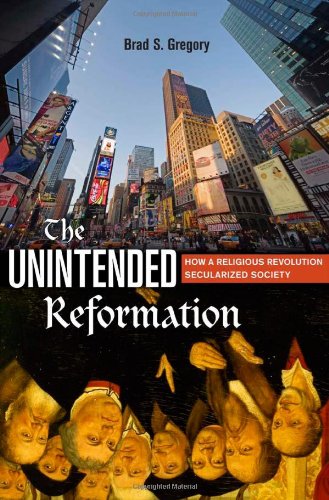
The Unintended Reformation

I recently finished a really interesting book I've been meaning to read for a long time, so now of course I'm going to tell you about it. The book is The Unintended Reformation: How a Religious Revolution Secularized Society by Brad Gregory, a professor of early modern history at Notre Dame. Professor Gregory's principal argument in this book is that "the Western world today is an extraordinarily complex, tangled product of rejections, retentions, and transformations of medieval Western Christianity, in which the Reformation era constitutes the critical watershed." In other words, as the subtitle suggests, he argues that the Reformation, a religious movement meant to revitalize and re-sanctify western Christianity, had an unintended but instrumental role in giving birth to the modern, secular society we live in today.

As an introductory point, he argues against the traditional, supersessionist view of modern history, in which "the distant past is assumed to have been left behind, explanatorily important to what immediately succeeded it but not to the present." Rather, he argues, much of the distant past has not been left behind, but continues to influence the present through its continuing ideas, values, worldviews, and institutions. "If this book's argument is near the mark," he says, "we cannot understand the character of contemporary realities until and unless we see how they have been and are still being shaped by the distant past."

Three Problems

Gregory sums up the argument of his book with three basic problems faced by early modern Christendom. First, late medieval Christianity was increasingly troubled by a gulf between the ethical prescriptions of the Christian faith and the actual practices of its followers, even (and especially) the clergy. This was a problem that reform-minded Christians hit on for centuries before the Reformation, but Luther and his contemporaries took the minority opinion that the church's problem was not simply moral, but doctrinal: the church was failing in its struggle against corruption and sin not simply because of personal or institutional failings to live up to its vision, but because of actual doctrinal error in its teaching. The solution, they thought, was to base the teachings and practices of the Church on Scripture alone, apart from manmade traditions which had led to the present muddle.

Yet this introduced a new problem: turning to the Bible as the sole authority for matters of faith and practice did not produce a renewed Christianity as the reformers hoped, but multiple, conflicting Christianities based on incompatible (but "authoritative") readings of Scripture, which fought with force of arms for more than a century and with words for far longer. In his second chapter Gregory expounds pretty exhaustively on the plurality of doctrinal claims that arose among the Protestants, even within ten years of the 95 theses. "From the early 1520s," he says, "those who rejected Rome disagreed about what God's word said. Therefore they disagreed about what God's truth was and so about what Christians were to believe and do." To list some of his examples:
  • In 1522, Andreas Karlstadt disputed Luther's disdain for the book of James as well as his views on the nature of the Old Testament, oral confession, the Eucharist, and the permissibility of religious images.
  • Luther and Melanchthon famously parted ways with Zwingli over the Real Presence of Christ in the Eucharist.
  • Between 1525 and 1527, nine different reformers published twenty-eight treatises against Luther's view of the Lord's Supper, leading to the Marburg Colloquy in 1529 and the split between Lutheran and Reformed Christianity.
  • Zwingli disagreed with his former Zurich colleagues Hubmaier and Grebel about the biblical basis for infant baptism. The early Anabaptists sharply denounced other reformers' practice of infant baptism, again on biblical grounds. In Grebel's words, "the baptism of children is a senseless, blasphemous abomination against all scripture."
  • Leaders behind the German Peasants' War repudiated Luther's distinction between "the Gospel" and social, economic, and political concerns, arguing for a stronger connection between the two. After the failure of the Peasants' War, by the late 1520s, the Anabaptists began dividing rapidly over a host of doctrinal issues.
  • Other attempts to distinguish true Christian teaching from false based on evidence of fruits of the Spirit, direct testimony from the Spirit, or reason were similarly unsuccessful; Protestants disagreed about what exactly the fruits of the Spirit looked like, how reason was to be used in formulating Christian truth claims, and what the Spirit was "saying" to them at the moment.
A few especially powerful summary statements from Gregory, again supporting the point that sola scriptura was (and still is) the source of a great deal of doctrinal pluralism among Protestants:
Christians who rejected the authority of the Roman church and its truth claims, notwithstanding certain alliances and reconciliations (such as the Lutheran Formula of Concord) among some of the constituent groups, never exhibited anything remotely resembling agreement about their own, alternative truth claims. It is thus misleading to say that "Protestantism itself splintered into rival denominations, or 'confessions,'", as if there ever was some point in the early Reformation when anti-Roman Christians had agreed among themselves about what scripture said and God taught. There wasn't. (p. 91)
Had Protestants simply disagreed about the interpretation of Scripture as such, their disputes would have remained much more circumscribed than they became. But more was sought—and needed—because the principle of sola scriptura itself did not yield the desired result. The would-be solution for reforming the late medieval church immediately became an unintended, enormous problem of its own, one different in kind from the problem of how to close the gap between the Roman church's prescriptions and late medieval Christians' practices. ... in addition to their continuous doctrinal disagreements with defenders of the Roman church before and after the Council of Trent, Protestants disagreed among themselves on multiple fronts. They disagreed about the meaning and prioritization of biblical texts, and the relationship of those texts to doctrines regarding the sacraments, worship, grace, the church, and so forth. They disagreed about the broad interpretive principles that ought to guide the interpretation of scripture, such as the relationship between the Old and New Testaments or the permissibility of religious practices not explicitly prohibited or enjoined in the Bible. They disagreed about the relationship among the interpretation of scripture, the exercise of reason, and God's influence in the hearts of individual Christians. And they disagreed about whether (and if so, to what degree) explicit, substantive truth claims were even important to being a Christian, with some spiritualists and alleged prophets radically relativizing the place of doctrines in Christian life. (pp. 109-110)
This problem of doctrinal pluralism among Christians and the resulting contentions (up to and including warfare and executions) that produced little progress towards resolving their differences gave rise to a third problem: "how was human life among frequently antagonistic Christians to be rendered stable and secure?" How could Europe be saved from completely fragmenting along confessional lines? How could future Thirty Years' Wars be prevented?

Gregory's chapters two through six follow the pattern of these questions pretty faithfully in five different areas of late medieval life: truth claims/answers to what he calls "Life Questions" ("serious questions about life, with important implications for life"), the institutional church and its relationship to the state, moral/ethical norms, the economy, and academia. Before the Reformation, each of these things was guided and shaped teleologically according to the faith and teachings of the late medieval Catholic Church. None were perfect, but all were unified and defined by the Church and its Christological vision of what constituted the "good" (virtuous) life.

The reformers, then, saw in the Church's failure to live up to its ideals in these things evidence not just of moral weakness, but systemic doctrinal error. Their goal was to replace human traditions and the false teachings of the Church that had accreted over the centuries with authentic Christianity as laid out in the Bible, the only ultimate ecclesial authority. Due to the unintended problem of Protestant pluralism, however, they did not succeed at this task, but instead added to Roman Christianity numerous Christianities that, because of their mutually contradictory claims, frequently clashed with each other in their visions for "biblically" transforming each of these areas of life.

By the mid-seventeenth century, weary from thirty years of confessionally-motivated bloodshed, many Europeans not at the front lines of their respective Christendoms began to look away from Christianity and its seemingly endless disagreements for a stabilizing principle that would produce societal unity rather than division. Despite their claims to the contrary, early modern Christians effectively excluded themselves from the discussion of what "Christendom" would look like because of their inability to agree on it. But increasingly, people realized that reason might be able to answer questions on life and ethics, that the liberal state could defuse religious conflicts by permitting freedom of worship and mandating tolerance, that modern capitalism and consumerism could meet peoples' needs and even make them quite happy with the "goods life", and that universities actually did much better when they were not protecting religious traditions from free inquiry. With little choice and plenty of motivation, early modern western society learned to function without the Church(es) at its center.

So answers to the "Life Questions", no longer based on Christian truth claims, are now highly pluralistic; the consensus of our culture is to believe whatever you like and live however makes you happiest, as long as you tolerate others' beliefs and lifestyles. The state has power over the churches (even if it uses that power to mandate religious tolerance and pluralism in the guise of "freedom of religion"), harkening back to the magisterial reformers' turn to secular magistrates for protection and civil enshrinement of their beliefs. "The consumerist cycle of acquire, discard, repeat now makes up the default fabric of Western life in the early twenty-first century, regardless of how one assesses it and whether or not one resists it." And knowledge, especially academic knowledge, is considered secular and academic by default, in contrast to religious "opinions". Gregory argues that this is so not because secularism somehow rose up and displaced Christianity as the ideological matrix of the modern western world, but because during the Reformation Christianity retreated from its central position in society into doctrinal controversies and polemicism. Much like how the Church itself rose to fill the space left by the fragmented Roman Empire, so now secular reason came in to take the place once occupied by a now-divided Christendom. Christianity is supposed to apply to and transform all of society, you say? Well, which Christianity?

Excluding God

Gregory's first chapter is different. In it, he explores the origins of the secular, scientific worldview that is so commonplace today as to make atheistic materialism virtually a given in many scientific and academic circles. In this way of thinking, science and religion are seen as being in conflict, with science having gained the upper hand since the Enlightenment. The idea of God is unnecessary and untenable because the advance of science has rendered him useless, "disenchanted" the world. The claims of religion are seen as antithetical to and disproven by the claims of science. He cites Max Weber for an example of this kind of thinking:
And today? Who today still believes—aside from certain big children whom one can indeed find in the natural sciences—that the findings of astronomy or biology or physics or chemistry have something to do with the meaning of the world or indeed could teach us something about it? By what path could one come upon the trace of such a "meaning", if any is there? If the natural sciences lead to anything and are suited to belief along these lines, it is to make the notion that there is a "meaning" of the world die out at its roots! And to conclude: science as a way "to God"? Science, this power expressly antithetical to religion? No one today in his heart of hearts is in doubt that science is antithetical to religion, whether or not he admits it to himself.
And this way of thinking its not today presented as one philosophy among many: it is widely taken as absolute bedrock truth in our culture, on the basis of which religious truth claims can be disregarded out of hand. Gregory says, "the assumptions about God, nature, and science that dominate contemporary intellectual life ... are widely regarded as ideologically neutral, obvious truths rather than seen for what they are: ideologically loaded, contestable truth claims based on unverifiable beliefs." In this chapter he traces the trajectory of western thought regarding the relationship between God and the "natural" world.

Western Christian thinkers up through Aquinas gave prominent place to what is known as an "apophatic" view of God: mysterious, transcendent, rationally, incomprehensible, beyond all of our attempts to describe him. Of course some knowledge of God is possible through what he has revealed to us, but "central Christian claims about God—the reality of his providence, the fact of his grace, the compatibility of his will and power with those of each human being—are unavoidably and irreducible mysterious." God existed in an entirely different, mysterious way than we flesh-and-blood creatures do, but rather than making him remote or totally unknowable, make possible his divine immanence and knowability through all things. Gregory refers to something like this as a sacramental view of reality. Apophatic theology is still alive and well in the Orthodox Church; the twentieth-century theologian Vladimir Lossky wrote of God's counterintuitive transcendence of being, knowledge, and everything else we know:
Now God is beyond all that exists. In order to approach Him it is necessary to deny all that is inferior to Him, that is to say, all that which is. If in seeing God one can know what one sees, then one has not seen God in Himself but something intelligible, something which is inferior to Him. It is by unknowing that one may know Him who is above every possible object of knowledge.
Later, he quotes St. John of Damascus:
God, then, is infinite and incomprehensible, and all that is comprehensible about Him is His infinity and incomprehensibility. All that we can say cataphatically [positively] concerning God does not show forth his nature, but the things that relate to his nature.
But in the west, two medieval Christian thinkers planted the seeds for the eventual end of the sacramental view of God in western culture. The first was John Duns Scotus, who believed that God had to share at least one predicate, namely existence, with everything else in order to be knowable at all. "Insofar as God's existence is considered in itself and in its most gradual sense, Scotus agreed [with Avicenna] that God's being does not differ from that of everything else that exists. ... Scotus's move made God, in Robert Barron's phrase, 'mappable on the same set of coordinates as creatures.'" According to Scotus, God belonged to a more encompassing reality along with his creatures and and does not "exist", but exists in it in the same way that do.

The second was William of Occam, who extended Scotus' idea of metaphysical univocity (applying the concept of "existence" to God in the same sense as to creatures) and more thoroughly rejected the views of Aquinas, who had still held to something like an apophatic approach to theology. In his nominalist theology, God is not an abstract essence or "the sheer act of to-be" but a discrete thing, however much he differed from every other entity. Occam also contributed his well-known principle of heuristic parsimony, "Occam's razor", the idea that explanations of natural phenomena "ought not to multiply entities beyond necessity." Scotus' metaphysical univocity and Occam's razor, Gregory argues, put in place the intellectual pieces for "the domestication of God's transcendence and the extrusion of his presence from the natural world." Again, these ideas are opposites of the classical Christian consensus even into the post-Schism west; continuing Lossky's quote of John of Damascus, "God does not belong to the class of existing things: not that He has no existence, but that He is above all existing things, nay even above existence itself."

Added to these major pieces were the Renaissance revivals of three major philosophical traditions, which were not adopted wholesale but partially and ended up contributing to the parting-of-ways of theology and science in the late medieval era through to the seventeenth century. From Platonism came the idea of mathematics as an explanatory language—for the physical world rather than the transcendent world of forms. From Stoicism came "a view of nature as homogeneous and deterministically governed by forces"—though without the pantheist underpinnings of "mutual sympathies". And from Epicureanism came a focus on the uniformity of efficient, natural causes with no reference to final causality—though with a physics based on Stoic determinism rather than random collisions between atoms.

But all of these philosophical and theological developments were largely confined to the academy. The central claims of Christianity were not based on any philosophy but on the testimony of God's salvific actions in history, reinforced by the familiar rhythm of the church and her traditions. These new philosophical ideas might have been assimilated into her thought as Aristotelianism had been, "so long as the church's teaching, preaching, worship, devotional practices, and prayer continued to convey and embody the faith's central truth claims."

But if the nature and meaning of God's actions, how Christians were to live, or Christianity itself were called into question, then these ideas might be able to transform the conversation about God's relationship with the world in unexpected and un-Christian ways. This is what happened in the Reformation. As in the other chapters, the continual doctrinal disagreements among Protestants and Catholics effectively made explicitly Christian claims about God and the natural world untenable; again, which Christianity? With little in the way of consensus in the foreseeable future, what was left were confessionally neutral ways of understanding the created world: empiricism and reason. The sidelining of Christian truth claims and the front-and-center inclusion of philosophy in this task turned out to be fertile ground for assumptions of metaphysical univocity and the principle of parsimony. In other words, science and reason did not "disprove" any theological claims, as is commonly supposed. Rather, incompatible views of different Christian confessions about the meaning of God's actions effectively removed theology from its place as, in Aquinas' words, "queen of the sciences". The tenuous alliance between science and theology was broken because "theology" was no longer a singular, coherent thing like the growing body of scientific knowledge.

The Protestant denial of Roman sacramentalism also had unintended consequences, since it tended to involve univocal metaphysical assumptions of which the reformers may not have been aware. As usual, Gregory says it better than I could (can you tell I enjoy his writing style?):
A "spiritual" presence that is contrasted with a real presence presupposes an either-or dichotomy between a crypto-spatial God and the natural world that precludes divine immanence in its desire to protect divine transcendence. But in traditional Christian metaphysics the two attributes are correlative: it is precisely and only God's radical otherness as nonspatial that makes his presence in and through creation possible, just as it had made the incarnation possible. (Otherwise, Jesus would have been something like a centaur—partly human and partly divine, rather than fully human and fully divine.) The denial of the possibility of Christ's real presence in the Eucharist, by contrast, ironically implies that the "spiritual" presence of God is itself being conceived in spatial or quasi-spatial terms—which is why, in order to be kept pure, it must be kept separate from and uncontaminated by the materiality of the "mere bread".
Some more quotes illustrating how the modern "conflict" between science and religion came to be, shaped by univocal metaphysics and Occam's razor:
Having sidelined theology, scripture, tradition, and religious experience as source of knowledge about God, the reason exercised by nearly all leading seventeenth-century thinkers, whatever its particular manifestations or emphases, assumed a univocal metaphysics. God existed—and thus, analogous to creatures, God was an individual ens, an entity within being, or God was in some way coextensive with the totality of being. The entire category of God's actions in history had been unintentionally paralyzed by doctrinal controversy. Hence reason—including observation and experiment—bore the full burden of the endeavor to understand God's relation to the natural world. Therefore all theology that sought to avoid confessional controversy had to be natural theology, based on reason alone.
To be sure, God remained important in the reflections and natural-theological theorizing of many scientists throughout much of the nineteenth century.  But whether individual scientists continued to insist on his integral relationship to the natural world, relegated him to a remote first cause, or denied his existence altogether, the combination of two ideas had rendered him expendable. The first was the metaphysically univocal conception of God as a highest being among others: this brought God within the same ontological and causal order as his creation. The second was Occam's razor: if God was unneeded to account for causal explanations of natural phenomena, there was no reason to invoke him. A clear corollary of this notion was methodological naturalism. God simply no longer had a place in the workings of the world, whether spatially or causally: if all natural events were adequately explained by natural causes, God was redundant. So however unrepresentative at the time was Laplace's famous quip to Napoleon in 1802 when asked about the place of God in his physics—"I have no need for that hypothesis"—the leading French physicist of his day proved to be prophetically prescient.
Despite cascades of (post-)Enlightenment propaganda to the contrary, the mathematization of ordinary natural processes could entail no exclusion of God's alleged, abiding, mysterious presence in and through them. That required metaphysical univocity and Occam's razor: if a natural cause explained a natural event, it was though, there was nothing supernatural about either. Therefore, as post-Newtonian deists believed, once all the regularities of nature were understood to have natural causes, God could be no more than a remote first cause. Nor, despite generations of (post-)Enlightenment polemics denouncing allegedly primitive superstitions, did the discovery of laws that explain natural regularities exclude the possibility of extraordinary actions by God. That, as we shall see, required a dogmatic, unverifiable belief that natural laws are necessarily and uniformly exceptionless, such that miracles as traditionally understood were impossible. But if, having absorbed and taken for granted metaphysical univocity, one imagined that God belonged to the same conceptual and causal reality as his creation, and if natural regularities could be explained through natural causes without reference or recourse to God, then clearly the more science explained, the less would God be necessary as a causal or explanatory principle.
The key point is not, as is commonly but wrongly believed, that the empirical investigation of the natural world made or makes a transcendent God's existence increasingly implausible. It is rather that this presumption depends historically and continues to depend on a conception of God as a hypothetical supernatural agent in competition with natural causality ... In diametric contrast, with the Christian conception of God as transcendent creator of the universe, it is precisely and only because of his radical difference from creation that God can be present to and through it. This is the metaphysics that continues to underlie and make possible a sacramental worldview, against supersessionist conceptions of history, in combination with any and all scientific findings.
But as with Newtonianism in the eighteenth century, (neo-)Darwinism can be troubling to Christians on scientific grounds only if they have a univocal conception of being and reject a sacramental view of reality. 

Reflections

After reading The Unintended Reformation, I have a new appreciation for Bishop Ware's statement in The Orthodox Church that "[Orthodox Christians] have known no Middle Ages (in the western sense) and have undergone no Reformations or Counter-Reformations; they have only been affected in an oblique way by the cultural and religious upheaval which transformed western Europe in the sixteenth and seventeenth centuries." Obviously to turn to Orthodoxy is not to simply rewind the clock five hundred years, for (at least in America) it exists within the religiously pluralistic society forged in the fallout of the Reformation. But it at least offers one Christianity among many that is unique in its freedom from the distorting influences on western faith unintentionally brought about by the Reformation.

This book powerfully confirmed several of the doubts about the basis of Protestantism that I already had confirmed by Orthodox teaching. Specifically, about the unsuitability of sola scriptura for producing a (single) rule of faith and the misguided, factious nature of attempts to recreate Christianity "from the ground up". Such methodologies are fertile ground for disagreement and controversy which, as Gregory shows time and again, can have disastrous effects that no one wanted.

The book was also very distressing. For though it expertly disagnoses the historical origins of modern, western secularism, it offers little idea of how, or if, the hundreds of Christianities out there can be reunited or how the secularization and pluralization of society can be reversed. Should Christians even desire these things? Even as I am increasingly able to believe in the unity of the Orthodox Church, The Unintended Reformation reminds me of a broader, ecumenical kind of unity among all Christians that has been missing for over a millennium before the Reformation, for which I still long and pray.

Saturday, November 1, 2014

My Journey, Part 11.25: Addenda on Sola Scriptura

This is part 11.25 of my rebooted series on my journey from Evangelicalism to Eastern Orthodoxy. The full series can be found here:

1Back to the beginning
2Cracks appear
3Questions multiply
4Questioning the "gospel"
5The big question
6A better hermeneutic
7Explorations in epistemology
7.5Excursus on oversystematization
8Back to the gospel
9The new direction
10Ecclesiological foundations
11.1Sola scriptura
11.2The insufficiency of Scripture
11.25Addenda on sola scriptura
11.3Holy Tradition
12Bridging the cracks
13.1Orthodoxy and Genesis 1–3
13.2A Better Atonement (Against Penal Substitution)
13.3Faith Alone?
13.4The Colour and the Shape of the Gospel
14Worshipping with the Church
15Mary, Saints, Baptism, and Other Odds/Ends
16Looking Back, Coming Home

A few addenda

In the discussion ensuing from my attack on sola scriptura, I realized a few other reasons why I no longer hold to it, which I'll mention in brief here instead of simply editing into the previous post.

First, equating the New Testament with the apostolic tradition implies that the apostles who didn't write or contribute to Scripture (Andrew, James the son of Zebedee, Philip, Bartholomew, Thomas, James the son of Alphaeus, Thaddeus, Simon the Zealot, and possibly Matthias) left no legacy of their own. Either their teaching was not part of the apostolic tradition, or it consisted entirely of things written by the Scripture-writing apostles. I find this hard to believe. Given how much the situations and contexts of the other New Testament writers affect their expressions of the gospel (Matthew's prophecy-conscious presentation of Jesus as the Jewish Messiah, Luke the Gentile's presentation of him as the savior of all humanity, Paul's Pharisee-turned-apostle perspective, James practical, pastoral teaching, etc.), it is very hard to see how, say, Simon the Zealot had nothing unique to contribute to the apostolic tradition from his own context.

Second, as I may have implied last post, every Christian is part of some kind of tradition, even those who would deny it. Reformed Christianity is a Christian tradition with its own dogmas, its own rule of faith that sets the parameters for how its members read Scripture and is authoritative for that tradition. So is Wesleyan Christianity, broadly speaking, or Lutheranism, or the Anabaptist movements. They would be quick to point out that their dogmas, their rules of faith, are based on Scripture—but so would Eastern Orthodoxy! None of these rules of faith are read directly from Scripture (the Bible is not a catechism), but are the result of (and the reason for) different interpretations of it. In light of this, the question at hand is not properly "Scripture or tradition?", but "Which tradition interprets Scripture truly?".

Third, in response to Catholic/Orthodox arguments that the number of denominations or divisions in Protestantism demonstrates the unworkability of sola scriptura, Protestant apologists often like to point out the divisions within Catholicism and Orthodoxy, as well as their Great Schism from each other in 1054. If Protestants can't agree on what Scripture says, it seems equally true that Christians who believe in an authoritative church and Holy Tradition can't agree on what they say, either.

Let me address these two kinds of division separately. First, divisions within Orthodoxy. These include things like schisms over which calendar to use, whether to use leavened or unleavened bread in the Eucharist, minor details in the liturgy, etc. I would respond to these accusations in three ways.
  1. A Protestant telling an Orthodox Christian that his church is divided is a bit like a Unitarian telling a Calvinist that his tradition is incoherent and jumbled. Or, to use a biblical analogy, it is like pointing out the speck in your neighbor's eye while blind to the plank in your own eye. More to the point, the Orthodox view of Tradition does not deny that the Church is full of sinful, imperfect people who can be prone to disagreement. This is just as true for Orthodoxy as it is for Protestantism. But, as I have explained, Orthodox see the Church as more than the sum of its members. It is the divine body of Christ, into which its human members are joined through the mystery of the Incarnation. This makes it possible, at least, to distinguish between schisms from the Church and schisms of the Church, though not merely empirically but by faith. At least to Orthodox, a small minority of believers breaking away from the majority consensus is easily distinguishable from the Church itself dividing due to irreconcilable differences on an issue. It does not prove that the Church itself is divided or that its teaching is confused, only that the people in it are still sinful and in need of grace.
  2. Protestant attempts to demonstrate the disunity of Tradition impose on it the same notion of democratic perspicuity that they impose on Scripture itself, a view that is not held by Orthodox. Due to the larger body of writings, practices, and other sources it involves, Tradition is even less of an "open book" than Scripture is. Thus these arguments will fail to be convincing because they proceed from assumptions considered wrong by those they seek to convince, somewhat like an atheist attempting to show that the Christian Scripture is full of contradictions. (After all, Scripture, like the Church, is a reflection of the incarnate Word of God, diverse in its humanity but one in its divinity)
  3. While Protestants like to point to the relative pettiness of reasons for division among Orthodox as evidence of the absurdity of manmade tradition, I would interpret this fact in a different way. If the biggest things Orthodox have seriously disagreed over since the Reformation are liturgical calendars, the kind of bread to use in the Eucharist, or the precise way to make the sign of the Cross, then they agree on everything of substance! That's great! Clearly this Church has a settled understanding of the essentials of the faith.
Second, divisions of Orthodoxy from other traditional forms of Christianity, namely Catholicism and Oriental Orthodoxy. As I said in my post on ecclesiology, these schisms remain my two biggest standing disagreements with the Orthodox teaching of the Church's indivisibility. I have no answer for them right now. Yet I don't consider them deal-breakers. Why is this? Well, I agree with the Orthodox Church in these schisms and believe its position is in continuity with the apostolic church. I don't believe that Jesus established St. Peter and his successors as infallible monarchs over his church (the incredible corruption of some historical popes makes this hard to see), and I believe that the Chalcedonian definition provides the best, fullest description of the mystery of the Incarnation. These reasons are subjective, but I don't think it's possible to objectively "prove" that a given church is the "true" church any more than it is that Christianity is true. This does not mean it isn't possible to know the truth about these things, simply that no one can be argued to that truth.

Finally, in response to the Protestant argument that sola scriptura Christians differ on non-essential matters but are led by the Holy Spirit to the truth on matters of salvation: if you define the "essentials" of the Christian faith as those beliefs on which sola scriptura Christians agree, you are quickly left with little of real substance. Sure, there may be broad agreement on, say, the Nicene Creed, but behind its words wildly different beliefs can be held. How is God the Maker of heaven and earth, and of all things visible and invisible, and does it matter? How did Christ's incarnation work out our salvation? Are the crucifixion and resurrection equally important in this, or is one of them the decisive completion of salvation? In what manner will Christ come again to judge the living and the dead, and does that matter? Does the Holy Spirit proceed from the Father alone, or from the Father and the Son? How is the Church one, holy, catholic, and apostolic; and if so, how? How is the one baptism for the remission of sins to be administered, and what is its meaning? I believe these questions are important and not simply matters of individual conscience. The Orthodox Church can offer one consistent, "biblical" answer/set of complementary answers to the essential questions and clearly distinguish which ones these are. Can Protestants?

Reflection on my story

I experienced this confusion about "non-essential" teachings of the Bible firsthand, and it was a major factor in my own rejection of sola scriptura. As I've previously told my story, a major driver of my journey of faith has been my growing questions and doubts about the "gospel" as I've been taught it within evangelicalism. I started facing questions like:
  • Atonement theories: Why did Jesus have to die on the cross? What did his death accomplish, both objectively and subjectively? How do the crucifixion and resurrection tie into this?
  • God's providence: How do God's sovereignty and our freedom intersect in our faith and salvation? Does God accomplish everything apart from our contributions, or do we cooperate with his grace somehow?
  • Soteriology: Is salvation to be thought of primarily in individual or corporate terms? Is there a prominent legal dimension to it, or does it consist of something else? Can we lose our salvation, or were we never really saved if we fall away? Is salvation an instantaneous event or somehow more distributed?
  • Origins: Were Adam and Eve historical people who introduced sin and death into the world by committing the first sin? If not, where did sin and death come from?
  • Theodicy: However it happened, was the fall a tragic and unintended disaster or is it somehow part of God's greater plan? That is, is God working to restore the creation to its former perfection, or is it part of his ongoing creation of something even better?
  • The law: Why was the Mosaic law given? How is it fulfilled in Christ? How are faith and obedience to the law (or, more generally, "works") related? How do the testaments fit together?
Later, after my big crisis of doubt, I started searching for different answers to these and other questions. These answers were often at odds with the ones my church held (which, after all, were what prompted my doubts). In light of sola scriptura, there were a few ways to explain this discrepancy:

I was wrong. My church's theology was correct, at least on the essentials, and my questions were based on personal sin or misunderstanding. This was the approach I took until around last February, when I realized that suppressing my doubts and questions, pretending to myself that they weren't well-founded, would never make them go away and was eroding the life of my faith as God ceased to make sense to me. Since then, this option has been closed for me. I had never been able to wholeheartedly affirm things like Calvinism or penal substitutionary atonement, even when I wanted to and sought to understand them as biblically as I could. I couldn't deny the problems I saw with them without compromising my theological integrity and my belief in God's basic goodness, which was not under any question. Submitting to evangelical tradition would be a much bigger compromise of my conscience than to Orthodox tradition.

These questions are about non-essential doctrines, on which differing opinions are to be expected. Then what is essential? The biblical authors certainly didn't seem to consider things like the workings of God's providence or the nature of salvation to be merely matters of godly speculation. They seemed to have strong views on these things and to expect their readers to as well. My conscience, my reading of Scripture in sincere pursuit of the truth of God, had led me to some seriously differing conclusions than the Reformed-evangelical tradition I was a part of. If I simply set aside any matter on which there was disagreement as "non-essential", what remained was so minimal and anemic as to not even qualify as a "gospel". It was also intolerably relativistic. As I explained when I started this series, my questions had progressed so that I wasn't even sure what the gospel was anymore, only some things it probably wasn't. Clearly I was lacking an understanding of the "essentials" of the Christian faith.

My church was wrong (and maybe I was too). This was the option I had pretty much settled on when I started the present series on the gospel. I sought to clearly define the things I disagreed on and seek out better answers to my questions that I didn't have to force myself to believe.

But necessary as this quest seemed, I started to feel uneasy about it. Striking out on my own to seek the truth of Scripture, apart from any tradition I knew of, far from a glorious exercise of my sola scriptura rights, felt terribly individualistic, even narcissistic. My lack of trust in established traditions seemed to imply that God's promise to lead his people into the truth applied only to me, and no one else, that he had instead simply left them to their own (insufficient) ability to figure things out. How was I so much smarter than all the theologians and exegetes I was sparring with, both past and present? Regardless of how much "biblical" sense whatever answers I found made to me, how did I know that they were actually true? You see, by this point, I was acutely aware of the difference between what the Bible actually says and how we interpret it. I couldn't see how I could trust that my interpretations were any more reliable or true than those of my former tradition. I was tired of simply judging things as my fallible eyes saw them. The "that's just your interpretation" defense I had used so many times on others turned back on myself.

Yet even if I didn't go it alone and sought another tradition, another denomination, another "church" with which to read Scripture, one that shared my new convictions, what did that prove? Instead of my interpretation against theirs, it was simply some other tradition's interpretation against theirs—two "churches" each reading Scripture in such a way as to make it say things congruent with their own convictions. How was this any more decisive? It simply kicked the theological problems I was having up to the institutional level rather than the individual. It seemed tribalistic, like simply seeking a tradition that would echo and validate my own convictions. There was nothing to commend, say, Methodism to me except that it made more sense to me. So I was disinclined to switch churches, but I also grew increasingly pessimistic and relativistic about the ability of any church or individual to read Scripture truly. It seemed like it was always just someone's opinion/interpretation against someone else's. What was there to assure me that any interpretation, besides being more pleasing to me, was actually true? Could we even know? So I journaled:
It’s not so much that Protestant traditions are the personal domains of individuals—although this does happen, and more traditions begin or are identified with a single person. The real issue is that choosing these traditions is highly individualized—it’s an a la carte approach to belief where we can easily surround ourselves with those we agree with. (2014-3-21)
Maybe you can understand a bit of my excitement about finding the Orthodox Church, then. Here was a tradition that articulated the answers I had been seeking about God, the Bible, and the gospel, better than any other I had heard from before. But even more importantly than this, its claim to being true rested on more than its own say-so. The legitimacy of Orthodox Tradition was not simply by fiat, but was based on history, on Orthodoxy's real, visible continuity with the Church that Christ founded on and through the apostles to celebrate, proclaim, and preserve his teaching. It was also based on the incredible, unbelievable (to my Protestant eyes so used to disagreement and confusion) degree of unity I saw among Orthodox. It was precisely the kind of unity that sola scriptura promised, but never seemed to deliver.

The most excellent way

Let me be clear what I do and don't mean by that. In the Orthodox tradition there is no simple list of doctrine that clearly answers all the above questions. There is no single "official" story on origins, or theodicy, or salvation. But there are also no conflicts concerning them between theological positions that resemble political camps. Instead, there is conversation between a number of different, complementary views and emphases, all of which may well be correct dimensions of the faith. The essentials have been clearly defined, the parameters for doing theology on these things set, so that we can be free to do so with the Church, not independently from it and so often against it. With my current understanding, I can only offer the barest sketch of how Orthodoxy handles my Protestant confusions:
  • Atonement theories: Orthodox teaching holds a combination of the Christus Victor, ransom, moral example, and substitutionary atonement theories (and probably has some other dimensions I'm forgetting). Penal substitution is ruled out, and I have a feeling Orthodox would also disagree with the governmental theory, though I don't know of any interaction with it. The crucifixion and resurrection are viewed largely as one event with neither getting an unfair share of the attention; to a lesser extent this is true of Jesus' whole life, and the Incarnation in general.
  • God's providence: Orthodoxy is unabashedly synergistic, like Arminianism (but without the influence of Reformed theology). Though the necessity of God's grace, administered inwardly and outwardly, is stressed at every point, people are expected to cooperate with God in working out their salvation (Phil 2:12-13). Far from there being an ongoing debate between two major "camps" regarding God's providence, Calvinism and the Augustinian view of God's sovereignty and predestination it holds are considered heterodox.
  • Soteriology: Salvation is more corporate and ontological than individual and legal. It is not an instantaneous event but growth in Christian righteousness, maturity, and union with God in all that he is. It does depend on our holding to God in love and faith, and can be "lost" if we deliberately turn away and reject him.
  • Origins: The Orthodox Church is not dogmatic about the historicity of Adam and Eve (though with its bias towards historical interpretations, it tends to speak about them as though they were historical people). What is more important than the literal truth of Genesis 1-3 is its spiritual truth, especially in light of Christ's redemptive role as the second Adam (Gen 5:12-21). The theology of Irenaeus, among others of the church fathers, offers a compelling vision for interpreting the origins accounts that doesn't depend on their historical truth,
  • Theodicy: Irenaeus also articulates a theology of the fall that is distinct from Augustine's and, again, does not depend entirely on its reality as a historical event to make sense of the human condition. Rather than through Adam, our predicament is fully understood only through Christ, eschatologically rather than historically. This most helpful blog post by Fr. Stephen Freeman explains this in some more detail.
  • The law: As I have explained, the New Perspective on Paul has done more than Orthodox theology to resolve my confusion on this point, but they are definitely not incompatible. When the "law" is spoken of in Orthodoxy, it is generally the "law" of sin and death that we are saved from rather than the Mosaic law, which was a redemptive (though incomplete) dispensation of God for the Israelites. Because the gospel accounts and their later interpretation through Tradition are much more determinative to the Orthodox understanding of the "gospel" than the epistles of Paul, there is much less of a law-grace dichotomy, which is what contributed to my confusion in the first place; it is set into its proper context, not front and center as the bread and butter of the gospel message. There is no dichotomy between faith and works in salvation; both are necessary and expected to accompany each other, and both are considered to be made possible by God's grace.
On some of these things, Orthodox teaching offers fairly clear and compelling answers. In all cases, though, the way to greater knowledge of the Truth is clear, and no one is required to choose sides against each other. This way is Christ, the heart and ultimate meaning of the Scriptures. Holy Tradition is, very simply, the life of the Church as it interprets them, inspired by the Spirit with Christ as the key. Scripture is still, in a sense, the church's authority for matters of faith and practice, but Scripture interpreted rightly. I will (finally) write more about what this means next time.

Wednesday, October 22, 2014

My Journey, Part 11.2: The Insufficiency of Scripture

This is part 11.2 of my rebooted series on my journey from Evangelicalism to Eastern Orthodoxy. The full series can be found here:

1Back to the beginning
2Cracks appear
3Questions multiply
4Questioning the "gospel"
5The big question
6A better hermeneutic
7Explorations in epistemology
7.5Excursus on oversystematization
8Back to the gospel
9The new direction
10Ecclesiological foundations
11.1Sola scriptura
11.2The insufficiency of Scripture
11.25Addenda on sola scriptura
11.3Holy Tradition
12Bridging the cracks
13.1Orthodoxy and Genesis 1–3
13.2A Better Atonement (Against Penal Substitution)
13.3Faith Alone?
13.4The Colour and the Shape of the Gospel
14Worshipping with the Church
15Mary, Saints, Baptism, and Other Odds/Ends
16Looking Back, Coming Home

Having given what I hope is a satisfactory explanation and defense of sola scriptura in the last post, I can now explain why I no longer agree with it.

Dualism

The basic distinction my previous argument set up is highly dualistic. It views "God's word" and "the traditions of men" as two mutually exclusive categories which must be held separate. One is authoritative and infallible, the other is fallible and authoritative only in its agreement with the infallible source. This mandates a strong distinction between the Bible and the traditions of the Church.

Orthodox teaching would say that this view fails to take the Incarnation seriously enough. When God became man, the simple human-divine distinction was obliterated, like the veil in the temple of Jerusalem (Mat 27:51). The second Person of the Trinity put on flesh and lived with us, for our salvation. The destiny of Christians is now to be become like him, to become by grace what he is by nature. Paul wrote in Ephesians 4:15-16: "Rather, speaking the truth in love, we are to grow up in every way into him who is the head, into Christ, from whom the whole body, joined and knit together by every joint with which it is supplied, when each part is working properly, makes bodily growth and upbuilds itself in love." Or, as St. Athanasius famously said, "God became man that man might become god." I lowercase the second "god" because, obviously, we will never become infinite or uncreated as God is. We will never become omnipotent or omniscient, never rule the cosmos as he does. God can never have an equal. Yet, in a very real sense, Orthodox view salvation as deification, increasing union with God and sharing with him in who he is.

Therefore, Orthodox believe the biblical teaching of the Church as the body of Christ the head (Eph 1:22-23, Col 1:18-20) has wide-ranging implications. The Church is the "the pillar and bulwark of the truth" (1 Tim 3:15) , built on the confession of Jesus as the Messiah (Mat 16:16-18), the recipient of the Spirit of truth (Jhn 16:13). Paul writes of the Church, "So then you are no longer strangers and sojourners, but you are fellow citizens with the saints and members of the household of God, built upon the foundation of the apostles and prophets, Christ Jesus himself being the cornerstone, in whom the whole structure is joined together and grows into a holy temple in the Lord; in whom you also are built into it for a dwelling place of God in the Spirit." (Eph 2:19-22) In light of all of these affirmations, it seems unjust to call the Church merely a human institution that perpetuates human tradition. The simple human-vs.-divine dualism of sola scriptura is no longer tenable if the Church is the body of Christ and the temple of the Spirit of truth, just as it doesn't apply to Christ himself. The aforementioned warnings against following human traditions (Jer 23:16, Mat 15:6, 1 Cor 2:4-5,10,13, Gal 1:10-11, Col 2:8, 1 Th 2:13) are not speaking of every tradition of the Church except Scripture, but against heretical teachings and corruptions of the apostolic tradition.

A few other observations: by implication, it seems like Protestants should simply repeat the words of Scripture in church, since saying anything else is simply speaking the words of man, and how can those possibly improve on the perfection of God's word? But of course no one does this, which means that, to some degree, Protestants unconsciously agree with the view of tradition I am stating. (As I will get to in a few more posts, the Orthodox liturgy arguably includes more words of Scripture than the typical Protestant service)

Luther's protests against the teachings of the Roman Catholic Church were somewhat valid in that the Church really had corrupted its teaching. There really was a tension between the teaching of Scripture and the "words of men" (the Magisterium), so it's unsurprising that Luther would draw a contrast there. But Luther's contrast between the teachings of men and the word of God doesn't transfer to Orthodoxy, which testifies that it has faithfully preserved the apostolic faith without change (and whose testimony I have come to believe). If Luther had been Orthodox, there would have been no Reformation because there would have been no need for one. I don't know of anyone in the eastern Church who has championed anything like the Protestant "back to the Bible" approach without being influenced by the Reformation.

Apostolic tradition = Scripture?

I'll turn now to my argument's equation of the "apostolic tradition" with Scripture, and the implied exclusion of everything else. Obviously, if the apostolic tradition has the exact same content as Scripture, it is at least somewhat propositional in nature, the kind of truth that can be put into a book. But Orthodox believe that Tradition is much more than doctrinal truth about Jesus: it also includes the prayers and liturgy of the Church, the lives of the saints, and holy icons, music, art, and architecture. It is the whole "grammar" of the faith that Orthodox live consciously and subconsciously. Tradition is the very Spirit-breathed life of the Church. not simply its doctrinal teaching. In the early Church God was powerfully active, by no means restricted to writing. Has he so restricted himself now?

The Bible itself speaks against the idea that it contains the entirety of the apostolic tradition. John 21:25 says, "But there are also many other things which Jesus did; were every one of them to be written, I suppose that the world itself could not contain the books that would be written." Did the apostles, when orally passing on the teachings and works of Christ, restrict themselves to talking about what they would later put into writing? I hope not. Also, as N.T. Wright notes, since Jesus taught all over Judea he probably preached each of his sermons and parables dozens of times in total, with a certain amount of variance or improvisation in each telling. Yet each gospel only records a single copy of each. (Incidentally, this may account for some of the differences in details and ordering between the gospels) Also, in Paul's farewell speech to the Ephesian church he quotes a saying of Jesus (Acts 20:35) which is not found in any of the gospels. He cites other extrabiblical traditions in 1 Cor 10:4 and 2 Tim 3:8, as does Jude in vv. 9 and 14-20. (But are they really "extrabiblical" then?)

Additionally, the idea that we now know Jesus exclusively through the Bible seems to make the Bible into the definitive mediator between us and God, but "there is one mediator between God and men, the man Christ Jesus" (1 Tim 2:5). Is there a paper-and-ink mediator between us and Jesus as well?

History

I think sola scriptura also has less historical founding than the Orthodox view. It claims to be faithful to the practice of the early Church, but my studies have not borne this claim out. The Orthodox Church, like the early Church, has not understood tradition as something separate from the Scriptures and tacked onto them, a distinct source of authority. Rather, it views Scripture as the central and most important part of the Church's tradition. This is how Protestants can read the church fathers and claim they believed in sola scriptura, because they base their points on Scripture and not on a different thing called "tradition". That is simply not how tradition works. Tradition includes the Scriptures, and everything in it can be traced back to biblical teaching. I will explain this more below, but because Scripture needs to be interpreted, the fact that everything in tradition is "biblical" in some sense does not mean sola scriptura is true.

My argument's statement that after the apostles died, their oral tradition ceased and only the written tradition was left is simply false. Oral tradition can be passed down just like written tradition; Paul even commands it in 2 Tim 2:2. Also, the division between "oral" and "written" tradition is blurry, since many parts of tradition besides the Bible (writings of the fathers, liturgies, prayers, canons of church councils...) have been put into writing. This process began at least with the Didache, which was written just after or contemporaneously with Revelation, around 100. "Written tradition" isn't equivalent to the Bible.

Finally, sola scriptura leads to a kind of foundationalism (the quest to base knowledge on a foundation of certain beliefs) that I see nowhere in the early Church. Protestants today view the Bible as a body of truth from which to rationally, inductively construct a faith. Ostensibly starting from nothing (even knowledge of God or the nature of Scripture), they first discover Scripture's "self-authenticating" nature and then develop a complete theology from its teachings. But this is absolutely not how the early church operated, even after churches started to acquire reasonably complete collections of New Testament writings. It used the Scriptures more as an expression of an already-realized faith (that is, the apostolic tradition) than as a constitution on which to base such a faith. The faith preceded the Scriptures (at least the New Testament) and encompasses them; it does not originate in them.

The problem of authority

But these are all preliminary arguments. The main reason why I came to disagree with sola scriptura is this: it is based on a lie—the lie that there is effectively no difference between reading Scripture and interpreting Scripture.

Sufficient how?

This is the crucial distinction that so often gets forgotten in proclamations of the "sufficiency" of Scripture. Luther's belief in Scripture as the arbiter of tradition and judge of the Church's teaching assumed that it can speak with a clear, definitive voice, objectively governing the Church and deciding which traditions are or are not "biblical".

Within ten years of Luther's 95 theses came the first big disagreement about the interpretation of Scripture between reformers, namely Luther and the Swiss reformer Ulrich Zwingli's differing opinions about the nature of the Eucharist, the central and climactic act of Christian worship before its later replacement by the sermon. Luther pointed to Christ's statement, "this is my body" (Mat 26:26, Mar 14:22, Luk 22:19, 1 Cor 11:24) to substantiate his interpretation of the Real Presence known as consubstantiation. Zwingli pointed to John 6:63 ("It is the spirit that gives life, the flesh is of no avail") to support his view of communion as a memorial and symbol of the atonement. Their disagreement proved irreconcilable before Zwingli's death and presaged future spats between the Lutheran and Reformed wings of the Reformation (to say nothing of the radical reformers that everyone else loved to hate).

What does this say about Luther's democratic view of Scripture, as the infallible basis for the rule of faith? Was one or both of the two unable to read the biblical teaching on the eucharist clearly because of sin? Or is it possible that the Bible itself does not conclusively label one view as "biblical" and not the other? Does it clearly enumerate the difference offices of the church (bishop, elder, deacon...) and their duties, or a comprehensive list of all the spiritual gifts, or instructions for performing the liturgy of the early Church? Does it clearly state how faith and works are supposed to intersect? Later variance among sola scriptura Christians on these and other matters strongly indicates that it does not.

What I am trying to get at here is, again, the distinction between reading Scripture and interpreting it (and between interpreting it and rightly interpreting it). The Bible certainly has things to say concerning all of these topics, but if Luther and Zwingli's feud is any indication, it does not give one clear, simple, authoritative teaching on them, at least not one that is equally evident to everyone throughout time and space. Interpretation is required to come to "biblical" views on these things, and not everyone interprets in the same way. It is not so clear on every subject of interest to Christians (no matter how important it may seem at the time) that everyone is able to come to the same conclusion on the matter by simply reading the Bible themselves. Trying to make the Bible into an arbiter of our modern disputes over faith and practice simply shifts the debate to the seemingly intractable question of which interpretation is correct or binding for Christians—what Orthodox often refer to as the "problem of authority". This is roughly the Catholic distinction between the material sufficiency of Scripture and the formal sufficiency, which I find quite helpful. How can Scripture be authoritative if it speaks different things to different people?

Perspicuity

Does this mean that Scripture really is unclear, that God did not speak intelligibly? This distinction is too simplistic. As I argued above, sola scriptura, the belief that the Bible alone is sufficient to inform Christian faith and practice, tends to place the focus of belief on rational, propositional truth. So here with the clarity of Scripture. The concern of the argument in my previous post was to establish and defend the intelligibility of Scripture to the intellect: no layman is "unqualified" to read Scripture on his own or obligated to defer to an authority outside Scripture itself. This statement is qualified by the admission that our hearts can still keep us from understanding Scripture properly, but this is not taken as a big deal since we have received the Spirit which is from God (1 Cor 2:12) to heal our rebellious hearts and lead us to the truth.

Yet if the point of interpreting the Bible is more than just correct belief (and even Protestants maintain that it is), then this is a big problem. In fact, it's an even bigger problem than not being able to understand the Scriptures intellectually. What difference does it make if we follow the prescribed model of reading Scripture faithfully, understanding it soundly, and then applying it if our hearts refuse to listen? Doesn't this just make us Pharisees? When Protestants quote 2 Peter 3:16, it is almost always in the context of proving that even as the New Testament was still being written, Paul's letters were already being considered "Scripture", indicating their self-authenticating nature. But look at what comes before: "There are some things in [Paul's letters] hard to understand, which the ignorant and unstable twist to their own destruction, as they do the other scriptures." Why do we assume that because we call ourselves Christians, Peter's warning never applies to us? "The heart is deceitful above all things, and desperately wicked" (Jer 17:9), so why do we place such trust in our own ability to interpret the Scriptures?

And if God does not guarantee that our hearts will understand the Scriptures, then why should we seek any such promise for our heads? Does a well-written textbook on calculus speak clearly? Yes, if the reader has the necessary background learning. Its lack of clarity to an uneducated person is not necessarily due to any mistake on the part of the author, but the nature of the content and the ability of the reader. Reading Scripture correctly requires discipline, discernment, and holiness. To flatly state that it is "perspicuous" doesn't do justice to its complexity and depth, in which those able to understand it find its richness. Fr. Stephen Freeman writes on the Protestant democratic view of Scripture:
The Scriptures are difficult to understand, simply on the most straightforward level. What often passes for understanding is nothing of the sort. To actually hear the Scriptures without the filters of cultural abuse and twisting they have endured over the centuries (and especially in the modern period) is a great spiritual feat, a miracle. 
This feat is even greater when it comes to reading the Fathers – for there the layers become even denser, the required contextual knowledge yet more complex. 
The scholarly reading of Scripture and the Fathers is inherently non-egalitarian. All are not equal. All will not have equal understanding. But neither is it truly and solely intellectual. For spiritual meaning is also spiritually discerned. And it is here that many make shipwreck of their understanding. For the arrogance of our times convinces many that “at least with themselves” the ability to spiritually discern will be present. Or, more commonly, they will champion this reader or that and choose sides like the crowds of a football match. Theological debate often resembles the conversation of sports clubs.
Orthodox don't believe the Bible is "perspicuous" to the head or the heart, not even on "salvific" subjects (as if it is made to be so divided). But this is not an issue, and does not mean that God has not spoken clearly or doesn't really want to save his people because salvation doesn't come from simply reading Scripture individually and then believing and applying what it says. We don't have to go it alone! Salvation is through the Church, which is itself the living interpretation of the Scriptures. It is through the instruction of the Church rather than any kind of common-sense principle or right methodology that we learn to read the Bible correctly, just as it has been from the first century onwards. This is not to discourage anyone from reading the Bible and seeking its riches for themselves, but a reply to the democratic rhetoric of the reformers that makes everyone's personal interpretation of Scripture authoritative and infallible for them.

Responding directly to the arguments I put forward for perspicuity last time, Paul's distinction between the "wisdom of men" and the gospel is a contrast between the pretensions of itinerant teachers and philosophers (against whom Paul was being unfavorably compared), not an argument for the simplicity of Scripture. "Making wise the simple" more likely means that the Scriptures are good and useful for the instruction of the simple to make them wise in Christian maturity, not that they are a metaphorically open book to the simple from the get-go.

Jesus' manner of correcting peoples' misreadings of Scripture actually argues for an undemocratic view of the Bible's clarity; in all but one of the cases I cited, Jesus is correcting Pharisees, Sadducees, chief priests, and other Jewish elites—people who were expected to know what the Scriptures said because they had studied them their entire lives and were considered qualified to teach others, not simply because they are equally clear to all. The exception is Luke 24:25, in which a) Jesus says the disciples are "slow of heart" to believe, not slow of mind, and b) He is about to embark on retrospective journey through the Scriptures to show how he fulfills them in ways not originally expected (and quite possibly allegorical). Paul's letters were written to entire churches, but of course they would have been read publically to the congregations and then expounded upon by a leader or teacher, not simply read and interpreted individually by each parishioner. The rarity of books in the ancient world made this impossible.

Pervasive interpretive pluralism

But perhaps the biggest argument against the clarity of Scripture is that Protestants who rely on the Bible and consider themselves "biblical" Christians disagree so much about what the Bible really says! There are over 32,000 hundreds of Protestant denominations who have divided with each other over almost any biblical subject imaginable—including the number and nature of the salvific "essentials" of the faith that Scripture supposedly speaks clearly about. Is this confusion the result you would expect if the Bible alone is really perspicuous and sufficient for matters of faith and practice? This is the problem of "pervasive interpretive pluralism", as Christian Smith calls it, and it began within ten years of Luther's 95 theses, even among his own followers. When Protestants equally seeking to read and apply the Bible aright interpret it in different and incompatible ways, how do you decide which interpretation is right? Can we even know? Who gets to decide this?

And the disagreement isn't just across space, but across time. Most any interpretation stands on the shoulders of some giant or another, so it's almost always possible to consider your view "traditional". But again, how do we know that we are right and the historical interpreters we disagree with are wrong? It seems like we'll always have to be ignoring some part of tradition. Aware of this selective approach, I journaled:
But...ignoring tradition is a kind of epistemological arrogance, albeit an unintentional, institutionalized one. (2014-2-1)
This all comes back to my point that the Bible never just "speaks" on its own. It has to be interpreted, and for a variety of reasons different Christians come to different conclusions. No one has a direct line to God through it. So just relying on "Scripture alone" will only generate pluralism and confusion. The problem, I realized in a pre-echo of the Orthodox approach to the Bible, is the individualism behind the assumption that anyone can pick up the Bible and understand what it means.
The expectation that someone can just pick up a Bible and understand it is unrealistic—it must be read in community to be understood holistically. (2013-6-13)

A nasty decision

Faced with this problem of pervasive interpretive pluralism, Protestants tend to pick one of three options to preserve the doctrine of sola scriptura.
  1. The modernist solution: Insist that you have read Scripture correctly or "objectively", and others have misread for various reasons, probably because of their sin or preconceptions. Most Protestants realize why this is not a solution at all—when everyone does it, it merely perpetuates the problem and even makes it worse. It effectively makes your own reading of Scripture as authoritative as Scripture itself.
  2. The postmodernist solution: Admit that maybe this pluralism is the the way it's supposed to be; we can't know what the Bible means for sure, but maybe its truth is found in the plurality of interpretations instead of boiling down to one right answer. Or maybe a truly "objective" reading of Scripture is an ideal that we can draw ever closer to but never actually reach, so we must be humble about our efforts. Aside from looking absolutely nothing like the approach of the early Church towards Scripture, I have found this option profoundly unsatisfying and hard to reconcile with the Bible's inspiration.
  3. The via media: Admit that some things in the Bible ("open-hand issues") are unclear, but the essentials (the "closed-hand issues"/"matters of salvation") are clear and and can be agreed on.
...except they can't. Protestants are unable to agree on even what is "essential" or "salvific". Some Calvinists hold that a Reformed understanding of God's grace is essential to be a Christian, but not all who call themselves Christians agree with this. Some young-earth creationists hold that agreeing with their account of origins is essential, but many Christians disagree. Quite a few Christians believe that a Nicene understanding of the Trinity is necessary to be a Christian, but not everyone self-identifying as a Christian (e.g. unitarians, Mormons) agrees with this. If you define the "essentials" as the things which all "Christians" (can we even agree on a definition of the word?) can agree on, the set of them quickly shrinks down to nil. If you adopt a stronger definition of what they are, you are asserting the correctness of your interpretation over someone else's. So this approach really reduces to one of the first two, though it is usually more humble about it. I expressed the pessimism of the second approach when I journaled:
There is also an opposite error to epistemological arrogance, on the other side of epistemological humility—an unwillingness to hold to crucial truth, to 'just get along'. But how do you decide what truth is worth holding to—or is that even the right question? (2014-2-2)
This search for the "essentials" or "fundamentals" of the authentic Christian faith also leads to a very boundary-oriented understanding of what Christian faith really is, defined by the beliefs that are merely "sufficient" for salvation. I now consider "mere salvation" an oxymoron, something we shouldn't even concern ourselves with for a moment. Orthodox theology, while it does have some clear boundaries, is much more center-oriented, focused on knowing and celebrating the mysteries of Christ, on laying hold of salvation and acquiring the Holy Spirit by any means possible. This is because the boundaries of Orthodoxy are well-known and universally agreed-upon, so no one tries to figure them out anew or challenge them. I also believe it's because they are correct, not excluding parts of the true faith or allowing for blatant heresies to coexist with it, so by and large no one feels called to question them as so often happens in Protestantism.

The search for the correct hermeneutic

To try to create some order in this chaos of different interpretations, Protestants seek a hermeneutical method that will allow people to agree on the "correct" interpretation of Scripture and establish it as the infallible rule of faith that Luther envisioned. (If such a method is needed and apparently not obvious, does that mean that Scripture alone really isn't sufficient?) These include:

Just read the Bible literally. Unfortunately, this doesn't work. As I have pointed out myself, there are plenty of instances where even staunch "biblical literalists" don't read it all literally. Does your church allow women to speak in church, or to worship with their heads uncovered? What about when Jesus said, "This is my body...this is my blood"? Or when the Bible uses anthropomorphic language to describe God the father, or says that he changed his mind? No one reads the Bible entirely literally, and that's a very, very good thing.

The Holy Spirit illuminates our hearts and guides us to the correct interpretation. Unfortunately, this approach compels one to de-Christianize those who disagree with you, since you both can't be led by the same Spirit to conflicting conclusions. Every difference in interpretation that can't be reconciled becomes an implicit accusation of some failure in the other's faith. As the number of denominations grows, it becomes harder and harder for a Protestant to maintain that the Spirit has led just one of them to interpret the Bible correctly—but he or she will probably believe that if it's any denomination, it's theirs.

Scripture interprets Scripture. As the Westminster Confession says, "the infallible rule of interpretation of Scripture, is the Scripture itself; and therefore, when there is a question about the true and full sense of any scripture (which is not manifold, but one), it may be searched and known by other places that speak more clearly." Yet, as I have pointed out before, which passages are "clear" and which are "unclear" varies from person to person, dependent on preassumptions. So this approach doesn't work either.

The historical-critical/grammatical method of exegesis. This approach acknowledges the biasing role of preconceptions that makes the above three methods untenable, and seeks to see past them. By studying the Bible "objectively" or "scientifically", it is thought, its true meaning will be revealed. While this approach has yielded much useful scholarship, it runs unto the problem of hermeneutics not being an empirical science. Because of the impossibility of banishing preconceptions entirely, this approach often just results in the scholar reading his or hers back out of the Bible behind a mask of objectivity. Again, if reading the Bible in such an empirical way were really possible, we would expect all historical-grammatical exegetes to agree in their reading (or at least the major points), but again this is not the case. Again there is interpretive pluralism.

Read the Bible with the Church. This approach recognizes the dangers of allowing individual interpretations to rule, and even seems to learn a lesson from more traditional forms of Christianity. But it runs into trouble when applied in the context of a fragmented Church. Yes, you can read your Bible with your church, as part of a tradition of some kind, but what about the church down the street that has a different understanding? How do you adjudicate between different churches' different interpretations? The problem of pervasive intepretive pluralism has simply been kicked up a level to churches rather than individuals. If your definition of the Church is effectively "those who hold the beliefs I consider salvifically essential", letting church tradition guide your reading will do little to produce unity with other churches. Tradition is inseparable from ecclesiology.

Even seeking to align your reading with the historical traditions of the wider Church doesn't work if you continue to hold to the sola scriptura tenet of the Bible as the arbiter of tradition. How can you know which traditions are "biblical" and which are not? For example, on what basis aside from personal conviction do most Protestants affirm that the first ecumenical council of Nicea (which established the orthodox view of Christ's two natures and promulgated the first version of the Nicene Creed) is "biblical", while the second (which allowed for the veneration of icons) is not? I expressed something like this sentiment when I was coming to terms with the Orthodox view of tradition, not seeing the contradiction:
I might be willing to accept Tradition inasmuch as it expounds, interprets, clarifies, strengthens, applies, etc. Scripture—but not when it contradicts it or innovates on it, as with the perpetual virginity of Mary. (2014-4-23)
It's nice to see Protestants paying an increasing number of attention to the historical tradition of the Church, but as long as these traditions and writings are simply treated as additional "texts" from which to draw in the pursuit of unity, the individual still reigns as the final interpreter, as this post argues. Even if churches seek to consciously draw from the wellspring of tradition, while the plurality of churches remains, people can always just choose the one whose reading of the Bible and tradition aligns the best with their personal interpretation.
It’s not so much that Protestant traditions are the personal domains of individuals—although this does happen, and more traditions begin or are identified with a single person. The real issue is that choosing these traditions is highly individualized—it’s an a la carte approach to belief where we can easily surround ourselves with those we agree with. (2014-3-21)
As my interest in Orthodoxy was growing (but a few significant doubts remained), I journaled:
I’m inclined to remain Protestant (not evangelical) and freely extol the overall truth of Orthodoxy and borrow from its tenets and traditions. Yet this seems like the epitome of hypocrisy; such borrowing is an affront to what Tradition is supposed to be to us. (2014-6-4)
I realized this borrowing approach to Tradition, whether sipping or guzzling from it, was ultimately against the nature of Tradition itself. It is as united as the Church; there can be no picking and choosing.

Eck's challenge

Protestants like to quote Luther's simple statement of the principle of sola scriptura which he gave at the debate in Leipzig: "A simple layman armed with Scripture is to be believed above a pope or a council without it." Much less popular (for some reason) is the response of his opponent, Johann Eck. (Emphasis added)
But this is the Bohemian virus [referring to the Bohemian proto-reformer, Jan Hus], to attach more weight to one's own interpretation of Scripture than to that of the popes and councils, the doctors and the universities. When Brother Luther says that this is the true meaning of the text, the pope and councils say, 'No, the brother has not understood it correctly.' Then I will take the council and let the brother go. Otherwise all the heresies will be renewed. They have all appealed to Scripture and have believed their interpretation to be correct, and have claimed that the popes and the councils were mistaken, as Luther now does.
Why, objectively, was Luther right and, say, Pelagius wrong? What gave Luther any more of a right to interpret Scripture against the teaching of the Church than Marcion? What guarantee have we that, by following Luther (or any other Christian leader promoting their own rule of interpretation), we are not plunging into heresy like the followers of Arius?

St. Irenaeus, when responding to Valentinianism (an early Christian gnostic sect) and its use of the Scriptures to support heresy, made a famous analogy:
Such, then, is their system, which neither the prophets announced, nor the Lord taught, nor the apostles delivered, but of which they boast that beyond all others they have a perfect knowledge. They gather their views from other sources than the Scriptures; and, to use a common proverb, they strive to weave ropes of sand, while they endeavour to adapt with an air of probability to their own peculiar assertions the parables of the Lord, the sayings of the prophets, and the words of the apostles, in order that their scheme may not seem altogether without support. In doing so, however, they disregard the order and the connection of the Scriptures, and so far as in them lies, dismember and destroy the truth. By transferring passages, and dressing them up anew, and making one thing out of another, they succeed in deluding many through their wicked are in adapting the oracles of the Lord to their opinions. Their manner of acting is just as if one, when a beautiful image of a king has been constructed by some skilful artist out of precious jewels, should then take this likeness of the man all to pieces, should rearrange the gems, and so fit them together as to make them into the form of a dog or of a fox, and even that but poorly executed; and should then maintain and declare that this was the beautiful image of the king which the skilful artist constructed, pointing to the jewels which had been admirably fitted together by the first artist to form the image of the king, but have been with bad effect transferred by the latter one to the shape of a dog, and by thus exhibiting the jewels, should deceive the ignorant who had no conception what a king's form was like, and persuade them that that miserable likeness of the fox was, in fact, the beautiful image of the king.
I'm not saying that all Protestants are like the Valentinians. But both follow the same dangerous approach to the Scriptures, that is, following one's own interpretation of them wherever it may lead rather than the "rule of faith" established by the apostles and passed down through the churches. This rule of faith, the teachings of Tradition on how to properly interpret the Scriptures, is the likeness of the king in Irenaeus' analogy, the guide to correctly assembling the mosaic. It is the universal faith, the teaching of the whole Church, which leads us to the truth, not simply whatever we think the text says. To disregard it and blaze a trail of one's own (or to follow those who do so) is to court heresy, false teaching and worship, and abusive theology and practice, institutionalized examples of which are plentiful even within American Protestantism.

Peter Bouteneff, referring to Irenaeus' analogy:
If Scripture inexorably produced the rule of faith from itself, it would be impossible to emerge from it reading it with the portrait of anything but the King. The apostolic witness—what the apostles preached based on how Christ taught them to understand the Scriptures—is what produces the rule, or canon, of faith. ... Holding to the rule of faith, then, naturally enables the Christian to reconstruct the mosaic of the King correctly, even as it also serves to unite him or her to the true church. Irenaeus readily admits, however, that Scripture does not present explicit solutions to all questions or completely penetrate the mysteries (e.g., of theodicy, the angels, the incarnation,  or the economy in general).
The Scripture itself does not explicitly rule on whatever matter of doctrine we may wonder about. Scripture alone is not sufficient for matters of faith or practice; it has to be interpreted, and if the present state of Protestantism is any indication, relying on your own judgment beholden to no other authority than the Bible is not a solution at all. The Bible does not, cannot, is not meant to establish a rule of faith; rather, the rule of faith guides the interpretation of the Bible and allows sound interpretations to be discerned from faulty ones. But which rule of faith is correct? Orthodox identify it with Holy Tradition, the subject of the next post.

More resources

Many Orthodox have written about sola scriptura and its differences from the Orthodox view of Tradition. Here are some articles I found helpful while composing this one.

A long article on the shortcomings of sola scriptura and summarizing the Orthodox approach to truth

Argument that solo and sola scriptura are effectively the same
Response of another blogger to the previous article

Another Orthodox critique of sola scriptura

Postcast by Fr. Andrew Stephen Damick explaining sola scriptura and its differences with Orthodoxy

Several recent blog posts by Fr. Stephen Freeman, one of the Orthodox bloggers I follow, roughly centering around sola scriptura and Tradition:
A contrast between Protestant and Orthodox ways of treating the "Bible"
Follow-up addressing criticisms of the previous post
The "grammar" of faith, or how Orthodox Tradition is broader and much deeper than the Bible
Critique of the democratic assumptions undergirding sola scriptura
The concept of "authority" as understood in Orthodoxy

Q&A with Elder Cleopa on Scripture and its proper use in the Church
Q&A with Elder Cleopa on Holy Tradition and the sufficiency of Scripture

Finally, Orthodox-Reformed Bridge (a site in dialogue with Reformed Christianity form an Orthodox perspective) has a a fairly lengthy four-part series critiquing sola scriptura: Part 1 Part 2 Part 3 Part 4