Pages

Showing posts with label Rants. Show all posts

Friday, May 10, 2013

Two Responses on the Historicity of Adam

Because of the high value I place on originality in my posts, I try to avoid writing direct responses to other articles, but this one on Justin Taylor's blog caught my eye. It critiques the view advanced by Peter Enns, Denis Lamoreux, and others that, in light of what we know about evolution, it's reasonable to conclude that Adam was not a historical person. There has, of course, been considerable pushback from evangelicals on this point, and Taylor himself links to two other articles which I'll address here.

Adam versus Claims from Genetics, by Vern Poythress

This fairly academic paper examines the claim that "voluminous data about the information contained in human DNA...demonstrates our ape ancestry." It seems to do a fairly faithful job of reporting scientific evidence brought to bear in support of evolution; unfortunately, it restricts itself to a tiny subset of the evidence: the resemblance of much of the human and chimpanzee genomes (he devotes a few pages to showing why this evidence can be misleading). Obviously there is much, much more that could be said for evolution than this point, but Poythress doesn't mention it.

He makes the excellent point that the raw data supporting evolutionary theory says nothing about any purpose behind it or the lack thereof; i.e. that evolution being true doesn't mean it's random and unguided as Dawkins and other secularists would say, and that God could have used it as a means to create. He then proceeds to ignore this point for the rest of the paper (at least for human origins) as he conflates Darwinism, gradualism, and evolution into one fuzzy package that is supposed to be opposed to good Biblical hermeneutics. (See the very title of the paper, which sets doctrine and science on opposing sides) He treats "gradualism" as the claim that God is somehow bound to natural laws and could only have created life via gradual processes, which he then proceeds to rebuke by demonstrating that God could have created Adam and Eve specially. Since I doubt any Christian holding to evolutionary creationism would consider God to be subject to the law of natural selection, this isn't very helpful.

Poythress explains that there are two ways to interpret the human-chimpanzee genome evidence: "Darwinism, with its purposelessness and gradualism" or a Christian framework. We see that he doesn't consider any separation between the domains of science and religion; theology can and should be used to interpret scientific data, not just results: "We cannot presume to say just how he did it without looking both at the data and whatever we have come to know about God." By this reasoning, theological reasoning should be brought to bear to control the interpretation of any evidence that could lead one away from sound doctrine. Having "science" in the name of my degree, I would argue that theology should affect scientific reasoning through basic, Christlike values like honesty, integrity, and fair-mindedness, not by steering our reasoning process to support preexisting theological conclusions.

Poythress goes into some other arguments about Jesus turning water into wine and population bottlenecks, but they all fall under the common head of establishing that, no matter the evidence, an original human pair could have existed at some point. (Which could be earlier than 4004 BC due to gaps in the genealogies) The implied conclusion, then, is that a faithful reading of scripture is enough to establish that they did exist: "If we receive the Bible’s instruction, we must be cautious about such assumptions." ("That the past is like the present, and that the rates of mutation and other genetic processes remain the same") He seems to be saying that we can trust our God-given intellect and intuition in the realm of science to the glory of God, until we start moving toward conclusions that cast doubt on our theology at which point even the most basic assumptions (like the regularity of nature) are no longer sound.

Overall, this paper assumes what I consider to be a rather unhealthy view towards scientific knowledge, as I have attempted to demonstrate above. It exploits whatever wiggle room there is in current conclusions to clear a place for its interpretation of scripture as it pertains to history, even if the evidence seems to be leading in a different direction. A quote towards the end worries me: "What looked like firm conclusions in the excitement at an early stage may be modified later. We need patience to assess the research." In other words, there is still plenty room for authentic Christian belief (in a historical Adam) in the uncertainty of the present scientific conclusions--a restatement of the "God of the gaps" view that proposes God as the explanation for what we don't know about the universe, rather than what we do know. The tricky thing about scientific gaps is that they close.

What Depends on an Historical Adam, by Steven Wedgeworth

This article incisively states the theological problem with evolution I observed a few months ago, namely that it casts doubt on our means of explaining sin and death, and even somewhat implies that God created death. Even more than Polythress above, Wedgeworth gets at the incompatibility between evolution and Christian belief in a historical Adam and original sin. he goes directly after the claims of Peter Enns in particular.

He uses several of the same tactics I disagreed with Polythress on (check the context if you like), such as conflating the scientific theory evolution with the secular worldview of "Darwinism":
The reason that evangelicals are losing the historical Adam are several, but they all reduce down to the dominance of the Darwinistic evolutionary theory, both in the academies and in the media.  
Or only allowing other scripture to be used as a reason for interpreting Genesis nonliterally (that is, the literal-historical hemeneutic is the "default" for faithful interpretation), and assuming that the only alternative to Genesis being historically true is its authors simply being wrong:
It is clear that only Biblical exegesis remains in the dock. Indeed, what we are seeing in theological circles is a new refusal to exegete at all. Instead of demonstrating the ways in which the rest of the Bible supports a figurative or mythical reading of Genesis, we are told that it doesn’t matter if even the Old and New Testament writers were mistaken.
His main argument, though, is somewhat more fundamental than Polythress': if we deny the historicity of Adam, we also deny the historicity of the Bible in general and the Gospel. Paul uses Adam as the counterpart to Jesus in Romans 5:12-19, and if the historicity of Adam is lost, then Jesus' work loses its meaning:
If the first Adam was mythical, then the nature and work of the Second Adam, precisely as Second Adam, would have to be mythical as well. This does not mean that the Judaean man whom Paul identified as the Second Adam was himself a myth, nor that his life did not unfold in real history. Rather it would mean that his redemptive identity, along with the nature of what He said was his work, was merely mythical, not an objective event with objective effects. He would have been seeking to fulfill a myth.
After mentioning Peter Enns almost as a kind of theological boogeyman at the beginning of the article, Wedgeworth never mentions him again or shows evidence of having read his book The Evolution of Adam, which devotes an entire chapter to the question, "What do we do with Romans 5:12-19?" Besides ignoring all of the arguments (both intra- and extrabiblical) that Enns uses to make his case, this also means he ignores Enns' response that, in far fewer words, Paul understands Adam as distant history and Jesus' as resurrection as a current event that had become central to his understanding of everything--that is, Paul is interpreting the Genesis account in light of the present reality of the death and resurrection of Christ, not the other way around. And not just interpreting, but reinterpreting (the OT and Jesus themselves significantly make no mention of Adam as the root of the human predicament).

He shows just how much doctrine evangelicalism has staked on its reading of Genesis 1-3 (emphasis added on the last sentence):
If Adam was not a historical individual, and if instead the Genesis account is a sort of mythical story which was employed in order to make a uniquely religious point, then Christianity is necessarily rendered merely metaphorical, expressing truths of the human condition through symbols. The Bible in this case is no longer an authoritative account of human origins, history, and final destiny. It no longer addresses all men in all places and times, but rather expresses one faith-narrative the seeks to convey a meaningful but wholly internal truth.
Put more simply: if Adam is mythical, then so is redemption. While it does not follow that if Adam is mythical, then the historicity of Jesus must also be denied, it does follow that if Adam is mythical, then the historicity of Jesus as Second Adam must be denied. And Christianity is founded on Jesus as Second Adam.
Apparently the only reason to believe in the historicity of Jesus is the historicity of Adam (nevermind the fact that there is actual historical evidence for the existence and ministry of Jesus): "The progressive evangelicals certainly believe in the historical Jesus. But apart from an earlier historical Adam, they have no coherent need to." I'd like to defer to N.T. Wright who provides an excellent explanation (which I've already linked to) about how the significance of Genesis 2 and 3 can be independent of its historicity. And not just the core of the gospel, but the very fabric of religious truth itself, and reality with it:
What exactly does this reimagining accomplish? The none-too-insignificant answer is that it changes our narrative of reality altogether. The Scriptures, and our religion, no longer tell a story about the structure of reality, but rather only of a particular subset of experience within it. In short, this retelling and reimaging also accomplishes a significant privatization of religious truth.
His interpretation of Romans 8: 20-25 is also interesting:
For the creation was subjected to futility, not willingly, but because of him who subjected it in hope; because the creation itself also will be delivered from the bondage of corruption into the glorious liberty of the children of God. For we know that the whole creation groans and labors with birth pangs together until now. Not only that, but we also who have the firstfruits of the Spirit, even we ourselves groan within ourselves, eagerly waiting for the adoption, the redemption of our body. For we were saved in this hope, but hope that is seen is not hope; for why does one still hope for what he sees? But if we hope for what we do not see, we eagerly wait for it with perseverance.
To which Wedgeworth says, "Sin is not only an internal and personal problem for the Apostle Paul. It is an ontological issue, affecting the very creation itself, the entire cosmos. Because of Adam’s sin, 'the creation was subjected to futility.'" He seems to be interpreting "him who subjected it in hope" here as Adam, not God; this is unbelievable to me. I have already tried to show how interpreting God as "him who subjected it" not only allows Christians to accept evolution, but results in a better hope and a better picture of God (which I am still working out) than the "Adam broke everything" narrative (which, again, begs the question of how on earth Adam's sin could have had such far-reaching consequences as changing the tectonic structure of the earth, creating disease, and apparently planting a bunch of old dead things in the ground that couldn't have died before?).

With all of that being as it may, Wedgeworth's article really falls short in that it doesn't address the view of evolutionary creation by looking at its chain of reasoning, pointing out weak points, and offering superior interpretations of the evidence it uses. (Which is exactly what I tried to do with the Fall narrative in my two-part post on it) Instead, it argues against it based on the perceived consequences of its being true, using an argument that is based on fear--fear of incorrect doctrine. (Which I no longer think is a good idea for Christians to follow) He says, "In light of what we already know, this can't possibly be true" rather than asking "This looks like it might be true; what would that mean?" Rather than dissecting the viewpoint of evolutionary creation, he fights it based on what lies at the bottom of the slippery slope of Biblical interpretation: the denial of the redemptive work of Jesus Christ. The tricky thing about slippery slopes is that they're rarely as slippery as you'd like.

The heart of the matter?

I'll say one more thing about an interesting quote by (of all sources for a Calvinist website) Pope Pius XII (emphasis added):
14. In theology some want to reduce to a minimum the meaning of dogmas; and to free dogma itself from terminology long established in the Church and from philosophical concepts held by Catholic teachers, to bring about a return in the explanation of Catholic doctrine to the way of speaking used in Holy Scripture and by the Fathers of the Church. They cherish the hope that when dogma is stripped of the elements which they hold to be extrinsic to divine revelation, it will compare advantageously with the dogmatic opinions of those who are separated from the unity of the Church and that in this way they will gradually arrive at a mutual assimilation of Catholic dogma with the tenets of the dissidents.
15. Moreover, they assert that when Catholic doctrine has been reduced to this condition, a way will be found to satisfy modern needs, that will permit of dogma being expressed also by the concepts of modern philosophy, whether of immanentism or idealism or existentialism or any other system. Some more audacious affirm that this can and must be done, because they hold that the mysteries of faith are never expressed by truly adequate concepts but only by approximate and ever changeable notions, in which the truth is to some extent expressed, but is necessarily distorted. Wherefore they do not consider it absurd, but altogether necessary, that theology should substitute new concepts in place of the old ones in keeping with the various philosophies which in the course of time it uses as its instruments, so that it should give human expression to divine truths in various ways which are even somewhat opposed, but still equivalent, as they say. They add that the history of dogmas consists in the reporting of the various forms in which revealed truth has been clothed, forms that have succeeded one another in accordance with the different teachings and opinions that have arisen over the course of the centuries.
Wedgeworth comments: "Pius’s concerns about viewing dogma as the reporting of mere forms or as intellectual clothings which only exist over and around the true reality is precisely the problem we are dealing with today." He seems to be saying, at least implicitly, that Biblical doctrine is absolutely true and not clothed in any particular intellectual or philosophical context. This is interesting because I directly and completely disagree with it. In any disagreement, I strive to understand exactly where the two parties diverge, which may be hidden under multiple layers of inference and rhetoric, and I suspect that in this case the above statement may be it.

So I'd be interested to hear other peoples' thoughts on this question, which has more than two answers--basically, how contextualized the truth in the Bible is. In the case of human origins or in general, what are the "elements [that are] extrinsic to divine revelation"--where does the human side of scripture end and the divine begin? Or, to push Enns' incarnational analogy to its logical conclusion, is scripture somehow 100% human and 100% divine? This is a fascinating question that I'll have to explore more in future posts.

As I said at the beginning, directly critiquing the work of anyone, let alone two men with several times as many years of life and degrees than me, gives me the heebie-jeebies--even if there is realistically no chance of their ever reading this post unless it is the one that finally breaks me into the Christian blagosphere. All I ask, faithful reader, is that you consider our words and not our credentials. I pray that these responses were not written out of selfish ambition or a disdain for those I disagree with, but of love for the truth. A healthier faith is one that encompasses and transforms more of our experience, and so we should seek a view of creation that explains our external knowledge instead of pushing it aside.

Friday, June 1, 2012

Touch Screens

You may have seen this video that Microsoft put out last year of its vision or technology in the near future. Virtually all of the fancy tech depicted centers around touch screens, with a healthy dose of Minority Report. Somewhere out there, possibly in an underground volcanic bunker, I swear there is a cabal that is overseeing touch screens' ongoing takeover of virtually all of our electronics. In ten or fifteen years, cars will have no controls save a 21" glass panel where the steering column used to be. Thanks largely to the trends kicked off by the iPhone and iPad, touch screens are practically ubiquitous today; most people use them on a daily (or hourly, or minutely) basis and tech companies are always thinking of where to put them next.

Besides the fact that everyone is trying to imitate Apple, I see two explanations for touch screens' popularity. From the users' perspective, touch screens offer a directness surpassing that of traditional mouse-and-keyboard interfaces. Instead of pressing buttons or moving a pointer that controls what's happening on screen, you directly manipulate what's on screen. This is supposedly more intuitive, and touch screen-equipped devices are making tech nerds out of people who would have had little interest in computers twenty years ago. From a developer's perspective, touch screens allow the user interface to be decided by the software, rather than locked in by the hardware; the abundance of touch screen-based app toolkits out there makes it relatively easy to harness their popularity for your app.

So popular are touch screens that people generally seem to take it for granted that they are the future of mobile computing, if not computing in general. All the hottest new phones use touch screens, with cheaper, keyboarded "feature phones" seemingly held onto as a concession to the old-fashioned. Virtually all high-end MP3 players (the gadget that prompted this post) use them as well. I'm not saying that touch screens don't have their aforementioned merits, but generally consumer culture seems virtually blind to the disadvantages of touch screens; they are categorically seen as a shining icon of progress, putting them on more things is a "good thing", and so on. Here are the problems I see with them.

Lack of tactile feedback. This is by far my biggest problem with touch screens. You may be able to display a pretty, near-life-sized keyboard on an iPad, but an interactive display on a glass screen is a pale shadow of even a cheap physical keyboard, much less a nice one like a Model M. The big difference is that a glass surface has no feedback as far as your sense of touch is concerned; unlike the complex surface of a keyboard, a touch screen is completely tactically uniform and there is no way to orient yourself on it by touch; you have to work by sight alone. (Which isn't made easier by the fact that your hands are occluding part of the display)

So basically, the whole touch screen "movement" really underestimates the power of our sense of touch. It's a whole dimension of our senses that can greatly increase the speed and ease of use of a device, and touch screens completely do away with it. For an example, I used to own an 80GB iPod Classic before it was lost/stolen. While walking around the U, I got pretty good at playing/pausing/skipping songs without taking the iPod off my belt or looking at the screen at all. Eventually I even got the hang of binary-searching through my music without looking by picking a song, checking what it was, and then accordingly scrolling closer to where I knew the song I wanted was. It was a cool cooperation between my senses of touch and hearing made possible by the good old "click wheel". On my iPod Touch, reliably pausing the music without looking is difficult enough, and seeking through my playlists is virtually impossible. Or, of course, there's the fact that without my iPod Touch's extensive auto-correct feature, I would type more slowly than I do on my 12-button phone thanks to muscle memory.

So that leads into my next point: because of how they (ironically) take our sense of touch out of the picture, touch screens tend to be less efficient than conventional interfaces at the same tasks. They may be more intuitive in many cases, but for keyboard-shortcut-hungry power users like myself the difference can be frustrating. It doesn't matter when you're playing Angry Birds, but it makes it hard for me to take iPads seriously as business devices. I wonder if I'll see any around Seagate next week and beyond?

On a related note is the lack of precision of touch screen interfaces. Unless you use a stylus, which are so early 2000s, or cut your fingernails into points (which apparently works), your fingers are quite a bit bigger than a cursor, which makes work requiring pointer precision (like selecting a specific point in some text, or image editing) difficult.

Another thing is the limited number of actions you can do on a touch screen. Let's see...you can tap, slide, pinch, rotate, swipe...I can't think of any more; certainly those are the most common ones. And like the standard keyboard shortcuts, they have been pretty well standardized; a tap is a click, sliding pans you around, pinching zooms in or out, and so on. Some of these may or may not make sense of applications, and in general there are simply fewer things you can do on a touch screen relative to many mechanical interfaces with diverse buttons that can be combined. Sure, zooming in and out may be a breeze, but copying, pasting, undoing, etc. are no longer single-gesture muscle-memory actions like they are on a keyboard. And allowing more complicated actions via multitouch that correspond to more things is generally unintuitive and against the whole point of the touch screen. (I still have no idea what three and four-finger swiping on a MacBook do and why)

A note: in my graphics class we did see some pretty cool demos of two-handed touch surfaces for rapidly navigating and designing 3D models in virtual reality. Certainly for some tasks, like 3D drafting and viewing, touch screens are a great fit. But these demos were highly experimental and certainly exceptional, and I was speaking to more diverse and common tasks.

Touch screens are certainly a cool and valuable technology, but recognizing these limitations, I for one hope that they keep mechanical controls for our gadgets around for the foreseeable future.

Thursday, December 1, 2011

OWS: An Addendum

I have two more things to add on developments in the OWS movement, one positive and one negative.

  • I've been horrified by the stories, pictures, and videos of unparalleled police brutality on protesters in the last few weeks. The willingness of law enforcement to use such extreme measures with so little provocation on peaceful protesters is frightening and, I assert, unjust. That the officers committing these acts are virtually immune to legal accountability is even more shocking. The OWS protesters are almost making more of a point by the reactions against them than by their own words and actions, and their courage is admirable.
  • Meanwhile, the self-righteousness displayed by some identifying with the more extreme side of the movement is not. Specifically, I groan when I see comparisons drawn between bank executives and criminals, or even vigilante efforts to punish them as such. It turns out there is no law against tanking the economy. Talking as if they were criminals replaces the law with your own conviction of right and wrong, which varies widely from person to person. Acting on these convictions, apart from the law, opens the door to anarchy. Imagine if everyone tried to take their own vision of right into their own hands. If they actually have broken real, established laws, find them and point them out rather than arguing from passion and frustration. Even if new regulations are enacted to make the practices that led to the crash illegal, they can't be applied retroactively. And condemning people for acting in their own self-interest within the established law is condemning everyone--this is exactly what policymakers should assume from people and corporations.

Tuesday, October 4, 2011

Us Versus Them

If you're been following the news much lately, you've surely heard about the "Occupy Wall Street" protest that's ongoing. Thousands of people are taking to the streets of Manhattan to protest...something or other. I wasn't sure of their goals until I read their statement. A related trend is stories from "The other 99%" from people struggling to get by in life, implicitly contrasted against the luxury the top 1% of America's wealthy presumably live in.

First, a quick aside from what I remember from economics class. Much of the protest is about decrying the perceived selfishness and greed of "Wall Street". (A convenient geographical metaphor for faceless corporations) The OWS statement specifically mentions "corporations which place profit over people, self-interest over justice..." They expect too much from businesses. We expect businesses--and individuals--to act in their own self-interest. The purpose of businesses is, first and foremost, to make money, not to improve their community or the environment or anything. (Unless this is what they're making money for doing)

Obviously there are countless ways for this to go wrong, as we've seen, which is why business needs regulation, so that we can expect corporations to also behave ethically and legally, which is often not the case. But the simple pursuit of profit is to be expected from businesses, not decried. Companies aren't beholden to public opinion but to their stockholders and their profit margin--the best way to make a statement to a corporation isn't a protest, but a boycott.

But that's just a minor correction. What really troubles--even frightens--me is the "us versus them" mentality I see behind both of these protests. It's an incredibly explicit, even objectively decidable division--"us" is the bottom 99% of earners in America, "them" is the top 1%. As history has shown over and over, painting the situation like this is one of the best ways to motivate people. Forget trying to learn and understand the complicated economic truth behind the recession--the super-rich are bleeding this country dry!

Occupy Wall Street is an example of the anger that blaming your problems on an external source can foster. I'm afraid of how ugly having all these disgruntled people in one place could become. If you're concerned about the direction America is going like the OWS protesters, know that positive change can only come if people start thinking rationally, compassionately, and above all, constructively. As one wise Jedi Master said, "Fear leads to anger. Anger leads to hate. Hate leads to suffering."

Sunday, February 6, 2011

American Football Championship Game!

So, how 'bout that Super Bowl? Two of the best teams in American football coming together to beat the crap out of each other like good all-Americans for a shiny trophy. (Well, until the Packers got their hands on it--literally) The Green Bay Packers versus the Pittsburgh Steelers. Seriously, what kind of a name is "Packers?" and I really think the Steelers should wear metal armor or something. That would be awesome and would make them unstoppable.

For me the big question when preparing for the Super Bowl party was simply: who to root for? It was hard to decide. At first I was thinking of picking the team with the cooler-looking uniforms. The Steelers are yellow and black, but they were wearing their away uniforms so it was more like yellow and white. Not as fun. And since they were playing in Texas for some reason, shouldn't both teams have been wearing their away uniforms? I guess Texas is a bit closer to Wisconsin, right?

So then I decided to look up all the numbers on the players' jerseys--those represent their power level, right?--add them up, and pick the team with the highest total power level. This was quickly defeated when my American football-savvy friends asked if I was counting all the players on the teams, or just the ones in for the season, or just the ones eligible to play in this game... I had no idea how confusing it was. How many players does an American football team need?

Quite a few, I learned. As the game began, the Steelers pursued a "war of attrition" strategy, taking out most of the Packers' defensive line. Were they going to run the Packers out of players? Would the Packers be forced to defend their lead with five guys by the last quarter?

So anyway, I apparently got invited to one of two Superbowl parties. The Packers one. That pretty much settled, if not which team I would root for, which team I wanted to win. Don't blame me, Minnesotans, it was the peer pressure!

But jumping back to before the game, that pre-game show was pretty exhaustive. I wasn't sure if they'd cut all the ribbons and sang all the songs they needed to to make the game officially on. Luckily we were enjoying fantastic food and each others' company. Which made it almost tolerable when the teams both ripped off two fantastic Guitar Hero/Rock Band songs for their self-promoting videos! And who was that cowboy they had narrate both of them? What a turncoat.

Apparently Christina Aguilera messed up the national anthem. I didn't notice during it, or when watching it on Youtube afterward, and eventually I had to listen while following along with the actual lyrics. Nice save. I doubt too many people noticed, right?

Anyway, back to the game. I don't really understand the rules of American football too well. Basically the teams run back and forth chasing the ball and trying to get it to their end, while beating the crap out of each other. And the Steelers were doing an especially good job of it. I kept hearing everyone groan and seeing another player getting hauled down the medical corridor. I don't think I'd enjoy American football, considering most of the players are twice my size.

How did that Ben whatever get to be a quarterback, anyway? His name is impossible to spell, and he has the lowest power level of anyone on his team! I guess it must only apply to attacking people and not to throwing, and he just left the clobbering to that guy with the bushier beard and 99 power level.

And the commercials! Excellent. For a while we rated them out of ten. I decided I liked the commercials more than either team and started rooting for them. The game was just the "commercial break", as in the break from the real show: the commercials. It was pretty funny when a completely ordinary Menards commercial aired in the middle of the high-budget ads. You'd think they'd try to do more with it.

I knew I was skipping the halftime show as soon as I heard it was the Black-Eyed Peas performing. Groan. Luckily I'd just picked up my old Sennheiser HD-201s from a friend I'd been lending them to, so I drowned the whole thing out in glorious metal. See my imminent music blog post on the mainstream. I saw a total of maybe 5 seconds of the show (all from checking if it was over) and heard about as much, so don't ask me how bad it was.

So anyway the Packers got off to a pretty early lead. Why did their endzone get painted green!? It was the right shade of green before it was painted! But of course the American Football committee or whoever controls the game--they're all fake, right?--couldn't have them washing out the Steelers, which was about when the beatdowns and injuries started. Things were looking pretty grim for the Packers going into the second half with their defensive players--especially some important Woodson guy--out of the game. The Steelers were starting to catch up. But the Packers managed to hold onto their lead until the last few minutes...

I've always wondered why, if the timer repeatedly fails to stop when the players are just walking around doing nothing, a team doesn't just stall it out. Well, today I learned why: it's lame and boring. That was a disappointing last minute. And so, through ingenuity, running around, and holding the line at all costs, the Packers won and got to touch a not-so-shiny trophy. See you next year!

Anyway, I think we can all agree who the real winners today were: those guys in the yellow pants. Also Brett Favre and all those commercials.
"What's a Bieber?"

Tuesday, November 2, 2010

My Political Rant/Change of Heart

The following is the result of years of processing and gathering information; I thought today would be a good time to finally put all my ideas together and elucidate my political views beyond the one-word description on Facebook.

Today, November 2nd, 2010, marks the climax of the two-year cycle known as American elections. With the constant bombardment of campaign ads, rallies, activists, and calls to vote, it's impossible to ignore, especially on a college campus. Honestly, I wish I could. One of the common tactics used to pressure people to vote is to reason that if you don't vote, you have no right to complain about politics. Maybe so, but what if my complaint isn't about what such-and-such candidate is doing, but that the entire American political system is thoroughly broken, and to participate in it is to implicitly endorse it?

Let me explain--

It was at this point that, while doing research and trying to figure out what to write next, that I had a colossal change of heart that ultimately led to me voting. That said, I'm going to go ahead with most of what I was going to say first.

It's pretty easy to see that the American political machine has some serious problems. American voters, the people we trust to decide to choose our government, are polarized along partisan lines, close-minded, and uninformed. Perhaps this is why they tend to elect people like them. The increasing polarization of politics has, I think, turned discussions of policy in a more negative direction. This is evidenced by the obstructionist tactics practiced by whatever party is in the minority, all the attack ads you see on TV, and the general sentiment that "[X candidate I'm not going to vote for] is going to run this country/state into the ground!" Who you're going to vote for isn't as much the question as who you're going to vote against. We're all too eager to blame some convenient person or group of people for America's problems: the president, the ruling party, "Wall Street fat cats", illegal immigrants, homosexuals, you name it.

The truth is that we're all to blame for the spirit of partisanship that has turned American politics into a battlefield, with everyone forced to take a side of run for cover. When politics is simplified to two sides, it's just as much a winning strategy to bash the other side as to try to work contructively for the good of your own, and a much easier one. I remember a few years ago in the Bush administration when the Republicans were responsible for all our problems; now the situation has reversed along with the party in power. Nothing new under the sun. How, I wondered, could government "for the people, by the people" possibly be a good idea when people were so flawed? Had America outgrown the democracy it pioneered?

Then, barely three hours before the polls closed, it hit me. Most of my issues weren't with the system itself, they were with the people in it. And by not voting, I was making it worse. So I biked over to Seward Towers and cast my vote--only for governor, since I hadn't had time to research any of the other races and it would have been a bit hypocritical of me to vote uninformed. I knew my vote wouldn't make a difference, but the principle of it was still important with this new viewpoint of mine.

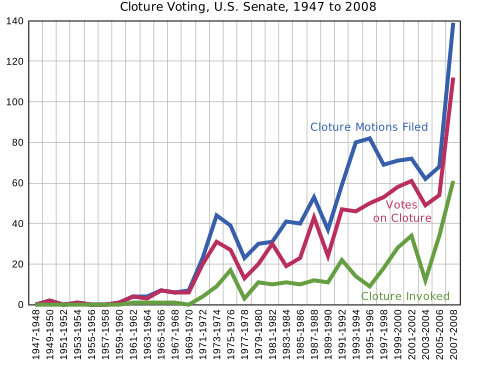
The problems with the political system itself, I realized, are surprisingly few and definitely fixable without radical restructuring. The main ones I have thus far are outlined in this article: the measures to protect minorities in Congress that once prevented the tyranny of the majority, but now mostly serve to make obstructionist tactics possible. One of the main ones is the filibuster. When I first learned what a filibuster was, I couldn't believe it was allowed, and my sentiment hasn't changed a bit. The absurdity of allowing one senator out of a hundred hold up useful debate for an arbitrary length of time by talking about biscuit recipes speaks for itself. As this chart shows, the number of cloture votes--a measure to end filibusters--has been rising since the 60s, especially in the new millennium. There are other rules loopholes that are used for the same purpose: to prevent constructive debate and progress and stick it to the "enemy" party. And people wonder why Congress doesn't do much.

I urge you to keep this issues mind in future elections, especially the national ones in two years, as they are fundamental to how everything else gets handled. One can only imagine how much better the government could function if Republicans and Democrats would stop trying to nullify each other and actually cooperate as they could before becoming so polarized. A quote from the article on how this might work:
"The irony is that getting rid of the rules meant to ensure bipartisanship may actually discourage partisanship. Obstructionism is a good minority strategy as long as it actually works to stymie the majority's agenda and return you to power. But if it just means you sit out the work of governance while the majority legislates around you, your constituents and interest groups will eventually begin demanding that you include them in the process. And that's as it should be: we hire legislators to legislate. We need a system that encourages them to do so."
As for the problem of people, there is no solution that will magically make American voters geniuses and politicians selfless, but you can do your part. Stay informed about current events and the candidates, come up with your own opinions, stay open-minded, get into dialogue with others (especially those you disagree with!), and vote for the candidate you believe will be best for the nation/state.

Thursday, August 12, 2010

On Heat

That's right, it's a Fractal blog double header night! Since my last post was one of the deepest and most intense things I've written thus far, it's time to balance it off with randomness. The Twin Cities are currently going through a heat wave and it's hard to think about anything else. This week has been consistent highs in the 30s (Celsius), with high humidity. The kind of weather that makes you sweat even if you're just sitting inside doing nothing. I was hoping to escape this kind of weather when I left Milwaukee, so I'm kind of annoyed. So, I will now write about how bad heat is and how cold weather is better than warm weather. WITHOUT DIVIDING INTO PARAGRAPHS BECAUSE IT'S A RANT!!! So, hot weather is basically the worst. It's not like cold weather where if you're cold you can just put on more layers or a coat or light a fire or anything. If it's too hot and you are out of layers, there is NOTHING YOU CAN DO. If you happen to be indoors with a fan or AC, good for you. But woe unto you if you have to do anything! Especially anything outside! You will be helpless as you feel increasingly disgusting and uncomfortable! The sun feels like a radioactive death ray zapping your strength and searing your flesh! Oh, if only you were in winter, when you could just run back inside and put on a coat and hat and then feel pleasantly toasty! I've noticed that having temperature gradients in my body feels good; wearing a winter coat and then my hands and feet being cold, for instance. But when it's hot you just get hot everywhere and it feels nasty. Just to prove that this isn't just a me thing, even the universe is against you in hot weather! It's the curse of the second law of thermodynamics that doing pretty much anything produces heat. When it's cold you can bundle up to preserve this heat and stay warm, but when it's hot it all builds up everywhere and everything is horrible forever!!! And you can't get rid of the heat, you can only move it elsewhere, which in itself makes more heat! And thanks to global warming, it's all getting worse! Okay, done now.