Pages

Showing posts with label Science. Show all posts

Saturday, May 9, 2026

Plans for the Blog

Christ is Risen! Indeed He is risen!

Now that I'm trying to write again and Holy Week is past, you may be wondering, dear reader, what I'm planning to do here after the 7-year hiatus. Obviously the things I write won't be exactly the same as they were before, since I and the world have changed so much. Most of my more fruitful thinking and reading recently has clustered around three main topics:

First, I hope to explore the relation between (and, ultimately, the complementarity of) faith and science. For the most part, modern Orthodoxy is not so much anti-science as it is not much in conversation with science at all. I'd like to do my small part to change that. In particular, I've done a good deal of thinking about how to bring the theory of evolution into conversation with my faith and worldview since my last post on the subject 11 years ago.

Second, I would be dishonest if I said that watching the Evangelical world I left behind largely rally behind the endless lies and cruelty of a would-be dictator over the past ten years didn't push me to do a lot of thinking about Christianity and the worldly powers, or that this thinking wasn't one of the things that drove me to revive the blog. Neither are Orthodox Christians immune to the temptation to an overly cozy relationship with worldly powers, to seek to build the Kingdom of God through worldly means deemed more "effective"—or else to withdraw from the social implications of the faith and focus on a purely otherworldly salvation. My meditations on this topic will be as much for my own benefit as anyone else's.

Third, I'd like to explore the ramifications of our increasingly rapidly evolving use of technology for our lives, our habits, and our spirituality. Increasingly large swaths of our lives are lived, or at least mediated, through screens, apps, digital technologies; the vast network that Luciano Floridi calls the "infosphere", and subject to the influence and surveillance of the multinational corporations that run them. As we use these devices, how are they 'using' us? What are they doing to us? How are they shaping our understanding of the 'good life', of what it means to be fully human—or whether being 'fully human' is even desirable anymore? In particular, I recently read Are We All Cyborgs Now? by Robin Phillips and Joshua Pauling, which has been very instructive in how to ask and think critically about these questions.

A technological subject that has developed drastically since before my hiatus, and on which I feel somewhat more qualified to speak than the average person, is artificial intelligence, specifically the generative AI that is disrupting industries, loosening peoples' grasp on reality, ostensibly replacing human labor, and insatiably devouring ever-increasing amounts of water, electricity, silicon, and cash as it pulls the whole global economy into its orbit. You can probably guess some of my thoughts on the subject already, but I hope to develop them more in the near future.

Related to technology and public life is a book I read last year that made a powerful impression on me and has influenced much of my reading and thinking ever since: Against the Machine by Paul Kingsnorth. It's not an easy book to summarize succinctly, but if I might attempt to do so, it's a manifesto against the dehumanizing global industrial-economic-techno-political anti-culture Kingsnorth and others call "the Machine" that uproots traditional communities and cultures, exploits people, and pollutes the environment, turning them all into fuel for the idol we've made of endless growth and "Progress". The result is alienation, moral confusion, and spiritual blindness as the Machine remakes us in its own image as its willing servants. If any of this sounds familiar to you, you're in luck: I've taken extensive notes and am hoping to blog through the book in detail.

Saturday, November 17, 2018

The Unfiltered Scripture

Last time, I tried to lay down some helpful foundations for approaching questions and doubts about the Bible. To briefly summarize, the written word of God is given to lead us into knowledge of and participation in the true Word of God, that is, Christ; not to give us data points with which to build a system of theology or anything else. This came more or less naturally to Christians throughout most of the church's history, but more recent changes in how we read the Bible and how we think have made it harder (but not impossible) today. Reading the Scriptures is not about interrogating them to find "what really happened", but about letting them interrogate us, probe what's really happening in our hearts and lead us to better know the Truth.

What this approach to the Scriptures does for many of the "contradictions" people find is not answer or "explain" them so much as move them from the center of our spiritual life to the periphery. I'm referring specifically to questions like these:
  • How is the seven-day creation account in Genesis 1 compatible with what we now know about the origins of the universe, the earth, and life? And, for that matter, how is it compatible with the other creation account in Genesis 2?
  • Is the earth about 6,500 years old, as the Bible has been calculated to depict, or billions of years old?
  • If Adam and Eve were the first humans, who was Cain worried would take vengeance on him after he killed Abel? And who did he and Seth marry?
  • Who exactly are the "nephilim" in Genesis 6?
  • Did the cataclysmic flood in Genesis 7 begin seven days or immediately after Noah and his family entered the ark? Where is the geological evidence for it that should exist? Where did the water making up the flood come from, and where did it go? And how do people and animals seem to have been living all over the world for up to millions of years when, according to the flood account, they all originated from the ark just a few thousand years ago?
  • What do we do with 1 Kings 7:23, which seems to say that pi is exactly 3? Or with Leviticus 11:19, which implies that bats are birds?
  • What are the "storehouses" of snow and hail in Job 38:22? Why does the previous chapter describe the sky as a solid object, "strong as a cast metal mirror", and what is the "leviathan" mentioned a few chapters later?
  • Why does the city of Tyre still exist when Ezekiel prophesied it would be destroyed and never rebuilt? (26:14)
  • Why is a miraculous event like Jesus' resurrection (and the various miracles that accompanied it and his crucifixion) so poorly attested everywhere outside the writings of the early church? The absences of other noteworthy events like the plagues of Egypt or Augustus' empire-wide census from the historical record are equally puzzling.
In this post I will be answering precisely none of these questions—at least not directly. In light of our modern-day background knowledge, these are all perfectly valid questions to ask, some better than others. People can and, in fact, should seek answers to them. What I am shedding light on is our perceived need to ask these kinds of questions in order to make any sense of the Bible. Our need to get them "out of the way" as a prerequisite for any kind of deeper engagement with it.

As I indicated last time, I think this need comes from how our reflex as modern people is to interpret the Bible "like any other book", to seek objective truths in its pages and fit them into our inherited framework of truth, one in which scientific inquiry seems to be steadily gaining ground against ignorance. We read about a seven-day creation, a global flood, and other scientific and historical anomalies and can't fit them in, can't reconcile them to this framework. At this point we might respond in a few different ways. We might, as so many do today, conclude that the Bible is hopelessly outdated, benighted, revealed by science as the book of ancient fables that it is. We might, on the other hand, conclude that the conclusions of science are the problem, and that science done correctly will inevitably confirm the claims of Scripture as we read them. We might hold the two sets of claims at a distance from each other, and say they are really about different things, never to come into conflict. Or we might try and come up with explanations to reconcile our reading of Scripture to science, hopefully changing it as little as possible in the process.

I don't think any of these approaches is really sufficient for the Christian. The first is, of course, a renunciation of anything like traditional Christianity. The second is deeply unsatisfying, pitting different forms of truth against each other, observation versus revelation, and denying in practice that "the heavens declare the glory of God" (Psa 19:1). In fact, not only can we learn nothing of value from studying the handiwork of God, we are likely to be deceived by doing so, by light that seems to have been emitted or fossils that seem to have been deposited before the creation of the universe. The irony of the kind of faith that claims to "trump" science is that it is likely to itself be a kind of science, a substitute for what it rejects, whose claims are considered infallible because of their divine source, no matter how many links of reasoning there are in between.

The third approach corresponds to Stephen Jay Gould's theory of non-overlapping magisteria (NOMA), which strictly relegates religion to speaking about matters of values and other intangibles. While NOMA is insightful and helpful for calming the animosity between the clashing forces of "science" and "religion", I can't agree with its circumscription of the scope of religion, at least the Christian religion. It's not that there are areas about which Christianity has nothing to say (after all, we confess that God created all things), but it is not the only way of knowing about them that there is. While not a substitute for (say) scientific inquiry, the Christian faith can inform, guide, and fuel it, as scientists like Gregor Mendel, Georges Lemaître, and (more recently) Francis Collins have demonstrated. Lastly, given how central science is to the modern worldview, accepting NOMA virtually guarantees that our faith will be isolated from and irrelevant to whatever it touches; that is, most of life.

The fourth is the default for many Christians today, and it used to be for me. It seems sensible; denying the claims of science in favor of our interpretation of the Scriptures is a huge mistake, so isn't it our interpretation that has to give? So we look for ways to read the Bible, particularly the Old Testament, as true for us as modern people, as compatible with our more enlightened view of things, as if divine inspiration gave the biblical authors a scientific understanding of how things "really are", which instead of passing on they obscured beneath the trappings and language of a premodern worldview to which they were no longer bound. Examples of this tendency are attempts to match up the days of creation with ages or periods of time in natural history, or saying that biblical language like the "four corners of the earth" or the "fountains of the deep and the windows of heaven" (Gen 8:2) is merely a "poetic device" on the authors' part not meant to be literal descriptions of reality, in the face of the evidence that ancient people really did envision the cosmos in such terms.

So I think that even this way of reading the Scriptures, well-intentioned though it is, also fails to do them justice. It can't handle reading the Bible as the set of ancient texts that it is, and seeks to update, to "modernize" it to make it more sensible to us. This touches on a topic I hope to write about more in the future, how our modern, scientific worldview has become the exclusive lens by which we know anything, including the Bible. Everything must be filtered through the skeptical eye of objective inquiry in order to be believable, perhaps even comprehensible to us. This seems so obvious to us as to be hardly worth questioning. But I have to ask, why? Why do we approach the Scripture first as historians, scientists, or archaeologists, and only later as believers?

A common theme in the writings I've read of the Reformed theologian and philosopher James K.A. Smith, is on the power of formation: the Christian worldview isn't a matter of thinking certain thoughts, believing certain truths, and making certain decisions, but rather of ways of thinking, loving, and (as he calls it) "being-in-the-world" that sink into our bones through the repetition of habit and ritual. Christian worship, in his vision, is supposed to be such a formative force, shaping us into citizens of the Kingdom of God who are defined more by what we love than what we consciously believe. But there are plenty of counterformative forces in the world that would shape us in different ways; in a particularly memorable piece in his book Desiring the Kingdom, Smith depicts a trip to the shopping mall as a religious liturgy. I think the modern, scientific worldview is another such counterformative force, one far more powerful and pervasive than the mall. It is because this worldview is so formative for us as modern people that we can't help but view the Scriptures through it.

Not, of course, that I am anti-science—it's the second word of my degree, after all! But I think a healthier way to view it is as a useful tool for better understanding the world around us, not as an all-encompassing way of knowing everything, a universal litmus test by which any and every claim is to be evaluated. The Church is deeply compromised when its members are modern skeptics first, Christians second.

And I do mean the Church, as I now understand it. I don't feel able to speak to other Christian traditions, but hopefully these closing words are applicable them in some way. Though we are perhaps not as affected as other Christians, Orthodox, at least those in western countries, are not immune to such counterformation—especially converts like myself. But the Church is also well-equipped to resist it. In her liturgical life, events from the history of salvation are made present to us, and we become participants in them, as if we had been there. (Just recently we began the 40-day journey to celebrating the Nativity of Christ) There is an immediacy to this life that is lost if we merely study these events as historians, and perhaps try to glean from them some "timeless truths" to apply in our own day. As I mentioned last time, though our faith is based on events that happened in specific times and places, we don't partake in them, we don't know Christ "historically". Just as being present "there and then" was no advantage to many of those who encountered Christ in the first century, living in the "here and now" isn't necessarily a disadvantage for us. The life of the Church, her saints, her liturgies, her tradition, act as a sort of bridge that lets us close the distance the modern worldview can't help but see between us and the One we open the Scriptures to meet.

Postscript
Again, as I said before, this approach to the Bible, while (I think) helpful, is not the answer to all biblical doubt. This is particularly evident from the fact that the church fathers faced and wrote about many questions about it, questions which were just as apparent to ancient people as they are to us. Questions raised by seeming contradictions and tensions within the Bible, not between it and an externally imposed body of knowledge. To these I will turn in my next post.

Friday, May 8, 2015

Climate change: How we know it is real and what we can do about it

As the 2016 presidential election becomes harder to ignore, I realized to my surprise that so far I have been silent on an issue that is incredibly important to me and much more controversial than it should be. The time has come for me to firmly plant my flag concerning the reality of climate change.

The fact of the matter is that the Earth is warming at an unprecedented rate, most of this warming is due to human activity, it is already having an increasingly negative effect on biodiversity and our ability to thrive, and it will have catastrophic consequences if we do not take action soon to reduce our production of greenhouse gases.

The science

The scientific basis for global warming is well-understood, based on physical principles that are beyond questioning, and supported by observation. The greenhouse effect, the process by which atmospheric gases (primarily water vapor and carbon dioxide, but also methane and others) absorb and trap heat radiated by the earth, is entirely uncontroversial, supported by basic science and observation of the Earth as well as other worlds (especially Venus, where it is responsible for the lead-melting temperatures). Thus, as the concentrations of "greenhouse gases" in the atmosphere increases, we should expect them to retain more heat, producing a net atmospheric warming effect.

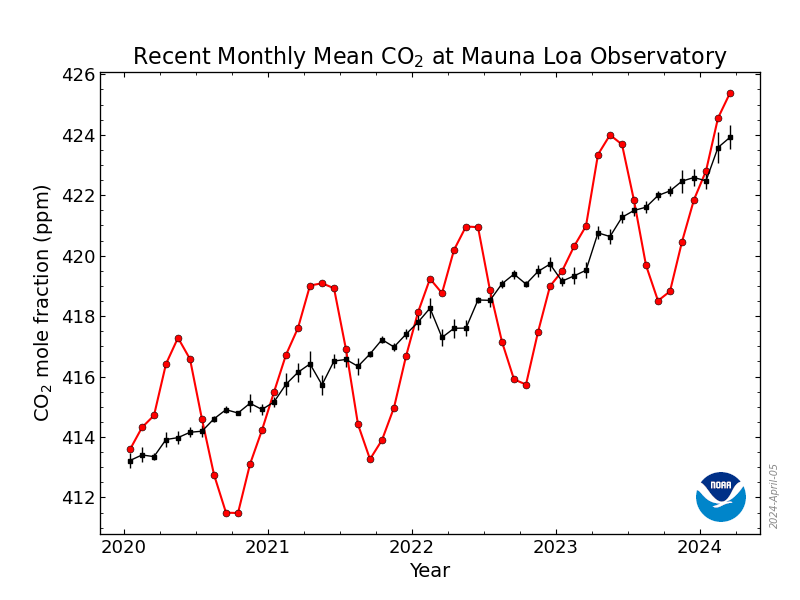
And this is exactly what we observe. Recent measurements show that the concentration of carbon dioxide in the atmosphere is steadily increasing. (The red line is the raw measurements, the black line is after correction for seasonal variation)
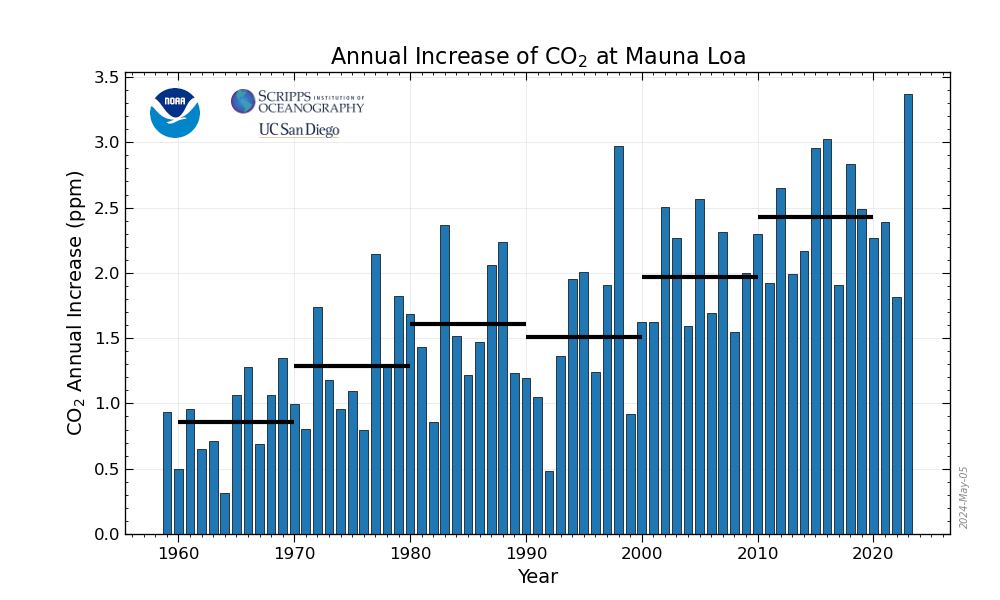
Over a somewhat longer timescale, we see that it might actually be exponentially increasing.
Lately, the growth rate of CO2 concentration has been about 2 ppm (parts per million) per year, or about 15 billion tons per year.
There is abundant evidence that this change in atmospheric carbon is anthropogenic (manmade). Human emissions of CO2 per year (see page 45 of that publication) are about 30 billion tons per year. This means that rather than producing a net emission of CO2, nature is in fact absorbing about half of the CO2 we emit. Additionally, atmospheric oxygen levels are steadily decreasing, which is just what we'd expect if the excess CO2 is being produced by burning carbon (i.e. fossil fuels) rather than by being released from a natural reservoir.
Over a longer timescale, this plot shows the correlation between the current rise in atmospheric carbon and human industrialization, beginning in the 19th century. By far the most obvious conclusion is that atmospheric carbon levels are increasing because we're putting it there by the burning of carbon-based energy sources.
One more plot shows the range of natural variation of atmospheric CO2 levels over a much longer timescale, and the relative magnitude and suddenness of the recent increase. Yes, carbon levels have changed in the past, but the present increase is virtually unprecedented in both its size and rapidness—150 years is the blink of an eye in geologic terms, and in that time we have already matched the increase in carbon over the past 11,000 years since the last ice age. Recently, atmospheric carbon reached 400 ppm—its highest level in the last three million years.
If the greenhouse effect works, this increase in atmospheric carbon should produce an increase in global temperatures. And it does. This plot shows five independent data sets of global surface or lower atmosphere temperature over the past 35 years. The second, smoother graph shows the data after removing the effects of the El Niño Southern Oscillation, solar variability, and volcanic emissions (several of the common natural explanations given for global warming). After filtering out these natural variables, a clear trend toward warmer temperatures remains.
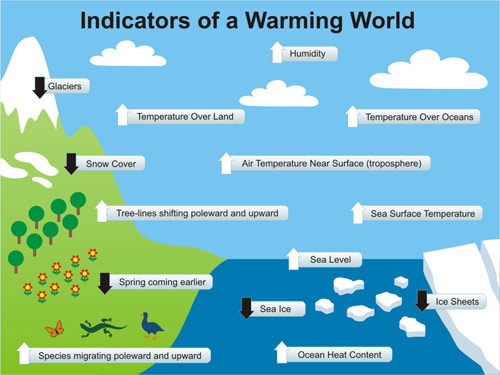
This change in observed global temperatures can be correlated with a number of other variables, some of the most obvious of which are depicted below: receding glaciers and ice caps, rising sea levels and temperatures, changes in the migration and habitation of plant and animal species, and increasing humidity. Independently measuring and correlating all of these indicators considerably strengthens the case for a warming planet. And besides scientific measurements, the effects of global warming are already being felt around the world: increased flooding in coastal cities, record-breakingly hot months/summers/years/decades, and (in the past few years) the devastating drought in California. The effects of climate change are felt perhaps nowhere as strongly as in Pacific island nations like Tuvalu, the Marshall Islands, and the Maldives whose very existence is threatened by rising sea levels.
Again, this warming trend can be traced back to the previously mentioned manmade increase in atmospheric carbon levels by a variety of means. The independence with which these indicators can be measured and correlated with each other makes the case for anthropogenic climate change much stronger than it would be if it were based on only one variable.

The danger

You may be asking, "so what?" Carbon levels and global temperatures have fluctuated widely in the past (as previously mentioned, our current level of atmospheric carbon was last reached 3 million years ago), so how do we know that the era of global warming will actually be worse rather than just different? Well, as also previously mentioned, the difference between manmade climate change and natural climate change is one of both scale and rate. An optimistic estimate of 2° C of warming will push global surface temperatures to a level not seen since the last time we had this much carbon in the atmosphere, the Pliocene era three million years ago. And if we keep producing carbon at anything like our current rate, this number will likely be higher. Most species alive today didn't even exist tens of millions of years ago when things were last this hot, so we can't expect them to be able to adapt.

Even more significant is the fact that while climate changes naturally over the course of thousands or tens of thousands of years (during which greenhouse gas emission and absorption remain roughly balanced at all times), manmade climate change is operative over just a few hundred years—orders of magnitude faster than the natural rate. Past instances in which atmospheric carbon levels and global temperatures changed suddenly and in an imbalanced way (as they are doing today), due to large igneous provinces or other causes, almost always resulted in mass extinction events—and it is very likely that our actions are sending the Earth into another one, as they are producing the same symptoms by the same means. The stress we have placed on species and ecosystems through other means like pollution, habitat loss, overhunting/fishing, and the introduction of invasive species makes it even harder for them to adapt to manmade climate change as they have to natural climate shifts in the past. This article explains these difficulties in more depth.

While warming temperatures may bring some positive effects, like improved agriculture and vegetation activity at higher latitudes and an ice-free Northwest Passage, the negative effects are expected to be far greater. These include unhappy things like decreased water supply and desertification (as in California), increased danger of heat stress, the growth of oxygen-poor zones in the ocean, extinction of numerous vulnerable species and the loss of biodiversity, and the displacement of hundreds of millions due to sea level rise. All of these things will carry catastrophic economic consequences for developing and developed nations alike. Still more troubling are effects like decline in global phytoplankton and the leakage of methane from formerly frozen areas that will create positive feedback, further intensifying the warming of our planet. In theory, if the planet warms enough to push the water vapor concentration in the atmosphere to a sufficient level, the feedback could become a self-sustaining loop that would turn the Earth into a second Venus (though we would likely already be doomed well before it got to this point).

The consensus

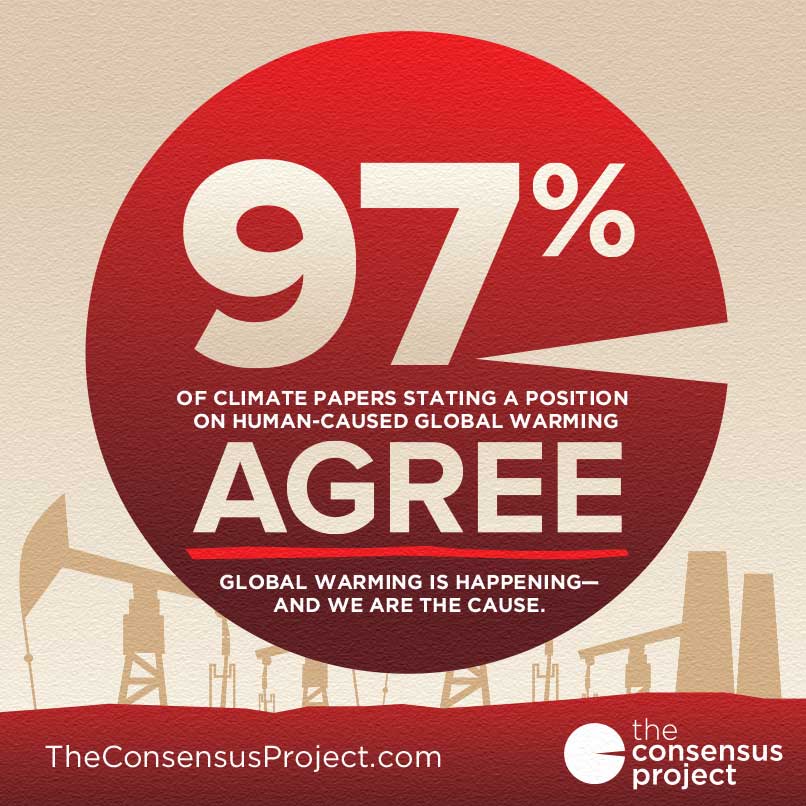
The scientific consensus on climate change is clear and unequivocal. A survey of peer-reviewed climate science papers found that 97% of the papers expressing a position explicitly affirm that anthropogenic climate change is real. If this figure seems surprisingly low, keep in mind that the 3% includes implicit (rather than explicit) endorsements, implicit rejections, and no opinions. Another, similar survey which only counted explicit rejections of anthropogenic climate change found that 24 out of 13,950 articles reject global warming—just 0.17%. This consensus is even stronger (at least 98% explicitly affirming) in more recent papers.

In light of all this, it saddens me to see so many of our nation's leaders (and the people who voted for them) willfully ignore the scientific consensus in favor of their own fantasies about climate change: that it is not happening, that is it is not a problem, that it is not caused by us, that there is no consensus, or that there is no need for them to take action because "I'm not a scientist" (and, apparently, not willing to trust them either). Certainly the media, in its well-intentioned dedication to balance, is partly responsible for enabling this ignorance: it creates the illusion that climate change is a two-sided issue under discussion rather than a matter of scientific fact. But really there is no "debate" or "conversation" regarding the reality of climate change; there is only an overwhelming consensus and those who (all too often for political or ideological reasons) refuse to accept it.

As an analogy, consider the fact that due to tidal acceleration, the Moon is moving away from the Earth at a rate of about 3.8 cm/year. This trend is not immediately or intuitively obvious to an observer, but it is well explained by basic physical principles and verifiable by multiple methods: studying ancient records of eclipses to establish the Moon's position in the past, gravitational data from satellite laser ranging, and simply bouncing light pulses off the retroreflectors left by the Apollo astronauts and measuring the return delay. Scientists are just as certain that anthropogenic climate change is happening as they are that the Moon is drifting away from the Earth. I have never heard anyone express doubt about the latter. Why is the former any different—because of its implications for how we live? Our own desires, interests, and preferences cannot change the truth of what we are doing to the climate.

The theology

My knowledge of the fragility and beauty of the Earth and our dependence on it, as well as my own experiences in nature, would be sufficient to instill in me a deep and abiding concern for environmental issues, especially anthropogenic global warming, dangerous as it is. But as a Christian, I have another, even stronger foundation for environmental concern and action.

In Genesis 1 God creates the heavens and the Earth (v. 1) and all the life on the Earth, declaring everything that he had made "very good" (v. 31). He also creates mankind in his image, to fill the Earth and subdue it and have dominion over nature. (v. 28) Does this mandate give us license to do as we please with the environment? No, for it must be considered along with the innate goodness of created nature and our role as God-appointed regents over it. If the creation is really good, and not "fallen"/evil or simply morally neutral raw material for our own designs, then by harming it we are harming God's handiwork. The image of God in man is not the only reason for human worth and dignity; simply being created at all conveys great worth and value. The mandate uses militaristic language ("subdue", "have dominion over") because of the present, frustrated state of the creation (cf. Rom 8:19-23), but this dominion always has as its intent wise, beneficent rule and redemption as God himself works, never exploitation or destruction.

The Psalms contain abundant examples of the value of creation as it reveals the glory of God. In Psalm 19 "the heavens are telling the glory of God" to the ends of the earth and the sun "like a strong man runs its course with joy". Psalm 33 praises God (through the Psalmist's ancient understanding of the cosmos) as the creator and ruler of the heavens, the earth, and the sea. Psalm 104 goes into considerably more detail, poetically describing the act of creation as well as God's ongoing governance of the created order, providing food for man and the animals; even the cycle of life and death is the occasion for praise. Psalms like these express what I have heard described as a sacramental view of nature which Fr. Stephen Freeman describes as the opposite of modern secularism, the reckoning of all the workings of the cosmos as a ceaseless act and a voiceless hymn of worship to their maker.

As an Orthodox Christian-to-be, I am happy to be part of a church which faithfully preserves and teaches this understanding of the cosmos. It is truly the basis for robust, authentic Christian environmentalism. As proof of this, one need look no further than the current ecumenical patriarch, Bartholomew. Like Pope Francis, he is deeply concerned about the human impact on the environment; unlike Pope Francis, he has already published a strongly-worded and very wise encyclical which expresses a theological basis for caring for the creation much better than I can (and takes a strong stance on climate change, much like the one the Vatican is expected to take). Even if you haven't been reading all the links I've been posting thus far, take just a few minutes and read it

One other way Christian teaching can contribute to the conversation on climate change is in its abiding concern for the poor. It is an unhappy fact of global warming that the nations most affected by it tend to be poor and developing (as well as very low in carbon emissions), while the nations least affected are predominately the wealthy nations responsible for causing it in the first place. It is a textbook negative externality on a global scale, a terrible injustice. Prominent among the Christian's reasons for environmental concern should be the awareness of the possible unjust effects of his/her actions on the poor who stand to lose the most to climate change—their crops, their livelihoods, even their homes and their lives.

In light of all this, arguments fielded by Christians in opposition to environmentalism are revealed for the falsehoods they are. Since they seem to exist solely among laypeople and not among scientists or theologians, I will not attempt to state them in a clearer, better-supported form as I usually do. These are not carefully-considered theological responses with any kind of historical pedigree or arrived at after careful reflection; they are from-the-hip answers that use Christian-esque ideas to justify a false position arrived at due to other factors.

First, I have heard it argued that God, as creator, is sovereign over nature, and that man doesn't have the power to change it or thwart his plans. My first response is that this is simply factually false. Man evidently does have the power to cause global-scale environmental changes because we are doing so and have already done so. This is simply undeniable, supported by reliable, repeatable observations; for instance, as shown above, we have demonstrably increased the carbon concentration of the atmosphere by about a third. Theological arguments can't falsify a scientific theory; only a scientific argument can. As Mark Noll explains in relation to young-Earth creationism in his book The Scandal of the Evangelical Mind, authentic Christian thinking requires listening to both "books" of God's revelation: Scripture and creation, not using your interpretation of one to contradict what we can know through the other. To do so is, ironically, to deny God as creator in order to confess him as sustainer of the creation.

Further, we know that God created us in his image as free, responsible beings with real moral agency and the ability to make real moral choices. This is implicit in all of the Bible's ethical commands, which wouldn't make sense otherwise, and has always been the teaching of the Orthodox Church. Sidestepping discussions of the exact nature or extent of this freedom, God's sovereignty obviously doesn't mean that he defends the integrity of his image in man by intervening to stop us from wronging or killing each other. Why then should we expect him to prevent us from sinning against the environment? There is no biblical support for such an idea, and plenty for the kind of Christian environmental ethic I sought to lay out above.

Additionally, this argument sidesteps the question of whether and how Christians are to care for the environment; it simply claims (without serious justification) that God will somehow restrain or prevent the negative consequences of our failing to do so, so there is no need to try. But if we really are appointed as stewards and even priests of the rest of the creation, then this argument is saying in effect that we should simply ignore this vocation because there was really no reason for God to give it to us in the first place. This is horribly irresponsible and dualistic, not to mention hubristic. "But who are you, O man, to talk back to God?" (Rom 9:20) By contrast, it is not hubristic at all to believe, on the basis of multiple independently measurable indicators, the sobering truth that human activity is having a major effect on the Earth's climate, which we have a mandate to care for. Rather, it is the beginning of humility and repentance.

The other argument I sometimes hear is similar to the first, but even worse. It is the sentiment that because Jesus is coming back to bring the old creation to an end and inaugurate the new, we don't have to be especially concerned about the environment. Similar to the previous argument, it basically states that we don't need to care about the effects of human activity on the environment because God will intervene to prevent them, in this case by returning to bring about the end of the world. In other words, it presumes that Jesus will return before climate change can begin to have catastrophic effects on future generations. But, in Jesus' own words, "watch therefore, for you know neither the day nor the hour." (Mat 25:13) Jesus was clear about few things relating to his return, but he was crystal clear about the fact that we can't know when it will be. (See also Mat 24:36,44,50; Mar 13:32; Luk 12:40,46; Acts 1:7) Like the first argument, it sidesteps any kind of teleological discussion of our appointed role as stewards of the creation, focusing only on why we will supposedly be spared from the consequences of scorning our calling.

Why not justify other corporate sins in this way? Why not support slavery, since Jesus will come back to break every chain? Why not selfishly exacerbate the suffering and poverty of people in developing countries (which, incidentally, is one of the effects of global warming), since Jesus will return to wipe every tear from their eyes? "And why not do evil that good may come?" (Rom 3:8) The return of Jesus and the last judgment, far from a cosmic reset button undoing our sins, will be a day of reckoning in which we will be called to account for all that we have done (Mat 25:31-46, Rom 2:6-8, 14:12, 2 Tim 4:1, 1 Pe 4:5, Rev 20:12). It is hard to imagine a greater folly than expecting the day in which everyone will be judged for what he has done to be the occasion for our escape from accountability for sins against the environment.

Edit: The sovereignty of God, invoked in the first counterargument, is relevant to discussions of the climate in another way. The Christian faith involves an unstoppable hope, based on the Incarnation, crucifixion, and resurrection of our Lord, that is sufficient to overcome even the grim certainty of death. Paul, describing this hope, says powerfully, "I am sure that neither death, nor life, nor angels, nor principalities, nor things present, nor things to come, nor powers, nor height, nor depth, nor anything else in all creation, will be able to separate us from the love of God in Christ Jesus our Lord." (Rom 8:38-39) So one implication of the sovereignty of God is that we are to remain hopeful and not despair no matter how bad things seem, since for many Christians they have seemed much worse. But not to fear is not to do nothing. Like any other issue incumbent on the Church, climate change demands a response, but that response should be out of hope, not fear or gloom.

What can we do?

In the face of these terrifying visions, and the continued politicized denial of climate change, especially by Republican leaders, it is very tempting (certainly for me) to simply despair of hope that anything can be done. At times like this it's very beneficial to rest and remind myself of some of the reasons for hope that we can actually address the climate crisis. But if you grasp the magnitude of the problem and the need for broad and deep action to address it, then remaining a bystander stops looking like a suitable option. I will try to present ways I have found to take personal action against climate change. Most of them are not that hard!

First, you can reduce your carbon footprint. Your carbon footprint is the sum of the carbon emissions caused by your actions and lifestyle, both directly (i.e. by driving or burning other fuels) and indirectly (e.g. by buying or using products that require carbon to produce or transport). Some ways to do this include:
  • Use less heating and air conditioning in your home. If you are a homeowner, this might mean insulting your home better to avoid having to heat it as much or installing a "smart" thermostat that only regulates your home's temperature when people need it. If, like me, you rent an apartment, you can still leave your thermostat at a lower temperature in winter and rely more on fans and opening/shading windows than air conditioning in the summer.
  • Minimize your energy usage. Ways to do this include using compact fluorescent bulbs for lighting (or, better yet, long-lasting and super-efficient LED bulbs), turning off lights when you leave a room, turning your computer off when not using it, and plugging devices that use power even when turned off (e.g. lots of electronics) into a power strip so you can fully de-power them when not using them. As previously mentioned, minimizing your use of heating and air conditioning also helps with this. If you are a homeowner, you can also try to install energy-efficient (e.g. Energy Star) appliances.
  • Use less hot water; heating water takes a lot of energy. If possible, you can do this by installing more efficient shower heads/faucets/toilets. Homeowners can also turn their hot water temperature down and/or ensure that their water heater is well-insulated.
  • The classic trifecta: reduce, reuse, recycle. This boils down to consuming and throwing away as little as possible. If you're unsure about what you can recycle, your city's web site should tell you. (Here is the one for Minneapolis as an example)
  • Drive less or not at all. When possible, use alternate forms of transportation like walking, cycling, carpooling, or public transportation. This may not be easy, but besides the environmental benefits it will also save you money, especially if you are able to completely replace owning a car with other ways of getting around. I am almost through my third post-college year without a car and loving it. I spend $85 a month on my bus pass and a total of about $200 a year on parts and maintenance for my bike. Not only do I save a lot of money, I love not having to spend lots of time driving or (as is all too often the case) sitting in traffic. Once we are married, my fiancee Marissa and I plan to own one car between us, which should be more than sufficient for our needs. This option may require some bigger lifestyle modifications, but can be quite worth it and have a major impact on your carbon footprint.
  • Eat less meat, especially red meat. Producing a given amount of calories of meat uses a lot more resources than producing the same amount of calories of plants. Even if you don't go fully vegetarian, reducing the amount of meat in your diet can make a sizable difference. Apparently minimizing your consumption of rice is also beneficial, since most rice is grown in methane-emitting paddies. Eating locally-grown food is also an obvious step (reducing fuel costs of transporting it), as is avoiding wasting food.
Second, you can offset your carbon footprint. This means supporting environmental projects that remove an amount of carbon from the atmosphere equal to the amount you put in. The cost of this is apparently just $15 per metric ton. The average carbon footprint of an American is 27 tons per year, which translates to an offset of $405, or just $33.75 per month. This is a surprisingly low price to pay to become "carbon neutral", and of course you can decrease it by lowering your footprint. This handy site lets you estimate your carbon footprint and donate to offset it.

And third, you can take action beyond your individual/household's carbon footprint. You can support organizations that are helping to fight climate change and promote the welfare of the environment like The Nature Conservancy, the Environmental Defense Fund, or the World Resources Institute. (The very useful website Charity Navigator can help you find another organization to support if you like) Or you can join the public conversation addressing climate change by signing petitions, writing to your elected officials about your concerns, or simply by telling others about it to raise awareness, perhaps by sharing concise, persuasive resources on the web (hint hint). The strategy and tactics of dealing with global warming are much more complex subjects than the basic scientific facts. Once we are in agreement that anthropogenic climate change is real, there is plenty of room for diversity of opinion on what to do about it, how to balance short-term needs and economic realities with the long-term need not to cook the planet to death. My goal in shutting down climate change denial is not to end constructive conversation, but to make it possible and invite more people into it by showing the obscurantist, anti-science rhetoric of denial for what it is and calling us to rise above it. If we are to resolve the climate crisis, we need all the voices—and hands—we can get.

Saturday, April 18, 2015

What If?


When I got my copy of Randall Munroe's (of the amazing webcomic xkcd) new book What If?, I had been holding out hope that in it he would finally answer some of the (multiple) questions I've asked him. Unfortunately, he didn't (although he did answer a very similar one from someone else). So I guess the only thing left for me to do is to take a crack at answering them myself. Obviously, I am not a webcomic artist or an astrophysicist who used to work at NASA, so my answers won't be nearly as funny, well-illustrated, or (possibly) correct as Randall's would be. But hopefully they'll still be worth it. Let's go back through my old Emails...

If people packed shoulder-to-shoulder on every floor of a tall building and jumped, would they have any chance of bringing the building down?

Great question, me! As our example skyscraper, I'll use the shiny new One World Trade Center; since it was built to survive being hit by a hijacked airplane or a truck bomb, it should have at least as much of a chance as any other skyscraper. The gross floor area of One WTC is 325,279 m2. If we assume three people can fit in a square meter, that's 975,837 people that can fit into the skyscraper (nevermind the hellish logistics of getting them all in there, which would be almost as bad as Randall explains in his similar answer here).

If I then assume that an average adult weighs 75 kg and can jump 0.3 meters in the air (per this article), they would be traveling at v = √(2gh) = √(2 * 9.8 * 0.3) = 2.42 m/s when they came down. The force exerted by an impact is the change in momentum divided by time. How much time does it take for you to stop moving after you hit the ground while jumping? It's hard to find good figures, but from this solid-looking question from a physics textbook and some testing that would no doubt confuse my roommate if he saw it, I'm going to be conservative and say about 0.1 seconds if you're smart and bend your knees.

So, the force exerted by a 75kg person when landing from a jump is about 2.42 * 75 / 0.1 = 1,815 N, decelerating the person at about 2.5 g. The force from all 975,837 people would then be about 1.771 GN (giganewtons), the equivalent of about 181,000 metric tons. All of this force will be transmitted to the Freedom Tower's base. Will it survive? Well, considering how each of the old towers weighed about 500,000 tons (I can't find data on the new one), it's safe to say that this additional load should be well within the structure's margin of safety. That [architect of One World Trade Center] David Childs really thought of everything.

I hope it isn't in bad taste that I originally answered this question on September 11th.

What would happen if you somehow brought a cubic meter of neutron star matter to earth? (Both the actual case where it would probably explosively decompress, and the hypothetical case where it stayed together in a solid unit)

Randall almost answered this one in his new book. The actual question was, "If a bullet with the density of a neutron star were fired from a handgun (ignoring the how) at the Earth's surface, would the Earth be destroyed?"

My guess of what would actually happen was right. It would indeed explosively decompress into superhot normal matter, apparently releasing more energy than a nuclear bomb. So Randall assumes it somehow stays in its superdense state; the bullet would weigh as much as the Empire State Building.

It wouldn't matter much if the bullet were fired or dropped. It would immediately burrow its way to the center of the earth, forming an underground shooting star, and would then sit there pretty uneventfully. He then explores what would happen if you could somehow keep it on the earth's surface. (Answer: if you tried to touch it, it would try to rip your arm off with gravity; surrounding it with water would allow buoyancy to cancel out the gravity and maybe, just maybe, allow you to touch it) It was a pretty cool question. But my question was about considerably more neutron star material. Let's see what happens...

According to Wikipedia, neutron stars have an average density of 3.7–5.9 × 10¹⁷ kg/m3. So our cubic meter of neutron star matter would weight about three to six hundred million billion kilograms. The Empire State Building weighs 365,000 imperial tons, or about 332,000 metric tons. So (if we take a middling estimate of the neutron star matter's density, 4.5 × 1017 kg/m3), our sample would have the mass of about 1.2 billion Empire State Buildings. Incidentally, it appears that Randall was (gasp!) wrong in his answer about the mass of the bullet. Assuming its volume is a teaspoon, it would weigh about as much as 7,410 Empire State Buildings, not just one. Sadly, this means you probably wouldn't be able to get within about twenty meters of it.

Anyway, our sphere (I'll assume it forms a sphere as expected rather than a cube) of neutron star matter is much bigger and much more massive. This means that its gravity becomes much more appreciable. The results are hard for me to imagine. The surface of the sphere will have a gravitation acceleration of nearly eight million g—four times that of the best ultracentrifuges. At ten meters, the sphere's gravitational force would still be equal to about thirty thousand g. This decreases to (only) 306 g at 100 meters and 3 g at a kilometer. An easier measure might be that due to its smaller mass and radius, our neutron sphere has an escape velocity of 9.8 km/s, nearly equal to that of the earth. This also means that at six kilometers out, the gravity of the sphere would make you feel like you were on a slope with a grade of about 1:11.75—steep enough to constitute a violation of the Americans with Disabilities Act.

If you somehow kept this sphere together, it would, of course, fall to the center of the earth, probably causing a good deal more damage on the surface as it did so. If you managed to keep it on the surface as well, things would get pretty weird. If we assume the ground around the sphere is made of reasonably firm dirt with an angle of repose of 45°, all the dirt within about 1.7 kilometers of the sphere (along with anything on top of it) would avalanche towards it. As it turns out, because of the inverse-square law, an object just five meters from the sphere (the equivalent of dropping something to earth from beyond geostationary orbit) will, ignoring air resistance, have picked up 95% of its escape velocity when it impacts. It's hard for me to specify exactly what would happen, but the energy created by the hypersonic impact would probably be contained by the continuing avalanche of dirt, eventually resulting in a large, hot hill developing around the sphere. It puts me in mind of a certain song by Megadeth: "High Speed Dirt".

What would the atmospheric pressure be at the bottom of the Mariana Trench if you took out all the water?

This is much easier than the last question. The relationship between atmospheric pressure and altitude is common knowledge. The side effects of draining the world's oceans (which Randall studies exhaustively in the book) would slightly change things since there would no longer be oceans to displace the atmosphere upward, but this won't significantly change our results (I think). Plugging in the depth of Mariana Trench gives us a pressure of 3.65 atmospheres at the bottom. Apparently, if you stayed in this pressure for several hours, you could develop pulmonary oxygen toxicity, whose main symptom is respiratory inflammation. We all know that humans need supplementary oxygen to survive at high altitudes, but apparently exceedingly low altitudes have problems of their own.

The more interesting part has to do with the atmospheric lapse rate, or how quickly it gets colder as you go higher. It is about 6.5 K per kilometer. As you might guess, it also works in reverse. With the Mariana Trench being 10.911 kilometers deep, the air at the bottom should be about 70(!) degrees Celsius hotter than at sea level—potentially hot enough to spontaneously boil water, if water didn't boil at 140° C due to the increased pressure. Also, due to the Mariana Trench being over five times the depth of the Grand Canyon, it's hard to predict what kind of climatic effects will moderate this temperature increase (I don't imagine the bottom of the trench would get much sunlight).

The Earth has come closer to this scenario than you might think. During the Messinian salinity crisis, which began about six million years ago, the Strait of Gibraltar closed off and the Mediterranean Sea dried up into a sort of super Dead Sea, a hypersaline lake surrounded by a desertified abyssal basin where temperatures may have reached 80° C. Rivers that fed into the basin, like the Nile, cut deep gorges as they ran down to several kilometers below their current mouths. African species like hippopotami migrated across the basin before it got too hot and dry, then were stranded on cooler highlands like Malta and underwent island dwarfism. The crisis finally ended with the Zanclean flood, in which the sea refilled through the Strait of Gibraltar at a rate of about a thousand times the discharge rate of today's Amazon River.

A common trope in anime, video games, or other media is to depict the moon as much larger in the sky than in real life, often seeming to fill half the sky. If the moon were actually this large (or, alternately, this close to the earth), how would it affect life on earth, gravity, the tides, etc.?
Okay, maybe I was exaggerating a bit. This GIF is a less extreme example of what I'm talking about. Technically, with the right use of a zoom lens, it is possible to make the Moon appear this big relative to foreground objects. But assuming that's not the case in this image, let's try to estimate the angular size of the Moon. Let's assume that Inuyasha's (or whosever that is) seated figure is about four feet tall. Due to the lack of perspective it's impossible to know for sure how far we are from him (her?). I'll guess about twelve feet. This gives him an angular size of about 18.9°. The moon's angular size, then, is something like 9.9°. By way of comparison, the real Moon has a maximum angular size of about 0.57°.

This can't end well.
The scale of the real-life Earth-Moon system, for reference.
If we increase the size of the moon to match this new angular size but keep its distance the same, we get a new lunar mean radius of about 33,300 km, as opposed to 1,700 km for the real Moon. Or 6,300 km for the Earth. This truly super-Moon would be by far the largest rocky body in the Solar System. It would not orbit around the Earth; the Earth would orbit around it in just under three days. If we naively scale up the real moon in its proportions, this truly super Moon would have the mass of 87 Earths, nearly as much as Saturn, and a surface gravity of over 3 g. This moon would also have a gravity differential over the earth more than seven thousand times that of the regular moon, which would probably cause mile-high tides or something. (In real life, the earth would be tidally locked to the super-Moon just as the regular moon is to the earth)

That's no Moon...
If, on the other hand, we move the moon closer to the Earth so it appears this large, we get a new semimajor axis of 20,000 km, about 5% of the old semimajor axis of 384,000 km. This is just over three Earth radii and perilously close to the Moon's Roche limit, the distance at which tidal forces from the Earth tear the Moon apart and turn it into a ring system. It will have a new orbital period of less than eight hours and produce even higher tides than the super-Moon. Its gravity would probably also destabilize the orbits of satellites in geosynchronous orbit (which it would orbit beneath) and make it impossible to keep them up for long.
Oh, hello there.

Here is an extreme example. Considering the fisheye effect in use here, let's suppose this moon has an angular size of 30°. Now things get really ridiculous. Scaling the moon up to these proportions gives it a ludicrous radius of 103,000 km, over a quarter of the distance to the Earth, and about 150% of the radius and eight times the mass of Jupiter. Its gravitational pull would cause your weight to tangibly fluctuate with the tides, which would be tens or hundreds of thousands of times their current proportions. Again, I don't know the science involved with packing this much dirt together with these kinds of forces, but this is probably astrophysically impossible.

Jupiter for scale.
Moving the moon this close to earth puts it at a distance of just 6,500 km, giving it a new orbital period of less than 90 minutes and off-the-scale tides, but that doesn't matter because before you can get the Moon this close it will collide with the Earth and kill us all.

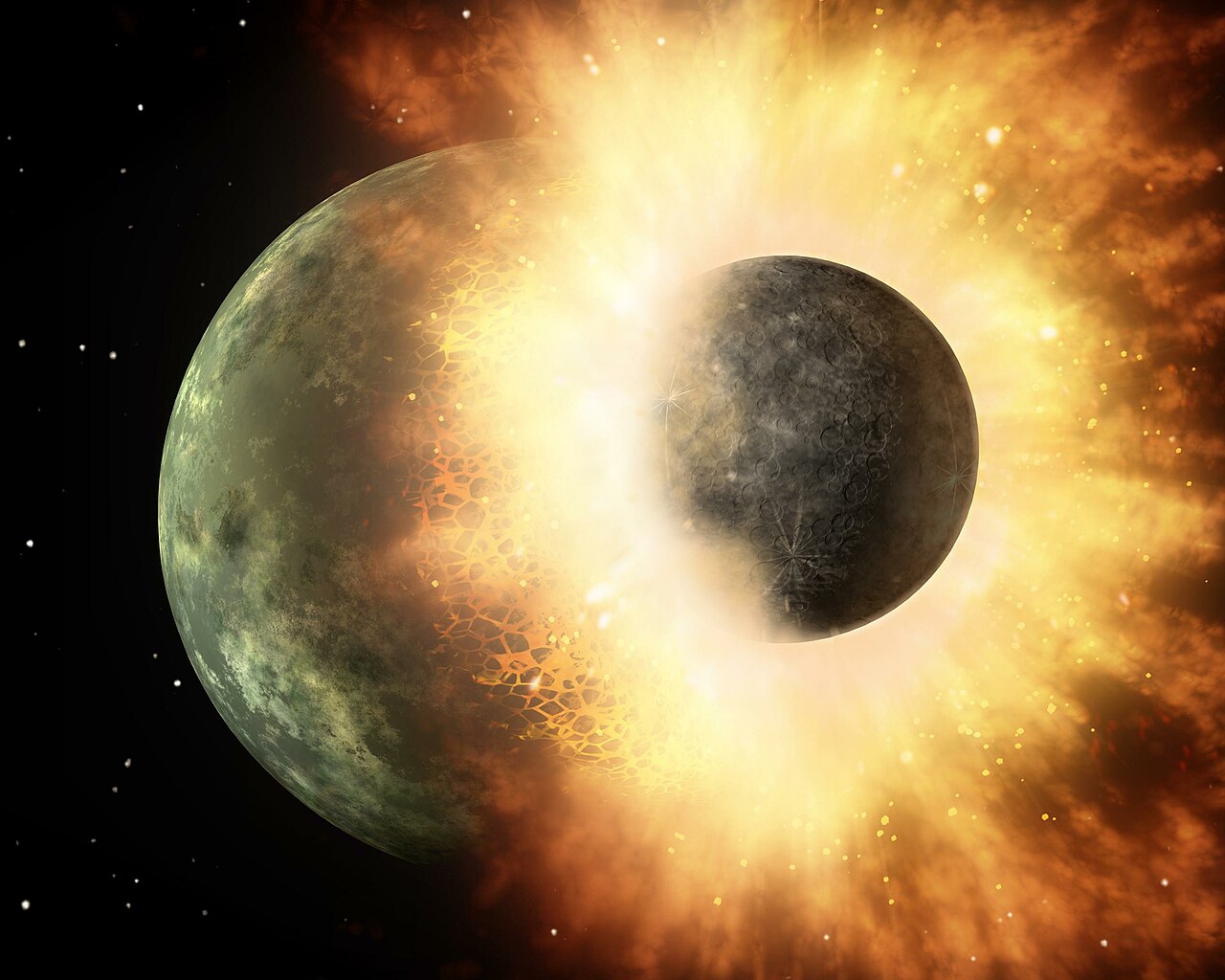
This is actually NASA's conception of the impact that created the Moon, but the actual result would be similar.
This is one way that I'm glad real life isn't more like anime.

What would happen if you could somehow connect two planets (say, Earth and Jupiter) with an unbreakable, unstretchable tether? Or an unbreakable, rigid girder?

Bad, bad things.

I wasn't sure how to answer this from a purely physical standpoint, so I wrote a quick Python simulation to model the situation. The results are interesting. If you connect the two planets at their point of conjunction (so they are about 4.2 AU apart), Earth basically acts a a pendulum hanging towards the Sun from Jupiter. Meanwhile, Jupiter's distance from the sun varies surprisingly regularly from about 5.3 AU to 4.64 AU over a 16-year year period; I think the Earth's swinging motion off the tether (which gets faster or slower as it gets closer to or farther from the Sun) acts somewhat like pumping your legs on a swing to go higher or lower; the force of the Sun's gravity on Earth, transmitted to Jupiter through the tether, either pulls it higher or lower in its orbit.

What this means for Earth is that instead of a normal year, it has a pendulum-like swing cycle that lasts about 10 months at its/Jupiter's furthest point from the Sun (where its distance varies from about 1 AU to 1.7 AU, beyond the orbit of Mars) and 4 months at their nearest approach (where the distance varies from about 0.45 to 1 AU, within the orbit of Mercury) with about 8 years elapsing between the high and low points of Earth/Jupiter's orbit. For reference, the habitable zone of the Solar System is (very roughly) around 0.75 AU to 1.4 AU. Earth's "orbit" will take it close enough to the Sun to boil the oceans and far enough away to freeze them. Presumably the atmosphere would exert some kind of moderating effect on these wild temperature swings (until it gets blown away by the close-range solar wind), but things look pretty grim. There is also the risk of planetary collision with Mercury, Venus, and Mars to worry about.

If the Earth and Jupiter start out in opposition, then the tether obviously does nothing. (Even assuming it is indestructible and can survive passing through the Sun) What about if Earth and Jupiter start out 90° apart in their orbits?

That's not good.
On second thought, let's not build an unbreakable, unstretchable, indestructible tether to Jupiter.

What (roughly) would Mars look like with all the water we drained from the Earth's oceans on it? How would the water affect its climate?

Randall actually answered this one! (As asked by someone else)

What if every human being on earth used all their mechanical power (say, on exercise bicycles) to heat and boil the oceans? Would this have any noticeable effect on water levels or the weather? What if we also turned the power we generate from other sources (turbines, generators, cars, etc.) to this purpose?

The average power output of someone working hard is about 500 W. Assuming the fit people are able to balance out the infirm/children, the human race should be able to produce about 7 × 109 × 500 = 3.5 TW. Impressively, this is about a fifth of the total power consumption of the world, so the answers of the two parts of the question are more similar than I expected. Assuming we are boiling water from the surface of the ocean, which has an average temperature of 17 °C, we could boil about 1,334 tons of seawater per second. This becomes about 8,000 tons/second if we include our other means of generating power, which works out to roughly 250 km3 of water per year—just 0.05% of the global evapotranspiration caused by the sun. So it looks like the Sun wins this one. If we were smart enough to actually capture all that distilled water instead of letting it escape into the atmosphere and return as rain, though, we could solve California's water woes 34 times over. This sounds nice, but put another way it means that distilling enough water to satisfy California would require about 615 gigawatts, 3.8% of the energy generated worldwide. With that much power, we could power over 500 time machines to just go back in time and tell California to use less water.
In homage to https://xkcd.com/656/.
What would happen if you changed the rotational period of the Earth to one hour? Two hours? Half an hour? One minute?

This question was inspired by this one, in which Randall describes the catastrophic consequences of speeding the Earth's rotation so that a day lasts one second. So I wondered, what about some more moderate day lengths? What is the shortest day the Earth could have and still have things remain "normal"? Jupiter has a ten-hour day; at this angular speed, the Earth's surface would be moving at around 1.1 km/s instead of the usual 0.46 km/s. The effects of the centrifugal force would not be enough to noticeably counteract Earth's gravity, so the most catastrophic effect would be having to adjust to a ten-hour day.

A two-hour day would cut the Earth's apparent gravity in half. This would likely be awesome and extremely fun. Swimming and sports would be more exciting, people would travel by bunny-hopping everywhere, and we might already have flying cars. The effects would probably be similar to those of increased gravity as described by Randall in this answer, only reversed. On the other hand, the Coriolis effect would be much stronger, potentially increasing the incidence of hurricanes, and the atmosphere would be less dense, which might make it harder to enjoy your newfound antigravity powers.

You can't go much further than a two-hour day. At about 84 minutes (just over the length of a day in Skyrim), the centrifugal force at the equator equals the force of gravity. Long before this, the Earth would deform into an oblate spheroid (more noticeably than it already has) and accordingly slow its rotation. With a one-hour day or less, the Earth's mass around the Equator would break off and fly out into space (moving at escape velocity), though without the awesome consequences of the one-second day.

What would be the effects on Earth if its axial tilt were 90°, like that of Uranus?

Increasing the Earth's axial tilt from 23.5° to 90° would have some pretty drastic effects on the climate. As commentors in this discussion say, this would basically mean that the Equator and the Arctic/Antarctic circles would become the same. Everywhere on earth would get experience the midnight sun and polar night for part of the year. I'll break down what the day-night-year cycle would look like at a few select latitudes:
  • The Equator: Exactly 12 hours of daylight every day of the year (just like the real Equator), except on the solstices. The Sun's maximum elevation during these days ranges from 90° at the equinoxes (the Sun would travel directly across the middle of the sky) to very low around the solstices; it would just barely peek about the horizon, albeit for longer than it does at the real-life poles (still 12 hours). At the solstices, the Sun would circle the entire horizon without actually rising above it, creating 24-hour twilight. This Equator would probably have more extreme seasons than the real one; it would likely get quite cold at the solstices, and would be hot around the equinoxes much like in real life.
  • 30°: Two months of midnight sun, from about May 21st to July 21st, polar night from about November 21st to February 21st. Lahaina Noon on about August 21st and April 21st. At the Summer solstice, the Sun would hang at 30° in the sky all day; consequently, Summers would be surprisingly cool. Spring and Fall would be very hot due to the high insolation and winter would be bitterly cold, but this might end up being one of the more habitable latitudes.
  • 45°: Three months of midnight sun from about May 6th to August 6th, polar night from about November 6th to March 6th. The days of maximum insolation would also be May 6th and August 6th; on these days the Sun rises from the horizon at midnight to directly overhead at midday; these days would be sweltering. At the Summer solstice the Sun would stay at 45° all day. Late Spring and Summer would be brutal, but at least you get to look forward to three months of icy darkness to make up for it!
  • 65°: Near the real-life Arctic/Antarctic circles. Four-plus months of midnight sun, from about April 16th to August 26th, and polar night from about October 16th to February 24th. At the Summer solstice the Sun is at a constant 65° of elevation, and during the entire month of June it is at over 45° 24 hours a day. On May 26th and about July 14th, the Sun rises from 45° to directly overhead. In case you haven't noticed, things are getting worse the closer we get to the poles.
  • The North Pole: The Sun's elevation is constant throughout the day, every day. Six months of midnight sun, six months of polar night. We have no Earthly analogue for what the Summer solstice would be like: the Sun would stay over nearly the same point on the Earth's surface for weeks, causing unimaginable amounts of heating and evaporation. Meanwhile the Winters would be even colder than those of our poles.
In a nutshell, the seasons would become much more extreme than those of the real Earth the further you go away from the Equator. Closer to the Equator, the equinoxes would be hot (as hot as the real-life Equator) and the solstices would be cold, but not uninhabitably so. Most people would probably live close to the Equator. I don't feel qualified to speculate about the plant and animal life that would inhabit this alternate Earth. I really think Randall should answer this one; it would be a good counterpart to his fascinating article Cassini.

Saturday, March 14, 2015

Why I Am an Evolutionary Creationist

This post is intended as a quick reference and resource in support of my position on the origins of living things, sometimes referred to as theistic evolution but which I (and others) prefer to call evolutionary creation. Evolutionary creation is defined by the Christian organization BioLogos as "the view that all life on earth came about by the God-ordained process of evolution with common descent". In other words, it understands evolution as the means by which God created life on earth.

I will begin by presenting, as clearly (but concisely) as I can, the evidence for creation and evolution, followed by my reasons for combining them.

Creation

"In the beginning God created the heavens and the earth." The very first words of the Bible express an unequivocally creationist (not to be confused with young-earth creationist, old-earth creationist, or other particular theories on the when and how of creation) viewpoint. The rest of Genesis 1 (and beginning of chapter 2) expound on this summary statement: in six "days", God separates light from darkness, the heavens/firmament (a solid dome thought to hold up the rain and snow) from the earth, and the land from the sea, then populates the earth with birds, sea creatures, plants, and land animals. This culminates in his creating man "in his own image" (Gen 1:27), male and female, to have dominion over the rest of the creation. So the center of Christian revelation begins with an account of God as creator; literarily, at least, "creator" is the foremost of his many names. By "creationism" I simply mean the fact that God is the creator of everything else. (See also Eph 3:9, Rev 4:11, 10:6)

Historically, the focus of creationism has been on the character of the creator (in the Nicene Creed: "I believe in one God, the Father Almighty, maker of heaven and earth, and of all things visible and invisible) and of the creation (its distinctness from God, Heb 1:10-12; its dependence on God, Psa 65:9-13, Col 1:16-17; its witness to God, Psa 19:1-4, Rom 1:19-20; its essential goodness as God's handiwork, Gen 1:31, 1 Tim 4:4). The Bible consistently depicts God as the author, sustainer, caretaker, and redeemer of the created order. The questions about creation which divide Christians today (the historical/scientific process of creation, the age of the earth, the means by which life arose) were never dogmatically defined by the historical church and are not the primary focus of the doctrine of creation. To lose sight of the essential truths of creationism in the midst of controversies over its peripheral implications is to forsake the historical understanding of the church.

Besides the biblical witness, I believe natural theology offers other reasons for the truth of creationism. There is the cosmological argument for the existence of God, which (in its stronger, nontemporal form) holds that the existence of something (particularly the particular cosmos we live in) must have a reason or explanation of some kind, and this reason can only be a self-existent, personal, eternal, omnipotent creator. There is the teleological argument or "argument from design", which argues that the existence of order and logic in the natural order (or perhaps in the laws governing it) is best explained by a designer. There is the fine-tuning argument, which points to the multitude of conditions, from physical constants to cosmological conditions to the place of the Earth in the universe, which are "just right" for life to exist here. And there is the ontological argument, which argues that an infinite number of Gods must necessarily exist by definition...oh, maybe not. Ignore that last one.

Anyway, I believe that all of these arguments are better answered by theistic creationism than by alternate worldviews like pantheism or naturalism. For the sake of brevity I will refrain from going into more detail on this here. Of course natural theology is just as indicative of the truth of Judaism or Islam as of Christianity, buy hey, it is also possible (I think) to be a Jewish or Muslim evolutionary creationist.

Evolution

Creationism fills in the "who" and "why" of origins; the theory of evolution supplies the "how" and the "when". Evolution is, according to renowned biologist Ernst Mayr in his helpful book What Evolution Is, "the gradual process by which the living world has been developing following the origin of life." The theory of evolution proposes that the diversity of living species today has its origin in common descent from an ancestor, combined with gradual modification by genetic mutation, combined with the preservation of certain advantageous mutations by natural selection. It makes the claim, audacious at first sight, that this seemingly random mechanism is the source of all the kinds of life we see today, even human beings.

Mayr outlines the evidence evolutionary scientists marshal for the theory. Most basically, evolution, like any scientific theory, is based on systematized observation—in this case, observation of the fossil record, the patterns of fossils discovered in various layers of the earth, or "geological strata". Since we can match these strata up with like layers around the world and date them with a variety of reliable methods (e.g. patterns in layers of sediment and radiometric dating of volcanic ash and igneous rock), fossils serve as partial records of organisms that lived in the time corresponding to the fossils' geological age. The most basic evidence for evolution consists in observations of developments in this fossil record—particularly the fact that more recent fossils bear more resemblance to living organisms, while older fossils tend to be more different. Darwinian theory predicts a smooth transition from species to species, but because of the incompleteness of the fossil record (due to the rarity of the conditions for fossilization), there are often gaps, though some lineages (such as the transition from reptiles to mammals, or whales and their land-living ancestors) are "remarkably complete".

In a bit more detail, the study of the degrees of similarity and difference of various fossils is called "homology". These similarities may be structural, physiological, molecular, or behavioral (as best as we can extrapolate it). Evolution supposes that the features of species change gradually due to mutation and natural selection, and the accumulation of such changes gives rise to new species. When a common ancestor is found for two species that demonstrates a point of divergence for their respective features, or when a transition fossil is found between a species and its purported ancestor, it is counted as evidence for the theory of evolution.

Another strong evidence is that, as method of dating fossils become more reliable, each fossil type is found at the time that it is "expected" in the record according to evolution. Evolution is extremely easy to disprove observationally. A single fossil determined to have been found in the wrong geological layer (e.g. a modern mammal fossil in a geological layer dated to 100 million years old) would be sufficient to cast serious doubt on it, or at least necessitate a major rethinking of the "tree of life". Yet no such too-early fossils have been found; the fossil record stubbornly refuses to (seriously) deviate from the patterns predicted by evolution. That constitutes strong evidence for its truth.

Originally, Charles Darwin formulated the theory of evolution not so much from observation of the fossil record as of extant species in the present. He noted the differences between similar species: namely, three species of mockingbird on three of the volcanic Galapagos Islands which got there by a single colonization from South America 1000 km to the east. If a single species of mockingbird was responsible for colonizing the islands, then all three modern species are descended from a single, common ancestor species; the differences between island species (e.g. in beak shape) were most likely adaptations to different conditions, different kinds of food, etc., which were selected for over time since they were advantageous for survival. Eventually, Darwin realized that this mechanism of common descent and mutation with natural selection could apply not just to birds, but to all species on earth. The "origin of species", in Darwin's view, was a single, common ancestor in the distant past.

Darwin's theory of common descent solved the biological mystery of why certain groups of organisms (mammals, birds, reptiles, insects, etc.) share many of the same characteristics: they are descended from a common ancestor. They get their similarities from this common ancestor, and their differences from subsequent changes. The fossil record provides abundant support for common descent, offering common ancestors of dogs and bears, dogs and cats, rodents, ungulates, birds, reptiles, fish, mammals, etc. The hierarchy of animal taxa was known to biologists before Darwin; what he provided for the first time was an explanation for why animal taxa exist in a hierarchy. Some specific kinds of similarity that are well explained by common descent are:

Morphology: "Very suggestive evidence for common descent is provided by comparative anatomy," says Mayr. This is the most immediately obvious way of assessing similarities and differences between species, and it is easily grasped both for living species and fossils. It is the kind of similarity that allowed for the creation of hierarchical animal taxa even before Darwin. Patterns in morphological similarity are some of the strongest and earliest evidence for common descent.

Vestigial Structures: Why do species have morphological structures that have no functionality at all (or much less functionality than their homological equivalents in other species), like the appendix (which appears to help other mammals digest leaves but which we have little use for), human wisdom teeth, teeth in baleen whale embryos, hind legs in whales, or eyes in cave-dwelling animals? Again, vestigial structures are explained by common descent, by a shift in lifestyle resulting in vestigial structures no longer being utilized or promoted by natural selection.

Biogeography: Evolution also helps explain the distribution of plant and animal species. The relative similarity of species in different geographic regions is correlated with the amount of time the regions have been isolated from each other; when they were last connected, a common ancestor would have been present in both regions. In this way, taxonomical similarities can be correlated with geology. For example, North America and Europe were connected by a land bridge 40 million years ago while South America and Africa have been separated for 80 million years, which explains why there is more similarity in North American and European species. Common descent and dispersal from a single point of origin explains why there tend to be no mammals on oceanic islands but plenty of birds and plants; mammals tend to be worse at crossing water gaps.

Molecular Evidence: More recently, it has become possible to study organisms at the molecular level as well as the morphological. Comparisons of molecules indifferent species tends to confirm the evidence of morphology, though occasionally it tells us things we didn't know before. The study and comparisons of genes has allowed us to find deep similarities not just between humans and other mammals, but with plants and insects as well. It is possible to trace the evolution of genes in much the same way as the evolution of species.

One last point of evidence: while it is true that most of the evidence for evolution is simply observational, we also have some experimental evidence of evolution. We have observed and even directed it both in the laboratory and outside it. (e.g. selective breeding and domestication of animals) As point 12 of this Scientific American article describes, we have even observed the creation of new species of fruit flies (using Mayr's definition of a species as a reproductively isolated community) by selective breeding.  We have also experimentally bred entirely new features into e. coli, namely the ability to feed on citrate. I often hear creationists say that they believe in microevolution (the development of differences within a species, like Galapagos Finches or dogs) but not macroevolution (the mechanism explaining the origin of all species from a common ancestor). But microevolution and macroevolution work by the exact same mechanism; they are only quantitatively, not qualitatively different. As the fruit fly experiment shows, the boundary between the two is not precisely definable. Saying you believe in microevolution but not macroevolution is somewhat like saying you believe in early modern, but not ancient history.

Note that in the whole preceding discussion, I have presented my reasons for believing the theory of evolution without trying to disprove the truthfulness of the Bible, bringing in philosophical notions opposed to a Christian worldview, or paying attention to religion at all. Contrary to what many Darwinists and creationists would have you believe, evolution is, first and foremost, a scientific theory (not a doctrine or interpretation of the Bible), supported by scientific evidence like any other theory, and is entirely distinguishable from the philosophical and sociological conclusions people have drawn from it. Consequently, it is not (methodologically) possible to disprove evolution using philosophical or theological argumentation. The way to disprove evolution is to show that it does not, in fact, adequately explain the observable evidence (e.g. by observing contradicting evidence, like a mammal fossil showing up too early in the record or some kind of bird-fungus hybrid) and to present a different scientific theory that explains it better. This is simply the way that any scientific theory is debunked and replaced.

Evolutionary Creation

I do not believe that evolution and creation are in any essential conflict. Further, while they are certainly conversant with each other, they make their points on fundamentally different levels. Creation is, first and foremost, a theological doctrine, while evolution is, first and foremost, a scientific theory. Confusion on this distinction lies behind a good deal of the supposed conflict between faith and science.

For this reason, I cannot support the efforts of creationists who try to reconcile the Bible and science by massaging the scientific consensus to make it fit their interpretation of Scripture. The first problem with this is that it subverts or distorts what we can know from the creation (which is, of course, God's handiwork) in order to preserve a preferred interpretation of Scripture. It thus denies God's general revelation in favor of (one's own understanding of) his special revelation. I do not believe that truth works like this. The Bible does not simply "trump" verified knowledge from other sources; all truth, as they say, is God's truth. I believe rather that the intelligibility of nature and our ability to study and benefit from it are results of God's creativity; to deny these things in favor of a doctrine of creation is simply self-undermining, tantamount to saying that not everything God made is good. The book of God's words does not contradict the book of God's works. And, of course, Scripture says nothing "on its own" without a human act of interpretation on our part. Even if the Bible is infallible, what justifies our confidence in interpreting it in a way that contradicts the scientific consensus, without any prior grounds for disputing this consensus?

The second problem with this approach is that reconciling the Bible with science in this way can't simply stop at evolution, or even the age of the earth (which is even better-supported scientifically, by literally dozens of independent indicators, than evolution). The Bible contains numerous other examples of the ancient science we would expect from its ancient Jewish authors. Denis Lamoureux, a Canadian evolutionary creationist, describes these in his book on the subject, appropriately titled Evolutionary Creation.
  • The immobility of the earth (1 Chr 16:30, Psa 93:1, Psa 96:10), in contrast to our modern understanding of the Solar System; this was one of the main points on which Galileo was condemned.
  • The earth resting on foundations/pillars, somewhat like a building (1 Sam 2:8, Job 38:4-6, Psa 75:3, Psa 104:5), or on the waters (Psa 24:2, Psa 136:6), again in contrast to our modern conception of a spherical, revolving, orbiting earth.
  • A flat (Mat 4:8), circular (Isa 40:22) or square (Isa 11:12, Ezek 7:2, Rev 7:1, 20:8) earth/landmass with a definite center (Dan 4:10) and ends (Isa 41:8-9, Dan 4:12, Matt 12:42); the Hebrew word translated "circle" refers to a flat, two-dimensional surface. No, the Old Testament does not presage the Greek discovery of a spherical earth.
  • The existence of a circumferential sea surrounding the earth (Job 26:7-14, Job 8:22-31).
  • The underworld, sheol or hades, spatially existing underneath the earth (Num 16:31-33, Pro 5:5, Isa 14:15, Matt 11:23, Luk 10:15). The underworld is also indirectly referred to along with heaven and earth, as being "under the earth" (Phil 2:10, Rev 5:13).
  • The movement of the sun across the sky (Josh 10:13, Psa 19:6, 50:1, Ecc 15); as distinct from the Sun appearing to move because the Earth rotates.
  • The firmament, a solid dome or "vault" of the sky holding up the (rain)waters above the earth (Gen 1:6-8, Psa 19:1). That the firmament is understood as a solid structure rather than simply the expanse of space is shown by the application of the Hebrew word raqa to it in Job 37:18, which is elsewhere used to describe metalworking (cf. job 22:14, Ezek 1:22).
  • Waters above the firmament, in the heavens, thought to be the source of rain (Gen 1:6-8, 7:11, Psa 104:2-3, 148:4, Jer 10:12-13).
  • Foundations of the heavens, holding them up above the earth (Job 26:11, 2 Sam 22:8); mention is also made of the "ends of the heavens" (Deu 4:32, Isa 13:5, Psa 19:6, Matt 24:31).
  • The location of the sun, moon, and stars in the firmament (Gen 1:14-19).
  • The heavens being rolled up and the stars "falling" to earth (Isa 34:4, Matt 24:29, Rev 6:13) or being thrown (Dan 8:10, Rev 12:4). We consider language of "shooting stars" to be merely figurative or poetic today, but only because we know that meteorites are not really stars. The ancient Israelites didn't!
  • Ancient taxonomy: bats are birds (Lev 11:13-19), the hyrax and rabbit are ruminants (Lev 11:5-6).
  • The mustard seed is the smallest of all seeds (Mat 13:31-32, Mar 4:30-32); seeds germinate by dying (Jhn 12:24-25, 1 Cor 15:35-37).
  • An ancient, one-seed model of reproduction in which the woman's womb serves as the "field" in which the man's "seed" (which contains his progeny in tiny form) grows. Hence the biblical language of women as "barren" (Gen 11:30, Jdg 13:2) and the statement that the yet-unconceived Levi was "in the loins of his ancestor", Abraham (Heb 7:9-10).
  • Medical conditions like muteness (Luk 11:14), blindness (Mat 12:22), epilepsy (Mat 17:14-18), and skeletomuscular problems (Luke 13:10-13, 16) are caused by demons, alongside other instances of what appears to be actual demon possession (Luk 8:26-39).
I have never seen anyone (even Ken Ham) attempt to consistently subscribe to the ancient science found in Scripture. Such a feat would be absurd, if not impossible for a modern person; it would involve denying modern geology, astronomy, medical science, biology, the eyewitness testimony of everyone who has been to space, and the existence of the orchid (among other facts). We have accepted all of these other discrepancies between biblical and modern science without much fuss (well, maybe with fuss in the case of the Heliocentric cosmos) and don't consider them to be contradictory to a "biblical" worldview. Why is evolution singled out as the one area of science that apparently can't be reconciled with the ancient science of Scripture?

This also rules out the converse approach, known as concordism, of altering our interpretation of the Bible to match our scientific knowledge. (Which, I suspect, is why the above examples don't bother most Christians; they simply don't notice the Bible's ancient worldview and assume it is speaking to their modern one with all these examples being "poetic" or "phenomenological") Aside from the fact that most concordists do not apply this method consistently (denying the scientific consensus on points like evolution that they cannot read into Scripture), I simply do not think that trying to locate a 4.5-billion-year-old earth, Darwinian evolution, a spherical earth revolving around the sun with the other planets, and modern cosmology all in the Bible constitutes a fair, respectful reading of the text. If we force the Bible to speak in the language of our modern cosmology/geology/biology, we silence its original voice.

I prefer to let both Scripture and science speak for themselves, without prematurely bringing them into conflict with each other. The Christian faith confesses God as the creator and sustainer who made all things good and man in his image; through the theory of evolution, science teaches us details of how he created life. Contrary to what Darwin himself and other skeptics have believed, studying God's means of creating through evolution does not marginalize him any more than studying his means of sustaining the creation through physics, chemistry, etc. does. I think this misconception traces at least partially to the shift in peoples' concept of God described in the first chapter of The Unintended Reformation, in which the loss of the apophatic (negative) view of God, Scotus' idea of metaphysical univocity, and Occam's razor combined to allow God to be "explained away" by reason and Enlightenment thinking. But God is far more than simply an explanation for questions of science or philosophy. Between the true God and our study of his works, then can be no final conflict.