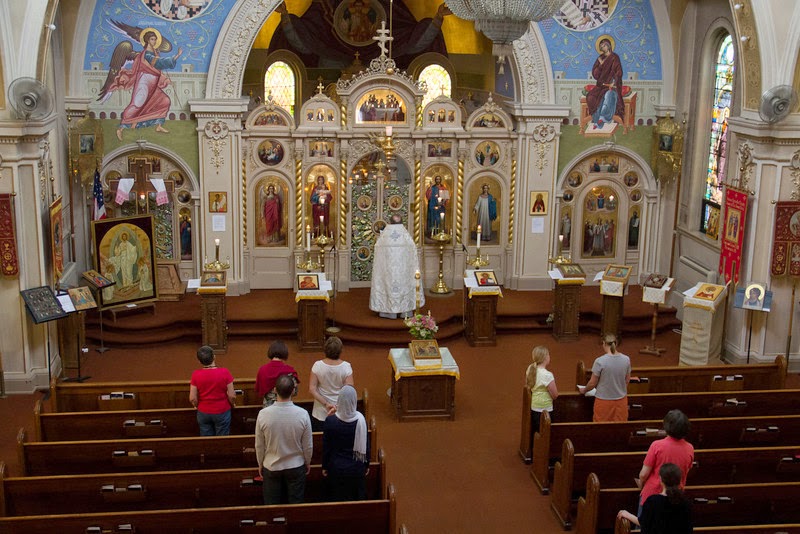
- The Incarnation. Perhaps the most fundamental reason I am drawn to Orthodoxy is how totally the Incarnation pervades everything the Church believes, prays, and does—what Fr. Alexander Schmemann calls the "sacramental worldview". This manifests in at least five areas (although the -logy terms I use for them are not used very commonly in Orthodoxy, nor are they treated as much like distinct fields of study as they are in Protestant theology):
- Epistemology: Reflects the reality that Jesus is "the Truth" (John 14:6), i.e. that the Truth is a human person, and deeply explores and applies the implications of this. The result is that the faith is never remotely reducible to a body of doctrines to be believed; knowing God or having right theology is irreducibly relational as it is also propositional. Both the head and the heart are involved in really doing theology (in Greek usage the human capacity to know God is thought to be centered in the heart).
- Bibliology: Similarly applies the reality that Jesus is the Word (John 1:1); Scripture is read as a fully divine and fully human book whose purpose is to witness to Christ and express the faith he embodies. The "Word of God" is usually understood to refer to Christ, not the Scriptures. The human and divine aspects of Scripture, as well as of the Holy Tradition of which it is the center and within which it is rightly read, are seen as complementary rather than conflicting.
- Ecclesiology: The Church is viewed as the body of Christ, an incarnational (not just a sociological) reality, defined as much by its unique and salvific relationship by God as by its members. In Orthodoxy the Church is seen as truly one, holy, catholic, and apostolic.
- Soteriology: Unabashedly synergistic; with the Incarnation as an example, there is again harmony rather than tension or competition between our will and God's, just as is embodied in Christ. (The doctrine of dyothelitism, "two wills")
- Doxology (that is, worship): Holistic, utilizing all the senses, reflecting the fact that God became matter and saves us through matter. Thus the form worship takes is viewed as just as significant and meaningful as the "message" it carries. It is centered around the Eucharist, which is in a sense a weekly celebration of the Incarnation.
- Orthodoxy's unbroken continuity with the early Church. Amid a sea of Protestant denominations, churches, movements, theologies, and groups making conflicting claims to represent "original Christianity" and the resultant skeptical attitude that no one can claim to be the "one true Church", Orthodoxy's apostolic succession and Holy Tradition which seeks to receive, treasure, and preserve the Truth rather than modify it made its claims stand out as uniquely believable. I truly believe is it is the unbroken continuation of the apostolic faith into the present day. The relative similarity of Eastern and Oriental Orthodoxy, despite the fact that they split off from each other long before the Catholics or Protestants went their separate ways, is striking and compelling evidence of the historical continuity of both.
- Its clear, wholehearted, unqualified affirmation of God's goodness. Uncertainty about God's goodness was the center of the struggles with doubt that led me to question everything I believed. Is God somehow complicit in the problem that "the gospel" solves? Is he the one from whom we are saved? Is sin willed by God, another means he uses to show forth his glory? Is death a punishment for sin created by God? Does God need to punish our sin before he is able to forgive us? Is his "justice" in tension or opposed to his "mercy"? Does God will to save only some and not all? Orthodoxy's answer to all these questions is a resounding and decisive "No", and I am incredibly grateful for it. Of particular note is its teaching that hell is not a cruel and endless torture chamber, the damned soul's experience of God's anger and vengeance, but of his love, which to them is torment but which to the saints is unutterable bliss. The message is that the difference between heaven and hell is not simply in how God treats us (for God never changes, and his love towards sinners never wavers), but in how we are able (or not) to receive his presence. It is still a terrible teaching, but it is fair or fitting in a way Eternal Conscious Torment never was.
- The indivisible unity of worship, prayer, theology, and life. The theology of the Orthodox Church is not best expressed in a statement of faith or systematic theology (John of Damascus' The Orthodox Faith is the closest I know of to one), but in its worship, creeds, practices, and prayers. "Theology" is truly knowledge of God, not just knowledge about God; as Evagrius of Pontus put it, "if you are a theologian, you pray truly, and if you pray truly, you are a theologian." Orthodoxy is seen not merely as a faith but as a way (leading to salvation), a life, namely the common life of the Church in union with the life of Christ. Knowing the truth and practicing it are two sides of the same coin. As a corollary, there is not much of a gap between the Church and the academy; the Church's best theology is not done in isolation from its worship. Much more often, it is expressed in its worship.
- Its beautiful, compelling, and perfectly-balanced vision of the gospel. To name just a few of the things I appreciate:
- The theological focus on what we are saved to, namely the lofty (but attainable by the Spirit) goal of theosis, holistic, mystical, transformative union with God. What we celebrate in church each week, what I find constantly throughout Orthodox writings ancient and contemporary, is a joyful exploration of the riches we have in Christ, that is, what we receive and become through our salvation. A quote by St. Athanasius that is very frequently thrown around exemplifies this: "God became man that man might become god." Orthodoxy sets the bar for salvation very, very high and is itself the Way to reach it.
- The gospel is cosmic as well as individual; objective as well as subjective. The constant focus in worship is on praising and making present objective spiritual realities, not just their subjective effects on and in me.
- Salvation is physical as well as spiritual (the incarnational soteriology again); there is no popular misconception that Christianity is about "going to heaven when you die". Death in all its senses is the enemy just as much as sin is. The veneration of relics, far from idolatry, is a reflection of God's power to redeem even our physical bodies. Nothing God has made is outside the scope of the gospel.
- Salvation is therapeutic rather than legalistic: we are saved not by meeting the right requirements in an impersonal system or being declared "not guilty" in a heavenly courtroom; though these metaphors can be applied, God does not need to do any such thing in order to forgive us, and they certainly do not describe the primary meaning of salvation. Rather, it is is viewed as healing, and sin, death, and the devil as oppressors from which Christ rescues us. What changes, what needs to change, is ourselves, not God's disposition towards us, which is in fact unchanging.
- Putting Christ and the cross front and center, in their fuller context. The divine victory was won just as much at Christmas and Easter as on Good Friday. Salvation is equally the work of the Father, Son, and Spirit, not the Son in isolation. Orthodoxy proclaims this reality clearly.
- Its wise wariness of the power of human reason, as well as its detachment from modernity and related tendencies like rationalism and individualism. In fairness, this may be in part a historical accident reflecting Orthodoxy's isolation from Scholasticism and the Enlightenment, but I see a somewhat similar trend of cautious, thoughtful engagement in its relations with classical philosophers. I sometimes hear talk of the "noetic effects of sin" in Protestant circles, but Orthodoxy is much more methodologically thorough in its distrust of human reason, not least in its sensitivity to the role of mystery in theology and the necessity to read the Scriptures with the mind of the Church instead of one's own judgment. Rational thought is considered a useful tool to support our knowledge of the truth, but is not a necessary or absolute criterion for believing it.
- No age discrimination in worship. In an Orthodox Church, there is no Sunday school, at least not during the liturgy; children and infants are baptized and chrismated and thereafter fully participate in worship alongside their parents, up to and including the Eucharist. I didn't realize how significant this is until I had experienced it for a while, but now I think it's quite beautiful (many Orthodox cite it as an advantage over Roman Catholicism as well). This reflects quite visibly Orthodoxy's lessened focus on reason and head-level understanding, as well as its understanding of salvation as healing and sacrament as mystery. You don't need to rationally understand grace in order to partake in it; in fact, the ways in which we receive grace are at bottom not rationally understandable. It strikes me as the fulfillment of Jesus' words in Matthew 19:14: "Let the little children come to Me, and do not forbid them; for of such is the kingdom of heaven." Fr. Josiah Trenham comments on this: "It is not the children who must grow up and become like adults in order for them to be baptized and saved as the Baptists would have us believe, but, on the contrary, it is the adults who must be converted and become like children if they hope to be saved."
- Its realization of things that feel like unreachable ideals in Protestantism. Orthodoxy has great unity and clarity on "essentials of the faith", which is nominally the goal for Protestant unity but only rarely and incompletely achieved. Any Orthodox can tell you just what "praying continually" (1 Thessalonians 5:17) looks like in life, even if the saint who fully becomes prayer is a rare and precious sight indeed. There is no sense of a need to recover, rehabilitate, reclaim, or move towards important but missing parts of the faith; there is instead an almost tangible "fullness of the faith", which I heard mentioned by many others in my catechism class as a reason for their interest in Orthodoxy. This reflects the Church's unbroken continuity with the apostles, its preservation of the faith entrusted to them by Jesus, leaving nothing out.
- A consistent stance toward all of these things, rather than a confused or conflicted one. They are applied, not merely talked about or paid lip service. I found many of Orthodoxy's truths at least hinted at in the books I read while searching for the truth on my own, but too often they were just academic ideas, applied on a small or individual level if at all. But in Orthodoxy they are much more.
Showing posts with label Journey to Orthodoxy. Show all posts
Tuesday, January 26, 2016
Why I Am (Becoming) Orthodox
Almost since I started becoming interested in Orthodoxy, a recurring theme in my journal entries has been my attempts to write an "elevator pitch" for it, not as if I were trying to sell something but a concise summary of why I find it convincing and why I am in the midst of a long transition from evangelical to Orthodox Christianity. If my 23-post series is any indication, I haven't come very close to "concise" yet. After a lot of reflection and brainstorming, I'm giving it a try now. Here are ten reasons why I am (becoming) Orthodox, hopefully kept to a short enough length that you won't have to schedule a time to read them in your calendar. (Optionally, compare my list with that of Fr. Andrew Stephen Damick, in which I see some similarities with my reasons)
Categories:
Journey to Orthodoxy
Monday, October 5, 2015
Prayer of Reception into the Catechumenate
Yesterday at the divine liturgy, I went and stood in the front of the name while the priest officiating (Father Andrew) laid his hand on my head and prayed this prayer:
Update: I was not at church the Sunday after this, but apparently my priest also put an explanation of the prayer into the bulletin that week. Here it is:
In thy Name, O Lord God of truth, and in the Name of thine Only-begotten Son, and of thy Holy Spirit, I lay my hand upon thy servant, David, who hath been found worthy to flee unto thy Holy Name, and to take refuge under the shelter of the thy wings. Remove far from him his former delusion and fill him with the faith, hope and love which are in thee; that he may know that thou art the only true God with thine Only-begotten Son, our Lord Jesus Christ, and thy Holy Spirit. Enable him to walk in all thy commandments, and to fulfill those things which are well pleasing unto thee; for if a man do those things, he shall find life in them. Inscribe him in thy Book of Life, and unite him to the flock of thine inheritance. And may thy Holy Name be glorified in him, together with that of thy beloved Son, our Lord Jesus Christ, and of thy life-giving Spirit. Let thine eyes ever regard him with mercy, and let thine ears attend unto the voice of his supplication. Make him to rejoice in the works of his hands, and in all his generation; that he may render praise unto thee, may sing worship and glorify thy great and exalted Name always, all the days of his life. For all the Powers of Heaven sing praises unto thee, and thine is the Glory; of the Father, and of the Son, and of the Holy Spirit; now and ever, and unto ages of ages.I'm officially a catechumen (one preparing for memebrship) in the Orthodox Church!
Update: I was not at church the Sunday after this, but apparently my priest also put an explanation of the prayer into the bulletin that week. Here it is:
Last Sunday we 'made' a catechumen during the Divine Liturgy. A catechumen is someone who is undergoing a program of instruction in the Orthodox faith with the intention of being received into the Orthodox Church. The prayer is called the Prayer of Reception into the Catechumenate. We do this at St Mary's from time to time, especially if the catechumen is taking a course, and if he or she does not mind standing up in front of all the congregation! Not everyone who converts to Orthodoxy is formally and publicly enrolled in this manner, although they will be in any event as part of the rite of reception, but when we do it in this public way it serves as a good reminder of important aspects of what we are about in the Church: dedication to study, spiritual growth, and evangelisation.
The prayer begins with an affirmation of the truth and power of the Most Holy Trinity. It states that having a right relationship with God, in Christ and by the power of the Holy Spirit, is the sure foundation and shelter for our lives. We ask for the catechumen that all things that ought to be set aside from his or her past - sins, failings, errors and mistakes, sorrows, delusions - be set aside, and in their place that the catechumen be filled with authentic Christian faith, hope, and love. It is the moral transformation of the catechumen that is critically important, certainly more important that any detailed 'head' knowledge of the faith, which - after all - we all have a lifetime to study. The call is to a living faith, that is to live in light of the mortal vision of the Church. Therefore we pray: Enable him to walk in all thy commandments, and to fulfill those things which are well pleasing unto thee; for if a man do those things, he shall find life in them. Although obviously deeply and profoundly personal, the life of faith is not something solitary and private. We are members of the Body of Christ, members of one another, a community, a family, the household of God. We pray that the catechumen will be united to 'the flock of thine inheritance', to live in and to be upheld and nurtured by the community of faith, and ultimately to share in the mutual responsibility and accountability that is part of our vision of the life of the Church. God is to be glorified in the way we live and through the example we offer. This is a struggle, of course (and as we all know), the struggle for Christian virtue, and therefore we ask: Let thine eyes ever regard him with mercy, and let thine ears attend unto the voice of his supplication.
What is perhaps most wonderful is the way in which the Orthodox Christian life into which the catechumen is entering is meant to be joyful and full of glory and praise. Just as the Divine Liturgy is understood to be a participation in heavenly worship, so too more generally a life ordered toward God unites us to the mystical doxology that lies at the heart of all things and is revealed in the biblical visions of heavenly worship. There is an end or goal for which we strive, and that end is glorification in the Kingdom: Make him to rejoice in the works of his hands, and in all his generation; that he may render praise unto thee, may sing worship and glorify thy great and exalted Name always, all the days of his life. For all the Powers of Heaven sing praises unto thee, and thine is the Glory; of the Father, and of the Son, and of the Holy Spirit; now and ever, and unto ages of ages.- Fr Andrew
Categories:
Journey to Orthodoxy
Wednesday, April 8, 2015
My Journey, Part 16: Looking Back, Coming Home
This is the final part of my rebooted series on my journey from Evangelicalism to Eastern Orthodoxy. The full series can be found here:
Growing up in a Presbyterian church, I was apathetic about God for most of my life. When I first started caring about the faith I'd been raised in, I had picked up some misconceptions: the version of Christianity existing in my head was highly dualistic ("it's not about what I do, it's about what God has done", "all I can do is trust God and let him take care of the rest", etc.), rationalistic, inward-oriented, and reduced everything to the state of my all-important "relationship with God". It was a caricature of authentic Christianity, but I didn't know anything better at the time, and it was still an improvement from my former near-total apathy toward God.
In college I became more closely involved with evangelical Christianity, which placed a strong emphasis on "making your faith your own" and "living it out" through intentionally following the teachings of Jesus, discipleship, and missions. In the course of following this calling, I ran into my first serious doubts in my newly personalized faith. First, my dualistic thinking led to great discouragement and doubt in the authenticity of my faith when I felt unable to see my obedience bearing any "fruit". Due to the pressure of the ministry I was involved in, I set this doubt aside, thinking I had conquered it. But the next year, I began questioning the point of it all: why do we seek to grow in relationship with God and introduce him to others? When does this become more than an activity or exercise and pervade the whole life? My other two misconceptions about my faith had begun to catch up with me; I went through a difficult time of doubt and rethinking of the ways I applied my faith, trying to make the inside and outside match better.
Reassessing the ways I was living my evangelical faith out, I realized many were more because of external pressure than any deep conviction within me. Rather than simply dismiss my uneasiness and remind myself that Christian living doesn't depend on feelings, I sought to reassess and deepen my beliefs to help them to make more sense to me, so that I could live my faith out more authentically. I wanted to make my "internal faith" match my "external faith". But, turning to the Bible in hopes that it would help me to do this, it instead ended up giving me stronger, deeper doubts. I encountered passages that seemed to depict God telling people to sin, or outright lying—what was going on? God's own word seemed to be calling his goodness into question. I took a biblical theology class at my church in hopes that it would help, but as it took me on a tour through the Bible from cover to cover I instead got even more questions. Amid all of these, a "meta-question" burned in my mind: why do I have to struggle with the Bible so much to get it to make sense?
I "knew" that the all-important gospel was the key to making sense of the story of Scripture, but around this time (in 2012 and 2013) the account of the gospel I had been taught so often from a Reformed evangelical background also stopped making sense. I questioned its assessment of the "big problem" the gospel solves (universal, endemic sin and just condemnation) and its origin; I questioned the sensicality of the proposed solution (penal substitutionary atonement); I questioned the strong evangelical focus on securing individual "decisions for Christ" and "getting saved". Though the authors and blogs I read offered tantalizingly ethereal alternatives to the teachings that gave rise to these questions, I was plagued above all by the problem of Paul: his writings, more definitive of the "gospel" I was trying to make sense of than any other part of the Bible, seemed to be irreducibly at odds with the Old Testament; it made the gospel appear to be a solution to a problem that God himself created. And if this was true (as it seemed to be, inescapably), the whole thing stopped making any sense.
Finally, I got tired of my attempts to push all these doubts aside for the sake of not making my faith about an "intellectual assent" rather than a "relationship". I realized that by refusing to deal with my doubts or thinking that they were "just me", I was allowing them to eat away at my faith until there was very little left. Finally I confessed to God that he had stopped making any sense to me and that his word had contradictions in it. But a funny thing happened: I didn't simply despair at losing my faith. I realized that I still had faith in God, that it ran deeper than what I could rationally make sense of. The trust I still had in God that led me to pray to him—I realized that is what faith really is.
My confidence renewed by this realization, I set out to reconstruct the edifice of beliefs and theology that my doubts had pulled down. Taking plenty of inspiration from "post-evangelical" types like Peter Enns, I sought new paradigms for thinking about the Bible, God, and truth itself. To address my doubts head-on, I learned to read Scripture in its original cultural and historical context, via something Enns (and others like Christian Smith) call the "incarnational hermeneutic". In search of a more humble epistemology that could see past all the denominational divisions between Christians (an area of increasing concern for me). I explored the implications of Jesus being the Truth (Jhn 14:6), and of truth therefore being bigger than what I can grasp with mere rationality. In my nerdier moments, I struggled to put into words the frustration I had with the tendency of evangelical theology to oversystematize things and pack weighty truths into convenient jargon. I looked for answers to my questions about the gospel, finding the idea of the New Perspective on Paul especially fruitful for reconciling Paul and the Old Testament. Yet I was frustrated by the individualism of my quest, the implicit relativism of trying in isolation to construct a theology that made sense to me, and the academic, idealistic nature of my search for truth: even if I did lay hold a vision of the gospel that had the ring of truth, where would I find a church that practiced it?
Then, through the master's program I was taking at the University of Northwestern, I stumbled upon both in the form of the Eastern Orthodox Church. The more I studied its teachings, the more I realized it was the church and the faith that I had been seeking for years, despite my initial misgivings. Unlike the traditions I'd been weighing, it has the historical backing to support its claim to be the Church holding the Faith that Jesus established on the apostles two thousand years ago, claims that are a dime a dozen within the Reformation tradition. (When they are considered possible at all) In its ecclesiology I saw the antidote to the metaphysical dualism, individualism, and divisions plaguing Protestant churches and their claims. In its approach to the Bible I saw the way past the doctrinal confusion and divisions sown by the ahistorical Protestant approach of sola scriptura; the answer is not Scripture alone, but Scripture at the center of the Holy Tradition of the Church, the body of Christ, reading, praying, and living the Scriptures together. Orthodoxy also exemplifies a more mystical, practical, incarnational approach to theology that is the perfect answer to the rationalism that divided my faith into interior and exterior dimensions and gave rise to my seemingly endless questions. It not simply a matter of believing the right things and then living or "applying" them; Orthodox spirituality is "real" (in the language of my doubts) to the core, and never simply heady.
But even as it has helped me see past the misconceptions that made my questions and doubts about evangelical Christianity seem so necessary and important, Orthodoxy has shown me a far better, more coherent, more intuitive, and more beautiful vision of the gospel than I had ever heard before, one which either makes my old questions unnecessary or replaces them with better ones. The Orthodox approach to Genesis is more compatible with modern science and makes clear that the "problem" of the gospel is not in any way God's doing, nor is it a total derailment of his purposes. The eastern telling of the gospel avoids the numerous problems of penal substitutionary atonement and instead offers a rich, multidimensional heritage of interpretations centering around Christ's defeat of sin, death, the devil, and all the spiritual forces that enslave and imprison humanity. It also offers an alternative to the various dichotomies (faith vs. works, law vs. gospel, human agency vs. divine agency) that contributed to my former confusion about how to "live out" the gospel, and the perhaps-excessive evangelical focus on "decisions for Christ" and the singular conversion experience. And finally, though it wasn't one of the reasons I initially felt drawn to Orthodoxy, I found its liturgical worship more beautiful, more historically grounded, and more consistently incarnational than a contemporary style.
But now I am blessed to see that the Church is not divided and biblical Christianity is not lost. God has not simply abandoned us to to try to derive the Christian faith for ourselves from first biblical principles. Rather, he is faithfully present with us through his Spirit which knits us together into the one, holy body of Christ, within which there can be no schism. Though the reunion of Christians is beneficial and highly desirable for many reasons, we do not "reunify" or "assemble" the Church by doing so. Protestants tend to consider it "arrogant" to claim to be the church that Christ founded, but consider the alternative! Such objections are little different from the relativist's argument that it is arrogant to make exclusive truth claims; I find it ironic that apologists who are so eager to defend "absolute truth" in epistemology are so reluctant to accept it when it comes to ecclesiology.
Moving forward, I face the challenge of continuing to be ecumenically-minded when when absolutely everything doesn't depend on it, as I used to think, and of pursuing unity humbly even while earnestly believing that this unity means everyone becoming Orthodox in some form. As I become more settled in the faith, I want to affirm it wherever I see it reflected in others, to learn to disagree constructively and charitably. Really, this has been my desire for years, but now I am called to do so even more and without compromising on my newfound certainty. In the end, I don't just want to cross over the gap between churches; I want to see it closed.
An emphasis on personal, authentic, lived faith. If I had to pick the greatest strength of evangelicalism (and the greatest contribution of western individualism to Christianity), this would be it. Though language of Christianity as a "personal commitment/decision/relationship" is often used erroneously or reductionistically, the truth is that Christianity is all of these things, though it is also much more. If evangelical Christianity had not deeply impressed on me the importance of personal applicability, authenticity, and practical, ground-level application in my faith, it's likely I would never have found the Orthodox Church, or even looked for it.
I hope my continuing relationship with evangelical (and Protestant) Christianity is a long and fruitful one.
tl;dr
When I first started this series, I promised 35,000 words over "about 13 posts", "in relatively quick succession". What I instead produced ended up being about 112,000 words over 22 posts and eight months. I am terrible at estimating. To avoid forcing more people to read through them all, I'll summarize my trajectory here as briefly as I can.Growing up in a Presbyterian church, I was apathetic about God for most of my life. When I first started caring about the faith I'd been raised in, I had picked up some misconceptions: the version of Christianity existing in my head was highly dualistic ("it's not about what I do, it's about what God has done", "all I can do is trust God and let him take care of the rest", etc.), rationalistic, inward-oriented, and reduced everything to the state of my all-important "relationship with God". It was a caricature of authentic Christianity, but I didn't know anything better at the time, and it was still an improvement from my former near-total apathy toward God.
In college I became more closely involved with evangelical Christianity, which placed a strong emphasis on "making your faith your own" and "living it out" through intentionally following the teachings of Jesus, discipleship, and missions. In the course of following this calling, I ran into my first serious doubts in my newly personalized faith. First, my dualistic thinking led to great discouragement and doubt in the authenticity of my faith when I felt unable to see my obedience bearing any "fruit". Due to the pressure of the ministry I was involved in, I set this doubt aside, thinking I had conquered it. But the next year, I began questioning the point of it all: why do we seek to grow in relationship with God and introduce him to others? When does this become more than an activity or exercise and pervade the whole life? My other two misconceptions about my faith had begun to catch up with me; I went through a difficult time of doubt and rethinking of the ways I applied my faith, trying to make the inside and outside match better.
Reassessing the ways I was living my evangelical faith out, I realized many were more because of external pressure than any deep conviction within me. Rather than simply dismiss my uneasiness and remind myself that Christian living doesn't depend on feelings, I sought to reassess and deepen my beliefs to help them to make more sense to me, so that I could live my faith out more authentically. I wanted to make my "internal faith" match my "external faith". But, turning to the Bible in hopes that it would help me to do this, it instead ended up giving me stronger, deeper doubts. I encountered passages that seemed to depict God telling people to sin, or outright lying—what was going on? God's own word seemed to be calling his goodness into question. I took a biblical theology class at my church in hopes that it would help, but as it took me on a tour through the Bible from cover to cover I instead got even more questions. Amid all of these, a "meta-question" burned in my mind: why do I have to struggle with the Bible so much to get it to make sense?
I "knew" that the all-important gospel was the key to making sense of the story of Scripture, but around this time (in 2012 and 2013) the account of the gospel I had been taught so often from a Reformed evangelical background also stopped making sense. I questioned its assessment of the "big problem" the gospel solves (universal, endemic sin and just condemnation) and its origin; I questioned the sensicality of the proposed solution (penal substitutionary atonement); I questioned the strong evangelical focus on securing individual "decisions for Christ" and "getting saved". Though the authors and blogs I read offered tantalizingly ethereal alternatives to the teachings that gave rise to these questions, I was plagued above all by the problem of Paul: his writings, more definitive of the "gospel" I was trying to make sense of than any other part of the Bible, seemed to be irreducibly at odds with the Old Testament; it made the gospel appear to be a solution to a problem that God himself created. And if this was true (as it seemed to be, inescapably), the whole thing stopped making any sense.
Finally, I got tired of my attempts to push all these doubts aside for the sake of not making my faith about an "intellectual assent" rather than a "relationship". I realized that by refusing to deal with my doubts or thinking that they were "just me", I was allowing them to eat away at my faith until there was very little left. Finally I confessed to God that he had stopped making any sense to me and that his word had contradictions in it. But a funny thing happened: I didn't simply despair at losing my faith. I realized that I still had faith in God, that it ran deeper than what I could rationally make sense of. The trust I still had in God that led me to pray to him—I realized that is what faith really is.
My confidence renewed by this realization, I set out to reconstruct the edifice of beliefs and theology that my doubts had pulled down. Taking plenty of inspiration from "post-evangelical" types like Peter Enns, I sought new paradigms for thinking about the Bible, God, and truth itself. To address my doubts head-on, I learned to read Scripture in its original cultural and historical context, via something Enns (and others like Christian Smith) call the "incarnational hermeneutic". In search of a more humble epistemology that could see past all the denominational divisions between Christians (an area of increasing concern for me). I explored the implications of Jesus being the Truth (Jhn 14:6), and of truth therefore being bigger than what I can grasp with mere rationality. In my nerdier moments, I struggled to put into words the frustration I had with the tendency of evangelical theology to oversystematize things and pack weighty truths into convenient jargon. I looked for answers to my questions about the gospel, finding the idea of the New Perspective on Paul especially fruitful for reconciling Paul and the Old Testament. Yet I was frustrated by the individualism of my quest, the implicit relativism of trying in isolation to construct a theology that made sense to me, and the academic, idealistic nature of my search for truth: even if I did lay hold a vision of the gospel that had the ring of truth, where would I find a church that practiced it?
Then, through the master's program I was taking at the University of Northwestern, I stumbled upon both in the form of the Eastern Orthodox Church. The more I studied its teachings, the more I realized it was the church and the faith that I had been seeking for years, despite my initial misgivings. Unlike the traditions I'd been weighing, it has the historical backing to support its claim to be the Church holding the Faith that Jesus established on the apostles two thousand years ago, claims that are a dime a dozen within the Reformation tradition. (When they are considered possible at all) In its ecclesiology I saw the antidote to the metaphysical dualism, individualism, and divisions plaguing Protestant churches and their claims. In its approach to the Bible I saw the way past the doctrinal confusion and divisions sown by the ahistorical Protestant approach of sola scriptura; the answer is not Scripture alone, but Scripture at the center of the Holy Tradition of the Church, the body of Christ, reading, praying, and living the Scriptures together. Orthodoxy also exemplifies a more mystical, practical, incarnational approach to theology that is the perfect answer to the rationalism that divided my faith into interior and exterior dimensions and gave rise to my seemingly endless questions. It not simply a matter of believing the right things and then living or "applying" them; Orthodox spirituality is "real" (in the language of my doubts) to the core, and never simply heady.
But even as it has helped me see past the misconceptions that made my questions and doubts about evangelical Christianity seem so necessary and important, Orthodoxy has shown me a far better, more coherent, more intuitive, and more beautiful vision of the gospel than I had ever heard before, one which either makes my old questions unnecessary or replaces them with better ones. The Orthodox approach to Genesis is more compatible with modern science and makes clear that the "problem" of the gospel is not in any way God's doing, nor is it a total derailment of his purposes. The eastern telling of the gospel avoids the numerous problems of penal substitutionary atonement and instead offers a rich, multidimensional heritage of interpretations centering around Christ's defeat of sin, death, the devil, and all the spiritual forces that enslave and imprison humanity. It also offers an alternative to the various dichotomies (faith vs. works, law vs. gospel, human agency vs. divine agency) that contributed to my former confusion about how to "live out" the gospel, and the perhaps-excessive evangelical focus on "decisions for Christ" and the singular conversion experience. And finally, though it wasn't one of the reasons I initially felt drawn to Orthodoxy, I found its liturgical worship more beautiful, more historically grounded, and more consistently incarnational than a contemporary style.
Whither ecumenism?
Looking over previous posts (and even the previous iteration of this one), I keep noticing how I used to be much more concerned for the unity of the church than I am today. This is understandable, because I used to think that the church—the one, holy, catholic, and apostolic Church that Jesus founded—really is divided up into disparate denominations, communions, and confessions. I felt adrift in a sea of relativism, unable to find any solid answers to my questions of faith; whatever answer I preferred, there seemed to be a denomination, church, or (at least) theologian that supported and legitimated it. Though most claimed to be after this elusive beast called "biblical Christianity", I feared that it had been lost in the plurality of viewpoints.But now I am blessed to see that the Church is not divided and biblical Christianity is not lost. God has not simply abandoned us to to try to derive the Christian faith for ourselves from first biblical principles. Rather, he is faithfully present with us through his Spirit which knits us together into the one, holy body of Christ, within which there can be no schism. Though the reunion of Christians is beneficial and highly desirable for many reasons, we do not "reunify" or "assemble" the Church by doing so. Protestants tend to consider it "arrogant" to claim to be the church that Christ founded, but consider the alternative! Such objections are little different from the relativist's argument that it is arrogant to make exclusive truth claims; I find it ironic that apologists who are so eager to defend "absolute truth" in epistemology are so reluctant to accept it when it comes to ecclesiology.
Moving forward, I face the challenge of continuing to be ecumenically-minded when when absolutely everything doesn't depend on it, as I used to think, and of pursuing unity humbly even while earnestly believing that this unity means everyone becoming Orthodox in some form. As I become more settled in the faith, I want to affirm it wherever I see it reflected in others, to learn to disagree constructively and charitably. Really, this has been my desire for years, but now I am called to do so even more and without compromising on my newfound certainty. In the end, I don't just want to cross over the gap between churches; I want to see it closed.
Looking back...
Through all of this transition, I've continued attending my old evangelical church and Bible study, which I consider a good thing. When I was just beginning to discover the riches of the Orthodox faith around a year ago, I was at risk of succumbing to "conversion sickness", becoming resentful of the tradition I was leaving and ignoring my own advice about not defining yourself by what you reject or disbelieve. I was not yet Orthodox, but I certainly felt "post-evangelical". Yet because of my continuing ties to it, I couldn't just fling criticisms at evangelicalism as from the outside. This was a tradition that many of my friends still belong to, that had been responsible for much of my own spiritual formation. How could I just step away and call it bankrupt? So as I continued to stay at least somewhat within the evangelical bubble, I felt called to make peace with my old tradition, albeit as an ecumenically-minded outsider to it: to affirm and encourage the good within it without feeling threatened or offended by the bad as I used to. So I started to think about things that evangelicalism does get right. Somewhat to my surprise, this list was not empty.
Engaging and redeeming culture. While I do prefer the traditional, liturgical, a capella worship of the Orthodox Church, this doesn't mean that more contemporary styles of music are outside the scope of the gospel. Though not always for the right reasons, evangelicals tend to be quite open to contemporary culture and seek to engage with it constructively. This is a truly scriptural impulse, based as it is on the universal scope of redemption, and in many ways better than the traditional Orthodox mentality which is content to let culture pass it by to preserve its traditions untouched. In their better, more creative moments, I think evangelical can teach Orthodox a thing or do about approaching and redeeming the culture around them from within.
Biblical/textual study. Even many Orthodox admit that Protestants, especially "Bible-believing" ones, tend to have a higher standard of biblical literacy for laypeople; all that emphasis on reading the Bible for yourself every day is really good for something. I've not sure how much background knowledge of the Bible I would have if I'd grown up Orthodox. A huge amount of academically solid biblical and theological studies go on in Protestant schools (again, their separation from the Church is unfortunate), and most textual criticism of the Bible is done by Protestants; English-speaking Orthodox mostly use Bible translations created by Protestant scholars, such as the RSV (which has also been approved for use by the Catholic Church). Of course this knowledge can be used to blaze your own path of personal interpretations away from the rest of the Church, maybe even taking others with you, but with the right attitude it is a precious resource.
Proselytizing/widespread willingness to go, even on missions. It's hard to deny that evangelicals take Jesus command to go in Matthew 28:19 very seriously. I had trouble going along with this constant push toward missions because a) it felt overwhelming at times, b) the main form of "evangelism" I heard about was walking up to strangers to start "spiritual conversations" with them, and c) the "gospel" I was supposed to be sharing didn't make sense to me. But the evangelical argument that you should be eager to share the best news of your life with people still holds. Even the prominent magician/atheist Penn Jillette acknowledges that if you really believe that the gospel is the best news anyone can ever hear, then you should be sharing it. As I've been taking in more of the Orthodox faith, I have started to notice myself really wishing that others could know it as well and for ways to share it—an impulse that was largely external in evangelicalism, but now comes from within.
An emphasis on personal, authentic, lived faith. If I had to pick the greatest strength of evangelicalism (and the greatest contribution of western individualism to Christianity), this would be it. Though language of Christianity as a "personal commitment/decision/relationship" is often used erroneously or reductionistically, the truth is that Christianity is all of these things, though it is also much more. If evangelical Christianity had not deeply impressed on me the importance of personal applicability, authenticity, and practical, ground-level application in my faith, it's likely I would never have found the Orthodox Church, or even looked for it.
I hope my continuing relationship with evangelical (and Protestant) Christianity is a long and fruitful one.
Coming home
"For everything there is a season, and a time for every matter under heaven", says the preacher. (Ecc 3:1),
a time to be born, and a time to die; a time to plant, and a time to pluck up what is planted;
a time to kill, and a time to heal; a time to break down, and a time to build up;
a time to weep, and a time to laugh; a time to mourn, and a time to dance;
a time to cast away stones, and a time to gather stones together; a time to embrace, and a time to refrain from embracing;
a time to seek, and a time to lose; a time to keep, and a time to cast away;
a time to rend, and a time to sew; a time to keep silence, and a time to speak;
a time to love, and a time to hate; a time for war, and a time for peace. (3:2-7)
To these I might add: "a time to doubt, and a time to put away doubt." When I stopped denying my doubt and started trying to truly address it, I adopted a very positive view of doubt, as something healthy, necessary, and normal. I also cautioned against excessive or "bad" doubt, and now I see this danger clearly. Doubt can be the chisel by which God carves away our unworthy beliefs, attitudes, and habits, or it can be our excuse for hesitating and ignoring our conscience. But while I still agree with all of this, it turns out I had my definitions reversed. Experiencing "good" doubt (uncertainty and skepticism) is actually a bad sign insofar as the thing you are doubting is worth doubting; experiencing "bad" doubt (hesitation and aversion) is actually a good thing insofar as the thing you are doubting is worth actively pursuing. (Jesus himself seemed to experience it; Mat 26:39) So I count it a blessing that I very rarely experience "good" doubt about Orthodox teaching; the challenge is no longer forcing myself to believe it or getting it to make sense to me, but consistently abiding by it, the test of every spiritual athlete.
In biblical studies, there is a literary technique called chiasmus in which a pattern is repeated in inverted order, which gives the text a concentric structure which (in some cases) can be quite elaborate. Looking back over my story, I can see this structure in it. When I first started to be intentional about my faith, I was concerned with matters of practice, with consistently living what I saw as the truth. But as my doubts grew, my faith turned more and more inward as I questioned what "the truth" really was. Now this questioning is very nearly over, and in many ways I'm back to where I started, with a lot more clarity and conviction. As I hoped and prayed, I have found a vision of the Christian faith which I can wholeheartedly believe, but this is only the starting point for the real journey it reveals stretching out before me—a path heavily trod by past generations of saints, leading ever upward to God.
Categories:
Doubt,
Faith,
Journey to Orthodoxy
Monday, April 6, 2015
My Journey, Part 15: Mary, Saints, Baptism, and Other Odds/Ends
This is part 15 of my rebooted series on my journey from Evangelicalism to Eastern Orthodoxy. The full series can be found here:
This post will be more defensive—a response to some other common arguments against Orthodoxy I hear, some of which I previously believed, or just things that people find confusing and off-putting.
First, as to terminology: The Greek word for "saint", of course, simply means "holy person"; it is the noun form of the adjective hagios, meaning "holy". And in a very real and basic sense, it is true that all Christians are called to be saints (that is, called to be holy), and indeed that they have already been made into saints/holy, or "sanctified" (same root again; 1 Cor 1:2, 1 Cor 6:11, Heb 10:10,14, 1 Pet 1:2). The Orthodox Church does not deny for a moment the holiness of those who are united with Christ, or the importance of actively growing in this holiness; it is precisely through the Church that people partake in God's holiness.
But it also uses the word hagios, "holy person", "saint", in another way, one which quickly grew directly out of its teaching on the first meaning. In this second usage, it refers to (in my own words) an individual who has heavily partaken of God's holiness or attained to an especially high degree of communion with him in this life. We are all meant to be saints, but the Orthodox Church publicly recognizes those who, through their life and teaching, have become living examples of what it means to be made holy and partake of the grace of God. Of course the saints who are publicly honored in the Orthodox Church are not an exhaustive list; their full number is known only to God. Of course in heaven we will all be holy and blessed beyond imagining, but those recognized as saints serve as living glimpses of heaven on earth. One of my Orthodox catechisms relates these two senses of the word "saint":
Protestants arguably commemorate significant people of faith without the "saint" terminology; depending on your denomination, you may respect Augustine, Luther, Calvin, and/or Wesley (to name a few) as much as the Orthodox do their saints, though not in the same way and probably more for the soundness of their theology than for their lives of breathtaking holiness. Hebrews 11 has the same idea in its commemoration of examples of faith from the Old Testament. The saints are part of this same "cloud of witnesses" (12:1), exhorting and encouraging us as we "run with perseverance the race" after them.
I believe that honoring the saints, embracing this second dimension of hagios, far from risking idolatry, is good and valuable to us. I think that in much Protestantism there is a tendency to overly focus on the settled, already-done aspect of our salvation over running the continuing race marked out for us (correlated with the centrality of forensic status to salvation). This leads to a kind of spiritual flatness (better described by Fr. Stephen Freeman), seeing everyone as equally sinful and equally holy solely because of their status in Christ, which marginalizes our continuing contribution to our salvation as described by the athletic imagery of sanctification in Hebrews 12, 1 Corinthians 9, and 2 Timothy 4 (which, I assure you, is still quite common in Orthodox spirituality). The Orthodox way of venerating saints, while not denying the universal holiness of the Church as Christ's body or the universal calling of all believers to be saints, also celebrates and remembers those whom God has made into special examples for the divine transformation he will work in all of us.
Far from idolatry, this honor is another way of worshipping the true God by celebrating what the Holy Spirit has done in the lives of our brothers and sisters in Christ. (Which, by the way, we should certainly also be doing in our own friends and contemporaries as well) Again, applying the Incarnation as always, we see that there is nothing intrinsically dirty or wrong with created humanity. As Fr. Freeman points out in another article, God seems strangely interested in letting others share in the work of salvation, regardless of his own sufficiency to save us. He does not defile himself by accomplishing his will through human flesh; rather, his taking on flesh is the crux of salvation history, to be remembered for all ages. And likewise, those who by the Spirit become channels of God's grace are not to be treated as distractions to true worship, but celebrated as objects of his love and living examples of his holiness (cf. 1 Cor 4:16, 11:1, 1 Th 1:6, 2:14, Heb 6:12).
But what about praying to the saints? This is something I seriously questioned about Orthodoxy (and more so about Catholicism) for most of my life. Why pray to anyone but God himself? Who else is able to save you? Is this not clear evidence of idolatry? To which I would now reply: no, it is simply a reflection of the communal nature of Christianity, the Church, and salvation. Orthodox theology views prayer not merely as asking for things with faith, but as the practice of "active communion with God", which is our salvation. But precisely because salvation is deification, union with God, no one is saved alone. As we grow in communion with God, we cannot but grow in communion with one another as well. In more Protestant terms, salvation has both horizontal and vertical dimensions, and both are essential. As I said last time in the context of worship, the term "the communion of the saints" refers to the spiritual unity of the Church as the one body of Christ; this unity spans both space and time, including believers who have finished the race as well as the angels. St. Symeon describes the unity of the saints in God as a "golden chain":
One last order of business: why do Orthodox keep relics (bodily remains) of the saints and venerate them? Don't they know that they have gone to be with God? This is a subject I am still pretty ignorant about. It is also a relatively minor part of Orthodox spirituality; I have not seen a relic at my church nor heard them discussed. But apparently the second Council of Nicea (the same one that legitimated the veneration of icons) also declared that each church should have a relic in its altar, so apparently we have at least one. The veneration of relics reflects the Orthodox belief of salvation, that God redeems us as whole people, as both souls and bodies. So we make no sharp distinction between the two in our veneration; as the soul becomes deified as it draws closer to its maker, so does the body. Fr. Kallistos Ware explains this better:
One last point of information: there is no formal, four-step process of "canonization" in the Orthodox Church as in the Catholic Church. Rather, since the deification of the saints is considered a work of God, saints are recognized as such in the same way as theological truths of God, simply by the consensus of the Church. Often evidence for sainthood will develop based on miracles manifested through relics, which leads to a formal proclamation of sainthood. Once this is accepted in the other churches (much the same way as a local council), the person has not been made into a saint, but only recognized by the earthly church as such.
Mary is known by three main titles in the Orthodox Church: Theotokos (God-bearer, mother of God), panagia (all-holy), and aeiparthenos (ever-virgin). The first of these, Theotokos, is practically an alternate name for Mary. It not only expresses the central truth that Mary is the mother of God (the reason for Orthodox devotion to her); it is also a reminder of the victory of the Orthodox dogma of the Incarnation. The heretic Nestorius, because of his inadequate Christology which drew too strong a division between the human and divine natures of Christ, taught that Mary could be called "Christ-bearer", but not "God-bearer". Thus the title Theotokos, besides describing Mary herself, also serves as a continual reminder of the mysterious union of humanity and divinity that took place in her womb. "Anyone who thinks out the implications of that great phrase, The Word was made flesh, cannot but feel a profound awe for her who was chosen as the instrument of so surpassing a mystery." (Ware 258) Since the veneration of Mary springs from Orthodox Christology, it is understandable that it is present only in seed form in the New Testament but grew later as the Church further meditated on the Incarnation.
Mary is also called panagia, all-holy, because she is the supreme example of synergistic cooperation between God and humanity. God could presumably have impregnated Mary with his Son without her consent, or without even telling her, or even have simply had the incarnate Jesus appear without a human mother. Yet he staked everything on Mary's willing consent: "Behold, I am the handmaid of the Lord; let it be to me according to your word." (Luk 1:38) Thus Mary is considered the supreme example of man's intended submission to and cooperation with the will of God for salvation.
The last title of Mary, aeiparthenos, ever-virgin, gave me a lot of trouble. This teaching of the Church seems blatantly unscriptural. After all, numerous mentions of Jesus' brothers are made throughout the New Testament (Mat 12:46-50, Mar 3:31-35, Luke 8:19-21, John 2:12, Acts 1:14, 1 Cor 9:5), with no qualifications that they were really step-brothers or anything like that. Matthew writes that Mary did not "know" Joseph "until she had borne a son" (1:25), and Luke describes Jesus as Mary's "first-born son" (2:7). Not to mention that remaining celibate was even more unusual in Jewish culture than it is today, especially for a married woman—wouldn't at least one of the apostles have mentioned something so bizarre?
So this teaching of Orthodoxy was one of the main ones that kept me from wanting to be Orthodox last year. Unfortunately, it's not just something I could have private doubts about; it is a dogma of the Church, established by the fifth ecumenical council:
The basic theological impetus for the ever-virginity of Mary (besides the fact that it is presumably historically true and would have been passed down from the early days of the church) is the fact that Mary was profoundly sanctified by her role as the living sanctuary in which God dwelled (quite literally) for nine months and from whom he derived his human nature. That is, Mary was made holy, or set apart, by her crucial part in one of the central mysteries of the Christian faith. (This ties back in with the Orthodox belief in the redemption of the physical body) After all of this, for her to have children the "normal way" would be unthinkable, like repurposing the Jewish temple into a dining hall or the Ark of the Covenant into a box for transporting goods to market (it comes with convenient handles!). Having children is not bad in and of itself, but for Mary it would have been unimaginable in light of her set-apartness as the source of her Lord's humanity. This Greek Orthodox article clarifies that "it was the practice for devout Jews in the ancient world to refrain from sexual activity following any great manifestation of the Holy Spirit." Orthodox fathers have also interpreted Ezekiel 44:2 as typologically as referring to Mary: "And he said to me, "This gate shall remain shut; it shall not be opened, and no one shall enter by it; for the LORD, the God of Israel, has entered by it; therefore it shall remain shut."
Moving on to the scriptural rationale, which is based on John 19:26-27.
A few more words on specific sacraments, which are another area of disagreement between Orthodox and Protestants:
Baptism
Baptism was another area of major disagreement with Orthodox theology for me. After all, I've already written two posts explaining and defending the symbolic view of baptism, which I've been told have been useful as teaching aids. And even besides my own disagreement with it, the Orthodox practice of infant baptism seems profoundly at odds with other Orthodox teachings: how does a synergistic view of salvation fit with baptizing infants who are unable to actively have faith or take any role in their salvation? Monergist reformers like Luther and Calvin continued to practice infant baptism because they saw it as a perfect, visible example of how Christ saves us when we are totally helpless and unable to contribute anything to our salvation. So what is it doing in the Orthodox Church?
First of all, my old symbolic view of baptism (that it doesn't actually "do anything" to you, but merely symbolizes what has already been done in you by grace through faith alone) is rather dualistic, in contrast to the Orthodox incarnational approach to sacraments, in which the symbolic nature of a rite makes it more rather than less "real". By threefold immersion, the one baptized symbolically dies with Christ and rises to new life. (See Rom 6:4-5, Col 2:12) Again, the spiritual reality of baptism which Paul proclaims in these passages is not seen by Orthodox as undermining the sacramental nature of the visible act of baptism; rather, the visible symbol is how we partake in the grace of baptism. Weary of dualism in other areas of theology as I was, I began to find the Orthodox view convincing.
In response to what is called "baptismal regeneration", many Protestants question the implication that the physical act of baptism is necessary for salvation: what if a sufficient amount of water isn't available? What if someone is too sick to be immersed? Will God deny someone salvation simply because they didn't go through the physical rite of baptism? Of course Orthodox don't believe that the grace of God is subject to rules like this, or that we can somehow control it through the Sacraments; in special cases baptism can be done by pouring, though this is never to be preferred. But this line of questioning again seems to be after what is minimally necessary to "get saved", which is, again, not something that Orthodox concern themselves with. The question is, rather, about how to maximally appropriate the grace and life of God for the utmost salvation of our bodies and souls, not simply how to "get by". Again, even before I could fully accept the Orthodox view of baptism, I had to admit that this seems like a better question to be asking.
It turns out the monergistic reformers' logic is more correct than I thought: God's grace, love, and acceptance are not dependent on anything in us, and infant baptism correctly shows this; he loves us and desires us to be his from the moment of our birth. Conversely, "to say that a person must reach the age of reason and believe in Christ before he may be baptized is to make God's grace in some way dependent on man's intelligence. But God's grace is not dependent on any act of ours, intellectual or otherwise; it is a pure gift of His love." (Coniaris 129) Ironically, all that Great Awakening-inspired talk of "making a personal decision for Christ" introduces a false conditionality into what is still called "salvation by grace alone".
Where I think the distortion arises is the Protestant idea of salvation as virtually synonymous with justification, instantaneous and complete due to the merits of Christ, as I addressed in posts 13.3 and 13.4. If this is indeed the case, then of course baptism and anything else done apart from the "decision of faith" cannot be salvific, since only the decision is; they can only memorialize it. There is then a single, all-sufficient "moment of salvation", and nothing we do can add to it. I think I have already sufficiently explained the Orthodox alternative to this view, in which salvation is the process of deification by which we grow in holiness and become "partakers in the divine nature", a process which does not happen instantaneously and indeed is never complete in this life. Anything that is conducive or beneficial to our deeper participation in the life of God is considered "salvific"; again, in Orthodoxy, there is no impetus to find what is minimally necessary for salvation and elevate it above everything else, but to lay hold of salvation by every means God has given us.
The Protestant characterization of baptismal regeneration as claiming the baptism "saves" us or that it is "necessary" to be a Christian is thus misleading, and often with dualistic undertones. It is entirely conceivable to view baptism as conveying salvific grace on us which we "grow into" and live out over time, even if we are too young to understand what is happening at the time of baptism. In the Orthodox Church, infants are baptized and chrismated (anointed with oil and the Holy Spirit, the eastern parallel to Catholic "confirmation") on the same day, and afterward become full participants in the life of the Church. (The divine liturgy therefore tends to be peppered with the occasional screams of children and the cries of babies) Diadochus of Photike explains:
You shouldn't just take my word for it. The mystery of baptism has been the subject of extensive study and meditation by most (if not all) of the church fathers; there is no shortage of better material on the subject. I have only set out to explain roughly the reasoning by which I have become convinced of the Orthodox view of baptism.
This post will be more defensive—a response to some other common arguments against Orthodoxy I hear, some of which I previously believed, or just things that people find confusing and off-putting.
Saints
Some Protestants may be uncomfortable at the degree to which Orthodoxy honors and focuses on Christian saints, commemorating them yearly, displaying and venerating images of them (as I discussed last time), even going so far as to pray to them. Is this not idolatry, or at least a distraction from worshipping God? Why pray to mere men and women who don't have power to do anything for us, rather than to God? And how can you designate specific people as saints when the New Testament repeatedly seems to equate the terms "saint" and "Christian"? This is a common feature of Paul's epistolary greetings when he writes to the saints at such-and-such church, or to those called to be saints (cf. Rom 1:7, 1 Cor 1:2, 2 Cor 1:1, Eph 1:1. Phil 1:1, Col 1:2) and elsewhere (Acts 9:13, Rom 8:27, 2 Cor 13:13, Eph 5:3, Heb 13:24, Jude 1:3).First, as to terminology: The Greek word for "saint", of course, simply means "holy person"; it is the noun form of the adjective hagios, meaning "holy". And in a very real and basic sense, it is true that all Christians are called to be saints (that is, called to be holy), and indeed that they have already been made into saints/holy, or "sanctified" (same root again; 1 Cor 1:2, 1 Cor 6:11, Heb 10:10,14, 1 Pet 1:2). The Orthodox Church does not deny for a moment the holiness of those who are united with Christ, or the importance of actively growing in this holiness; it is precisely through the Church that people partake in God's holiness.
But it also uses the word hagios, "holy person", "saint", in another way, one which quickly grew directly out of its teaching on the first meaning. In this second usage, it refers to (in my own words) an individual who has heavily partaken of God's holiness or attained to an especially high degree of communion with him in this life. We are all meant to be saints, but the Orthodox Church publicly recognizes those who, through their life and teaching, have become living examples of what it means to be made holy and partake of the grace of God. Of course the saints who are publicly honored in the Orthodox Church are not an exhaustive list; their full number is known only to God. Of course in heaven we will all be holy and blessed beyond imagining, but those recognized as saints serve as living glimpses of heaven on earth. One of my Orthodox catechisms relates these two senses of the word "saint":
Every Christian is called to perfection and is capable of revealing the image of God hidden in him. But only a few become so transfigured through the Holy Spirit during their earthly life that they can be recognized as saints by other Christians and are canonized as such by the Church. This should not draw our attention away from the fact that every baptized Christian is called to be a saint. In the New Testament the saints were not a spiritual elite but the whole body of Christians. That never meant that all Christians were regarded as having reached a sinless perfection. In that sense there are no saints in the New Testament, for even the best Christians are far from perfect. The only saints the New Testament knows are forgiven sinners who are always ready to place their utter dependence on God's mercy and grace. (Coniaris, Introducing the Orthodox Church, 94)The catechism also gives a list of other illustrative definitions of a saint, of which I have reproduced some:
- A saint is one who makes God's goodness attractive.
- Saints are forgiven sinners living out their lives in the forgiveness God has given them.
- Saints are people who make it easier for others to believe in God.
- St. Symeon the New Theologian says that the reason vigil lights are placed before the icons of the saints is to show that without the Light, Who is Christ, the saints are nothing. It is only as the light of Christ shines on them that they become alive and resplendent.
- A saint is one who sees himself in the sins of others.
- A saint is one who has been made actually what baptism declares him to be, one set apart for God.
Protestants arguably commemorate significant people of faith without the "saint" terminology; depending on your denomination, you may respect Augustine, Luther, Calvin, and/or Wesley (to name a few) as much as the Orthodox do their saints, though not in the same way and probably more for the soundness of their theology than for their lives of breathtaking holiness. Hebrews 11 has the same idea in its commemoration of examples of faith from the Old Testament. The saints are part of this same "cloud of witnesses" (12:1), exhorting and encouraging us as we "run with perseverance the race" after them.
I believe that honoring the saints, embracing this second dimension of hagios, far from risking idolatry, is good and valuable to us. I think that in much Protestantism there is a tendency to overly focus on the settled, already-done aspect of our salvation over running the continuing race marked out for us (correlated with the centrality of forensic status to salvation). This leads to a kind of spiritual flatness (better described by Fr. Stephen Freeman), seeing everyone as equally sinful and equally holy solely because of their status in Christ, which marginalizes our continuing contribution to our salvation as described by the athletic imagery of sanctification in Hebrews 12, 1 Corinthians 9, and 2 Timothy 4 (which, I assure you, is still quite common in Orthodox spirituality). The Orthodox way of venerating saints, while not denying the universal holiness of the Church as Christ's body or the universal calling of all believers to be saints, also celebrates and remembers those whom God has made into special examples for the divine transformation he will work in all of us.
Far from idolatry, this honor is another way of worshipping the true God by celebrating what the Holy Spirit has done in the lives of our brothers and sisters in Christ. (Which, by the way, we should certainly also be doing in our own friends and contemporaries as well) Again, applying the Incarnation as always, we see that there is nothing intrinsically dirty or wrong with created humanity. As Fr. Freeman points out in another article, God seems strangely interested in letting others share in the work of salvation, regardless of his own sufficiency to save us. He does not defile himself by accomplishing his will through human flesh; rather, his taking on flesh is the crux of salvation history, to be remembered for all ages. And likewise, those who by the Spirit become channels of God's grace are not to be treated as distractions to true worship, but celebrated as objects of his love and living examples of his holiness (cf. 1 Cor 4:16, 11:1, 1 Th 1:6, 2:14, Heb 6:12).
But what about praying to the saints? This is something I seriously questioned about Orthodoxy (and more so about Catholicism) for most of my life. Why pray to anyone but God himself? Who else is able to save you? Is this not clear evidence of idolatry? To which I would now reply: no, it is simply a reflection of the communal nature of Christianity, the Church, and salvation. Orthodox theology views prayer not merely as asking for things with faith, but as the practice of "active communion with God", which is our salvation. But precisely because salvation is deification, union with God, no one is saved alone. As we grow in communion with God, we cannot but grow in communion with one another as well. In more Protestant terms, salvation has both horizontal and vertical dimensions, and both are essential. As I said last time in the context of worship, the term "the communion of the saints" refers to the spiritual unity of the Church as the one body of Christ; this unity spans both space and time, including believers who have finished the race as well as the angels. St. Symeon describes the unity of the saints in God as a "golden chain":
The Holy Trinity, pervading everyone from first to last, from head to foot, binds them all together. ... The saints in each generation, joined to those who have gone before, and filled like them with light, become a golden chain, in which each saint is a separate link, united to the next by faith, works, and love. So in the One God they form a single chain which cannot quickly be broken. (Centuries, 111.2-4)If we commune with God through prayer, we also inescapably commune with the rest of the saints. So why not recognize this? Orthodox Christians invoke the saints in their prayers to God not because they think the saints have some divine power of their own for us to draw on, or because God is quicker to listen to them than to us, but because the faith, the Church, and the salvation in which we are partakers by grace are communal to the core. So we remember the saints in our prayers and ask them to pray to God for us (this is no more questionable than asking a friend to pray for you at Bible study or asking for prayer from your church—and of course praying with and for our Christian brothers and sisters on earth with us is important too). Prayer is not a magic formula you use to get things, but the expression of our living union with God and each other. (I am probably the worst person to try to explain prayer in any detail; you should read the previous article) So, though it is just my opinion, I think it is more accurate (or at least less misleading to Protestants) to say that Orthodox pray with the saints rather than to the saints.
One last order of business: why do Orthodox keep relics (bodily remains) of the saints and venerate them? Don't they know that they have gone to be with God? This is a subject I am still pretty ignorant about. It is also a relatively minor part of Orthodox spirituality; I have not seen a relic at my church nor heard them discussed. But apparently the second Council of Nicea (the same one that legitimated the veneration of icons) also declared that each church should have a relic in its altar, so apparently we have at least one. The veneration of relics reflects the Orthodox belief of salvation, that God redeems us as whole people, as both souls and bodies. So we make no sharp distinction between the two in our veneration; as the soul becomes deified as it draws closer to its maker, so does the body. Fr. Kallistos Ware explains this better:
Belief in the deification of the body and in its eventual resurrection helps to explain the Orthodox veneration of relics. Since the body is redeemed and sanctified along with the soul, and since the body will rise again, it is only fitting that Christians should show respect for the bodily remains of the saints. Reverence for relics is not the fruit of ignorance and superstition, but springs from a highly developed theology of the body. (Ware, The Transfiguration of the Body)This is still a little strange to me, but there is also precedent for it in an obscure corner of the Bible, in 2 Kings 13:20-21:
So Eli'sha died, and they buried him. Now bands of Moabites used to invade the land in the spring of the year. And as a man was being buried, lo, a marauding band was seen and the man was cast into the grave of Eli'sha; and as soon as the man touched the bones of Eli'sha, he revived, and stood on his feet. (RSV)So it appears that even after his death, the remains of the prophet Elisha were infused with supernatural power and performed miracles seemingly independently of his soul. St. Cyril of Jerusalem explains, "Though the soul is not present, a power resides in the bodies of the saints because of the righteous soul which has for so many years dwelt in it, or used it as its minister." (Catechetical Lectures XVIII.16) In Orthodox theology, the body is more than simply a container for the soul. It is not the case that you are a soul and you have a body; you are a body and a soul, or simply an ensouled body. Both are part of full humanity as created and redeemed by God. The Orthodox perspective on relics is based on this.
One last point of information: there is no formal, four-step process of "canonization" in the Orthodox Church as in the Catholic Church. Rather, since the deification of the saints is considered a work of God, saints are recognized as such in the same way as theological truths of God, simply by the consensus of the Church. Often evidence for sainthood will develop based on miracles manifested through relics, which leads to a formal proclamation of sainthood. Once this is accepted in the other churches (much the same way as a local council), the person has not been made into a saint, but only recognized by the earthly church as such.
Mary
Because of the special attention shown to Mary in Orthodox and Catholic liturgy (she is prominent in the iconography of my church, which is also named after her), veneration of her is an especially common target for charges of idolatry from Protestants. Yet I suspect that more than anything else, these accusations are driven by ignorance and an automatic suspicion of anything "too Catholic". Orthodox venerate (but do not worship) Mary as the highest and most glorified of God's creatures, not due to any specialness "of her own" as with God, but because of her central role in the glorious and salvific mystery of the Incarnation, as the gateway through whom God became man. My catechism says, "the Mother is venerated because of the Son and never apart from Him." The attention shown to Mary, far from a distraction from worship of the true God, is another way in which we honor and commemorate his work of salvation through Christ. "When people refuse to honor Mary, only too often it is because they do not really believe in the Incarnation." (Ware 258)Mary is known by three main titles in the Orthodox Church: Theotokos (God-bearer, mother of God), panagia (all-holy), and aeiparthenos (ever-virgin). The first of these, Theotokos, is practically an alternate name for Mary. It not only expresses the central truth that Mary is the mother of God (the reason for Orthodox devotion to her); it is also a reminder of the victory of the Orthodox dogma of the Incarnation. The heretic Nestorius, because of his inadequate Christology which drew too strong a division between the human and divine natures of Christ, taught that Mary could be called "Christ-bearer", but not "God-bearer". Thus the title Theotokos, besides describing Mary herself, also serves as a continual reminder of the mysterious union of humanity and divinity that took place in her womb. "Anyone who thinks out the implications of that great phrase, The Word was made flesh, cannot but feel a profound awe for her who was chosen as the instrument of so surpassing a mystery." (Ware 258) Since the veneration of Mary springs from Orthodox Christology, it is understandable that it is present only in seed form in the New Testament but grew later as the Church further meditated on the Incarnation.
Mary is also called panagia, all-holy, because she is the supreme example of synergistic cooperation between God and humanity. God could presumably have impregnated Mary with his Son without her consent, or without even telling her, or even have simply had the incarnate Jesus appear without a human mother. Yet he staked everything on Mary's willing consent: "Behold, I am the handmaid of the Lord; let it be to me according to your word." (Luk 1:38) Thus Mary is considered the supreme example of man's intended submission to and cooperation with the will of God for salvation.
The last title of Mary, aeiparthenos, ever-virgin, gave me a lot of trouble. This teaching of the Church seems blatantly unscriptural. After all, numerous mentions of Jesus' brothers are made throughout the New Testament (Mat 12:46-50, Mar 3:31-35, Luke 8:19-21, John 2:12, Acts 1:14, 1 Cor 9:5), with no qualifications that they were really step-brothers or anything like that. Matthew writes that Mary did not "know" Joseph "until she had borne a son" (1:25), and Luke describes Jesus as Mary's "first-born son" (2:7). Not to mention that remaining celibate was even more unusual in Jewish culture than it is today, especially for a married woman—wouldn't at least one of the apostles have mentioned something so bizarre?
So this teaching of Orthodoxy was one of the main ones that kept me from wanting to be Orthodox last year. Unfortunately, it's not just something I could have private doubts about; it is a dogma of the Church, established by the fifth ecumenical council:
If anyone shall not confess that the Word of God has two nativities, the one from all eternity of the Father, without time and without body; and the other in these last days, coming down from heaven and being made flesh of the holy and glorious Mary, Mother of God [Theotokos] and always a virgin [aeiparthenos], and born of her: let him be anathema. (Canon II)So why do Orthodox (and Catholics) believe that Mary remained a virgin her whole life? Here is where I think a lot of Orthodox apologists get it wrong, and why I remained unconvinced of this dogma for a while: they focus on undermining the arguments Protestants field against her ever-virginity, or by showing how their scriptural support can be interpreted differently, but without explaining why it should be, why interpreting it as supporting the ever-virginity of Mary is really the sounder, more intuitive way to go. I will attempt to rectify this procedural mistake by starting with the theological basis for the doctrine.
The basic theological impetus for the ever-virginity of Mary (besides the fact that it is presumably historically true and would have been passed down from the early days of the church) is the fact that Mary was profoundly sanctified by her role as the living sanctuary in which God dwelled (quite literally) for nine months and from whom he derived his human nature. That is, Mary was made holy, or set apart, by her crucial part in one of the central mysteries of the Christian faith. (This ties back in with the Orthodox belief in the redemption of the physical body) After all of this, for her to have children the "normal way" would be unthinkable, like repurposing the Jewish temple into a dining hall or the Ark of the Covenant into a box for transporting goods to market (it comes with convenient handles!). Having children is not bad in and of itself, but for Mary it would have been unimaginable in light of her set-apartness as the source of her Lord's humanity. This Greek Orthodox article clarifies that "it was the practice for devout Jews in the ancient world to refrain from sexual activity following any great manifestation of the Holy Spirit." Orthodox fathers have also interpreted Ezekiel 44:2 as typologically as referring to Mary: "And he said to me, "This gate shall remain shut; it shall not be opened, and no one shall enter by it; for the LORD, the God of Israel, has entered by it; therefore it shall remain shut."
Moving on to the scriptural rationale, which is based on John 19:26-27.
In this passage, often depicted in Orthodox iconography, Mary and the disciple John are standing near the cross, mourning their Lord. "When Jesus saw his mother, and the disciple whom he loved standing near, he said to his mother, "Woman, behold, your son!" Then he said to the disciple, "Behold, your mother!" And from that hour the disciple took her to his own home." The fact that Jesus entrusts the care of Mary to John before his death strongly indicates that a) Joseph was dead by this time, and b) Mary had no other children of her own, or they would have taken care of her instead of John. Since we know that James, the "Lord's brother" (Gal 1:19) survived long enough to become a bishop and preside over the council of Jerusalem (see Acts 15) and write an epistle, he can't have been the son of Mary: either he was a child of Joseph's from a previous marriage, or more likely a cousin or other indirect relation (the Greek word for "brother" is flexible enough to mean this). In short, this passage is very difficult to explain unless Mary had no children other than Jesus, which constitutes fairly strong biblical support for the ever-virginity of Mary. Even when I disbelieved it, I was still unsure because of John 19:26-27.
Another biblical evidence I didn't hear or consider until after I was convinced of the doctrine comes from the Annunciation in Luke 1. The archangel Gabriel appears to the virgin, promising that she will conceive and bear a son who will be called Son of the Highest and reign forever from the throne of David. (Luk 1:30-33) To which Mary responds by asking, "How can this be, since I do not know a man?" (i.e. since I am a virgin) Mary's response is commonly used in sermons to show her simple faith in the promises of God in contrast to Zechariah's initial doubt, but there is another angle from which to think about it. Mary was betrothed to Joseph at the time (1:27). So when the angel promises the virgin that she will bear a blessed Child, why does she not merely assume that this promise will be fulfilled after she is married to Joseph and "knows" him in the usual way? Gabriel does not tell Mary that she will conceive Christ immediately, or that she will do so as a virgin. Her responding question makes no sense if she is expecting any sort of "normal" marriage to Joseph. But it makes sense if she had taken a vow of virginity, as the tradition of the Church teaches, and Joseph was an older man betrothed to her in order to care and provide for her.
The biblical evidence against the ever-virginity of Mary is more ambiguous. As I mentioned, the Greek for for "brother", adelphos, can also mean "half-brother", "cousin", "relative", or just "kinsman". The Greek word for "until" in Matthew 1:25 can be used to describe a situation that continues after the event mentioned (Mat 5:18, 11:23, Rom 8:22, 1 Tim 4:13). Surely Jesus did not mean to tell his disciples that he would depart from them at the end of the age! (Mat 28:20) The word prototokos, first-born, in Luke 2:7 is similarly inconclusive; for example, its usage in Col 1:15 doesn't imply that there is a "second-born" over all creation! The term doesn't express order of birth so much as legal primacy as the rightful heir. None of these points are positive evidence for the doctrine, but they still show that the common counterargument doesn't have as much force as it appears to. There is also the fact that it has been the consistent and unbroken teaching of the Orthodox and Catholic churches for their entire history, and has only been seriously questioned in the wake of the Reformation drive to go "back to the Bible" (even the early Reformers continued to affirm it).
I should also mention the distinction between Orthodox and Catholic Mariology. The Orthodox Church does not take the veneration of Mary to the extent that the Catholic Church does, and is suspicious of western attempts to honor her in her own right, apart from her relation to the incarnate Jesus, or even to elevate her to the status of "co-mediatrix of salvation" with Christ or even (it sometimes seems) an honorary fourth member of the Trinity. The eastern churches consider these expressions of Marian piety to be excessive and doctrinally false. Later Catholic theological developments regarding Mary, like the Immaculate Conception, are considered to be innovations with no basis in the early church. In the Orthodox Church, Mary is commemorated and honored, as she predicted (Luk 1:48), but never worshipped.
This Syriac hymn exemplifies the role of Mary in the life of the Church, and how venerating her comes hand in hand with celebrating the Incarnation:
Blessed is she: she has received the Spirit who made her immaculate. She has become the temple in which dwells the Son of the heights of heaven...
Blessed is she: through her the race of Adam has been restored, and those who had deserted the Father's house have been brought back...
Blessed is she: within the bounds of her body was contained the Boundless One who fills the heavens, which cannot contain him.
Blessed is she: in giving our life to the common Ancestor, the Father of Adam, she renewed fallen creatures.
Blessed is she: she gave her womb to him who lets loose the waves of the sea.
Blessed is she: she has born the mighty giant who sustains the world, she has embraced him and covered him with kisses.
Blessed is she: she has raised up for the prisoners a deliverer who overcame their gaoler.
Blessed is she: her lips have touched him whose blazing made angels of fire recoil.
Blessed is she: she has fed with her milk him who gives life to the whole world.
Blessed is she: for to her Son all the saints owe their happiness.
Blessed be the Holy One of God who has sprung from thee.
Sacraments
Next, a few words about Orthodox theology of sacraments. (I am not the best person to explain the sacraments fully, so if you are curious, you should look elsewhere. I am mostly just trying to explain my rationale for changing my mind about them) The Greek word used here is mysterion, so they are equally called "mysteries". The main connotation this use of "mystery" carries is "something discerned through faith, and not merely by sight". As St. John Chrysostom preached:
Ware comments on this, "This double character, at once outward and inward, is the distinctive feature of a sacrament: the sacraments, like the Church, are both visible and invisible; in every sacrament there is the combination of an outward visible sign with an inward spiritual grace." (Ware 274) In this way, they are intentionally, distinctly incarnational: "The human person is to be seen in holistic terms, as an integral unity of soul and body, and so the sacramental worship in which we humans participate should involve to the full our bodies along with our minds." (274-275) Here the Orthodox idea of a symbol as an accompaniment to (rather than a substitute for) the reality symbolized is evident: a sacrament is a visible symbol or sign by which the life, grace, and love of God is communicated to us. My catechism gives some other useful descriptions of the sacraments:And in another sense, too, a mystery is so called; because we do not behold the things which we see, but some things we see and others we believe. For such is the nature of our Mysteries. I, for instance, feel differently upon these subjects from an unbeliever. I hear, “Christ was crucified;” and forthwith I admire His loving-kindness unto men: the other hears, and esteems it weakness. I hear, “He became a servant;” and I wonder at his care for us: the other hears, and counts it dishonor. I hear, “He died;” and am astonished at His might, that being in death He was not holden, but even broke the bands of death: the other hears, and surmises it to be helplessness. He hearing of the resurrection, saith, the thing is a legend; I, aware of the facts which demonstrate it, fall down and worship the dispensation of God. He hearing of a laver, counts it merely as water: but I behold not simply the thing which is seen, but the purification of the soul which is by the Spirit. He considers only that my body hath been washed; but I have believed that the soul also hath become both pure and holy; and I count it the sepulchre, the resurrection, the sanctification, the righteousness, the redemption, the adoption, the inheritance, the kingdom of heaven, the plenary effusion (χορηγίαν) of the Spirit. For not by the sight do I judge of the things that appear, but by the eyes of the mind. I hear of the “Body of Christ:” in one sense I understand the expression, in another sense the unbeliever. (Homilies on 1 Corinthians VII.2)
If it is true that Christ has been invisible since the Ascension, it is also true that He has remained visible in the Church which is His body, through which He is made present to the world today. From the Church, Christ reaches out to us with the Sacraments to bring us His grace and love.Obviously the Sacraments, like the rest of Orthodox belief and practice, have in view a gospel by which we are not saved completely and instantaneously, but in which the work of Christ is "once for all" and appropriated by us through the process of deification by which we grow closer to God; there is again little distinction between what Protestants call "justification" and "sanctification". Thus the sacraments are not simply memorials or reminders of the salvific life of Christ; they actually convey his life and grace through visible symbols, which is just what we need as body-and-soul creatures in constant need of grace.
Every sacrament puts us in touch with Christ and applies to us the power of the Cross and the Resurrection.
It has been said that the blood and water on the Cross, flowing from the Body that was pierced by the lance, represent the Sacraments. These flow from Christ's love for us, which led Him to give His life in our behalf.
The Sacraments are the kiss of God where He pours out the riches of His love. They communicate to us the very life of God.
Every Sacrament is a theophany, the appearance of God to us for a specific purpose and need.
The Sacraments are the way to theosis (becoming like God) since they make us partakers of divine nature.
The Sacraments are the ways by which we come into intimate personal communion with Jesus today.
The Sacraments are like the hands of Jesus reaching out over the expanse of time to touch us with His love and power and to let us know that He is still with us.
Through the Sacraments we go to Christ to appropriate the fullness of life that is in Him.
A Sacrament is a divine rite instituted by Christ and/or the Apostles which through visible signs conveys to us the hidden grace of God. The Basic requirements are: divine institution, visible sign, and the hidden power of God. (Coniaris 123-124)
A few more words on specific sacraments, which are another area of disagreement between Orthodox and Protestants:
Baptism
Baptism was another area of major disagreement with Orthodox theology for me. After all, I've already written two posts explaining and defending the symbolic view of baptism, which I've been told have been useful as teaching aids. And even besides my own disagreement with it, the Orthodox practice of infant baptism seems profoundly at odds with other Orthodox teachings: how does a synergistic view of salvation fit with baptizing infants who are unable to actively have faith or take any role in their salvation? Monergist reformers like Luther and Calvin continued to practice infant baptism because they saw it as a perfect, visible example of how Christ saves us when we are totally helpless and unable to contribute anything to our salvation. So what is it doing in the Orthodox Church?
First of all, my old symbolic view of baptism (that it doesn't actually "do anything" to you, but merely symbolizes what has already been done in you by grace through faith alone) is rather dualistic, in contrast to the Orthodox incarnational approach to sacraments, in which the symbolic nature of a rite makes it more rather than less "real". By threefold immersion, the one baptized symbolically dies with Christ and rises to new life. (See Rom 6:4-5, Col 2:12) Again, the spiritual reality of baptism which Paul proclaims in these passages is not seen by Orthodox as undermining the sacramental nature of the visible act of baptism; rather, the visible symbol is how we partake in the grace of baptism. Weary of dualism in other areas of theology as I was, I began to find the Orthodox view convincing.
In response to what is called "baptismal regeneration", many Protestants question the implication that the physical act of baptism is necessary for salvation: what if a sufficient amount of water isn't available? What if someone is too sick to be immersed? Will God deny someone salvation simply because they didn't go through the physical rite of baptism? Of course Orthodox don't believe that the grace of God is subject to rules like this, or that we can somehow control it through the Sacraments; in special cases baptism can be done by pouring, though this is never to be preferred. But this line of questioning again seems to be after what is minimally necessary to "get saved", which is, again, not something that Orthodox concern themselves with. The question is, rather, about how to maximally appropriate the grace and life of God for the utmost salvation of our bodies and souls, not simply how to "get by". Again, even before I could fully accept the Orthodox view of baptism, I had to admit that this seems like a better question to be asking.
It turns out the monergistic reformers' logic is more correct than I thought: God's grace, love, and acceptance are not dependent on anything in us, and infant baptism correctly shows this; he loves us and desires us to be his from the moment of our birth. Conversely, "to say that a person must reach the age of reason and believe in Christ before he may be baptized is to make God's grace in some way dependent on man's intelligence. But God's grace is not dependent on any act of ours, intellectual or otherwise; it is a pure gift of His love." (Coniaris 129) Ironically, all that Great Awakening-inspired talk of "making a personal decision for Christ" introduces a false conditionality into what is still called "salvation by grace alone".
Where I think the distortion arises is the Protestant idea of salvation as virtually synonymous with justification, instantaneous and complete due to the merits of Christ, as I addressed in posts 13.3 and 13.4. If this is indeed the case, then of course baptism and anything else done apart from the "decision of faith" cannot be salvific, since only the decision is; they can only memorialize it. There is then a single, all-sufficient "moment of salvation", and nothing we do can add to it. I think I have already sufficiently explained the Orthodox alternative to this view, in which salvation is the process of deification by which we grow in holiness and become "partakers in the divine nature", a process which does not happen instantaneously and indeed is never complete in this life. Anything that is conducive or beneficial to our deeper participation in the life of God is considered "salvific"; again, in Orthodoxy, there is no impetus to find what is minimally necessary for salvation and elevate it above everything else, but to lay hold of salvation by every means God has given us.
The Protestant characterization of baptismal regeneration as claiming the baptism "saves" us or that it is "necessary" to be a Christian is thus misleading, and often with dualistic undertones. It is entirely conceivable to view baptism as conveying salvific grace on us which we "grow into" and live out over time, even if we are too young to understand what is happening at the time of baptism. In the Orthodox Church, infants are baptized and chrismated (anointed with oil and the Holy Spirit, the eastern parallel to Catholic "confirmation") on the same day, and afterward become full participants in the life of the Church. (The divine liturgy therefore tends to be peppered with the occasional screams of children and the cries of babies) Diadochus of Photike explains:
By the baptism of regeneration grace confers two benefits on us, one of which infinitely surpasses the other. It gives the first immediately, for in the water itself it renews us and causes the image of God to shine in us....As for the other, it awaits our collaboration to produce it: it is the likeness of God. (Gnostic Chapters 89)With these obstacles cleared away, some positive Orthodox arguments for infant baptism include these: it is the fulfillment and new covenant successor to circumcision, the sign of the old covenant, which was mandated to be administered to infants (Gen 17:12); thus any argument against infant baptism also applies to infant circumcision, and falls flat. The New Testament repeatedly speaks of entire households being saved at once (Mat 10:12-14, Luk 19:9, Jhn 4:53, Act 10:2, 16:15,33, 1 Cor 1:16, 2 Tim 1:16, Hbr 11:7-9); though it makes no comment on whether infants were or were not among them, this seems to be the pattern of the early Church rather than the individual, decision-centered salvation assumed by adult baptism. As well, infant baptism reverses the Lord's teaching that "unless you are converted and become as little children, you will by no means enter the kingdom of heaven." (Mat 18:3) Commenting on this, Fr. Josiah Trenham says, "It is not the children who must grow up and become like adults in order for them to be baptized and saved ... but, on the contrary, it is the adults who must be converted and become like children if they hope to be saved." (Rock and Sand, 118)
You shouldn't just take my word for it. The mystery of baptism has been the subject of extensive study and meditation by most (if not all) of the church fathers; there is no shortage of better material on the subject. I have only set out to explain roughly the reasoning by which I have become convinced of the Orthodox view of baptism.
Eucharist
In contrast, I had no trouble at all accepting the Orthodox view of the Eucharist (communion), though it wasn't one of the things that positively drew me to the Church. Like the Catholic Church, the Orthodox Church believes that the bread and wine of the Eucharist actually become the body and blood of Christ. Unlike the Catholic Church, it makes no attempt to further explain how this works, least of all with Aristotelian metaphysics. When Orthodox do describe their view with the term "transubstantiation", it is with none of the medieval philosophical connotations. As defined above, the sacrament is a mystery, and we are not able to fully explain or define the change that takes place in the elements. Suffice it to say that Orthodox take the Lord's words, "this is my body...this is my blood," and "I am the bread of life" not as "merely" symbolic or metaphorical parallels, or as absurd contradictions of the visible data, but as profound, incarnational mysteries central to the Christian faith.
Because my weariness with dualism, when I learned of the Orthodox view of the Eucharist the only other difficulty I had in accepting it was a literal-minded lack of imagination and faith to accept what I can't understand. Once you take into consideration that it is not making any sort of scientific or empirical claim, I consider the Orthodox doctrine to be somewhat of a strengthened version of what the Protestant belief of symbolism seeks to accomplish, minus its rationalistic unease about mystery. But again, I am not giving a complete theology of the Eucharist here, just explaining how I came to agree with the Orthodox view on it.
One other point to note: Orthodox do not believe that Christ's sacrifice is reenacted in the Eucharist every time it is served. (I'm not even sure Catholics really believe this) Though the sacrifice offered is that of Christ, it is not re-presented, but his once-for-all atonement is mysteriously made present with the communicants; this is essential to the doctrine of the communion of the saints. Nicolas Cabasilas says it this way:
I won't go into much detail on any of the other sacraments here. They have some differences from their Catholic analogues; as I mentioned, chrismation takes the place of confirmation and follows baptism for infants; the anointing of the sick is done for anyone who is ailing, not just the dying. But the Orthodox don't rigidly limit the number of the sacraments to seven, like the Catholic Church; "sacrament" has a broader, adjectival use that is applied to other rites like the burial of the dead, monastic rites, icons, prayer, charity, or the blessing of waters, crops, homes, cars, rifles, helicopters, MRI machines, spaceships, swimming pools, and horses (I think that is especially true of the Russian Orthodox). The number seven symbolizes perfection and was never insisted on until the reformers sought to reduce the number of sacraments to two; certainly it is not meant to limit them. There is also a hierarchy of sacraments, with the eucharist considered the most important. The late Fr. Thomas Hopko states: "Traditionally the Orthodox understand everything in the church to be sacramental. All of life becomes a sacrament in Christ who fills life itself with the Spirit of God." (Quoted on Coniaris 124) The Incarnation of Jesus Christ can be considered the ultimate and original sacrament that makes all the others possible; the universe itself is a sacrament; man, with his dual physical/spiritual nature, is a living sacrament. All of life becomes a sacrament as we learn to see the grace and love of God through everything and everyone around us.
So obviously, there is no rule in Orthodoxy that the sacraments have to have been instituted by Christ. (Where is this stated in Scripture?) The above definition of a sacrament does not involve us having to imitate Jesus in something he did in his earthly life (though all seven of the main sacraments are reflected in some form somewhere in his life). Again, because his teachings and authority have been passed down to his body, the Church, there is no inherent problem with the apostles or their successors instituting sacraments. In light of the maximalism of Orthodoxy which seeks to preserve and enjoy the fullness of the apostolic faith rather than take everything "back to the Bible", I no longer have trouble accepting the teaching of the Church regarding sacraments.
In contrast, I had no trouble at all accepting the Orthodox view of the Eucharist (communion), though it wasn't one of the things that positively drew me to the Church. Like the Catholic Church, the Orthodox Church believes that the bread and wine of the Eucharist actually become the body and blood of Christ. Unlike the Catholic Church, it makes no attempt to further explain how this works, least of all with Aristotelian metaphysics. When Orthodox do describe their view with the term "transubstantiation", it is with none of the medieval philosophical connotations. As defined above, the sacrament is a mystery, and we are not able to fully explain or define the change that takes place in the elements. Suffice it to say that Orthodox take the Lord's words, "this is my body...this is my blood," and "I am the bread of life" not as "merely" symbolic or metaphorical parallels, or as absurd contradictions of the visible data, but as profound, incarnational mysteries central to the Christian faith.
Because my weariness with dualism, when I learned of the Orthodox view of the Eucharist the only other difficulty I had in accepting it was a literal-minded lack of imagination and faith to accept what I can't understand. Once you take into consideration that it is not making any sort of scientific or empirical claim, I consider the Orthodox doctrine to be somewhat of a strengthened version of what the Protestant belief of symbolism seeks to accomplish, minus its rationalistic unease about mystery. But again, I am not giving a complete theology of the Eucharist here, just explaining how I came to agree with the Orthodox view on it.
One other point to note: Orthodox do not believe that Christ's sacrifice is reenacted in the Eucharist every time it is served. (I'm not even sure Catholics really believe this) Though the sacrifice offered is that of Christ, it is not re-presented, but his once-for-all atonement is mysteriously made present with the communicants; this is essential to the doctrine of the communion of the saints. Nicolas Cabasilas says it this way:
First, the sacrifice is not a mere figure or symbol but a true sacrifice; secondly, it is not the bread that is sacrificed, but the very Body of Christ; thirdly, the Lamb of God was sacrificed once only, for all time. ... The sacrifice at the Eucharist consists, not in the real and bloody immolation of the Lamb, but in the transformation of the bread into the sacrificed Lamb. (Quoted on Ware 286)Others
I won't go into much detail on any of the other sacraments here. They have some differences from their Catholic analogues; as I mentioned, chrismation takes the place of confirmation and follows baptism for infants; the anointing of the sick is done for anyone who is ailing, not just the dying. But the Orthodox don't rigidly limit the number of the sacraments to seven, like the Catholic Church; "sacrament" has a broader, adjectival use that is applied to other rites like the burial of the dead, monastic rites, icons, prayer, charity, or the blessing of waters, crops, homes, cars, rifles, helicopters, MRI machines, spaceships, swimming pools, and horses (I think that is especially true of the Russian Orthodox). The number seven symbolizes perfection and was never insisted on until the reformers sought to reduce the number of sacraments to two; certainly it is not meant to limit them. There is also a hierarchy of sacraments, with the eucharist considered the most important. The late Fr. Thomas Hopko states: "Traditionally the Orthodox understand everything in the church to be sacramental. All of life becomes a sacrament in Christ who fills life itself with the Spirit of God." (Quoted on Coniaris 124) The Incarnation of Jesus Christ can be considered the ultimate and original sacrament that makes all the others possible; the universe itself is a sacrament; man, with his dual physical/spiritual nature, is a living sacrament. All of life becomes a sacrament as we learn to see the grace and love of God through everything and everyone around us.
So obviously, there is no rule in Orthodoxy that the sacraments have to have been instituted by Christ. (Where is this stated in Scripture?) The above definition of a sacrament does not involve us having to imitate Jesus in something he did in his earthly life (though all seven of the main sacraments are reflected in some form somewhere in his life). Again, because his teachings and authority have been passed down to his body, the Church, there is no inherent problem with the apostles or their successors instituting sacraments. In light of the maximalism of Orthodoxy which seeks to preserve and enjoy the fullness of the apostolic faith rather than take everything "back to the Bible", I no longer have trouble accepting the teaching of the Church regarding sacraments.
National churches
I'll cover one last subject, one which is a major source of confusion about Orthodoxy for many outsiders. Why, in contrast to the single Catholic Church, are there so many various ethnic Orthodox churches: Russian Orthodox, Greek Orthodox, Serbian Orthodox, Ukrainian Orthodox, the Orthodox Church in America, and so on? This is a historical artifact of how Orthodoxy spread to North America. It first arrived in 1794 in what is now Alaska, from Russia. Until the 20th century, all Orthodox Christians in North America were nominally under the Russian Orthodox Church. But when the Russian Revolution broke out in 1917, the American churches had to become administratively independent. At the same time, immigrants from other national Orthodox churches established their own missions under the jurisdiction of their mother churches, resulting in the unfortunate patchwork of churches we see today. (By the way, the Catholic Church is actually in a similar situation with 23 autonomous Eastern Catholic churches in addition to the Roman Catholic Church; it is less well-known because the latter is so dominant and visible that most people consider "Catholic" and "Roman Catholic" to simply be synonymous terms)
It should be noted that the various Orthodox churches in America today are not different Orthodox "denominations". Unlike Protestant denominations, the differences between the churches are purely administrative; all confess the same faith and are in full communion with each other. There is nothing dividing the churches on the same order as, say, Protestant debates over gay marriage, the nature of communion, or even how to worship. The particular flavor of Orthodox Church you attend is largely just a matter of preference (I attend an OCA church since it is less ethnic and feels welcoming to newcomers, but I chose it over a Greek Orthodox church largely because of the service time and location), and this is fine since they are in full agreement in their teaching and worship. As I mentioned in an earlier post, the Orthodox Church actually enjoys the unity that Protestants dream and theologize about, and the administrative divisions in the North American churches pose no threat to this. Still, no one is particularly happy about the present situation; it is detrimental to the Church's mission in America and technically in violation of a council decision that each diocese should have only one bishop. Orthodox hope to take a decisive step towards a resolution at the upcoming council next year.
Further Reading
Prayers and the One God of All
The Ever-Virginity of the Mother of God
The Sacraments
The Mystical Reality of Holy Week (contains some helpful thoughts on baptism and its Christological parallels)
Orthodox Unity in North America
The Ever-Virginity of the Mother of God
The Sacraments
The Mystical Reality of Holy Week (contains some helpful thoughts on baptism and its Christological parallels)
Orthodox Unity in North America
Categories:
Baptism,
Church History,
Communion,
Journey to Orthodoxy,
Mary
Tuesday, March 24, 2015
My Journey, Part 14: Worshipping with the Church
This is part 14 of my rebooted series on my journey from Evangelicalism to Eastern Orthodoxy. The full series can be found here:
Unlike ecclesiology, Scripture, epistemology, and the gospel, the subject of worship was not one of the reasons why I chose to become Orthodox. Rather, it was an interesting surprise for me as I started to visit an Orthodox church service (called the divine liturgy) last year. So don't hear this post as an explanation of why I'm fed up with evangelical worship (though there are some Orthodox who are very critical of it), but as an explanation of why I have come to think Orthodox worship has more to offer and is at least worth seriously thinking about.
Suffice it to say that Orthodox worship is totally different from any other church I've experienced. The closest was the more traditional Lutheran church my mom grew up in, which we would visit sometimes, but even this was only a slight resemblance.
First and most obviously, there are no instruments in Orthodox worship; all of the music is sung or chanted a capella (some Greek churches have become fond of using the organ, which serves to make them sound less old-fashioned). And the music is not contemporary worship hits, or even the centuries-old hymns I'd come to associate with "traditional" church music, but ancient hymns written long before the Reformation and translated from Greek or Slavonic, with chanted melodies and none of the verse-chorus structure (or rhyme and rhythm) I was so used to. The normal liturgy used in Orthodox churches around the world was originally written by one of their most revered church fathers, St. John Chrysostom, over 1600 years ago (!), though it has had some revisions in the intervening centuries. Since I started to attend the divine liturgy, I have consequently viewed "old" Protestant hymns, even those written by Luther, quite differently.
The result is that the worship is simply off my scale of "traditional" or "contemporary". Rather, it feels completely and totally other to what I was used to—and I think that's a good thing. I genuinely appreciate how not just the general message but the actual style and content of the liturgy are not left open to individual churches' creative interpretation but are received and enjoyed as a treasure. I felt connected to the countless other Christians who shared in this same liturgy both around the world and into the early history of the Church. Additionally, there is much less of a distinction between "worship" from the rest of the liturgy; except for the sermon and a few other small parts of the liturgy, everything is sung or chanted. This makes it easy to see that worship is more than just singing.
I'll try to explain the theological and ecclesiological basis for these features of Orthodox worship as best I can.
For this reason, Orthodox worship intentionally seeks to reflect heavenly worship in all its glory. When Vladimir, the prince of Kiev who converted to Christianity, sent representatives to Constantinople to see how eastern Christians worshipped, they reported, "We knew not whether we were in heaven or on earth, for surely there is no such splendour or beauty anywhere upon earth. We cannot describe it to you: only this we know, that God dwells there among humans, and that their service surpasses the worship of all other places. For we cannot forget that beauty." (Quoted in Ware 264) I have experienced and am already learning to appreciate that beauty for myself.
This is the reason for a lot of Orthodox worship practices that Protestants may find odd. Orthodox worship is informed by biblical depictions of the "pattern" set by worship in heaven which often go unnoticed in Protestant theology. It is not merely an imitation of the worship in heaven, it is a participation in heavenly worship. When the Eucharist is first brought out, the people sing a hymn beginning with "We who mystically represent the cherubim..."; the cherubim, that is, who surround God's heavenly throne and never cease to sing his praise. This article by an Orthodox convert from a Reformed background explains pretty thoroughly the ways in which Orthodox worship is based on the heavenly pattern. I will simply try to summarize:
So from an Orthodox perspective, it is not traditional, liturgical worship that is strange and in need of explanation, but contemporary worship. Orthodox worship is guided and shaped by its purpose of conforming to and partaking in the worship of heaven. But central to contemporary worship is an assumption not shared by liturgical churches: that the form (or "style") of worship is a matter of personal preference and a passive vehicle distinct and fully detachable from the content ("message") of worship. This results in worship that seeks to convey "timeless Christian truth" in a manner that is accessible, attractive, and engaging. Contemporary worship is also highly experiential; another motivation for pursuing a certain style of worship is to produce an appropriate feeling or attitude in the worshipper.
Brett McCracken, the author of Hipster Christianity, disagrees with the assumption that form and content are so cleanly separable. He argues (in a quintessentially Orthodox way) that the nature of the Incarnation speaks against this dichotomy; the gospel did not come to earth as a formless spiritual message to be packaged in a way determined by the culture and preferences of each recipient, but in the form of the God-man Jesus who lived in a specific time and place. He further argues with examples:
I also no longer believe that the purpose of worship is simply subjective, to meet our needs and preferences or to engender a certain feeling or experience in us. If form really is inseparable from content, if the truth of the faith is expressed not only through some disembodied "message" being conveyed but through the concrete, sensory details of the liturgy, then changing the style of worship is no longer merely a matter of opinion or producing the right attitude in us, but of Christian truth. If you would rather worship God with contemporary hymns to rock music than according to the heavenly pattern because you find the former more enjoyable or conducive to a "religious experience", what needs to be changed is not the worship style but your heart. We rightly shudder at the thought of changing the doctrines of the faith to suit ourselves; why should worship be any different?
This one, taken from a different angle, shows something like what a worship service looks like, with all the decorations out (though not actually taken during the liturgy).
The differences from a typical Protestant church (traditional or contemporary) are pretty obvious. The walls, the windows, and even the ceiling are covered with images. Protestants, especially those of a more Puritan denominational background, may feel uneasy about this. Isn't this idolatry, the worship of manmade constructs of wood, paint, and gold leaf? Did God not command us not to make any images (Exo 20:4-5) but to worship him alone? I will first address concerns about the use of physical images in worship, then the misconception that Orthodox worship those images as idols.
As an initial point, the second commandment does not prohibit the use of all images in worship but the construction of pagan idols. The KJV/RSV translation "graven image" is highly misleading; the Hebrew word used here, pecel, basically means "idol" and its usage in this manner is evident throughout the Old Testament. The Greek word used in the Septuagint, eidolon, is even clearer. As well, the use of images can't be generally prohibited because God goes on to instruct the Israelites to build them for tabernacle (and later temple) worship. The ark of the covenant has two golden cherubim above it (Exo 25:17-22), and the curtain of the tabernacle also has images of cherubim (Exo 26:1, 31-33). Solomon made two giant cherubim for the inner sanctuary of the temple and carved more images onto the walls and doors of the temple (1 Kings 6:23-35, 2 Chr 3:10-14). The prophet Ezekiel, in his prophetic vision of the heavenly temple, again sees carved images on the walls. (Eze 41:15-26) In the Old Testament, at least, the use of images in worship, far from automatically constituting idolatry, is actually commanded by God and appears in depictions of heavenly worship. However, before Christ those images are simply of the created order, as a means of praising and honoring their creator by way of his handiwork.
Has the situation somehow changed in the New Testament and the Church age? Quite the opposite! The rationale for the prohibition against idols in Exodus 20:4-5, besides the need to set Israel apart from her pagan neighbors, was because God was spirit and bodiless, unable to be depicted in physical form, so any attempt to depict him could not be anything but idolatry. Well, not anymore. Through the Incarnation, God has taken a physical, flesh-and-blood body and graciously enabled himself to be depicted in images (though not, of course, in his divine essence). As I have already described, the Incarnation is hugely consequential for Orthodox theology. They take it as an authoritative divine declaration that matter as well as spirit is good and able to be redeemed, and so Orthodox worship with their bodies, with their five senses as well as in their spirits. John's refutation of the Gnostics in the beginning of his first epistle, that the incarnate Word is "That which was from the beginning, which we have heard, which we have seen with our eyes, which we have looked upon and touched with our hands", applies also to the puritanical logic which sees idolatry in physically manifested worship. Bishop Kallistos Ware writes:
Enough about the principle of using images in worship. Do Orthodox then worship images, since they kiss them, prostrate themselves before them? Absolutely not. This concern is much older than Protestantism; it was the rallying cry of the iconoclasts (icon-smashers) of the eighth and ninth centuries. They believed that to pay honor to a religious image was to worship it rather than the one true God, and thus to commit idolatry. To which Orthodox Christians responded that there is a real and important difference between honor or veneration and worship. This distinction was eventually dogmatized by the seventh ecumenical council in 787, which rejected the implicit dualism of the iconoclasts and continued to grasp and apply the profound theological implications of the Incarnation (as the sixth council did for monothelitism). St. John of Damascus was one of the leading defenders of icon veneration in this time. This article summarizes his thought on the issue as follows, tying it in with the previous point about the deification of material creation through the Incarnation:
The concept of icons as symbolically representing a deeper reality is used in other ways as well. The Bible is called a "verbal icon" of God and is likewise venerated in worship services. Jesus himself, in his humanity, can be considered an icon (of sorts) of the Father, whom he represented to the people of Israel during his time on earth. And Orthodox believe that human beings are also living icons, since we bear the image of God. This helps explain how the Lord can say, "as you did it to one of the least of these my brethren, you did it to me. ... as you did it not to one of the least of these, you did it not to me." (Mat 25:40, 45)
The use of icons in Orthodox churches is also an application of the communion of saints, the Orthodox belief that earthly worship is a participation in heavenly worship and that the whole catholic Church is present. The presence of icons of the angels and saints from throughout the ages visibly affirms this. Ware writes:
Also, notice the ornate wall covered in icons (apparently made in Russia and shipped here over a century ago) partially separating the sanctuary from the rest of the cathedral; this is called the iconostasis. Is this a return to the curtain in the Jewish temple separating the Presence of God from everyone, which tore in two at Jesus' death (Mat 27:51)? No! The iconostasis has three doors which are usually kept open, allowing worshippers to see into the sanctuary; though worshippers aren't exactly free to go back there, there is little secrecy involved. Generally the two side doors are used for access into the sanctuary; when the center door is opened, closed, and used, it is for a symbolic purpose. When the scriptures are brought out through this door, it represents the divine inspiration that gave birth to them. When the elements are processed out through it, it is a weekly depiction of the cornerstone of Orthodox theology, the incarnation by which God became man and dwelt among us. Through Orthodox worship, the drama of the gospel narrative of redemption is reenacted weekly.
Though it wasn't one of the reasons I originally sought after a different kind of Christianity, Orthodox worship came as an answer to a journal entry I wrote a year before learning about the Orthodox Church, after visiting some beautiful Anglican churches in England.
Orthodox Worship versus Contemporary Worship
Christian Worship or Pagan Worship
Let's Get Physical
Puritan Sacramentalism (by the ecumenically-minded Protestant Peter Leithart; the next three articles are Orthodox responses)
Unlike ecclesiology, Scripture, epistemology, and the gospel, the subject of worship was not one of the reasons why I chose to become Orthodox. Rather, it was an interesting surprise for me as I started to visit an Orthodox church service (called the divine liturgy) last year. So don't hear this post as an explanation of why I'm fed up with evangelical worship (though there are some Orthodox who are very critical of it), but as an explanation of why I have come to think Orthodox worship has more to offer and is at least worth seriously thinking about.
![]() |
| This isn't my priest, but still an amazing picture. |
Impressions
I pretty quickly realized that Orthodox worship doesn't share the common evangelical concern for "user-friendliness" or "seeker sensitivity", for being as nonthreatening, welcoming, and accessible as possible to someone who has never set foot. The meaning of the actions performed and the words spoken is not always immediately obvious, which is a big shift for me. So much so that a 12-point article explaining some parts of worship is frequently shared with inquirers like myself. Having done my homework, I was excited and nervous for my first visit to a divine liturgy last May. I still didn't really know what to expect.
Upon entering the church, I was immediately hit by the rich smell of incense. I heard indistinct chanting coming from a distance. After being warmly greeted and handed a program, I made my way towards the main part of the church. I pretty quickly noticed people doing things I wasn't used to: bowing, crossing themselves, kissing icons (more on that later), and so on. I took a seat and tried to be as invisible as possible, taking everything in. I'll talk about my visual impressions of the cathedral later: for now, I'll focus on the order of worship, and what everyone was actually doing.
The result is that the worship is simply off my scale of "traditional" or "contemporary". Rather, it feels completely and totally other to what I was used to—and I think that's a good thing. I genuinely appreciate how not just the general message but the actual style and content of the liturgy are not left open to individual churches' creative interpretation but are received and enjoyed as a treasure. I felt connected to the countless other Christians who shared in this same liturgy both around the world and into the early history of the Church. Additionally, there is much less of a distinction between "worship" from the rest of the liturgy; except for the sermon and a few other small parts of the liturgy, everything is sung or chanted. This makes it easy to see that worship is more than just singing.
I'll try to explain the theological and ecclesiological basis for these features of Orthodox worship as best I can.
Liturgical Worship: "According to the Pattern"
Orthodox don't believe that traditional worship is just a matter of personal preference (as is implicitly admitted in the multiple styles of service held in many Protestant churches). The reason for this is one of the central points of Orthodox theology of worship, which will be the basis for much to come: Orthodox view worship as "heaven on earth", the redemptive meeting of two worlds, where worshippers are "taken up to the heavenly places" (in Bishop Kallistos Ware's words, The Orthodox Church, 265) or, equally, heaven comes down to fill the church. During worship, Orthodox believe that the whole universal Church—not merely fellow believers elsewhere on earth, but all the saints throughout history, the angels, the Mother of God, and Christ himself—is mystically present, worshipping alongside the parishioners. The Greek root of the word "liturgy" means "work of [or for] the people"; it is our participation in the heavenly worship and in the work of redemption God is doing in and through us. This point is tremendously significant.For this reason, Orthodox worship intentionally seeks to reflect heavenly worship in all its glory. When Vladimir, the prince of Kiev who converted to Christianity, sent representatives to Constantinople to see how eastern Christians worshipped, they reported, "We knew not whether we were in heaven or on earth, for surely there is no such splendour or beauty anywhere upon earth. We cannot describe it to you: only this we know, that God dwells there among humans, and that their service surpasses the worship of all other places. For we cannot forget that beauty." (Quoted in Ware 264) I have experienced and am already learning to appreciate that beauty for myself.
This is the reason for a lot of Orthodox worship practices that Protestants may find odd. Orthodox worship is informed by biblical depictions of the "pattern" set by worship in heaven which often go unnoticed in Protestant theology. It is not merely an imitation of the worship in heaven, it is a participation in heavenly worship. When the Eucharist is first brought out, the people sing a hymn beginning with "We who mystically represent the cherubim..."; the cherubim, that is, who surround God's heavenly throne and never cease to sing his praise. This article by an Orthodox convert from a Reformed background explains pretty thoroughly the ways in which Orthodox worship is based on the heavenly pattern. I will simply try to summarize:
- Acts 7:44 and Hebrews 8:5, 9:23-24 speak of a heavenly pattern for Israelite worship given to Moses by God on Mount Sinai, in Exodus 25-31, which is repeatedly referred to as God is giving the specifications for the tabernacle. (Exo 25:8, 25:40, 26:30, 27:8) For the Israelites, worshipping God rightly meant conforming to his prescriptions for worship as well as having one's heart in the right place.
- Orthodox worship (and the basic layout of an Orthodox church) is patterned after worship in the tabernacle and the temple of Solomon. It is also patterned after the biblical glimpses of heavenly worship such as in Isaiah 6 and Revelation 4-5. (This article gives more examples from Revelation of heavenly patterns for elements of the liturgy like altars, incense, candles, vestments, sacred writings, and prostration)
- Specific elements of worship like vestments, incense, and images (more on this later) are also directly based on analogues in the Old Testament.
- Malachi 1:11 predicts a universal worship of God (through incense) which is fulfilled by the Church.
- Hebrews 13:10 refers to worship involving an altar.
- Numerous verses (like Isa 61:4-6, 66:21; 1 Pet 2:5,9) refer to a continuing priesthood.
So from an Orthodox perspective, it is not traditional, liturgical worship that is strange and in need of explanation, but contemporary worship. Orthodox worship is guided and shaped by its purpose of conforming to and partaking in the worship of heaven. But central to contemporary worship is an assumption not shared by liturgical churches: that the form (or "style") of worship is a matter of personal preference and a passive vehicle distinct and fully detachable from the content ("message") of worship. This results in worship that seeks to convey "timeless Christian truth" in a manner that is accessible, attractive, and engaging. Contemporary worship is also highly experiential; another motivation for pursuing a certain style of worship is to produce an appropriate feeling or attitude in the worshipper.
Brett McCracken, the author of Hipster Christianity, disagrees with the assumption that form and content are so cleanly separable. He argues (in a quintessentially Orthodox way) that the nature of the Incarnation speaks against this dichotomy; the gospel did not come to earth as a formless spiritual message to be packaged in a way determined by the culture and preferences of each recipient, but in the form of the God-man Jesus who lived in a specific time and place. He further argues with examples:
“Be Thou My Vision” is a different experience when sung a capella by a group of Christians in a house church than when performed by a loud, seven-piece worship band in an arena megachurch or on a tiny bar stage by a somber David Bazan. The Apostle’s Creed is a different thing when an individual silently reads it on a page than when a church stands and recites it corporately. The words may be the same, but different forms necessarily imbue them with slightly different meanings. There is plenty of truth in Marshall McLuhan’s famous adage “the medium is the message.”
Given this, we must admit that the particular shape and style Christianity takes has some bearing on what people perceive it to mean. Does the gospel message conveyed in a glitzy American suburban megachurch equal that which is conveyed by the beleaguered churches of Iraq or Syria? Does the fact that a church meets in a bar, or a cathedral, or a gutted shopping mall, or someone’s living room, make no difference whatsoever in how the church’s faith is understood?The form-content dichotomy is ultimately dualistic, in stark contrast to the thoroughly incarnational nature of Christianity. So while contemporary worship is not entirely without value (oftentimes it more closely resembles corporate prayer and devotions), insofar as it is shaped by this dualism, I believe it falls short of the biblical vision of worship and that liturgical Orthodox worship, with its focus on partaking in the form (not just the message) of the worship in heaven and its joyous use of all five senses, is much more in keeping with the mystery of the Incarnation which is commemorated weekly in Orthodox churches around the world.
I also no longer believe that the purpose of worship is simply subjective, to meet our needs and preferences or to engender a certain feeling or experience in us. If form really is inseparable from content, if the truth of the faith is expressed not only through some disembodied "message" being conveyed but through the concrete, sensory details of the liturgy, then changing the style of worship is no longer merely a matter of opinion or producing the right attitude in us, but of Christian truth. If you would rather worship God with contemporary hymns to rock music than according to the heavenly pattern because you find the former more enjoyable or conducive to a "religious experience", what needs to be changed is not the worship style but your heart. We rightly shudder at the thought of changing the doctrines of the faith to suit ourselves; why should worship be any different?
About those Icons...
I am addressing the visual aspect of Orthodox worship separately because it is a major point of tension with Protestant Christians, especially those of a Reformed disposition. The incarnational nature of Orthodox worship is expressed in its adherence to the heavenly pattern: the incense, the vestments, the altar, the candles, and so on. But it is also reflected in the church itself, which is covered in and filled with hand-painted images (icons) of Jesus, Mary, other people from the Bible, and saints from the history of the church. Here is a picture of what the front of my church looks like.This one, taken from a different angle, shows something like what a worship service looks like, with all the decorations out (though not actually taken during the liturgy).
As an initial point, the second commandment does not prohibit the use of all images in worship but the construction of pagan idols. The KJV/RSV translation "graven image" is highly misleading; the Hebrew word used here, pecel, basically means "idol" and its usage in this manner is evident throughout the Old Testament. The Greek word used in the Septuagint, eidolon, is even clearer. As well, the use of images can't be generally prohibited because God goes on to instruct the Israelites to build them for tabernacle (and later temple) worship. The ark of the covenant has two golden cherubim above it (Exo 25:17-22), and the curtain of the tabernacle also has images of cherubim (Exo 26:1, 31-33). Solomon made two giant cherubim for the inner sanctuary of the temple and carved more images onto the walls and doors of the temple (1 Kings 6:23-35, 2 Chr 3:10-14). The prophet Ezekiel, in his prophetic vision of the heavenly temple, again sees carved images on the walls. (Eze 41:15-26) In the Old Testament, at least, the use of images in worship, far from automatically constituting idolatry, is actually commanded by God and appears in depictions of heavenly worship. However, before Christ those images are simply of the created order, as a means of praising and honoring their creator by way of his handiwork.
Has the situation somehow changed in the New Testament and the Church age? Quite the opposite! The rationale for the prohibition against idols in Exodus 20:4-5, besides the need to set Israel apart from her pagan neighbors, was because God was spirit and bodiless, unable to be depicted in physical form, so any attempt to depict him could not be anything but idolatry. Well, not anymore. Through the Incarnation, God has taken a physical, flesh-and-blood body and graciously enabled himself to be depicted in images (though not, of course, in his divine essence). As I have already described, the Incarnation is hugely consequential for Orthodox theology. They take it as an authoritative divine declaration that matter as well as spirit is good and able to be redeemed, and so Orthodox worship with their bodies, with their five senses as well as in their spirits. John's refutation of the Gnostics in the beginning of his first epistle, that the incarnate Word is "That which was from the beginning, which we have heard, which we have seen with our eyes, which we have looked upon and touched with our hands", applies also to the puritanical logic which sees idolatry in physically manifested worship. Bishop Kallistos Ware writes:
God took a material body, thereby proving that matter can be redeemed: 'The Word made flesh has deified the flesh,' said John of Damascus. God has 'deified' matter, making it 'spirit-bearing'; and if flesh has become a vehicle of the Spirit, then so—though in a different way—can wood and paint. The Orthodox doctrine of icons is bound up with the Orthodox belief that the whole of God's creation, material as well as spiritual, is to be redeemed or glorified. (The Orthodox Church, 33-34)Though the Incarnation of the Word of God is a truly unique event with cosmic significance, Orthodox also view it as a type for the deification (union with God) of all of creation, including his image-bearers. As St. Athanasius said, "God became man that we might become god." So the Incarnation is the basis for the use of icons in worship. They are made possible by the mystery of God taking on human flesh, and they serve as revelatory "windows to eternity", as eschatological glimpses of the new, deified creation bursting out from the old. Nicolas Zernov beautifully writes:
[Icons] were for the Russians not merely paintings. They were dynamic manifestations of man's spiritual power to redeem creation through beauty and art. The colors and lines of the [icons] were not meant to imitate nature; the artists aimed at demonstrating that men, animals, and plants, and the whole cosmos, could be rescued from their present state of degradation and restored to their proper "Image". The [icons] were pledges of a coming victory of a redeemed creation over the fallen one...The artistic perfection of an icon was not only a reflection of the celestial glory–it was a concrete example of matter restored to its original harmony and beauty, and serving as a vehicle of the Spirit. The icons were part of the transfigured cosmos. (quoted in The Orthodox Church, 34)And lastly, I would be remiss if I didn't mention that icons are not a late corruption of worship, but have been in use since the early Church and were well established by the fourth century (besides the aforementioned use of images in pre-Christ Jewish worship).
Enough about the principle of using images in worship. Do Orthodox then worship images, since they kiss them, prostrate themselves before them? Absolutely not. This concern is much older than Protestantism; it was the rallying cry of the iconoclasts (icon-smashers) of the eighth and ninth centuries. They believed that to pay honor to a religious image was to worship it rather than the one true God, and thus to commit idolatry. To which Orthodox Christians responded that there is a real and important difference between honor or veneration and worship. This distinction was eventually dogmatized by the seventh ecumenical council in 787, which rejected the implicit dualism of the iconoclasts and continued to grasp and apply the profound theological implications of the Incarnation (as the sixth council did for monothelitism). St. John of Damascus was one of the leading defenders of icon veneration in this time. This article summarizes his thought on the issue as follows, tying it in with the previous point about the deification of material creation through the Incarnation:
The icon stands for something other than itself. An icon is a representation of a real sacred person or event, and is designed to lead us to it. An idol lacks this authentic symbolic character. Icons are based on the same principle as the theophanies of the Old Testament and the Incarnation of our Lord Jesus Christ. All spiritual revelations have to use material media. We honour the icons just as we honour the Gospel or the Cross. Things made by our own hands can be holy if they are set apart for the use of God. Through matter, they can lead us to the invisible God. We do not venerate the icons as God but only as filled with the energy and grace of God. The veneration of icons belongs to the tradition and many miracles are wrought through them. Hence, to depart from them is a sin. John of Damascus also quotes St. Basil the Great who said, 'The honour which is given to the icon passes over to the prototype.' The prototype honoured is, in the last analysis, God, as God created man in His own image.In the case of icons of Jesus Christ, we do worship the one depicted through the icon, not of course worshipping the physical icon itself. In the case of other icons, we honor (or venerate) the one depicted and, therefore, worship the God who works wonderful things through them. The central point is that it is possible to distinguish between the icon and the person(s) it depicts without rejecting icons as worthless distractions from "true", purely spiritual worship, so that rather than becoming an object of worship the icon serves as a sort of physical conduit for our worship of God, the redeemer of all things, and our apprehension of his presence and his truth. As Jesus said, "He who has seen me has seen the Father" (Jhn 14:9); if Jesus' disciples could glimpse God through his human face, then why not through other material means as well? Ware summarizes more briefly: "When an Orthodox kisses an icon or prostrates himself before it, he is not guilty of idolatry. The icon is not an idol but a symbol; the veneration shown to images is directed, not towards stone, wood, and paint, but towards the person depicted." (32)
The concept of icons as symbolically representing a deeper reality is used in other ways as well. The Bible is called a "verbal icon" of God and is likewise venerated in worship services. Jesus himself, in his humanity, can be considered an icon (of sorts) of the Father, whom he represented to the people of Israel during his time on earth. And Orthodox believe that human beings are also living icons, since we bear the image of God. This helps explain how the Lord can say, "as you did it to one of the least of these my brethren, you did it to me. ... as you did it not to one of the least of these, you did it not to me." (Mat 25:40, 45)
The use of icons in Orthodox churches is also an application of the communion of saints, the Orthodox belief that earthly worship is a participation in heavenly worship and that the whole catholic Church is present. The presence of icons of the angels and saints from throughout the ages visibly affirms this. Ware writes:
The icons which fill the church serve as a point of meeting between heaven and earth. As each local congregation prays Sunday by Sunday, surrounded by the figures of Christ, the angels, and the saints, these visible images remind the faithful unceasingly of the invisible presence of the whole company of heaven at the Liturgy. The faithful can feel that the walls of the church open out upon eternity, and they are helped to realize that their Liturgy on earth is one and the same with the great Liturgy of heaven. The multitudinous icons express visibly the sense of 'heaven on earth.' (271-272)And finally, icons can also serve in a teaching role. They say a picture is worth a thousand words; so icons are able to depict spiritual realities in an immediate and intuitive (not to mention visual) way that words of theology alone cannot. (This is also an advantage for children and, in former ages, illiterate people) For example, in the first image of my church you can somewhat see that a larger-than-life icon of Mary with arms outstretched in the hindmost part of the cathedral (technically called the "sanctuary"). Is this because Mary is more important than Jesus? No! Rather, because the sanctuary ("holy place") is where the scriptures (the Word) are kept, and where the elements of Jesus' body are prepared for the Eucharist, Mary is traditionally depicted in the sanctuary because, like it, she also acted as a physical vessel for Christ. This is one example of the symbolic, intricately interconnected way in which Orthodox iconography works. Icons depicting events in the life of Christ (such as his birth, death, and resurrection) are especially informative of the Orthodox faith.
Also, notice the ornate wall covered in icons (apparently made in Russia and shipped here over a century ago) partially separating the sanctuary from the rest of the cathedral; this is called the iconostasis. Is this a return to the curtain in the Jewish temple separating the Presence of God from everyone, which tore in two at Jesus' death (Mat 27:51)? No! The iconostasis has three doors which are usually kept open, allowing worshippers to see into the sanctuary; though worshippers aren't exactly free to go back there, there is little secrecy involved. Generally the two side doors are used for access into the sanctuary; when the center door is opened, closed, and used, it is for a symbolic purpose. When the scriptures are brought out through this door, it represents the divine inspiration that gave birth to them. When the elements are processed out through it, it is a weekly depiction of the cornerstone of Orthodox theology, the incarnation by which God became man and dwelt among us. Through Orthodox worship, the drama of the gospel narrative of redemption is reenacted weekly.
Though it wasn't one of the reasons I originally sought after a different kind of Christianity, Orthodox worship came as an answer to a journal entry I wrote a year before learning about the Orthodox Church, after visiting some beautiful Anglican churches in England.
God coming down to our level is only half the story. The other is Him bringing us up to His, and I see that in these magnificent churches, once the center of community life—all of life—in their villages. ... [My church] recognizes the danger of a sacred-secular divide and so does away with "sacred spaces" like Christchurch Cathedral, to try to pervade the everyday with the spiritual. But maybe all spaces are supposed to be sacred spaces. (2013-4-24)I think that last statement describes the intent of the Incarnation: to transform human hearts, human bodies, human societies, the whole world, the cosmos into "sacred space". But this transformation has a definite starting point in the proclamation and practice of the gospel of Jesus Christ. In Lewisian terms, Orthodox churches are beachheads for the divine invasion and ongoing redemption of the material world.
Further Reading
Hipster Christianity, revisitedOrthodox Worship versus Contemporary Worship
Christian Worship or Pagan Worship
Let's Get Physical
Puritan Sacramentalism (by the ecumenically-minded Protestant Peter Leithart; the next three articles are Orthodox responses)
Categories:
Journey to Orthodoxy,
Worship
Subscribe to:
Posts (Atom)