Pages

Showing posts with label Math. Show all posts

Sunday, February 24, 2013

Two Parables

One of the most common ways Jesus taught was by parable. ("Parabolic", instead of "hyperbolic" speech, though He certainly used that too) Parables are extended analogies used to make a point about a subject that may be hard to grasp when talked about normally (such as the kingdom of God) in plain, everyday speech. Though the format can seem similar, they are not allegories where every character and story element has a spiritual analog. The Bible says Jesus spoke in parables rather than plainly when teaching so only those who actively sought to understand His teaching would be able to do so. Another reason, I think, is that parables are good at catching people "off guard" by getting them to consider a subject from a perspective that they normally wouldn't. At least, that's my hope with this post.

As I argued in my response to Dan Barker's book, the interface between Christians and atheists can't simply be argumentation and debate. Actual, mutual understanding is needed (and atheists can't simply claim to already have this understanding by virtue of formerly being Christians). Christian "apologetics" should not simply be studying how to craft the perfect argument to persuade skeptics and detractors; it should be the pursuit of dialogue and real relationships with people of different beliefs than yourself. Promoting understanding, not persuasion, is the goal of the following two parables.

Disclaimer: The following parable requires some basic knowledge of calculus to fully appreciate. If you're feeling rusty, please review the basics of differentiation and integration.

Dedifferentiated

Suppose, in some kind of alternate reality, mathematics was not pursued by science and engineering but by religion. Specifically, you have been raised in the holy faith of calculus. which believes that the culmination of all mathematics is the laws laid down by the great mathematician Isaac Newton. At your church, the preaching, teaching, and fellowship all revolve around the proclamation of the following eight laws, which you have been taught from childhood and which are supposed to be able to explain all manner of differentiation and integration.
Eight laws, four for differentiation and four perfectly matched ones for its inverse, integration. (It's true that the last of each law can be derived from the others) The two are perfect inverses of each other, and with the power of both every mathematical mystery can be answered. You gather weekly to remind each other of these laws, apply them to your lives, and sing praises to the great father Newton who derived them.

One day, feeling curious and less than satisfied with what you've been taught about the clarity, harmony, and sufficiency of these laws, you decide to try to apply them all by yourself. You quickly run into difficulty. You try testing the inverse relationship of differentiation and integration on a simple function, but get the following by applying the laws:
Wait a minute. You differentiated and integrated x squared, but you just got x back, even ignoring the extraneous C. How are they perfect inverses of each other? Moving on and hoping it will make sense later, you try plotting x squared and its derivative next to each other.
More confusion! Isn't the derivative supposed to be the rate of change of a function? If the graph of x squared is curved, that means its rate of change is, well, changing! And yet the derivative is a flat line, a constant 1! How can this be? Poking around in your holy scripture, you even find functions like logarithms that don't seem to have any way of being differentiated or integrated at all!

You arrange a meeting with your pastor for some answers. You show him your calculations, you show him the pages with the odd functions in your Bible. He closes his eyes, sighs, and shakes his head. He says, "Newton sometimes works in mysterious ways. For now, it is ours to have faith in the perfect correctness and completeness of the revelation he has given us, and to trust that one day he will make everything clear."

You don't find this answer very helpful or even credible at all. If calculus is so correct and complete, worked out by the smartest man who ever lived, why does it seem like it has contradictions and flaws, and why doesn't even your pastor know about it? You decide to turn to the internet, posting your questions on some calculus forums in hope that someone else out there has the right answers, though you're starting to wonder if there is no "right answer".

But the answers aren't much more helpful either. Some internet mathematicians say that these questions, don't bother them because they "feel in their heart of hearts" that Newton's system is correct and complete. Some make wild arguments about the order of nature and internet stories of people seeing Newton's laws show up on their toast. Some intellectual types try to redirect your questions or answer ones you never asked, explaining from their ivory tower that your church's teaching isn't true to Newton and drawing up pages of proofs and derivations of their supposedly-perfect system from algebra (if Newton was real, why would he make the truth so incomprehensibly complicated?). Some go on the offensive, asking, "How dare you question Newton?"

You start broadening your search, asking liberal mathematicians who only accept the first two laws and even followers of the antimathematician Leibniz you once considered heretics, but really it's starting to seem like there is no grand, mathematical system for finding derivatives and integrals. You finally reject the faith you once held and decide to pursue an BA in English.

This parable is largely a response to the other atheist book I read, Deconverted by Seth Andrews. He describes four kinds of people he interacted with in his doomed search for answers, represented above: the feeler, the folklorist, the theologian, and the foot soldier. Obviously I would fall into the theologian category. It sounds like Andrews saw the (partially true) answers the theologian types were giving him as overcomplicated, overconfident, grasping-at-straws attempts to explain away what he saw as increasingly obvious evidence for Christianity being a bunch of baloney. The parable is an attempt to show what this might have looked like to the theologians he was talking to--an unreasonable demand to have truth conform to expectations of simplicity and rejection of evidence that said otherwise as "explaining away' the obvious. (e.g. answering some Biblical questions by bringing up the need to read the Bible in its original context, which he dismisses but which I see as "obvious")

A New Sect of Islam

Suppose that in the near future, in Iran, a new sect of Islam emerged. This movement worshipped a previously little-known, poor, itinerant Muslim imam (teacher) named Isa. This man's life was little-documented at the time, but he was believed to have been stoned to death as a heretic in 1980, the early days of the Islamic Republic of Iran. Isa had been killed for claiming to be God, unthinkable blasphemy in Islam, but nonetheless after his death the cult he had led continued to persist and even grow, proclaiming that Isa really was God and was equal in stature with Allah, though somehow, mysteriously, one in spirit with him. Despite continuing, fierce persecution, the cult of Isa continued to spread, both inside and outside Iran, in the east and the west, converting not just Muslims but people or all faiths, finally gaining widespread, international attention in the present day.

Obviously not all of the parts of this story align perfectly with the gospel accounts. The point is that the emergence and persistence of an Islamic sect that holds a multipersonal view of God is just as unthinkable today as the emergence of a Jewish sect that held a multipersonal view of God in the first century. Judaism and Islam are both strongly monotheistic religions. The very existence of such an offshoot sect begs the question, how can this religion have possibly formed around a belief that completely flies in the face of the most cherished beliefs of its parent religion, and how can it possibly continue to hold traction and convert believers of this parent religion?

Again, to use another analogy, this would be like an explosively popular Christian denomination emerging, converting many existing Christians, while proclaiming that we should actually be worshipping Michael, with God as his assistant. It's that different. Atheists, who are inclined to see all religion as equally superstitious nonsense held by people who will believe anything, may not see any difficulty with how this could happen, but in my opinion it is even harder to explain than the resurrection accounts.

Wednesday, October 3, 2012

Generalizing the Ontological Argument

My generalized version of Anselm's ontological argument for the existence of God with two additional steps and a different conclusion:
  1. Our understanding of God is a being than which no greater can be conceived.
  2. The idea of God exists in the mind.
  3. A being which exists both in the mind and in reality is greater than a being that exists only in the mind.
  4. If God only exists in the mind, then we can conceive of a greater being—that which exists in reality.
  5. A being of whom more exist in reality is greater than a being of whom fewer exist in reality.
  6. If God is a being of Whom n exist, then we can conceive of a greater being—a being of Whom n + 1 exist.
  7. We cannot be imagining something that is greater than God.
  8. Therefore, by induction an infinite number of Gods exist.
I maintain that this version is entirely acceptable--inevitable, even--by the logic of the original argument, but even if you disagree, it makes the fallacy of the ontological argument clearer. There is no intrinsic difference between something of which n exist and something of which n + 1 exist--it does not change the nature of the thing and certainly does not make it greater. Notice how awkwardly I had to word it--"a being of Whom n exist"--to make quantity even sound like a property of something. If n = 0, this means that the existence or nonexistence of something does not affect its nature. In other words, "existence" is not a property you can apply to something like you can attributes of greatness--God's power, knowledge, love, etc.

An analogy from my native field of computer science. It is common to define classes, which can then be instantiated into individual objects. It's similar to the idea of Platonic forms--I could define a "Circle" class, analogous to the abstract conception of a circle, then then from that class make some Circle objects with definite radii, positions, etc. Each Circle object has its own particular properties, but the Circle class (abstract circle) also has some intrinsic properties--the formulas for perimeter, area, and so on. It is part of the nature of a circle that its perimeter is 2π times its radius. It is not part of the nature of a circle--not in anything like the same way--that any particular circle or circular object exists. The existence or nonexistence of real circles does nothing to change the nature of the abstract circle.

And so with God. Anselm is taking an extrinsic property of God--existence or nonexistence--and trying to reason about it as if it were an intrinsic property--like God's justice. Intrinsic properties are true of something even when reasoning about it in the abstract and if it doesn't exist, extrinsic properties like existence or position only apply to things that already exist. Generalizing existence (0 or 1?) into numerical quantity (how many?) makes this fallacy much more obvious. If God is better if He exists rather than not existing, then wouldn't God be greater still if there were two of Him? And so on, by induction, until you have proved the existence of an infinite number of Gods.

Friday, June 15, 2012

In Which I Attempt Too Much Dimensional Analysis

I did my best with the research for not having a lot of time. I made the assumption that number of passengers doesn't affect fuel economy, but this shouldn't significantly skew results. And, uh, yeah, of course cycling came out on top. I assumed that the cars (except the Leaf) ran on unleaded and the other vehicles (including the 747) on diesel; the Person-MPG equivalents were all calculated using unleaded.

Mode Efficiency (kJ/km*person) Person-MPG equivalent
Hummer H2 9036 10
Ocean liner (Queen Elizabeth 2, fully loaded) 6170 15
2011 Toyota Camry (1 person) 3475 26
LRT (Minneapolis, estimated) 1766 51
2011 Toyota Camry (2 person) 1738 52
2008 Toyota Prius (1 person) 1632 55
Bus (average occupancy = 9) 1577 57
Boeing 747-400 (fully loaded, maximum range) 1120 81
2011 Toyota Camry (4 person) 869 104
2008 Toyota Prius (2 person) 816 111
Nissan Leaf (1 person) 768 118
2008 Toyota Prius (4 person) 408 222
Nissan Leaf (2 person) 384 236
Bus (full) 355 255
Running (16 km/h) 267 339
Walking (moderate speed) 205 442
Nissan Leaf (4 person) 192 471
Cycling (16 km/h) 110 823


Sources:
https://en.wikipedia.org/wiki/Fuel_efficiency_in_transportation
http://www.brianmac.co.uk/energyexp.htm
http://www.coyoteblog.com/coyote_blog/2009/08/light-rail-uses-twice-the-energy-as-driving.html
http://boeing.com/commercial/747family/pf/pf_400_prod.html

Wednesday, May 4, 2011

Fractal Flames, Part 2

Time for another quick feature on fractal flames. I knew I already did a post on them! I just wanted to share some of the more recent ones I've been working on.


Normally I don't do white backgrounds, or commission art. This one was for Christmas 2010.


I love how the thing lines on this one turned out, and how "contained" it is.

If turkeys were powerful psychics...

This is the current background of my primitive, custom homepage. It reminds me of the pictures of processors we looked at today in class.

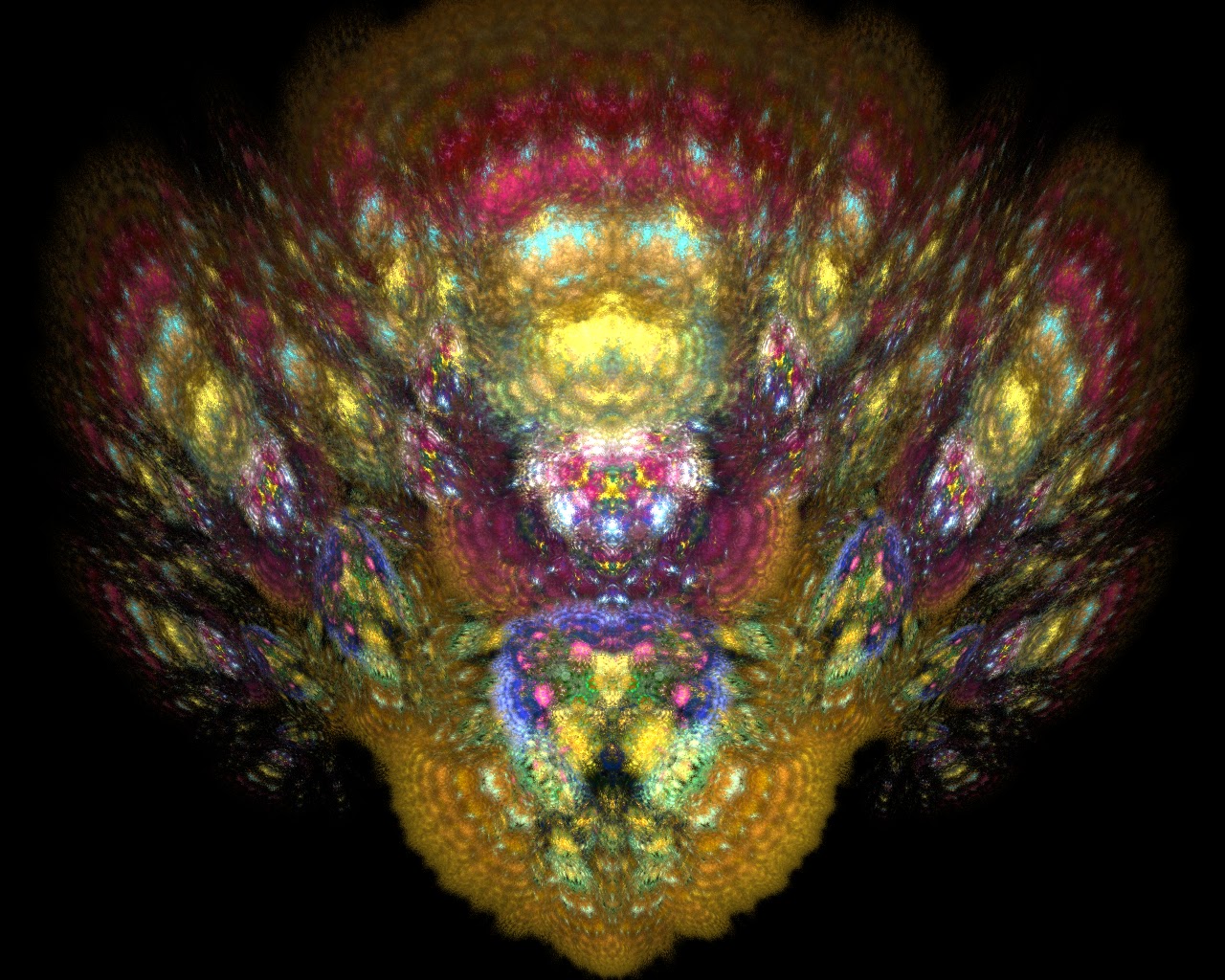
This one is fresh off the presses! It's a composite of two flames with a bit editing done. Enjoy.

Thursday, May 13, 2010

On Fractal Flames

A few posts ago, I realize I mentioned 'fractal flames' without further explanation, in the context of saying how much cooler nebulae are. Fractal flames are hobby of mine, and they're still pretty cool.

Basically, fractal flames are art generated by math. Fractals themselves could be considered a subclass of this, but fractal flames are much more general and artificial. With that said, let's get to the cool pictures!

This one is a 3'x2' poster hanging in my room. My favorite.

So, fractal flames are pretty cool. I post all of them to my Photobucket Account, along with some other regular fractals. The software I made all these with is called Apophysis, which you should totally check out. It takes some practice, but fractal flames are so awesome that it's not too hard to stumble across something awesome, tweak it a bit, and render a great image. Most fractal flames are abstract, but occasionally something discernible jumps out. Both of these were made with a single render, and no editing except color fixing done to them.
And there you have it: the rest of the story of why I'm called Fractal. If you have time, check out Apophysis and make mind-blowingly cool images of your own!

Tuesday, March 9, 2010

On Fractals, Part 2

Recently I and a friend concurrently stumbled upon this article on how an adaptation of the root-finding algorithm Newton's Method led a mathematician (the co-author of my math text from last year, actually) to discover a fractal pattern in the distribution of which starting points led to which roots of a function. A quick explanation:

Newton's Method is an algorithm invented by physicist, mathematician, alchemist, and all-around genius Isaac Newton for finding roots of a function--places where it equals zero. It's quite simple, and though it has some drawbacks, when it finds roots it finds them incredibly quickly. As my CSci 2031 professor won't let us forget, it's the basis for a lot of numerical answer-finding algorithms today since it's so easy for computers to perform. But it only finds at most one root, so one run of the method isn't sufficient for a function with multiple roots.

The fractal in the first link was generates by testing a variety of points in the complex plane with an adaptation of Newton's Method that apparently works with complex numbers (I'm fuzzy on the details). The function used was f(z) = z^3 - 1, which has only one real root (1) but two more complex ones. Points were colored red, blue, or green depending on which of the three roots Newton's Method found starting from that point, resulting in an infinitely complex, self-similar pattern--a fractal. Not as complicated as the Mandelbrot set since it mostly has one pattern that repeats, but still cool. I don't know why complex functions so often tend to produce mind-blowing patterns like this, but it's one of my favorite math mysteries.

Friday, March 5, 2010

On the Origin of Mathematics

Tonight I was treated to a most excellent discussion on, among other things, the origin of mathematics and science: man-made or divine?

First, let me say a few words about the means by which I learned about and was able to participate in this discussion, namely Mars Hill. Mars Hill is a student organization at the U of M where we discuss various topics of academia, philosophy, and religion from a scholarly perspective. We welcome anyone interested in a good, deep discussion; topics this year have ranged from the nature of beauty to just war theory to what I'm about to write about.

Anyway, tonight our discussion came to the nature of math and science. What are they, and are they human creations or from God? For a former math major with considerable experience with the subject, it was a good topic for me. We started with science; the consensus was eventually that science is the rational study of the physical world, i.e. the creation. Then, on to the nature of math. My initial position was that mathematics is a series of statements derived from applied logic and exists separately. Others argued based on how we study math or what we do with it, but out speaker urged us to define it as "the study of ____". She defined it as the study of structure, which was new to me. The way I see it now, the mathematical truth is objective and not man-made, but mathematics is the study of how it all works and is man-made. Logic is the basic tool we use to study math.

Lastly, I apologize for my extremely abbreviated description of the discussion that doesn't do it justice. If anyone with a functioning memory who was there happens to read this, feel free to add on.

Greetings from the internet, plus why I am called Fractal David

Well, guess who started a blog. I think some of my thoughts have been bouncing around in my oversized head for a bit too long. This blog will be the outlet for them, hopefully for the general enlightenment of all who read it. Hopefully after partaking you will somehow feel less confused than before. (or perhaps more?) Anyway, I feel under a good deal of pressure to make my first post a good one, so I'll begin with a subject that is very dear to me:

Fractals are cool. I mean it--really, really cool. Objects in real life are limited in how complex they can be--once you look at them closely enough, they're just atoms, and not far beyond that is all theoretical physics and speculation. Fractals, on the other hand, are different: they're infinitely complex. No matter how far you zoom in on one, they never get any simpler; you can never get down to their smallest constituent because they go on forever.

Some of the simplest fractals are generated by simple processes. The Cantor set, for instance, starts with a line. Remove the middle third of this line. Repeat the process for the two thirds of the line you have left, giving you four shorter lines. Repeat this process on each line ad nauseum until all that's left is a fine dust of infinitely many infinitely short lines. The first few steps of this process look like this:

Pretty cool, and infinitely complex, but not terribly interesting. Other fractals of this kind include the Koch curve, the Peano curve, and Sierpinski's triangle, which I encourage (but don't force) you to look up.

But other processes can make much different, more interesting fractals. By choosing a complex number and repeatedly squaring the result and adding the original number, a fractal can be made out of the points that don't become infinitely large: the Mandelbrot set, which looks something like this:
Much more interesting than a collection of line fragments, in my opinion. The Mandelbrot set has a fascinating geography unlike anything in real life, showing various infinite patterns wherever you zoom in along its boundary. Coolest of all is that smaller versions of the whole set are hidden away in it--the tiny black dot on the uppermost 'branch' of the set is one. This video illustrates just how ridiculous the Mandelbrot set is better than my ramblings ever could. If you don't feel like sitting through the whole 10 minutes (it gets kind of repetitive), skip to the end, where after zooming in to a magnification that dwarfs the size of the universe, we finally get back to a minuscule version of the whole set. I honestly cheered the first time I saw that.

Anyway, this infinite complexity and self-copying make fractals amazing. I don't doubt I could spend my life trying to understand why such a simple process can generate something so far beyond human imagination as the Mandelbrot set. But it's always fascinating to try. Exploring the Mandelbrot set is a hobby that never gets old.

So hopefully you're now at least a fraction as excited about fractals as I am. In conclusion, hello. And until next time, goodbye.