Someone who has actually tasted truth is not contentious for truth.
Someone who is considered by people to be zealous for truth has not yet
learnt what truth is really like; once he has truly learnt it, he will
cease from zealousness on its behalf. (Kephalaia IV.77; The Wisdom of Saint Isaac the Syrian, translated by Sebastian Brock)
When I first came across this passage of St. Isaac a few months ago, it grabbed my attention forcefully because I recognized its truth in myself (and not because I'm "someone who has actually tasted truth"). As I've listened to the reflections of wiser men than myself, I've began to glimpse its profundity, far greater than I first imagined. In just a few words, this bishop who lived in the seventh century on the other side of the world diagnosed a spiritual sickness that is running rampant to this day.
Before I can begin to explore more of what St. Isaac meant, a bit of ground-clearing is in order. He wrote against being "zealous" or "contentious" for truth, but aren't we supposed to have zeal for God (Rom 10:2, 2 Cor 7:11), and "to contend for the faith that was once for all delivered to the saints" (Jude 1:3 ESV)? How can Isaac proscribe what God commands?
The first thing to note is that as his title implies, St. Isaac the Syrian was not writing in Greek, but in Syriac, so of course the words he used for "zealousness" or "contentious" are not exactly the same ones used in the New Testament. This makes possible the same kind of semantic slippage that we see in the denigration of the "passions" (epithymia) as dangerous and needing to be subdued both in the New Testament (Rom 6:12, Gal 5:24, Tit 2:12) and in the Orthodox tradition, whereas today the word "passion" is used much more positively, especially in Evangelical Christianity, to mean a God-given affinity or calling to something that is generally worth following.
I don't know a word of Syriac, but I can at least investigate how the New Testament speaks of "zeal" or "contending". The word used in Jude 1:3 is unique in the NT, but it is constructed from the more common root agonizomai, "I struggle/fight", used by Paul to refer to "fighting the good fight" (1 Tim 6:12, 2 Tim 4:7), as well as striving in the work of God (Col 1:29) or to lay hold of salvation (Luke 13:24). Paul uses it to metaphorically describe the way of Christ as a foot race in which we compete for the prize, salvation (1 Cor 9:25). Just once is it used negatively, to refer to physically fighting in John 18:36.
The Greek word for "zeal", in both its noun and verb forms, is more mixed. It frequently denotes envy, jealousy, or coveting (Acts 7:9, 13:45 17:5, Rom 13:13, 1 Cor 13:4, 2 Cor 12:20, Gal 5:20, Jas 3:14,16, 4:2) and can also mean indignation (Acts 5:17, Heb 10:27). But it can also be rendered as earnest desire (1 Cor 12:31, 14:1,39) or simply "zeal" (John 2:17, Rom 10:2, 2 Cor 7:7, 11, 9:2, Phil 3:6, Col 4:13, Rev 4:19). Paul writes that "it is good to be zealous in a good thing always" (Gal 4:18 NKJV). Paul is "jealous for you [the Corinthians] with godly jealousy" (2 Cor 11:2), and in the Septuagint God himself teaches that he is a "jealous God" (Exo 20:5, 34:14, Deu 4:24, 5:9, 6:15, Jos 24:19).
What it seems to me is happening with these usages is that zeal/jealousy and contending/fighting/struggling, while literally denoting undesirable qualities, are being used metaphorically to mean something good. I don't know what else to make of "godly jealousy". It's somewhat like how Jesus commands us to hate our parents (Luk 14:26)—obviously he is not commanding us to break the fifth commandment, but calling us to love God so surpassingly above any other attachment that it seems like hatred in comparison.
Most people are already aware of this example; I think something similar is going on with the usage of epagonizomai and zelos/zeloo. Physical altercations and quarrels have no place among God's people, but there is a "good fight" to fight (1 Tim 6:12), and we are to "contend" for the faith (Jude 1:3)—describing how we are to strive for the life and salvation of ourselves and others with the vigor and discipline of an athlete or a soldier. God's concern for the good of his people, that they worship and serve only him, is so strong and stringent that it is described as jealousy (Exo 20:5), as is Paul's (2 Cor 11:2). God wants us to belong to him and not to any idol or lesser thing. When applied to us (Gal 4:18), zeloo probably likewise refers to the fervor, exclusivity, and purity of our devotion to "a good thing", and not anything else. Likewise, the "zeal" for which the Levite Phinehas is commended in Numbers 25:11 (same Greek root) is his concern for the purity of Israel's worship, mirroring God's zeal/jealousy for his people.
Presumably, St. Isaac did not have these positive meanings of "zealous" and "contentious" in mind, but was writing more literally, with the negative connotations not elided through metaphor. I also think he was speaking more with respect to the inner life, whereas the NT authors are metaphorically describing external actions and disciplines by drawing parallels between them and combativeness or jealousy. (This is especially evident in descriptions of God as jealous, which are certainly anthropomorphisms) The Reformed theologian R.C. Sproul paraphrases his peer John Piper as aptly saying "that we not only have to believe the
truth, that it’s not enough even to defend the truth, but we must also
contend for the truth. That does not mean, however, that we are to be
contentious people by nature." I think St. Isaac is highlighting this same distinction, between contending for the truth and becoming contentious.
That wraps up the ground-clearing. The next post will be longer and delve as deeply as I can manage into what St. Isaac did mean.
Sadly, this interlude isn't for as high a purpose as the interlude of my series on God's providence two years ago, which marked a major turning point in my struggles with doubts about God's goodness (already related in post 3 of this series). This is just some extra material that was supposed to go in post 7, but which required enough explaining, unpacking, and digressing from the main trajectory of my story that it seemed best to split it off. (This way you can skip it if it puts you to sleep)
Somewhat relatedly to my thinking about epistemology, I kept wrestling with a theological habit that I've noticed for years, but have had a lot of trouble clearly defining. I call it "spiritual object" thinking. I saw it in a lot of the theological "big important words" that form the building blocks of evangelical theology.
Pinning it down
After a good deal of reflection, I think I can take a stab at defining it. I think that at the root of spiritual object thinking is the assumption that our theological terminology corresponds to clearly-definable theological concepts on a one-to-one basis—a simple form of the view that truth is "that which corresponds to reality". These term/concept unities are what I call "spiritual objects". They are assumed to have some kind of substantial existence or "life-of-one's-own" as opposed to being human constructs, somewhat like Plato's forms, and so are kept conceptually separate from one another with careful definitions. (For example, "righteousness" and "justice", which are translated from the same word in biblical Greek, dikaiosyne, though krisis, "judgment", is a different word and can sometimes translate to "justice" as well)
From there, the way these concepts/terms are used goes in two different directions. First, we specify a large amount of meaning for them, so that concepts like "salvation", "gospel", "the glory of God", etc. become very rich and deep. But at the same time, we try to pin down and establish these meanings very precisely. Normally, words can take on a range of possible meanings, determined by their usage and context, centered around what we would consider their definition. For example, the verb "plan" takes on different connotations when it is used to describe a shopping excursion vs. a military operation; the two meanings coincide at a certain level of abstraction. Words can also be used in more concrete or more metaphorical/analogical ways, like "concrete". Normally rich, deep words like "love" have a very wide range of possible uses on multiple levels; it's part of what makes them so rich.
But theological concepts that we treat as spiritual objects are different. While we specify lots of meaning for them, we do so in a narrow way. Their "conceptual space" (to borrow a term from Douglas Hofstadter) is small or nonexistent; they mean basically the exact same thing regardless of context, like technical terms or symbols in formulas. Their meaning is self-contained; the only context they require to be fully meant is other abstract spiritual objects. When we encounter the "regular", more concrete versions of these concepts, we don't treat them independently but subsume them under the spiritual object version, which is seen as more important or simply more real, again something like Plato's forms.
Some examples:
When we think about (say) sin in a spiritual object manner, we can do so without reference to a particular sin committed (which could be anything) or the one doing the sinning (who could be anyone); the one sinned against is always the same. We refer to an abstracted concept of sin, apart from particulars, as the human condition of alienation from God and an inability to do good on our own, inherited from Adam.When we do get to talking about particulars, we still use our self-contained, context-free understanding of sin. Rather than focusing on our particular sins, we mostly see this spiritual object of sin that has to be dealt with by the spiritual object of justification so that we can receive the spiritual object of salvation, etc... After being saved, though we still commit sins, our "sin" has been taken away by Jesus, which is considered the important part but which shows the difference between the definitions.
When we talk about "salvation", we mean the very specific process where our "sin" (see above) is exchanged for Christ's righteousness via imputation. Again, we can do so without reference to the person being saved; the one doing the saving and what he/she is saved from are always the same. We see it as a spiritual object that God gives us in exchange for "saving faith", and can (or definitely can't, depending on your tradition) be "lost". The theological concept of salvation is quite consciously held distinct from lesser salvations (individual instances of deliverance or rescue from something). For example, we make clear that though an important sacrament, the act of baptism is not salvific in itself; it is merely a signifier of the true act of salvation which happens by faith alone. Similarly lesser biblical salvations (like the Israelites from Egypt and Babylon, or Noah from the flood) are seen as "foreshadows" of the true salvation that comes from Christ.
"Inspiration" is a spiritual object that the books of the (Protestant) biblical canon are believed to have which automatically makes them (or our interpretation of them) "authoritative" over any other source of truth. We can talk about it without reference to what, specifically, it means for a certain book of the Bible to be inspired; it just is, what what we may say about specific books is subsumed under it. It is intentionally differentiated from lesser instances of brilliance (literary or otherwise) that we might call "inspired" in other contexts. Either a book is inspired, or it merely human words.
This way of conceptualizing theological truth is more prescriptive than descriptive; the realities we talk about are established abstractly and then used as a pre-formed mold into which we expect our own situation to fit. It is more universal and propositional than particular and personal. It tends to view concepts more as nouns than verbs, even ones like "salvation" or "inspiration" that start as verbs. Because they are thought to be based on God's infinite nature, they are thought of as absolute, all-or-nothing, totally present or totally absent. The practice of typology is not dependent on spiritual object thinking, but with its casting of biblical people and events as "shadows" of the life and work of Jesus, it lends itself easily enough.
I stress that these are tendencies, not certainties and certainly not hard-and-fast rules that theologians are taught to follow. But that doesn't mean they aren't real. I think this kind of "spiritual object" thinking describes a fair deal of how evangelical Christians process and handle the gospel, at least at the lay/semi-academic level. I think it boils down to the bad habits of oversystematization and overabstraction in academic theology. It is what happens when the systematic descriptions of theological truths become our definitions for them. It can induce us to read the Bible as a systematic theology textbook rather than the diverse, often-messy, always-surprising collection of inspired books that it is.
Words break
The problem (besides the fact that we're digesting Christian theology into a form that bears little resemblence to anything in the Bible) is that language (certainly theological language) doesn't work the same way as mathematics. You can't expect to encapsulate theological concepts into self-contained definitions that simply interact like variables in a formula. Trying to pack so much meaning into isolated words risks making them meaningless and largely disconnected from experience—at least for me. I'm reminded of a poem that N.T. Wright cited to illustrate the weight that gets placed on on the word "justification".
Words strain,
Crack and sometimes break, under the burden,
Under the tension, slip, slide, perish,
Will not stay still.
(T.S. Eliot, Four Quartets, I.v)
In one journal entry, I objected to the "spiritual objectification" of the "glory of God", which I frequently heard thrown around as little more than the generic justification for God to do anything. Is this really the place the glory of God should occupy in our theology?
'The glory of God'—three simple words behind (or within) which much can be hidden. It's as if a breathtaking mountain landscape could be packed into a suitcase and carried off, bought and sold, changing hands dozens of times while its handlers remain blind to its contents. (2013-9-9)
If I wrote this entry today, I might have the suitcase be full of dynamite instead. In another entry, I was becoming suspicious of how oversystematization tends to make us read concepts like "gospel" as technical terms, always referring to the same thing. I observed the potential for misreadings of Scripture this could cause:
Galatians 3:8 reminded me of how much we have turned 'the gospel' into a technical term, a bit of Christian jargon. But Paul seems to be using it to simply mean 'told good news' here. Our technical definition forces us to read all kinds of meaning into simple passages so 'the gospel' as we define it can be found there. (2013-11-27)
I also observed how it sets us up to see "tensions" where there need not be any. By trying to nail down clear, context-free definitions of things, it can unnaturally separate things that come together in the Christian gospel.
Spiritual object thinking tends to miss how the various parts of our salvation and new life can paradoxically combine—God's grace and our effort/works, the divine inspiration and humanity of Scripture, the divinity/humanity of Jesus...it puts these concepts in airtight compartments. We can talk about how they interact as from a distance, but this doesn't go far enough, as a relational model does, which views them as dynamic parts of a relationship. It [spiritual object thinking] also leaves the question of how to apply things like 'life by grace' rather open to hidden tradition. Relational theology sees these things as their own application. (2014-1-5)
Such important parts of the Christian message, viewed as spiritual objects, seemed to be always held at arm's length; you had to authentically understand and believe them, then somehow apply them to your own life. I longed for a more immediate theology where definitions did not abstractify and isolate from our experience, where the simplistic model of belief -> application was shaken up, if not done away with entirely. I nebulously termed this ideal "relational theology", but I had trouble specifically describing it, much less envisioning it.
A better way?
I'll get to how I went about finding a way past this kind of oversystematic thinking later. But for now, in light of how I've defined it, some suggestions present themselves.
First, we can realize that even though we have the Bible, we are still only human. We have no God's-eye perspective on spiritual realities; there is much beyond our purview, and our terminology doesn't necessarily map directly to tidy, noun-like concepts, even if it is from Scripture. The limitations of our knowledge don't just mean that we can't always find answers to our questions—the questions themselves, and the categories/patterns of thought that underlie them, may need correcting.
We should strive to be descriptive rather than prescriptive in our theology, realizing the fine distinction between understanding something and controlling it, if only in our minds. We should be open to redefining and expanding our theological concepts, even radically, and not exclusively holding onto the definitions we've built as "the way things are". Realizing that our terms and definitions will never fully encompass the things of God frees us from expecting them to pull so much weight and from using them as technical terms. We are able to use them in smaller (but still important) ways, like calling the manifestations of grace by which God delivers us from sin "salvific" without detracting from Christ's "finished" work of redemption by doing so.
In light of Jesus' identity as the ultimate Truth God reveals to us (Jhn 14:6, Hbr 1:1), we do well to pay attention to the personal, experiential side of truth as well as the propositional, even though it can be much messier. This doesn't replace the propositional aspect of Christian belief—there are plenty of definite things about Him to proclaim—but it puts doctrine in its proper place and makes our theology dynamic not static; personal not mathematical. We can never define a human person completely with propositions; how much less God Himself! Persons can always surprise us—though we can trust that, being perfect, Jesus will only do so positively. Trusting God to be Himself even on admittedly imperfect knowledge is a crucial part of what faith is. What we say and believe about Jesus avails us nothing if it isn't informed by our knowing and being known by Him.
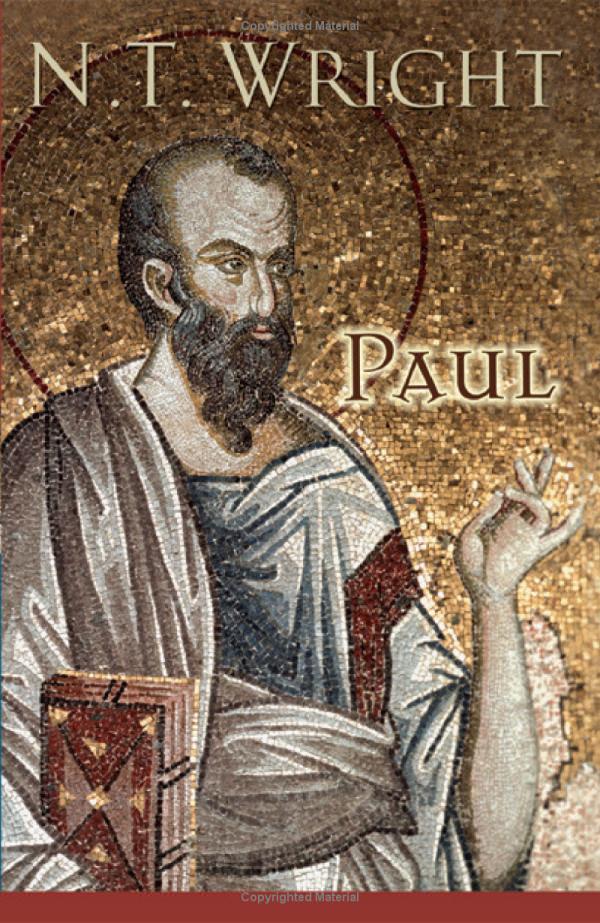
I've recently been reading an excellent book by N.T. Wright on Paul. It's basically an in-depth look at Paul's religious, social, historical, and political contexts, and the various strains of thought that his presentation of the gospel brilliantly ties together.
Some of the more thought-provoking points Wright makes:
He emphasizes the role of narrative and story: how the Jews saw themselves as caught up in one story, and how Paul presents the gospel as the happy ending of this story.
The main point of narratives in the second-Temple Jewish world, and in that of Paul, is not simply that people likes telling stories as illustrations of, or scriptural proofs for, this or that experience or doctrine, but that second-Temple Jews believed themselves to be actors within a real-life narrative. To put it another way, they were not merely storytellers who used their folklore (in their case, mostly the Bible) to illustrate the otherwise unrelated joys and sorrows, trials and triumphs, of everyday life. Their narratives could and did function typologically, that is, by providing a pattern which could be laid as a template across incidents and stories from another period without any historical continuity to link the two together. (11)
He views Paul's writings on the gospel through two main lenses: creation and covenant, which he sees (and argues Paul saw) as deeply interwoven. God makes a covenant with Abraham to restore the fallen creation, the people of the covenant turn out to be part of the problem (sinful), so God comes in human form to fulfill the covenant where sinful man could not and ultimately renew all creation in Himself.
He proposes that δικαιοσυνη θεου ("the righteousness of God") refers not to righteousness that God imputes to us, but "the faithful covenant justice of God", which is revealed through the person of Christ and by which God is to be "faithful to the covenant and just in his dealings with the whole creation". This strikes me as a more plausible reading free of the focus we often place on individual salvation.
The whole chapter on Gospel and Empire, which made me realize just how political Paul's writing was. At almost every turn, he sets Jesus up over and against the emperor. People accepted the emperor as their "lord and savior", who ruled them and granted them "freedom, justice, peace, and salvation"—salvation from civil strife and external enemies. The announcement of these themes was known as the ευαγγελιον—"good news". The παρουσια, parousia, was the arrival, appearance, and royal presence of the emperor. So Paul declares the ευαγγελιον of Jesus Christ, not the emperor, the true Lord and Savior of the world. It's amazing to see how much of Paul's language was to show off Christ as a direct answer to the claims of the empire.
And most of all, he points out how he translates πιστις χριστου (e.g. in Galatians 2:16) as "the faithfulness of Christ" instead of "faith in Christ". I might have previously just remarked at this as an eye-opening linguistic trick to help us see another side of salvation by faith, but I have been renewing my studies of Greek lately, and my jaw dropped as I realized that not only was this a possible translation, it was the natural translation.
What follows is a brief excursion into Biblical Greek explaining how this translation works. If you already believe me, feel free to skip to the next heading.
Greek has four main noun cases: nominative, genitive, dative, and accusative. Nominative is used for nouns that serve as the subject of a sentence or phrase; genitive roughly corresponds to the possessive case in English (τον πλοιον Πετρου means "Peter's boat", or "the boat of Peter", with Peter in the genitive case); dative is used for indirect objects or spatial relations like "in", "with", or "by"; the accusative is used for direct objects.
Here is Galatians 2:16: "Yet we know that a person is not justified by works of the law but through faith in Jesus Christ, so we also have believed in Christ Jesus, in order to be justified by faith in Christ and not by works of the law, because by works of the law no one will be justified."
What is happening here is that in the phrases translated "faith in Jesus Christ" and "faith in Christ", "Jesus Christ/Christ" is in the genitive, not the dative case. If Paul really wanted to say "faith in Christ", he would put "Christ" in the dative case and use εν, the Greek preposition for "in" , as he does in Colossians 1:4:
την πιστιν υμων εν Χριστω Ιησου = "your faith in Christ Jesus".
This construction is also used in Acts 27:25, Ephesians 1:15, 2 Thessalonians 1:4, and 1 Timothy 3:15.
Or he might say "Christ" in the accusative case and the preposition εις, "into" as in Acts 24:24:
της εις Χριστον Ιησουν πιστεως = "faith in Christ Jesus".
This construction is also used in Acts 20:21, Acts 26:18, Colossians 2:5, and 1 Thessalonians 1:8.
But Paul doesn't do that in Galatians 2:16. In both cases, "Jesus Christ/Christ" is in the genitive case. There is one possible translation of the genitive that can give us something like "faith in Christ" (actually "the faith received by Christ"), but if this is what Paul is getting at it seems much more likely that he would use one of the two unambiguous ways of saying "faith in Christ" he already knew. Again, translating πιστις Χριστου as "faith in Christ" gives a meaning much closer to that of the dative or accusative cases. The natural inclination when you see the genitive case is to assume it refers to possession or description (using the key word "of") unless this does't make sense. But here the natural translation does make sense, if we recall that πιστις, besides meaning "faith" or "trust", can also mean "faithfulness".
The Faithfulness of Christ
So πιστις Χριστου, while possibly translating to "faith in Christ", much more defensibly translates to "faithfulness of Christ". Of course, after realizing this, I searched for other times when this phrase may have been...shall we say, strangely translated. They are as follows (again, try mentally substituting "the faithfulness of" for "faith in"):
Mark 11:22: And Jesus answered them, “Have faith in God. (This one arguably makes more sense translated as it is)
Acts 3:16: And his name—by faith in his name—has made this man strong whom you see and know, and the faith that is through Jesus has given the man this perfect health in the presence of you all.
Romans 3:22: the righteousness of God through faith in Jesus Christ for all who believe. For there is no distinction:
Galatians 2:20: I have been crucified with Christ. It is no longer I who live, but Christ who lives in me. And the life I now live in the flesh I live by faith in the Son of God, who loved me and gave himself for me. (This one is difficult for me to translate. The relevant part literally means something like "And that which I now live in the flesh in [faith/faithfulness] I live [it? in it?] of the son of God". So the Greek for "I live it" could just be inserted into the phrase "the faithfulness of the Son of God", or it could be something I don't understand.)
Galatians 3:22: But the Scripture imprisoned everything under sin, so that the promise by faith in Jesus Christ might be given to those who believe.
Ephesians 3:12: in whom we have boldness and access with confidence through our faith in him (Interestingly, the Greek here has nothing like ημων, "our"—it is added in the translation.)
Philippians 3:9: and be found in him, not having a righteousness of my own that comes from the law, but that which comes through faith in Christ, the righteousness from God that depends on faith—
Colossians 2:12: having been buried with him in baptism, in which you were also raised with him through faith in the powerful working of God, who raised him from the dead.
James 2:1: My brothers, show no partiality as you hold the faith in our Lord Jesus Christ, the Lord of glory. (Also makes more sense translated as it is)
These last two examples are grammatically ambiguous, as the conjugation of "Jesus" in the constructions "of Jesus" and "in Jesus" are impossible to distinguish.
Romans 3:26: It was to show his righteousness at the present time, so that he might be just and the justifier of the one who has faith in Jesus. (This is even more confusing. The straight literal translation is something like "in order to be just and justifying the one [from/out of] [faith in/faithfulness of] Jesus". The best translation of this is beyond me.)
Revelation 14:12: Here is a call for the endurance of the saints, those who keep the commandments of God and their faith in Jesus. (This one makes more sense translated as it is)
Sola sola sola sola sola sola sola fidei fidei fidei fidei fidei fidei fidei
If this is making you uncomfortable, know that I'm definitely not trying to mount some kind of hermeneutical assault on salvation by faith per se. There are still plenty of verses that unambiguously support it. What I am getting at is the reason this realization practically took my breath away as I searched through the New Testament looking at it. Namely, the strong emphasis in Protestant (particularly Reformed/Evangelical) circles that is placed on salvation by faith, which to me is almost suffocating at times—strong enough to lead to such a counterintuitive translation of relatively straightforward Greek. It's almost like an arms race, or a game of one-upsmanship, to see who can focus more on just how totally salvation is by faith alone.
This emphasis on faith leads to an emphasis (possibly even stronger) on what is perceived from Paul's writings as its opposite—that dirty five-letter word, works. So Paul is read, perhaps anachronistically, as almost constantly proclaiming the freeness of salvation, depending only on faith, never from works. Sometimes it's seemed to me like the gospel is presented more as the opposite of salvation by works, or that Evangelical boogeyman known as legalism. For someone like me who doesn't closely identify with Paul's former legalism (my delusion tends to be that I can redefine what it means to be "justified" to a definition more suitable to me, not that by working hard enough I can satisfy what I perceive to be God's definition), this negatively defined gospel is meaningless.
It also leads to something of a contradiction of methods. We constantly, adamantly insist that salvation is a gift of God, that we can never possibly earn it in or do anything to deserve it in any way—yet equally prominent in Evangelical rhetoric is the be-all and end-all condition for salvation, namely our faith. Salvation absolutely doesn't depend on anything we do, but it absolutely is conditional on the faith we have. How is this contradiction resolved? Simple—by presenting faith itself as a gift that God gives us or creates in us, not something we choose or decide for ourselves. Nevermind the obvious question of why then God doesn't just give everyone faith, and all its implications—placing all this emphasis and importance on something in ourselves (whether we do it or God does) when the point of faith is its reliance on something outside ourselves is merely a less obvious contradiction, one that could be alleviated if we realized that πιστις, the Greek word for faith, equivalently translates to "trust".
This is why my realization from N.T. Wright was such a breath of fresh air. Shifting our focus from salvation by faith in Christ to salvation by the faithfulness of Christ, ironically, helps to create faith in Christ by concisely showing how the primary actor of redemption is not ourselves having faith, but God, in the person of Jesus, acting with perfect faithfulness to the covenant He made with Abraham, by which He has always intended to make all things new. I felt a bit like the first Christians felt, rereading their whole Bibles through the lens of their new knowledge of Christ. I will probably say much more on this subject as I continue to think about what the Gospel really means, but for now I prefer to (re)read.
The glory of God—three simple words, so often used in theology (starting with Paul) to refer to the ultimate purpose of God, our lives, history—virtually everything. But much can be hidden behind them, and I sometimes wonder if by using them so much we've forgotten what they really mean.
It's as if a breathtaking mountain landscape could somehow be packed into a suitcase, carried off, bought and sold, changing hands dozens of times, its presence duly recorded in arrival logs and transaction ledgers, spoken of as one might refer to the next shipment of wood, a drop in the ocean of human endeavours for the day, all while its handlers remained ignorant of its awesome contents. I say unpack the suitcase, and let the grandeur speak and be seen for itself rather than being spoken of.
If you've been following my blog in pretty much any capacity of late, you know that I just won't shut up about the nature of truth, the role of doctrine, the evolution of my perspective on the Bible as the word of God and Jesus as the Word of God, et cetera. Lately my suspicions have been confirmed--what I have been advocating so strongly for is a distinctly postmodern view of Christianity and truth. Myron Bradley Penner, in the introduction to his book The End of Apologetics, gives a good definition; he sees
postmodernity as a kind of self-reflexive condition that emerges as modernity becomes conscious or aware of itself as modernity...it makes little sense to think of the postmodern ethos as characterized by a set of theses or adherence to philosophical doctrines and positions. Postmodernity is a condition, or a set of attitudes, dispositions, and practices, that is aware of itself as modern and aware that modernity's claims to rational superiority are deeply problematic.
The massive post I just finished a few days ago is all about moving from a strictly propositional, heavy, doctrine-oriented definition of "faith" to one rooted in the heart, or (using Greek to escape the overly emotional connotations) the καρδια. It questions whether truth itself is primarily propositional and natively suited to expression by words and rational discourse and pushes a role of scripture that is more about finding Jesus the Truth than finding inerrant "Biblical" truth about God.
Compare that with this article by Scot McKnight about the postmodernism of the emerging church movement, which says:
The third kind of emerging postmodernity attracts all the attention. Some have chosen to minister as postmoderns. That is, they embrace the idea that we cannot know absolute truth, or, at least, that we cannot know truth absolutely. They speak of the end of metanarratives and the importance of social location in shaping one's view of truth. They frequently express nervousness about propositional truth. LeRon Shults, formerly a professor of theology at Bethel Theological Seminary, writes:
From a theological perspective, this fixation with propositions can easily lead to the attempt to use the finite tool of language on an absolute Presence that transcends and embraces all finite reality. Languages are culturally constructed symbol systems that enable humans to communicate by designating one finite reality in distinction from another. The truly infinite God of Christian faith is beyond all our linguistic grasping, as all the great theologians from Irenaeus to Calvin have insisted, and so the struggle to capture God in our finite propositional structures is nothing short of linguistic idolatry.
Though I would probably try to express it in less dense language, I pretty much agree with these sentiments, in the sense that we should rejoice that it's a testament to the grandness and majesty of the Truth that we can't know Him absolutely as we can know a doctrinal system. The comments on language are also echoed by posts I've written recently on language and how, though it is the best tool we have for communication, it is an imperfect one at best whose limitations become evident when speaking of God.
What really amuses me is that I cited that same Christianity Today article in one of my very first posts over three years ago when I didn't know who Scot McKnight is, only I was critiquing the emerging church and especially postmodernism. Normally I intensely dislike line-by-line rebuttals of peoples' writing (as if they're never allowed to be the slightest bit right), but my twenty-year-old self is in no position to defend himself and I'm quite willing to be hard on him. Let's do this.
Several things of this description of the emerging church distinctly worry me. Foremost is the movement's embracing of postmodernism, a pervasive system of thought whose central message is (correct me if I'm wrong) that scientific, rational attempts to figure the universe out have failed and that there is no one objective reality or truth, only everyone's own perception of it.
Sure, I'll correct you. Of course scientific-esque, rationalistic attempts to fully, objectively describe "the universe" or some part of the nature of God have failed. This is because what they tend to come down to is an attempt to place yourself, epistemologically, in the position of God as the one who has perfect knowledge, which amounts to a denial of your finite creature-ness. Jesus really was God and was uniquely entitled to use truth in this way (that is, tell everyone, "Your theology is wrong and I'll tell you why because I know the truth" and be totally correct), but by and large He didn't because He Himself was the Truth He was communicating to people (John 14:6). As I recently put it, this kind of beating people over the head with truth entails "assuming that we ourselves are infallible because we possess an infallible gospel", or are in communion with an infallible source.
Postmodernists put everything under skepticism (even, hopefully, postmodernism itself) and are leery of any truths that claim to be objective, or universal.
Well, yes. I've changed the title of my blog a few times since writing that and it now incorporates the seeming contradiction "faithful skeptic", reflecting my willingness to question anything, including my own epistemology. The conflict over "absolute truth" is probably the biggest point of friction between postmodern types and evangelicals, who see it as an attempt to undermine the very validity of the "gospel". Of course I believe absolute truth exists, most especially in the person of Jesus Christ. And it's fine to try to communicate this truth (even in propositional form) or to claim to know it. But if Jesus is the Truth, then truth is not essentially propositional (that is, directly expressible through words and graspable through logic) in nature. You could say these things aren't truth's "native language". And while our words can describe truth to a high degree of accuracy, they always (except in technical fields) involve simplification, like projecting a three-dimensional scene onto a two-dimensional screen.
An example might help show what I mean. The (to understate) ongoing conversation between Calvinists and Arminians is a tense one because each "camp" has, beneath its respective five points about how predestination and salvation work, a very different position on his God works in and through His people. To the Calvinist, people are so fallen and tainted by sin that they are incapable in themselves of doing or willing any good, so their salvation and sanctification are wholly the gracious work of the God who chose them before the foundation of the world through faith alone (which is itself a gift from God by the regeneration of the Holy Spirit). The Calvinist embraces verses like Ephesians 2:1-10, which reads, in part:
But God, being rich in mercy, because of the great love with which he loved us, even when we were dead in our trespasses, made us alive together with Christ—by grace you have been saved—and raised us up with him and seated us with him in the heavenly places in Christ Jesus, so that in the coming ages he might show the immeasurable riches of his grace in kindness toward us in Christ Jesus. For by grace you have been saved through faith. And this is not your own doing; it is the gift of God, not a result of works, so that no one may boast.
(The Calvinist is sure to point out that Paul is saying that faith itself is a gift from God, so that we have absolutely nothing in our walk with God that we can boastfully claim as "our own") To the Arminian, people are not passive spectators but, again by God's grace, active participants in God's work in them who are (by prevenient grace) able to freely respond to and "go along with" Him even as His Spirit does the real work. They point to Philippians 2:12-13:
Therefore, my beloved, as you have always obeyed, so now, not only as in my presence but much more in my absence, work out your own salvation with fear and trembling, for it is God who works in you, both to will and to work for his good pleasure.
To the Arminian, Calvinism makes God out to be an all-controlling dictator and ignores the role we are assigned in our spiritual life; to the Calvinist, Arminianism portrays God as an ineffectual softie whose plans are easily thwarted by human will and makes humans out to be their own functional saviors by the power of their own choices. To all of this, I respond that even before I try to draw any conclusions of my own about God's providence (which I have done very extensively), I question whether the two camps are as diametrically opposed as they seem. Could it be that the Calvinist and the Arminian both have the same intuitive, nonverbal sense of "what is really going on" when God works in us (which is independent of their perception of it), but then interpret or describe it in sharply different ways according to their chosen theological systems, both of which fail to fully describe the reality? Is this view--that something has a life and truth of its own apart from what we can say about it--more or less "objective" than the absolutist paradigm under which theology is usually pursued?
At least to me, there seems to be a bit of a problem with attempting to combine postmodernism and Christianity. While postmodernism denies that we can know any truly universal truth, Christianity emphatically declares that we can know the truth--and not just that we can intellectually grasp the truth, but that we can truly know the Truth, the Way, and the Life. The person of God--father, spirit, and son-- is the ultimate foundation of Christianity from which our beliefs and actions should descend. If, as postmodernists, we begin questioning and tampering with this essential truth, can the results really be called Christianity?
You fool! You are just starting to "get" that there is more to the truth than intellectual facts, and you think that postmodernism is opposed to that? No, no, keep going! But remember that since it's possible to "know" a friend without having them completely pinned down and figured out (so you could, for instance, make all their decisions for them), how much less can we expect to ever know God the way He knows us? And that's a good thing!
This has been a nice reminder for me of why I don't like to use labels: because they can easily go from descriptions to reductionistic definitions, whether you're applying them to yourself or to someone else. I made the first mistake in my thinking about MBTI types, as I was prevented from seeing myself as an INFJ because I "knew" that I was a "thinker". For an example of the second way, consider Matthew 9:11, when the Pharisees ask about Jesus, "Why does your teacher eat with tax collectors and sinners?" To which He responds, "Those who are well have no need of a physician, but those who are sick. Go and learn what this means, 'I desire mercy, and not sacrifice.' For I came not to call the righteous, but sinners." Those people the Pharisees thought they could write off and stuff into the dismissive label "sinners"--they are the ones Jesus came to call, the ones who get to be part of what He is doing; "the first will be last and the last will be first." (Of course, we can easily make the same mistake when thinking about the Pharisees themselves, allowing us to become much more like them than like Jesus and never notice)
Don't fear labels. (This is actually a direct application of words not being the "native language" of truth) If your walk with God takes you through territory demarcated as "postmodernist", "emergent", or anywhere else you've been taught angels fear to tread, keep walking.
Addendum
In keeping with Penner's description of postmodernism as a condition by which modernism becomes aware of its own assumptions and limitations, I think it's a fallacy to divide moderns and postmoderns into two separate "camps" and pit one against the other. Postmodernism doesn't deny modernism, it seeks to move past its naivete and take a look below the surface of its assumptions. I would then expect to see degrees of this growing awareness in people, and thus a smooth spectrum between pure "modernism" (which no one truly lives by) and fully self-aware (postmodern) modernism.
Have twenty minutes? Read this essay by Margaret Wertheim; it's the most interesting this I've read in weeks. Don't have time? Stay up twenty minutes later or something. It's worth it.
Summary (for those who didn't read it)
Wertheim has extensive experience in both the sciences and in the arts and brings both fields to bear. She describes the Platonist assumptions that underlie much of modern physics: that physics is a way of objectively describing "the way things are". During the Scientific Revolution nature was thought of as a "book" written by God in the language of mathematics which we, by the discovery of scientific "laws", are able to know. Though the explicit linkage between physics and theology has since dried up, the metaphor of delving into the "mind of God" continues. Current tensions in physics like the wave-particle duality--the tendency of photons, electrons, etc. to behave like waves and particles simultaneously--or the seeming incompatibility between the branches of physics pertaining to very large scales (general relativity) and very small ones (quantum mechanics) are seen as thorns in the side of the quest for an all-encompassing "theory of everything", tantamount to Galileo's "cosmic book", and many religious physicists continue to see a strong linkage between their faith and their work.
Wertheim contrasts her experiences serving on two panels: one with a cosmologist who saw physics in this way, as "a progression towards an ever more accurate and encompassing Truth", and another with a Lewis Carroll scholar who viewed mathematics as playful storytelling and mythmaking with little connection to reality. She here highlights a divide in academics' thinking about mathematics: scientists tend to see the correspondence between equation and reality as so reliable that the mathematics is allowed to proceed ahead of experience and intuition as our tool for finding "the way things are", leading us to counterintuitive (and impossible-to-test) theories to make sense of the math like the many-worlds hypothesis. She says, "what is so epistemologically daring here is that the equations are taken to be the fundamental reality. The fact that the mathematics allows for gazillions of variations is seen to be evidence for gazillions of actual worlds." Meanwhile, humanities scholars see this thinking as naive and disconnected from what is truly "real".
Duck or rabbit?
She ties this in intriguingly with a book called Purity and Danger by Mary Douglas, which ends with some theory about language, noting that all languages parse the world into discrete categories. For example, we categorize animals between categories like "mammals", "reptiles", "birds", "arthropods", and so on. But then we run into animals that refuse to follow these categories, like the pangolin, echidna, or platypus. Or consider the above optical illusion: is it a duck or a rabbit? Our brains flip between categorizing the same image in two different ways, trying to resolve the ambiguity because it's easier to just pick one than not categorize the image at all.
Wertheim notes the parallels between these linguistic paradoxes and issues in physics like the wave-particle duality:
As Douglas sees it, cultures themselves can be categorised in terms of how well they deal with linguistic ambiguity. Some cultures accept the limits of their own language, and of language itself, by understanding that there will always be things that cannot be cleanly parsed. Others become obsessed with ever-finer levels of categorisation as they try to rid their system of every pangolin-like ‘duck-rabbit’ anomaly. For such societies, Douglas argues, a kind of neurosis ensues, as the project of categorisation takes ever more energy and mental effort. If we take this analysis seriously, then, in Douglas’ terms, might it be that particle-waves are our pangolins? Perhaps what we are encountering here is not so much the edge of reality, but the limits of the physicists’ category system.
She is suggesting another possible approach to paradoxes in physics: rather than attempting to resolve the apparent contradiction between quantum mechanics and relativity, or between light being a wave or a particle, Wertheim wonders if the categories dictated by the language of physics we have, combined with the rejection of contradiction as unacceptable in the "mind of God", might be leading us to ask the wrong questions. Perhaps by trying to cram photons into the wave-particle spectrum we are missing something. "To put this into Douglas’s terms, the powers that have been attributed to physicists’ structure of ideas have been overreaching. ‘Attempts to force experience into logical categories of non-contradiction’ have, she would say, inevitably failed. From the contemplation of wave-particle pangolins we have been led to the limits of the linguistic system of physicists."
Commentary
The comments on the Reddit thread by which I found this essay criticize it for being overly dismissive and pessimistic about scientific progress. I agree in that Wertheim doesn't really try to offer a constructive solution, but simply thinks scientific inquiry has reached a barrier: "Will we accept, at some point, that there are limits to the quantification project, just as there are to all taxonomic schemes?" What Wertheim misses is that this ambiguity is an artifact only of our language, not of our minds, which are not bound to the symbol-concept mapping of any one language or even, necessarily, by the need to fit everything into a single clear-cut category. If our current classification scheme is inadequate, we can find a better one. The conclusion I would tentatively draw from the wave-particle duality is not that it is an ambiguity impossible to resolve conclusively, but that our categories of "wave" and "particle" themselves may need to be rethought into something stranger. (I'll leave how to do this and keep the results meaningful and applicable to the physicists)
Of course, I can't help but try to relate this subject to theology. Like with physicists, theologians' thinking can easily become caught on simplistic dualities, categories, and spectra that don't fully describe the more complex "way things are". These things can be useful mental stepping stones for trying to wrap our brains around a complex subject (and there is no more complex subject than God), but allowing them to define theological reality to our thinking leads to dead ends, endless debates, and wondering why-can't-they-just-see-it-my-way. I'm sure you can provide your own examples of this, but a few that readily come to my mind would be Calvinism and Arminianism, asking whether salvation is by faith or by works (usually before affirming that it's by faith alone), and asking whether it's a sin to do ____. I call this allowing of one perspective to crowd out others that aren't necessarily incompatible "totalization".
Because theology is the study of an infinite, transcendent Subject, it will always be incomplete. I think this is why I find it so much more exciting than my field of undergraduate study, which being a manmade subject has relatively little in the way of unanswered, weighty questions besides ones that intersect with mathematics like whether P equals NP. This continual incompleteness means recognizing that no theory of atonement, of salvation, of Trinity, etc. can ever totally describe these weighty subjects or definitively box up our discussion of them (and that's a good thing!). Let that be a reminder to keep your mind open to truth and always learning.
I have been rereading through Searching for God Knows What, a wonderful book by Donald Miller (I recommend it, along with anything else he's written). It contains several chapters of musings on Genesis 1-3: God's creation of the cosmos, the Garden of Eden, and the Fall. During one such chapter he wonders about how God had Adam name the animals all while lonely, because Eve hadn't been created yet:
And if it took John Muir the better portion of his life to realize his theory about the landscape in small Yosemite, I wondered, then, how much longer it must have taken Adam to name all the animals in the earth. I wondered how long it must have taken him to journey to the ocean to name the sea life, and whether he had to make a boat and go out on a boat or whether God had them swim up close to the shore, so Adam only had to go in about waist-deep. I looked up how many animals there are in the world, and it turns out there are between ten million and one hundred million different species. So even if you believe in evolution, that means there were between one million and fifty million species around in the time of the Garden, and Adam, apparently, had to name all of them. And the entire time he was lonely.
The source text, Genesis 2:18-20, reads:
Then the LORD God said, “It is not good that the man should be alone; I will make him a helper fit for him.” Now out of the ground the LORD God had formed every beast of the field and every bird of the heavens and brought them to the man to see what he would call them. And whatever the man called every living creature, that was its name. The man gave names to all livestock and to the birds of the heavens and to every beast of the field. But for Adam there was not found a helper fit for him.
Like I said, I really enjoy Miller's writing and have for years, but after the thinking I've done recently on God's manner of creation and the Fall, this part struck me a bit oddly. Miller reads that Adam named all the animals and assumes that this process was similar to the creation of our modern taxonomic system, meaning Adam was probably the smartest man who ever lived (which is ridiculous if you think about it; I highly doubt Adam, or any ancient peoples, would have distinguished between twenty-two thousand different varieties of ants). When my church's lead pastor touches on Genesis 2 (which is often, because of our strong focus on the Creation-Fall-Redemption-Restoration narrative), he jokes about Adam naming all the animals: "Big grey thing with big ears and a trunk? Hm...I'll call you, 'elephant.' Or, because he wasn't naming them in English, um... elephiantium." At most, we imagine Adam's "job" of naming the animals as simply deciding how to refer to them in whatever language they (actually, just Adam) spoke in the Garden. (Which, unfortunately, means all his "work" has since been lost along with this proto-language)
After reading up on the Ancient Near East (ANE) background of creation stories like Genesis, I have learned how names had much more significance in these stories than they do for us. John H. Walton, an Old Testament professor at Wheaton, writes in his book The Lost World of Genesis One that far more than simply being concise ways of referring to something,
Names in the ancient world were associated with identity, role, and function. Consequently, naming is a typical part of the creation narratives. The Egyptian Memphite Theology identifies the Creator as the one who pronounced the name of everything. Enuma Elish begins with neither the heavens and earth nor the gods having been named. In this is is clear that naming is a significant part of something's existence, and therefore of its creation.
This ancient understanding of name as identity makes more sense of other phrases relating to names in the Old Testament, like naming a child as "calling his name" (Genesis 4:25, Matthew 1:21), which just sounds redundant to us, or describing worship as "calling upon the name of the Lord" (Genesis 4:26, 1 Corinthians 1:2), or David giving thanks to God's name (Psalm 138:2) or Jesus receiving "the name that is above every name" (Philippians 2:9). It also helps explain why the Jews refused to speak the true name of God and abbreviated it in writing as YHWH, which used to seem like silly superstition to me.
And so Adam's task of naming the animals takes on much more significance than we normally think; it means assigning them their identity, role, and function in the world. So Adam's naming the elephant wasn't just deciding what to call it, it was bestowing its very identity of "elephant-ness" (possibly including its physical characteristics) on the beast. Genesis 2 is, then, the ultimate "how the leopard got its spots" story, or rather, "how all the animals became what they are".
And there's more. Adam's naming work can be seen as a direct continuation of God's creative work in Genesis 1:
And God said, “Let there be light,” and there was light. And God saw that the light was good. And God separated the light from the darkness. God called the light Day, and the darkness he called Night. And there was evening and there was morning, the first day.
And God said, “Let there be an expanse in the midst of the waters, and let it separate the waters from the waters.” And God made the expanse and separated the waters that were under the expanse from the waters that were above the expanse. And it was so. And God called the expanse Heaven. And there was evening and there was morning, the second day.
And God said, “Let the waters under the heavens be gathered together into one place, and let the dry land appear.” And it was so. God called the dry land Earth, and the waters that were gathered together he called Seas. And God saw that it was good. (1:3-10)
God's naming the Day, Night, Earth, Heavens and Sea is an integral part of His creating these things (which, additionally, was more defined by bestowing them with a role and function in the cosmos than giving them material being as we think of creation). But God's naming stops with the Sea. He doesn't name any of the plants or animals (except humans) He creates (doesn't give them defined roles or "identities"). He leaves this task to humans, His appointed image-bearers (1:26-27). It's a cool image of how we are appointed to be co-creators, God continuing through us His ongoing work of creation and re-creation.
This understanding of naming is difficult to handle if you try to read Genesis in a way that concords with modern science. It means that animals have their characteristics not simply because God created them that way, but also because they were named as they are by humans. The work of humans, God's appointed image-bearers, is an integral part of the creation of the animals in Genesis. This is difficult to reconcile with animals that lived and died before humans existed (e.g. the dinosaurs). It's also difficult because it doesn't resemble any theory we have about animal origins, or indeed accord with any theory somehow explaining how naming something can change its characteristics.
The solution is to stop reading Genesis in a culturally imperialistic way that assumes that the ancient Hebrew author of Genesis (be it Moses or whoever) must have had the same perspective of the world that we do today, only perhaps missing a few of the finer points from the fossil record. This is an absurd assumption to make, as the radically different ancient understanding of names shows. If we try to force Genesis to fit into a modern worldview, we not only run into many hermeneutical roadblocks (and the need to poeticize away all that stuff about the "vault of the sky", "waters under the earth", and so on), we risk missing out on the theological knowledge it's supposed to convey, like humanity's role as "little creators". If we let Genesis be Genesis, an ancient book written by an ancient culture very different from our own, we begin to understand its original significance and how this significance can be transferred to today.
In which St. Patrick, trying to explain the Trinity to some simple Irish peasants, runs into difficulty:
In case you're like me and don't like pausing your music to watch videos: St. Patrick presents multiple analogies to describe the doctrine of the Trinity, each of which is promptly shot down for being tantamount to heresy.
The Trinity is like the three different phases of water, which are all the same substance: Modalism (Sabellianism); God is all three persons simultaneously.
The Trinity is like the Sun, a star that also produces light and heat: Arianism; it makes the Son and Spirit out to be creations of God.
The Trinity is like the leaves of a clover: Partialism (tritheism); the persons of the Trinity are not three parts of a whole.
The Trinity is like a man who is a husband, father, and employee: Modalism again.
The Trinity is like an apple with three layers: Partialism again.
Finally, exasperated, St. Patrick breaks out a highly technical and theological definition of the Trinity, which satisfies the peasants. The video highlights a difficulty I see in discussing theology, especially pertaining to loftier subjects like the Trinity: our language just doesn't seem up to the task. We can speak in terms of human analogies or we can define/import more abstract, technical terms like "procession" (more on that below), perichoresis and hypostasis to try to get our point across better.
But neither of these options is quite suitable. As the video aptly shows, human analogies for spiritual realities always seem to carry baggage that can make them inaccurate and misleading. I don't think this is just because we need better analogies: rather, it's because we're attempting to describe something metaphysical (meta, the Greek prefix meaning "beyond") by analogy with something physical. This is no small task. Could it be that something like the Trinity is so other to our own physical reality that every analogy we make inevitably falls short of describing it in some way?
Using more technical "theobabble" doesn't work much better. We can describe the Trinity as "a hypostatic union in perichoresis" and clarify that "the Son is begotten of the Father while the Spirit proceeds from Him", but what on earth (or in heaven) does that mean for anyone who hasn't been through seminary? It's more confusing than trying to wrap my head around group theory! Even if these terms are based on Biblical language, it becomes hard to believe that we're recapturing the original meaning of the Bible by using them and not constructing something new.
The Trinity highlights the fact that the connection made by words between our understanding and concepts is not always clear or simple. There seems to be a wide gulf between our ability to understand and the true nature of God that words cannot bridge for us. Either we define them on our side and make analogy after analogy only to have them all fall short, or we define them on the far side and make doctrinally "true" statements about God while struggling to understand (much less apply) what they mean. This gap in understanding is, I think, what is meant in theology by a "mystery". Not a wall beyond which we aren't allowed to ask questions or follow implications, or where what seems wrong to our most sanctified understanding is actually right to God, but simply the limitations of our own capacity to understand.
The Filioque
For a more concrete example of this dilemma, I'll use the debate over the Filioque as a case study of sorts. For those unaware, the Filioque is a short clause in the Nicene Creed stating that the Spirit proceeds from the Son as well as from the Father. It may sound innocuous, but believe it or not, this phrase is one of the primary causes of the division between the Catholic and Eastern Orthodox churches. I'll try to (greatly) simplify the history of the conflict.
In more detail, the conflict has to do with the translation of the Nicene Creed from Greek to Latin. The original Greek creed stated at the first ecumenical council of Nicaea in 325 simply ended with Καὶ εἰς τὸ Πνεῦμα τὸ Ἅγιον, "and in the Holy Spirit". The second council at Constantinople in 381 confirmed the Nicene Creed, but changed the ending to speak of the Holy Spirit as ἐκ τοῦ Πατρὸς ἐκπορευόμενον, "from the Father proceeding". This has scriptural support in John 15:26 which speaks of the Holy Spirit as "the Helper...the Spirit of truth, who proceeds from the Father". The third council at Ephesus in 431 quoted the 325 version of the creed and declared anathema anyone who tried to change it. Nonetheless, the 381 creed was adopted into the liturgy of the eastern church, and later a Latin variant into the western church. The fourth council at Chalcedon in 451 quoted the 381 creed and treated both versions as valid, and despite being anathematized, the 381 version became the standard throughout the church.
That is all background. Over time, councils and church fathers began to write about the Spirit as proceeding from the Son as well as from the Father, or from the Father through the Son. So Tertullian, at the beginning of the third century, writes of the Trinity:
As if in this way also one were not All, in that All are of One, by unity (that is) of substance; while the mystery of the dispensation is still guarded, which distributes the Unity into a Trinity, placing in their order the three Persons—the Father, the Son, and the Holy Ghost: three, however, not in condition, but in degree; not in substance, but in form; not in power, but in aspect; yet of one substance, and of one condition, and of one power, inasmuch as He is one God, from whom these degrees and forms and aspects are reckoned, under the name of the Father, and of the Son, and of the Holy Ghost.
This is a prime example of what I mean by abstract theological speech: the members of the Trinity are said to be three in degree, form, and aspect, but one in substance, condition, and power It is far from clear what this is supposed to mean, or how these words are supposed to be contrasted with each other when, say, form, aspect, and substance are normally considered to be near-synonyms. And, in more length, he describes the Spirit as emanating from the Father through the Son like the fruit from the roots through the tree:
This will be the prolation, taught by the truth, the guardian of the Unity, wherein we declare that the Son is a prolation from the Father, without being separated from Him. For God sent forth the Word, as the Paraclete also declares, just as the root puts forth the tree, and the fountain the river, and the sun the ray. For these are προβολαί, or emanations, of the substances from which they proceed. I should not hesitate, indeed, to call the tree the son or offspring of the root, and the river of the fountain, and the ray of the sun; because every original source is a parent, and everything which issues from the origin is an offspring. Much more is (this true of) the Word of God, who has actually received as His own peculiar designation the name of Son. But still the tree is not severed from the root, nor the river from the fountain, nor the ray from the sun; nor, indeed, is the Word separated from God. Following, therefore, the form of these analogies, I confess that I call God and His Word—the Father and His Son—two. For the root and the tree are distinctly two things, but correlatively joined; the fountain and the river are also two forms, but indivisible; so likewise the sun and the ray are two forms, but coherent ones. Everything which proceeds from something else must needs be second to that from which it proceeds, without being on that account separated. Where, however, there is a second, there must be two; and where there is a third, there must be three. Now the Spirit indeed is third from God and the Son; just as the fruit of the tree is third from the root, or as the stream out of the river is third from the fountain, or as the apex of the ray is third from the sun. Nothing, however, is alien from that original source whence it derives its own properties. In like manner the Trinity, flowing down from the Father through intertwined and connected steps, does not at all disturb the Monarchy whilst it at the same time guards the state of the Economy.
Gregory Nazianzen clarifies (if that word is here appropriate) that the Son is generated from the Father while the Spirit proceeds from the Father:
The Father is Father, and is Unoriginate, for He is of no one; the Son is Son, and is not unoriginate, for He is of the Father. But if you take the word Origin in a temporal sense, He too is Unoriginate, for He is the Maker of Time, and is not subject to Time. The Holy Ghost is truly Spirit, coming forth from the Father indeed, but not after the manner of the Son, for it is not by Generation but by Procession (since I must coin a word for the sake of clearness); for neither did the Father cease to be Unbegotten because of His begetting something, nor the Son to be begotten because He is of the Unbegotten (how could that be?), nor is the Spirit changed into Father or Son because He proceeds, or because He is God—though the ungodly do not believe it.
Over time, this generated tension between the western and eastern churches. This was underscored by the different implications of the Latin verb procedere and the Greek εκπορευεσθαι in their respective versions of the Nicene Creed. Both translate to "to proceed", but the Greek verb had come to mean the Spirit's unique form of being immediately from the Father while the Latin verb had no such connotations. This controversy came somewhat to a head around 860 when Patriarch Photius declared that the Spirit proceeds from the Father alone, which was a new statement at the time. Nonetheless, the eastern church rallied around this statement, while the western church held that the Spirit proceeds from the Father and or through the Son.
The disagreement continues to this day; the Roman Catholic church holds that "The Holy Spirit, the third person of the Trinity, is God, one and equal with the Father and the Son, of the same substance and also of the same nature... Yet he is not called the Spirit of the Father alone,... but the Spirit of both the Father and the Son." (Catechism 245) It accommodates the eastern view by explaining that "By confessing the Spirit as he 'who proceeds from the Father', it affirms that he comes from the Father through the Son...for the eternal order of the divine persons in their consubstantial communion implies that the Father, as "the principle without principle", is the first origin of the Spirit, but also that as Father of the only Son, he is, with the Son, the single principle from which the Holy Spirit proceeds." (Catechism 248) Meanwhile, the Orthodox church is split between rigorists who continue to hold to Photius' strict statement that the Spirit proceeds from the Father alone, and more liberal theologians who are open to the Spirit proceeding at least from the Father through the Son. The doctrine of the OCA states that "The Son is born from the Father, and the Spirit proceeds from the Father—both in the same timeless and eternal action of the Father’s own being." So we have three different views on the origin of the Spirit: the western view that He proceeds "from the Father and the Son", the accommodation to the eastern view that He proceeds "from the Father through the Son", and the rigorist eastern view that He proceeds "from the Father alone". Each of these statements is speaking of a spiritual reality (the origin of the Holy Spirit) through a spatial analogy, which I have brilliantly represented below:
In literal spatial terms (think plumbing), these three modes of being are obviously incompatible. Of course, the relationship of the Father, Son, and Spirit is not directly analogous to plumbing setups. But no matter how much we insist on a precise, technical meaning for "proceeds" in this case that actualizes this distinction, the fact remains that its meaning is conceptually very hard to grasp in the mind, so our cognition about the relationship of the Trinity often slips back into the analogical thinking connoted by words like "through", "alone", and "proceeds". There seems to be no escape from analogy in theological thinking to some greener pasture beyond where we are able to directly speak and think about spiritual truths like physical objects, at least not in a subject as lofty as the Trinity.
For an example, let me use my imagination to give another direction in which the Filioque debate could (feasibly, I think) have gone. Suppose the Catholic church further split on the question of whether the Spirit proceeds from the Father and Son together, or separately. Again, each of these possibilities translates analogically into a simple flow chart:
I don't think this distinction is unreasonably finer than some of the ones made in the church father quotes above. And yet it is quite a wall-banger: what on earth (or in heaven) does it really mean for the Spirit to proceed from the Father and Son together or separately? And what difference does it make for Christian faith and practice? The fact that each of these possibilities is based on a simple, easily distinguished spatial analogy belies the fact that they are conceptually very hard to grasp and distinguish clearly--this last example especially, but also the three real positions regarding the Filioque. By trying to look beyond the analogies to the "real nature of things" being signified, they lead us ultimately to places our minds are unable to follow and our minds, needing to latch onto something to reason about, fall back to thinking in terms of the spatial analogy.
I am growing increasingly suspicious of attempts to "peer behind the curtain" of the mystery of the Trinity--again, not to access understanding that is forbidden for some reason, but understanding of the spiritual nature of God that is simply beyond us. We cannot define or analogize our way into this understanding. Let me propose something that may be radical or obvious: despite being inspired by the Spirit while writing it, John did not have some kind of amazingly precise, transcendent understanding of the origin of that Spirit while he was writing John 15:26. In other words, he was in the same boat that we find ourselves in, trying to grasp at sublime things of heaven with earthly analogies that always seem to fall somewhat short. His statement was true, but incomplete.
If this is the case, we don't need to discern the exact, technical theological meaning of ἐκπορεύεται; we instead simply believe that John was speaking about the Spirit analogically using the everyday speech of his time. Does this mean our best bet for practically understanding, say, the Trinity is heretical analogies like the ones St. Patrick tried? I think so, as long as you realize the limitations of the analogy--what it does and does not connote. The water analogy is accurate in its depiction of the Trinity as three manifestations of the same basic substance, but falls short in that they aren't simultaneous. The Sun analogy is accurate in its depiction of the Father as (in some mysterious way) the source of the Son and Spirit, but falls short in that He did not "create" them. And so on. Better an imperfect/incomplete analogy that gives us some understanding than attempts to speak precisely that give us none.
Addendum
In a helpful AMA (Ask Me Anything) session on r/Christianity, I learned that the reason for the church split over the filioque was not so much a matter Trinitarian theology as of ecclesiology. The clause was added to the Latin version of the Nicene Creed without an ecumenical council, which the eastern churches refused to accept. The western churches retorted that the Pope did have the authority to do it, and papal supremacy remains one of the biggest disagreements between the churches today.
A quick note on a Genesis question I have had and that you might not even know you had. Genesis 2:17-18 reads:
And the LORD God commanded the man, saying, “You may surely eat of every tree of the garden, but of the tree of the knowledge of good and evil you shall not eat, for in the day that you eat of it you shall surely die.”
You know the story: Adam and Eve do eat the fruit, and then...don't die that day? Does this mean God lied to them, and the serpent was only guilty of correcting His lie? I've heard (and used) a number of responses. Some commentators focus on His mercy in letting them live--but this basically says of the lie, "it's no big deal, God can lie as long as He's merciful about it". Others, eager to fit the narrative into the evangelical narrative of salvation by grace through faith, interpret it as meaning spiritual death as separation from fellowship with God--nevermind that this dimension of death is not clearly seen until the New Testament. (And that it seems very likely that Genesis was supposed to explain the phenomenon of physical death) But there is a better way.
The Hebrew word translating to "in the day" is yowm, the same word used to give the "days" of creation in Genesis 1, which takes a variety of other temporal meanings throughout the OT including by not limited to a general "age" or period of time. (e.g. the "day of the Lord", which is really a new era of history) Because no two languages correspond exactly in their lexicons, yowm, while most often translated "day", should not be assumed to always have the same meaning as our English word "day"; we need to allow for a more flexible definition to account for the translational ambiguity.
Of course, lest you think Hebrew is just a sloppy language, the relationship can go the other way; for instance, Greek has two main words for "time", chronos, meaning a more specific length of time or specific point of occurrence and kairos, meaning an age or season similar to yowm. Now imagine a fictional first-century Greek person somehow listening to "Turn! Turn! Turn!" by the Byrds (nevermind that it it itself based on Ecclesiastes translated from Hebrew), assuming every instance of "time" meant chronos, and doing an intensive study to determine what the exact times to be born, die, plant, reap, etc. the song is talking about are. This person would be missing the point.
Or, of course, Biblical Greek has two words for "love": agape, meaning selfless love in the pattern of God's love for us, and philos, meaning love between friends, both contrasted with eros, meaning romantic love. I think a lot of the modern evangelical confusion with overly emotional spirituality and "Jesus is my boyfriend" songs comes from the fact that these three drastically different concepts are translated to the same word in English. Suppose a Greek individual, reading an English translation of 1 Corinthians 13, insisted on reading "love" only as eros love.
So, in this understanding, Adam's eating the fruit can be seen as inaugurating a new era in history in which people die. While I no longer believe this is literally/historically true (see my posts on the Fall), I think it's exactly what the text is saying in context--no trickery or double speech on God's part.
Somewhat in a similar vein to my comment on "Christianese", last Sunday I was treated to a video, "Shoot Christians Say", which will likely either make you laugh for its entire duration or make no sense whatsoever. It's a brilliant bit of fun-poking at the evangelical Christian subculture which I arguably still have one foot (or a few toes) in. Sadly, it seems to have been removed, but luckily I typed most of the idomatic words and phrases and, as anyone in my situation would do, categorized them into three groups:
1. Often-vague allusions to Biblical language:
"Fruit"
"Blessed"
"In the world, not of it"
"Brings/teaches the word"
"Guard her heart"
"Testimony"
"Saved"
"Released"
"Fellowship"
"Accountable"
"Believer"
2. Ambiguous words behind which much of significance can be hidden:
"Backsliding"
"Struggling/Wrestling"
"Pursue"
"God thing"
"Purpose-driven"
"Passion"
"Witness"
"Intentional"
"Secular"
"Words guy"
"Relevant"
"Brought the word"
"Watered down"
3. Christian "memes" that aren't necessarily ambiguous, but are highly idiosyncratic and may have a different meaning within a Christian context than without:
"Bless his heart"
"Slippery slope"
"How's your heart?"
"Safe for the family"
"Unspokens"
"Echo"
"Small"/"D-"/"cell"/"community"/"access"/"accountability"/"Acts 27 group" (note: Acts 27 is the chapter in which Paul is shipwrecked on Malta)
"Seeker"
"Non-denom"
"Bounce your eyes"
This all got me thinking: what does it mean when you say a word or phrase has been used so much that it has "lost all meaning"? Perhaps we've said this of so many things that the expression has...well, you know. Obviously these terms don't simply have no meaning like nonsensical gibberish. People use them in real conversation, more often than not to get a point across. Here is my theory.
I see two extremes when thinking about language. On one hand, you can see a perfect, one-to-one mapping between words (in your language) and underlying meaning. This view holds that when used properly, language is clear and unmistakable, to the point where you can think of meaning as being inherent to the words, On the other, you can think that words have no real meaning and language is whatever you make of it. Having set up that dichotomy, I, of course, think the answer is somewhere in between. Words are imperfect tools for accessing the world of real meaning, and the linkage between them can be complex and subject to change over time. Words come into and out of fashion or shift to take on unexpected new meanings.
In the case of "Christianese" words like in the video, I think there are two trends at work. One, terms like "in the world, not of it" or "relevant", due to their relative trendiness, are being used extensively so that their meaning becomes broader and broader until, on their own, they only give a fuzzy, "feel-good" sense of the speaker's original meaning. So the powerful, radical, razor-sharp intent of Christ when saying He and His disciples were not of this world (John 17:16) is replaced by a vague, blunted sense of detachment or "being different" that can mean different things to just about everyone: spending 15 minutes every morning in devotions and prayer, spending an hour a week starting spiritual conversations with people in the street, listening to "Christian" music instead of "secular" music...the list goes on. In another sense, the term, while it may be continually repeated verbatim and straight from scripture, becomes detached from its original meaning and replaced with whatever it means to the speaker at that moment or what they want it to mean.
And two, terms like "seeker" and "servant", while they may be better-defined in Christian circles, have taken on meanings that may be completely unrelated to their common usage in the English language at large. (A comment on the post by my pastor linked at the beginning of this post has a story about this clash of meanings for "servant") This is an extension of and contributing force to the tendency of American evangelicalism to form "parallel institutions" that resemble those of the world, only separate and "Christian". To authentically connect as Christians to the world at large, it's essential to speak the language of those you are trying to reach (a fact that was powerfully, miraculously, and literally demonstrated at Pentecost).
I worry that Christianity in America is doing increasingly poorly at this. On the one hand, many people still connect Christianity with arcane, KJV-esque "thee and thou" language or dense theological terms like "propitiation" or "supralapsarianism". On the other, as the video showed, there is a whole new set of counter-jargon associated with "hip" Christianity which I even see to a limited degree at my church, which strongly desires to reach young people who may encounter barriers to faith at other churches but can end up being just as confusing.
I've pretty much given up on making this old blog a hub for dynamic conversation, but I recommend checking out and possibly contributing to the discussion on my pastor Cor's blog above.
It seems that I haven't posted anything in almost three weeks, so here is a comment I made on a blog post written by my pastor Cor on "Christianese" sayings in which I give my definition.
I was thinking and journaling about this a few days ago. I define “Christianese” as a) Words or phrases that are used and thrown around in Christian culture as if they had very precise, technical, literal meanings, but whose meanings are actually broad, ill-defined, and vary from person to person. This fuzziness is often comfortable because it’s easy to hide behind. e.g. “Walk with God”, “pursue”, “call”, “doing life together”, “struggles”, “broken”, and, of course, “religion”. It’s unfortunate because some of these words represent important Biblical concepts that I worry we’re losing focus on.
Or b) Words or phrases that are used in Christian culture to mean something only tangentially related (or not related at all) to their literal meaning, often by way of an allusion to a Bible verse. e.g. “Unequally yoked”, “born again”, “stumbling block”, “sprinkled”, and (sorry [Pastor] Steve) “garden glimpse”.
Or like Tim said, c) Subtle ways to establish your “right-ness” over other Christians that are stolen from upright Christian discourse, like “biblical” or “Bible-believing”.
Any of these things can make “Christianese” virtually impenetrable to non-Christians (and even to Christians). Although Cor, I would distinguish between Christianese (which I would say tends to be contemporary and endemic to Christian culture) and theological jargon like “omniscient”, which has been around a lot longer and is better-defined and understood outside Christianity.
The other comments on Cor's post are also worth checking out for other good examples and fun at contemporary Christian culture's expense.


Someone who has actually tasted truth is not contentious for truth. Someone who is considered by people to be zealous for truth has not yet learnt what truth is really like; once he has truly learnt it, he will cease from zealousness on its behalf. (Kephalaia IV.77; The Wisdom of Saint Isaac the Syrian, translated by Sebastian Brock)