Pages

Showing posts with label Homosexuality. Show all posts

Thursday, July 9, 2015

The perils of being a Christian florist, baker, clerk, etc.

Is the legalization of same-sex marriage a threat to religious liberty? According to this article, many Christians think so, especially after the Supreme Court ruling making it legal in all 50 states. Christian caterers, bakers, photographers, florists, and clerks are refraining from serving same-sex marriages, claiming that to participate would impinge on their religious liberty. This is a step beyond previous applications of religious liberty which simply let faithful separate themselves from institutions they can't support in good conscience rather than refusing to serve others. The subsequent ridicule and persecution of these individuals (and, in some cases, businesses) for taking a stand on their beliefs is seen by many Christians as a form of persecution by an irreligious culture that we can only expect to get worse. Rachel Held Evans has written a very sobering article analyzing and critiquing this "persecution complex", which is a heart check well worth reading, even though I ultimately disagree with her support for same-sex marriage in the church.

The refusal to serve same-sex couples for the sake of "religious liberty" presupposes, of course, that abstaining from having any part in same-sex weddings is morally obligatory for Christians, even those who normally serve weddings as their job. It is to this assumption that I would like to offer a response in four parts. At least two of these I have already stated in previous posts but would like to reaffirm and clarify here. All four take the form of distinctions that I think it is important, now more than ever, for Christians to keep in mind in order to live faithfully in a culture which, undeniably, is increasingly rejecting God, or indeed any kind of transcendent power or value beyond the cause célèbre of "liberty" in all its forms.

The legal institution of marriage is not the sacrament of marriage.

As I have said, I have previously made this point, but I don't think it can be repeated too often now. In the Bible marriage is not referred to as an "institution", but as a "mystery" (Eph 5:32)—or, in the Latin which has become the basis for our English word, sacramentum. In Orthodox teaching a "sacrament", or mystery, is a particular, visible means by which we receive the grace of God to a certain end. As Fr. Thomas Hopko explains, the goal for Christians and for the Church is for all of life to become "sacramental", lived in mystical and life-giving union with God; the sacraments are simply special examples of this union; unlike the Catholic Church, the Orthodox Church has never restricted the term "sacrament" to just seven rites. "In the sacrament of marriage," Hopko says, "a man and a woman are given the possibility to become one spirit and one flesh [Gen 2:24] in a way which no human love can provide by itself." Christian marriage began simply as the formal recognition or blessing of the love between a man and a woman, a union designed by God not merely for our enjoyment, but to visibly depict the unyielding, transformative, covenantal love of Christ for his bride, the Church.

My point is that this dimension of marriage has obviously always been distinct from the one recognized by the state. This was obvious in the early Church, which (in a curious reversal of the modern situation) blessed marriages that the empire was not willing to sanction, e.g. between two people of radically different social classes. Even in later centuries, when the Church was nearly coterminous with the state, the legal institution of marriage was distinct from the spiritual mystery believed to be taking place. It is becoming increasingly evident again today: though most couples still find it advantageous and desirable to have their marriage recognized in the eyes of the state, this remains, as it has always been, distinct from their sacramental union in the eyes of their church. The state can do whatever it likes with the civil institution of marriage, but it has no power whatsoever to redefine the sacrament of marriage.

Increasingly today, there is a disconnect between the character of legal and sacramental marriage as well as their nature. This article talks about how the sacramental view of marriage has largely been replaced in our culture by what the author calls a "therapeutic view" of marriage, one whose main point is the happiness, betterment, and self-fulfillment of two individuals. This is a much more pragmatic and self-oriented approach than marriage as a sacrament, one which is able to be dissolved at any time if the marriage turns out to no longer be mutually beneficial. The replacement of the sacramental view with the therapeutic one in our culture (to say nothing of our churches!) was and is a far greater threat to the "sanctity of marriage" than the legalization of same-sex marriage or even the rise of "no-fault divorce", not least because it made these things seem not only acceptable but desirable. Why is it so rarely questioned, in stark contrast to the public and ugly protests against same-sex marriage?

So I would like to state one more time that it is misleading and arguably dangerous to simply refer to marriage (whether in a civil or religious context) as an "institution", and to think, speak, and act under the assumption that what is said and legislated regarding this institution in civil or political discourse somehow affects its spiritual nature, or vice versa. The ongoing redefinition of marriage in our culture may be a strong sign that it is becoming (or has already become) post-Christian, but it is no threat at all to the sacrament that continues to be performed in American churches, and Christian activists do themselves and their brothers and sisters few favors by believing otherwise.

Tolerating sin is not condoning sin.

As I said in my virally popular post on same-sex marriage, we still have a lot to learn from Jesus in how we treat other people. (Understatement of the year?) I'll simply quote myself for a moment:
who did Jesus associate with, besides His disciples? Tax collectors (like His disciple Matthew, Matthew 9:9, Mark 2:14), "sinners", (Matthew 11:19, Mark 2:15-17, Luke 15:1-2), Samaritans (John 4:4-42), and Gentiles (Matthew 15:22-28, Luke 7:1-10)—in general, the castoffs and outcasts of His society. It was the Pharisees, the "holy" men who claimed the moral high ground, for whom He reserved most of His scorn (see Matthew 23). Obviously there is much that Jesus could have condemned about the lives the people around Him were leading, yet in most cases He says nothing; He stays and eats with them and attracts them to His teaching. ... Yet Jesus does not endlessly tolerate peoples' sin or treat it like it's no big deal. The difference is in the order in which He does things.
For many American Christians (or at least the ones who make it onto the news), the prevalent attitude towards gays seems to be one of condemnation: confronting people with the truth, telling them the "bad news" of their sins so they can receive the good news of the gospel. Even when this is done out of "love" rather than unconcealed hatred or disgust (of which RHE gives some chilling examples), holding out peoples' (particular) sins in your witness, to the point of being willing to disrespect them or even to refuse to serve them in a professional capacity, is incongruous with our Lord's example. Except for the Pharisees and teachers of the law, he never used peoples' sins as a reason to treat them badly—more often as an occasion to treat them with love and grace, knowing that this would more effectively lead them to repentance. I would say more on this, but it leads very closely into the next distinction...

The church (much less an individual Christian) is not the "moral police".

To put it more clearly, the role of the Church, at least in the present time, is not to pass judgment on the world; it is instead to judge those already in the Church. St. Paul says this 1 Corinthians 5, saying pointedly in verses 12 and 13: "For what have I to do with judging outsiders? Is it not those inside the church whom you are to judge? God judges those outside. 'Drive out the wicked person from among you.'" It is God's place to judge the world; it is ours to judge ourselves and each other (Mat 7:1-5), and to make known his gospel and salvation to the world.

I don't understand what Christians passing condemnation on homosexual behavior in the world are trying to do. Do they expect non-Christians to abide by a roughly "Christian" ethic of marriage, despite not understanding or partaking in its sacramental, grace-filled depths? Our culture has arguably lost the vocabulary and very ability to do so, having traded the Church's sacramental, covenantal understanding of marriage for language of self-fulfillment, personal liberty, individual rights, and the pursuit of happiness. We cannot expect anyone to recover this understanding without first being converted. In light of this, expecting those outside the Church to play by our rules when it comes to marriage is not helpful, and may even be counterproductive.

What I mean by this is that refusing to do something as basic as bake a cake for someone (as part of a business transaction) because of your religious beliefs makes them feel (in the words of the New York Times article) "judged and mortified" and will very likely have the effect of driving them away from having anything to do with those beliefs. Even if you consider warning people of their sin a "loving" thing to do, in such a case as this they will likely only see it as "loving" (rather than hateful) after they have been converted; until then, it may create a formidable (and unnecessary) obstacle to that conversion.

The Church reads Matthew 13:24-30, the parable of the weeds, as a warning against judging those outside for these reasons. In seeking to root out the "weeds" (sinners, enemies of the kingdom of God) in this world, we may also uproot the "wheat" (those who are or would become Christians) along with them. It is trumpeted nowhere as clearly as in evangelical Protestantism that you don't have to get "cleaned up" before coming to God in repentence, and this sentiment is very true. Why does homosexuality work any differently? Why this insistence on calling gay couples out on their sin, to the point of claiming that being required to serve them would be a violation of your religious liberty, of your rights as an American citizen?

Paul, it turns out, has much to say about the use of "rights" or "liberty", specifically in 1 Corinthians 8-10. As a faithful, Messiah-following Jew, Paul is very much aware that idols have no real existence, and that meat sacrificed to idols is just meat. He is at liberty, therefore, to eat such meat without any wrongdoing. But in 8:9 he warns, "only take care lest this liberty of yours somehow become a stumbling block to the weak." The popular perception that Christianity teaches bigotry and discrimination is definitely a stumbling block in our culture. Do we contribute to it through the exercise of our "liberty"?

In chapter 9 Paul goes on to describe his rights as an apostle, but also expresses a radical willingness to renounce these rights in order to win as many people with the gospel. (9:15-18) "For though I am free from all men, I have made myself a slave to all, that I might win the more." (9:19) Throughout these three chapters Paul shows how he elevates the salvation over others above his concern for himself: "Let no one seek his own good, but the good of his neighbor. ... Give no offense to Jews or to Greeks or to the church of God, just as I try to please all men in everything I do, not seeking my own advantage, but that of many, that they may be saved." (10:24, 32-33) The example he thus sets is of one who is willing to lay nearly everything aside, including rights and liberties (or maybe even his own salvation; Romans 9:1-5), to win people over to the gospel. Discriminating against same-sex couples for the sake of your "religious liberty" has the opposite effect, and seems to reflect the American worldview a good deal more more than Paul's.

Elsewhere he well describes the attitude that Christians are to assume, not least of all at times such as this. (Note how the beginning of verse 16 implies that verses 14 and 15 describe the attitude Christians should hold towards those outside the Church, even those who persecute them)
14 Bless those who persecute you; bless and do not curse. 15 Rejoice with those who rejoice, and weep with those who weep. 16 Be of the same mind toward one another. Do not set your mind on high things, but associate with the humble. Do not be wise in your own opinion. 17 Repay no one evil for evil. Have regard for good things in the sight of all men. 18 If it is possible, as much as depends on you, live peaceably with all men. 19 Beloved, do not avenge yourselves, but [rather] give place to wrath; for it is written, "Vengeance [is] Mine, I will repay," says the Lord. 20 Therefore "If your enemy is hungry, feed him; If he is thirsty, give him a drink; For in so doing you will heap coals of fire on his head." 21 Do not be overcome by evil, but overcome evil with good. [Rom 12:14-21 NKJV]
Paul did not believe that Christians should antagonize or behave callously towards those in "the world", but rather (leading by example here) that they should live uprightly and graciously, giving no occasion for criticism or scorn except for their proclamation of Jesus Christ. (cf. 1 Cor 10:32, 2 Cor 6:3) The Lord's promise that the world will hate us for his sake (Jhn 15:18-21) is by no means an invitation to seek out such hatred, or to dismiss it without self-examination when it flares up.

Doing your job for someone is not an approval of their decisions or lifestyle.

But isn't it still important to avoid participating in sin? Isn't this even more basic than winning people for Christ? Indeed it is. But is simply having anything to do with a same-sex marriage "participating in sin"? Not necessarily; in most cases it is simply doing your job. How far can this attitude be taken? Should Christians working in printing companies refuse to make invitations for same-sex weddings? Should Christians at rental companies refuse to lend them tables, chairs, or ice cream machines? Should Christians in commodities firms make sure they don't sell any precious metals or stones to jewelers who might in turn sell wedding rings to gay couples?

The more general question to be asked is this: when is it acceptable to apply your own religious beliefs to others in your capacity as a worker (as opposed to an individual, and as opposed to personally sinning)? To which I would tentatively answer: if it is your job to apply your beliefs to others. That is, if you are a spiritual leader under whose religious authority they have placed themselves. If you are a pastor or priest, if the scope of your job actually includes sanctioning and blessing the union of a couple through the sacrament of marriage, then by all means do your job properly and be discriminatory in whom you marry. You have the constitutional right to do so, and to do otherwise would be a corruption of the teaching and practice of the Church.

For the rest of us, I don't think it's appropriate to use your job to apply your beliefs to others, at least not if it means doing your job poorly or not at all (all things being equal, isn't it better for Christians to be known as good rather than bad employees?). Simply doing your job for someone doesn't mean accepting everything about how they are living or what they are doing. Again, this is not the same as abstaining from work that you regard as actually sinful. It also does not rule out sharing and living your faith as an individual, as long as it doesn't detract from your work.

Try to apply this to case of a Christian (say) baker tasked with making a cake for a same-sex wedding: you are being asked to make a cake, not to officiate at the wedding or to justify it in God's sight. So do your job and make the cake. It is not yours to call the couple out for whatever kind of sin they may be living in, but rather to search your own heart for sin, such as fear or intolerance of your neighbor. If your Christian faith comes up, by all means express (as a Christian individual) that you believe God intends for marriage to be between a man and a woman, but that (as a Christian baker) you are nonetheless happy to serve them. If your mere disapproval induces the couple to look elsewhere for a cake, then you will not be the "intolerant" or discriminatory one.

Postscript: After some more reflection, I don't think the separation I just drew between being an individual and being an employee is absolute. It is fairly straightforward if you are simply tasked with making something or performing clerical work for a wedding. If your job actually involves personally participating in a wedding (e.g. as a photographer or musician), it becomes much harder to make such a distinction, and (in my view) more justifiable to abstain from serving a same-sex wedding for conscience's sake—especially if you are already selective in the jobs you take on.

Friday, June 26, 2015

The sanctity of marriage and the American worldview

AP photo.
Well, America, there you have it. This morning the Supreme Court ruled 5-4 that bans on same-sex marriage are unconstitutional, and that same-sex couples in all 50 states should be allowed to marry. Supporters of "traditional marriage" (a term with dangerous connotations) have lost the "culture war". Depending on who you're listening to, this is either a huge advance in justice, equality, and the American Way, or a decisive lurch toward moral dissipation and religious persecution of all who do not embrace the new regime of "marriage equality".

I try not to listen too closely to either of these opinions.

I still stand by most of what I said in my surprisingly popular post on same-sex marriage. I still believe God designed marriage as a gift for mankind to be enjoyed by a man and his wife; I still fail to see how this inexorably leads to fighting against the right of same-sex couples to legally wed, let alone to denouncing them as sinners who need to repent of their idolatry. I still think people who adopt these stances are very often being selective in how they stand for their Christian convictions in a way that does their living witness few favors. I still think Christ set an example as radical in his day as it is today in how we, his followers, are to humbly love all people. (Because public opinion is decisively in their favor, I no longer think gay couples can be described as "the tax collectors of our day", but the Lord's example still stands)

As the relative sparseness of my recent posts shows, I am reluctant to assume that my thoughts on a given topic are particularly wise or worth listening to. But considering the magnitude of the Supreme Court's decision, I think this is a good time to restate with more clarity some things which I am reasonably sure about. Since my previous posts on same-sex marriage went up before I started my journey to Orthodoxy, this will also be an interesting look (mainly for me) at how my approach to social issue like this has shifted.

The "sanctity of marriage"

If you are one of the conservative Christians wringing their hands over the decision and the collapse of the "sanctity of marriage" that it heralds, I would like to point a few things out. We live in a nation where 50% of marriages end in divorce (relatively easy, legalized divorce, at that), where many people elect not to marry at all and simply cohabit or have hookups to get the pleasurable part of marriage with none of the commitment, where marriages are marred by desertion, adultery, even spousal abuse. All this to say that if you are hoping to save the "sanctity of marriage" in American culture, you are far, far too late. (And I do think it is culture, not legislation or court decisions, that is the fundamental issue; no one ever passed a law to make the hookup culture possible, and the real problem is not that same-sex marriage is now legally a constitutional right, but that so many people already considered it to be one) Out of all of these problems, some of which are much more clearly condemned in Scripture, why have you made same-sex marriage your hill to die upon? (I could also ask: why do you not equally protest legalized same-sex marriage in other countries, if gay couples getting married anywhere apparently threatens the sanctity of marriage?)

As a recently-married man(!), I am happy to report that the sanctity of my own marriage has not been affected in the slightest by the legal state of affairs in the United States, or in any other country. The real threat to the "sanctity" of my marriage is not the efforts of third parties to redefine it in the eyes of the state, but my and my wife's own sin, our selfishness, our weakness, all the ways that we fail to truly represent the love between Christ and the Church. The Lord taught us to remove the log from our own eye before trying to take out the speck from our neighbor's eye (Mat 7:3-5), a point well made now as ever. Since taking interest in the Orthodox Church over a year ago, I have found it consistently does a better job of teaching and applying this kind of humility, to an almost radical degree, than most western churches. What right have we to condemn the damage we perceive others to be doing to marriage if our own marriage is full of sin?

As I said in my previous post, I think it's misleading to talk about the present conflict as being over the "definition of marriage". Why must the Church and the state have identical definitions of marriage, when their definitions of so many other things (not least who is a "Christian" and what is a "church") are allowed to differ radically? Talk of marriage as an "institution" adds to this confusion of terms. In classical Christianity, marriage is much more consistently considered a sacrament—a way in which God imparts grace to his people. If it is to be an institution, it is certainly no legal institution; Christians have been supporting a different ethic of marriage since before Constantine, when people of different social classes would be united in marriages that could not be recognized by the government. (An ironic reversal of the modern situation) America's historic profession of "traditional marriage" is an artifact of the Judeo-Christian ethic of its founders, not an article of the faith. This ruling is a radical redefinition of the legal institution of marriage, but it does nothing to alter the Christian sacrament of marriage. (This author puts it better than I can)

Keeping faith out of politics?

I'd like to turn now to one of the arguments I hear in support of the ruling: that Christians shouldn't oppose it because that would be bringing their faith into politics, which would be a violation of the "separation of church and state". (It goes something like that) As you have no doubt heard, this phrase, so often cited as a summary of the First Amendment (or at least the part of it pertaining to religious freedom), does not actually appear in it. The actual text reads:
Congress shall make no law respecting an establishment of religion, or prohibiting the free exercise thereof
Obviously, this amendment pertains only to Congress; it says nothing about whether or how individual Christians, or members of any other faith, are to carry their faith into political engagement. (Does this also mean the president or Supreme Court can issue executive orders/rulings "respecting an establishment of religion"?) If there is a general rule stating that Christians should keep their faith out of politics, it will have to be found elsewhere.

But what if the problem is not the mixing of religion and politics, but the unwise mixing of religion and politics?

I said earlier that I stand by most of what I wrote in my earlier post. I say this because I no longer agree that "Jesus' concern [in ministry] was not political in nature, changing the conditions of the kingdoms of this world, it was incarnating a completely different kingdom that is not of this world at all, with any ensuing political change merely a side effect of the coming of the Kingdom of God." I now consider it much more accurate to say that Jesus' ministry was political, strongly so at times—just not in the ways people expected.

The truth is that the modern dichotomy between religion and politics (and, arguably, the ability to imagine "religion" as a discrete part of life separable from everything else) is a new invention, dating back to the Enlightenment and no earlier. It will do us no good to try to apply it to Jesus. In the first century, what we would call "religion" and "politics" were virtually inseparable, especially for the Jewish people, for whom there was little difference between "religious" and "political" parties. The Jews' definition of "salvation" entailed the forgiveness and vindication of Israel, the defeat of the Gentile nations that oppressed her, and the exaltation of the Lord as the actual ruler over the whole world. This would, of course, have earth-shattering political consequences.

In the opposite corner, the Roman empire had a worldview of its own which, if possible, combined "religion" and "politics" to an even greater degree: the emperor was divine, the son of god, savior of the world, the bringer of "peace and safety", and worthy of reverence, if not a god worthy of worship in his own right. To live as a loyal subject of the emperor was to pay him the proper respects; even the Jews merely managed to work out a deal where they would pray to their god for the emperor, rather than to him as everyone else increasingly did.

It is often assumed that Christ came bearing an unexpectedly apolitical answer to the hopes and prayers of Israel: instead of salvation from the Romans, salvation from sin and death; rather than the rulership of Jesus over an earthly kingdom, his spiritual headship over the Church. As the Lord said, "my kingship is not of this world." (Jhn 18:36) This is only partially true. Once you understand the worldview implicit in the Roman empire and the rising tide of emperor-worship, you begin to see all the ways that the New Testament writers (especially Paul) proclaim the Christian gospel in such a way as to contrast with the imperial "gospel". "Jesus is Lord"; by implication, Caesar is not. Jesus is the savior of the world, not Augustus. He is the ruler over all, whose coming we are to faithfully await; he is truly the Son of God; he is the one who will set the world to rights. He is the "real deal", the true Lord of which the emperor with all his pompous claims and titles is only an imitation. In the Christian gospel, all the promises of the empire were revealed to be false and Christ the one who could truly fulfill them.

In other words, the gospel, as the early Church understood it, was political in that it made "political" claims in competition with those of the empire. Yet this did not mean confronting Rome head on, with its own tactics, as if Jesus had tried to set himself up as a rival emperor in the east hundreds of years before the division of the Roman empire into east and west. Jesus triumphed over the powers and authorities of this world not by political or military victories (as the Jews expected), but primarily by dying and rising from the dead (cf. Col 2:15), demonstrating his lordship over death and all creation. Against the Roman "gospel" and the imperial worldview surrounding it, the early Christians fielded a different gospel, the gospel of Jesus the Messiah, with a different way of living, different answers to the questions to which the emperor claimed to be the solution, and a different narrative in which to locate themselves.

Confronting the powers

What I am suggesting is that American Christians today need to do the same with our country. Just as Rome offered its people a ready-made worldview by which to order their lives, I suspect that there is such a thing as an "American worldview". What is the narrative in which our American culture encourages us to find ourselves? What answers does the American way of life offer to the human condition? I am probably not the person to answer this question in full, but a few quotes from documents that have shaped our nation should be demonstrative. From the Declaration of Independence:
We hold these truths to be self-evident, that all men are created equal, that they are endowed by their Creator with certain unalienable Rights, that among these are Life, Liberty and the pursuit of Happiness. 
That to secure these rights, Governments are instituted among Men, deriving their just powers from the consent of the governed, That whenever any Form of Government becomes destructive of these ends, it is the Right of the People to alter or to abolish it, and to institute new Government, laying its foundation on such principles and organizing its powers in such form, as to them shall seem most likely to effect their Safety and Happiness.
The preamble of the Constitution:
We the People of the United States, in Order to form a more perfect Union, establish Justice, insure domestic Tranquility, provide for the common defence, promote the general Welfare, and secure the Blessings of Liberty to ourselves and our Posterity, do ordain and establish this Constitution for the United States of America.
And from Planned Parenthood v. Casey, a 1992 Supreme Court ruling that helped pave the way for today's:
At the heart of liberty is the right to define one's own concept of existence, of meaning, of the universe, and of the mystery of human life. 
These help to sharpen the suspicions I already had: the American "worldview", though hard to define precisely, places a high priority on individual rights such as life, equality, personal liberty, and the "pursuit of happiness" (whatever that entails), and sees it as the purpose of government to secure these rights. In a more postmodern twist, this liberty entails the right to self-determination, the ability wherever possible to define the course and meaning of one's existence without hindrance. In light of these values, consider a few quotes from Justice Kennedy's ruling today:
From their beginning to their most recent page, the annals of human history reveal the transcendent importance of marriage. The lifelong union of a man and a woman always has promised nobility and dignity to all persons, without regard to their station in life. Marriage is sacred to those who live by their religions and offers unique fulfillment to those who find meaning in the secular realm. Its dynamic allows two people to find a life that could not be found alone, for a marriage becomes greater than just the two persons. Rising from the most basic human needs, marriage is essential to our most profound hopes and aspirations. 
The fundamental liberties protected by [the 14th Amendment] include most of the rights enumerated in the Bill of Rights. See Duncan v. Louisiana, 391 U. S. 145, 147–149 (1968). In addition these liberties extend to certain personal choices central to individual dignity and autonomy, including intimate choices that define personal identity and beliefs. 
No union is more profound than marriage, for it embodies the highest ideals of love, fidelity, devotion, sacrifice, and family. In forming a marital union, two people become something greater than once they were. As some of the petitioners in these cases demonstrate, marriage embodies a love that may endure even past death. It would misunderstand these men and women to say they disrespect the idea of marriage. Their plea is that they do respect it, respect it so deeply that they seek to find its fulfillment for themselves. Their hope is not to be condemned to live in loneliness, excluded from one of civilization’s oldest institutions. They ask for equal dignity in the eyes of the law. The Constitution grants them that right.
Kennedy easily applies the rights to personal liberty and self-determination to marriage: if the right to marriage is so important, so essential to a meaningful, fulfilled, "dignified" life, then of course it is unconstitutional to deprive anyone of it without due process of law. However much conservatives may decry same-sex marriage, it's hard to argue that it runs against the spirit of the Constitution.

Maybe what we, as Christians, need to be critiquing is not individual hot-button issues like same-sex marriage, but the hypertolerant, individualistic, libertarian-self-determination worldview on which this nation is founded, which gave rise to this ruling and others that Christians have rightly decried. True justice, true freedom, and true meaning are found in Jesus Christ, not the American way. The early Christians refused to bow before effigies of the emperor; do we today refuse to bow before America's functional "savior", the ateleological sanctity of individual rights and self-determination? Do we glimpse even a fraction of the ways in which our citizenship in the kingdom of God pushes up against our American citizenship, or worse, do we consider the two somehow complementary, as if patriotism is really next to godliness? Obviously the way to oppose such intangible ideals is not by antagonistic protesting or pushing for such-and-such legislation. Rather, it is to live differently, as the body of Christ, the embodiment of a worldview centered around the death and resurrection of the Messiah—much as the early Church did.

Rather than a defeat, this ruling can be an opportunity for Christians to reevaluate and seek to embody to the world a more balanced vision of "God's plan for marriage"—to be known not primarily for what we are against (let alone for being sticks-in-the-mud on a few particular issues). The Christian model of marriage is not simply bigotry, but something far greater and more beautiful, of which the insistence on "traditional marriage" is only a corollary. Through marriage we are called to live out the self-sacrificial, transformative love between Christ and the Church (Eph 5:22-33), which even today has the potential to be a tremendously compelling witness for the faith. In the absence of a deeper closing statement, I think St. Paul's words are apt concluding instructions: "Repay no one evil for evil, but take thought for what is noble in the sight of all. If possible, so far as it depends upon you, live peaceably with all. ... Do not be overcome by evil, but overcome evil with good." (Rom 12:17,18,21)

Thursday, December 19, 2013

Why I don't stand with Phil Robertson (or his critics)

In recent news, a Christian said something controversial in the news again and everyone is making a big deal about it. Other Christians rush to his defense, saying he was only standing for his beliefs and his his free speech rights have been violated, while others explain that this isn't how free speech works.

Sigh. Usually I keep silent on hot-button news stories like this one, but this time I'm going to give my two cents and hope they're helpful.

As a Christian, I can certainly understand the comments commending Phil Robertson for standing up for his beliefs. The Bible is full of examples of Christians suffering more than banning from a TV show and public ridicule for holding onto their faith. But I worry that many of the people who say this haven't looked too closely at the beliefs he actually expressed—particularly the context in which he expressed them. Here is the relevant section from page 2 of the GQ interview:
“We’re Bible-thumpers who just happened to end up on television,” he tells me. “You put in your article that the Robertson family really believes strongly that if the human race loved each other and they loved God, we would just be better off. We ought to just be repentant, turn to God, and let’s get on with it, and everything will turn around.” 
What does repentance entail? Well, in Robertson’s worldview, America was a country founded upon Christian values (Thou shalt not kill, etc.), and he believes that the gradual removal of Christian symbolism from public spaces has diluted those founding principles. (He and Si take turns going on about why the Ten Commandments ought to be displayed outside courthouses.) He sees the popularity of Duck Dynasty as a small corrective to all that we have lost. 
“Everything is blurred on what’s right and what’s wrong,” he says. “Sin becomes fine.” 
What, in your mind, is sinful? 
“Start with homosexual behavior and just morph out from there. Bestiality, sleeping around with this woman and that woman and that woman and those men,” he says. Then he paraphrases Corinthians: “Don’t be deceived. Neither the adulterers, the idolaters, the male prostitutes, the homosexual offenders, the greedy, the drunkards, the slanderers, the swindlers—they won’t inherit the kingdom of God. Don’t deceive yourself. It’s not right.”
The first thing to notice about Robertson's controversial remarks is that they were a response to a request to define sin on a major news site—an opportunity any pastor or theologian would long for. But I can't defend his answer. Saying that "homosexual behavior" is the very epicenter of sin isn't just offensive, it's grossly unbiblical. To his credit, he does follow this up with citing Scripture, but cites one of Paul's "sin lists" in 1 Corinthians 6:9-10. These lists weren't meant to be definitions of sin any more than his later lists of spiritual gifts (see 1 Cor 12:28-30) were meant to be comprehensive—more likely, Paul was targeting specific sins that the Corinthians were shamelessly practicing in the name of "freedom in Christ". His purpose was to convict and bring about repentance in a church that was under his pastoral care, not to provide a proof-text to Christians who want to tell openly gay people why they're going to hell.

Even more generally, I can't agree with defining sin as any list of specific bad behaviors or rules broken; as I know all too well, such a list will always serve as a license to freely do things that aren't on it. Any definition of sin that leaves anyone feeling as if they've dodged a bullet isn't big enough, because we're all sinners—and prone to forget that fact if we're not reminded of it. What if the outrage at Robertson's comments aren't simply the expected sinful resistance to Christian teaching, but directed at an uneven definition of sin that designates the one giving it a paragon of righteousness and "those people" the problem? Paul actually does define sin in Romans 14:23: "For whatever does not proceed from faith is sin." This verse makes me deeply uncomfortable because it shows how impossibly high the bar for righteousness is set. There is no one in a lifeboat floating above the flood of sin, calling out to haul people in; we're all slowly sinking, and Jesus is our (metaphorical) lifeboat. Anyone who uses other peoples' sin simply to condemn them or feel better about themselves has missed the point. First take the log out of your own eye (Mat 7:5).

But neither do I want to join the torrent of outrage over Robertson's comments. Parts of the outcry also worry me. The secular pattern of sacralizing the ideal of "tolerance" and demonizing anyone who dares infringe on it with labels like "bigotry", "hate speech", or "homophobia" is surprisingly reminiscent of conflicts within conservative Christianity in which [DOCTRINE] is righteously defended from all its unbelieving naysayers, whose Christian credentials are (respectfully) questioned for their refusal to believe God when He tells them [DOCTRINE]. Not that I'm saying every gay-rights advocate is like this—but I do often see what appears to be incredulity that anyone would dare to be so backward as to question gay rights or the homosexual lifestyle. Let's not get intolerant for the sake of tolerance.

Finally, the whole shenanigan reminds me of what the apostle John said about the world. Christians are not supposed to be surprised that the world hates them (1 Jo 3:13), and should remember that it hated Jesus first (Jhn 15:18). But this is often taken further from not being surprised, to expecting the world to hate you as a sign that you're successfully shining as a "light for Christ" in the darkness. This expectation makes it remarkably easy to miss how comments like Robertson's are a problem and damage peoples' views not just of Christians, but of their God. But neither should we be willing to go to any lengths to avoid being branded a "bigot" for the sake of being "all things to all people" (1 Cor 9:22) in order to win some, until we're bending over backwards to our culture to show how "hip" or "relevant" Christianity can be. Maybe it's best to just not worry what people are calling us.

Tuesday, July 30, 2013

Revisiting Same-Sex Marriage

This week I met up with an old friend from my Cru (formerly Campus Crusade for Christ) friends for the first time since he moved to California. While there, a woman from our mutual circle of friends asked me about what I realized was my post on same-sex marriage, which made bigger internet waves than anything else I've written. I was pleasantly surprised and encouraged to know that people who don't regularly read my blog were finding and enjoying this post nonetheless. Being asked to describe the thought behind the post several months later with no notes (also the small news item of Minnesota legalizing same-sex marriage) got me thinking about the subject again.

The basic gist of that post, as was hopefully evident from the name, is that while I believe the "traditional" (to western culture) definition of marriage is God's desire for us, I don't necessarily think this should translate to politically opposing it. I think conservative Christians can be very selective and inconsistent in their opposition to same-sex marriage (while relatively ignoring other things that the Bible condemns much more clearly like divorce), and extremely un-Christlike in their condemnatory attitude towards gays and even other Christians who adopt a more tolerant stance. In contrast to the common attitude towards gays of "Repent, clean up your abominable sin, and then you can be accepted in the church", the gospel says (through the words and actions of Jesus) that were are all sinners and we are all loved more than we can imagine by God, even in the midst of our sin. This love comes before, not after, we start following Jesus.

I still stand by everything I said in that post, but I would like to add a few things. First, while I don't think that a conservative theological stance automatically translates to a "culture war" mentality of fighting it politically, neither do I think the Christian's politics can (or should) be separated from his convictions. While I don't think Minnesota's legal redefinition of marriage should be repealed, I've realized that it is certainly possible for Christians to disagree with me on this. What is critical is not the position you take, but how you hold it. (Echoing what I said about how what you believe is not as important as how you believe it) But (and this is a big but) if you take a political stance against same-sex marriage, it must be in a Christlike manner (which is rather rare, at least in the news). Your political attitude's being "for" Biblical marriage does not automatically make it okay with God, not if you hold it while looking down your nose at gays and believing they need more grace than the rest of us.

Similarly, if I were to start attacking Christians who oppose same-sex marriage as "unbiblical bigots", questioning the authenticity of their faith, and in general slinging mud and using their beliefs as an excuse not to love them, that wouldn't be very Christlike either. Claiming that your "camp" is the only one that gets it right and everyone else isn't a true believer is just the thing I want to avoid. It's really important that we get over this myth that being a Christian always means taking X stance on Y hot-button political issue because the Bible says so, "that's what Christians do", or any other conversation-destroying reason.

Also, I'd like to share a a quote from Wesley Hill, an evangelical Christian and professor of theology at Trinity School for Ministry who experiences same-sex attraction. It is from this article in which he is responding to a book written in support of an egalitarian view of gender in Christianity. When I wrote my post, while I did believe marriage between a man and a woman was what God desires for humans, but it had never really "clicked" in that intuitive way that's so essential for me. Not until I heard this.
According to the christological meaning of Genesis 2:24 given in Ephesians 5:32, the difference between male and female becomes not incidental to the meaning of marriage but essential. God established marriage, Ephesians suggests, in order that it might be a sign (mysterion; sacramentum) of Christ’s love for the Church. In order for this parable to “work,” the difference between the covenant partners is required. The relationship between man and woman is here “related over and above itself to an eternal, holy, and spotless standing before God, in the love of the incarnate Christ for his bride, which is the Church”… Or, to borrow Karl Barth’s language, marriage is a parable, and for the parable to communicate its truth effectively requires certain kinds of characters, certain kinds of bodies, and not others.
This focus on gender difference—rather than the alleged presence of “exploitation” or an “excess of desire” in homosexual unions—would then explain Paul’s denunciation of same-sex erotic behavior in Romans 1:26-27. In their near locale, Paul’s descriptions of homosexuality link it to humanity’s turn away from the Creator to images of their fellow creatures. Difference is exchanged for sameness. As Simon Gathercole has written, “The key correspondence [between idolatry on the one hand and homosexual behavior on the other] lies in the fact that both involve turning away from the ‘other’ to the ‘same’ …. Humanity should be oriented toward God but turns in on itself (Rom. 1.25). Woman should be oriented toward man, but turns in on itself (Rom. 1.26). Man should be oriented toward woman, but turns in on itself (Rom. 1.27)”… 
The communion of the “wholly other” God with his creation, which was mirrored in man’s turning toward woman and vice versa, breaks down in homosexual relationships, and thus the christological meaning of marriage and gender difference is obscured.

Thursday, March 28, 2013

Why I support same-sex marriage politically, but not theologically (and why this is justified)

For Christians, this is an era of historical significance—and not just because of the marriage issue. While defending the institution of marriage is an important and worthy goal, the divorce debate has uncovered a question that is similar to Justice Scalia's: When did it become acceptable for Christians to embrace and endorse divorce and remarriage afterward?

Like Mr. Olson, I would say there is no specific date in time. It was the result of an evolutionary cycle in which the church became more accepting of rampant idolatry.

At its root, the issue has more to do with idolatry than marriage, since divorce culture could not have advanced in America if believers had not exchanged the God of Abraham, Isaac, and Jacob for the God of faux-love, cultural acceptance, and open theism.

The idolatry of Christian divorce/remarriage advocates takes two general forms. The first group still recognizes the authority of God's Word, or at least still believes in the general concept of "sin." They will freely admit that, like other types of fornication, sex between remarried people is forbidden in the Bible with only narrow exceptions, and even excluded by Jesus' clear and concise definition of marriage. Yet despite this understanding they still choose to embrace it because they have made an idol of American libertarian freedom. They have replaced Jesus' commandment—"You shall love your neighbor as yourself"—with the guiding motto of the neopagan religion of Wicca, "Do what you will, so long as it harms none."

In endorsing laws based solely on the secular liberal-libertarian conception of freedom (at least those that produce no obvious self-harm), they are doing the very opposite of what Jesus called them to do: They are hating their neighbors, including their divorced and remarried neighbors. You do not love your neighbor by encouraging them to engage in actions that invoke God's wrath (Psalm 5:4-5; Romans 1:18). As Christians we may be required to tolerate ungodly behavior, but the moment we begin to endorse the same then we too have become suppressers of the truth. You cannot love your neighbor and want to see them excluded from the kingdom of Christ (Eph. 5:5).

The second group has completely rejected the authority of Scripture and embraced the idol of open theism, a god who changes his mind over time. Not surprisingly, this god seems to change his mind in ways that comport exactly with the secular morality of twenty-first century America. A prime example of this embrace of a progressive, open deity is found in a comment by former evangelical pastor Rob Bell. Bell recently said:
What we're seeing now, in this day, is god pulling us ahead into greater and greater affirmation and acceptance of our gay brothers and sisters . . . and we're realizing that god made some of us one way and some of us another and it can be a beautiful thing.
Bell goes on to clarify that what he advocates is not an affirmation and acceptance of repentant sinners, but affirmation and acceptance of their sin. Bell has rejected the God of the Bible, a God that is the same yesterday, today, and forever (Hebrews 13:8), and embraced a false idol that tells him that what is considered sin changes based on the fickle attitudes of Americans.

Bell, like other remarriage advocates, has moved beyond the temptation and struggle we all have with idolatry ad have boldly set up their idols for all to see. Yesterday, on social media sites like Facebook and Twitter, many Christians displayed the red equals sign—a symbol of divorcee rights and "marriage equality"—so that their friends, family, and followers would see that they stood with the forces opposed to God's Word.

For too long those of us in the church have grumbled to ourselves or remained silent about this open idolatry. We fear that if we point out too clearly or forcefully that you can't both serve God and endorse sin that they may leave our congregations. We seem more concerned with losing the volunteer for the Sunday morning nursery or the regular check in the offering plate than we do with the souls of those in open and unrepentant rebellion against God. We seem more worried about the judgment of the kids in the youth ministry than we do with the judgment of a wrathful and holy God. We are so troubled by the thought that remarriage advocates will fall away from the faith that we fail to see that they've already rejected the faith of historic, orthodox Christianity and replaced it with an idolatrous heresy—one that is as destructive and hateful as any that has come before.

What is needed is courage in speaking the truth: We cannot love our neighbor and tolerate idolatry and unrepentant rebellion against God. We cannot continue with the "go along to get along" mentality that is leading those we love to destruction. We must speak the word of God with boldness (Acts 4:31) and accept the fact that those who have fallen away may not ever return. We must choose this day whom we will serve. Will we stand with the only wise God or with the foolish idol-makers of divorce and remarriage?

I realize that the shock value of this trick only works once and that those who read my last post on marriage were likely not taken in by it again. This is a post by Gospel Coalition editor and author Joe Carter, again edited to be about divorce rather than same-sex marriage. I don't mean to keep belaboring the same-sex marriage issue--believe me, I have plenty of other less current things to write about--but it is all over the news with the Supreme Court case and in lots of my friends' discussions, so here I am.

I also realize I have never clearly stated my own position on gay marriage, only on issues I see with how other Christians are approaching it. This is because I think a big part of the problem is Christians clinging to their "Biblical" positions to prioritize correct theology over loving people. But this refusal could also be interpreted as some kind of sneaky attempt to get my ultra-controversial views under the radar, so I'll briefly state them.

Biblical Argument for "Traditional" Marriage

The usual go-to verse in debates about the definition of marriage is Genesis 2:24: "That is why a man leaves his father and mother and is united to his wife, and they become one flesh." I don't think this verse is a deliberate attempt to state a once-and-for-all definition of marriage, but is stating the basis for the Jewish definition of marriage. (It's not actually asserting that this is what marriage is, but explaining why marriage is what it is, based on the creation order) Nonetheless, this verse is then cited by Jesus (Matthew 19:5, Mark 10:7-8) and Paul (Ephesians 5:31). Granted, Jesus is talking about divorce and Paul is talking about the church-as-bride-of-Christ metaphor, so neither is intentionally making the kind of crystal-clear definition of marriage that conservative Christians so desperately want today--they are simply assuming that this is how marriage is. (Jesus appeals to this definition to argue against easy divorce, which may have had the kind of "popular" status gay marriage is enjoying today) But I think that is still meaningful.

Paul's argument in Ephesians for marriage as a metaphor indicates that there is more going on here than simply a special living arrangement for a man and a woman who love each other very much. Marriage is a God-given preview of the relationship that Christ will have with the church. Never having been married, I feel fairly unqualified to speak to this, but I think God desires that every marriage be a reflection, however imperfect, of the love between Christ and His bride. And (going way out on a limb here) I think the only kind of marriage capable of reflecting this is the kind God has instituted--between one man and one woman.

Critics of this view are quick to point out that the Bible depicts all kinds of marriages, as this chart says; why are none of them supposed to be normative, only "traditional" marriage (why, then, is it called "traditional" marriage anyway)? Or, similarly, why are Christians focusing so much on homosexuality (condemned in Leviticus 18:22 and 20:13) and not any of the other hundreds of Old Testament laws, like not wearing clothing made of composite materials (Leviticus 19:19)? Isn't this just cherry-picking?

To the first objection I would point out that, quite obviously, we are not living in ancient Palestine. The Bible is breathed by an eternal God, but its words are steeped in a particular, distinctly temporal and human context. It may be valuable for us today, but it was not written to us. I consider judging Biblical morality by modern standards to be not only bad exegesis, but just a bit arrogant--have we officially Figured Out ethics to the point where we can freely judge what is and is not affirmed (or not condemned) in the cultures of the Bible?

When we clearly spell out the kind of moral expectations for the Bible this kind of trans-cultural comparing implies, the absurdity becomes more evident--how dare God command Abram to go to Canaan without first having him free all his slaves, rehire them as paid laborers with benefits, anti-discrimination policies, and minimum wage, dictate total gender equality with his wife and the other women in his household, renounce the barbaric culture of clan rivalry and warfare he was steeped in, see all the gods of the surrounding pagan tribes as primitive superstition, etc... Additionally, these alternative marriage setups weren't so much endorsed as they were provisioned for in the law ("If a man...") or "just happened". God is perplexingly silent either way on His approval of, say, Abraham fathering a child through Hagar.

To the second I would point to the above argument and say that I am definitely not just basing my theological opposition to same-sex marriage on Levitical law. Rather, I am basing it on the pattern for marriage I see set up in Genesis, affirmed throughout the rest of the Bible, and based on the love between Christ and the church. This is not cherry-picking or proof-texting, it is (I hope) solid Biblical theology.

So far, I don't think I've departed from the conservative Christian platform at all. Friends who oppose same-sex marriage for reasons like the ones I just explained: I was like you once. I understood the Biblical evidence, I got that God created marriage as a total union of one man and one woman reflecting Christ and the church, and so I thought that marriage should naturally be defined as such. Until, one day, the thought came to me: "So the Bible clearly condemns homosexual behavior and marriage. Why on earth does that mean same-sex marriage has to be illegal in America?"

(Re)Defining Marriage and Other Reasons

This is what I am getting at by editing these writings to be about divorce instead of gay marriage. Divorce is much more clearly condemned in the Bible than gay marriage, both by Jesus (Matthew 19:3-12, Mark 10:2-12) and Paul (1 Corinthians 7:11), with the only exceptions being a nonbelieving spouse wanting to leave and possibly unfaithfulness (given as a reason in Matthew, but not Mark). Yet I have never heard of anyone, Christian or otherwise, lobbying to make American marriages legally indissoluble. Christians who ardently oppose gay marriage on Biblical grounds really are cherry-picking; why try to enshrine this one issue in law and not countless others? Why not try to legalize Matthew 5:42 by abolishing property rights? I am not saying we need to base our legal system on the teachings of Jesus; I am saying that on the issue of gay marriage we seem to forget the reasons why not everything the Bible teaches, however clearly, has to be a law. I have already said a few years ago more about why naively trying to legislate Biblical morality is disastrous here.

In a follow-up comment, Carter elaborates on why he is not being naive or cherry-picking, why same-sex marriage is an issue that Christians must take a stand on and not, say, property rights.
The State has the right to recognize any relationships it wants and to provide and regulate any benefits it chooses. What it does not have the right to do is to redefine an institution that existed prior to the State. And the "theocracy" canard is a red herring. Applying biblical principles to how we govern our society is not theocratic.
This is what Christians appealing to the "Biblical definition of marriage", as I described it above, are getting at--I think this is how they can feel threatened by another couple's right to marry that doesn't seem to affect them in any way. What is at stake here is not just the happiness and legal benefits of same-sex couples--it is the very definition of marriage. But again, there is evident inconsistency. God's definition of marriage also includes its permanence as a God-ordained union (Matthew 19:6), yet we seem to have accepted the legality of divorce in America. Isn't the ability of married couples to mutually decide to part ways at least as much of a threat to the "definition of marriage" or the practical institution of marriage, given the divorce rate of about 50%? And why, indeed, do we place such great importance on our secular government getting God's definition of marriage right? Why must the Christian church and the state fight over one definition of marriage?

And this "definition" language doesn't just apply to marriage. Jesus' definition of a Christian consists of holding to His teachings (John 8:31, 15:14) or love for one another (John 13:35), the state's definition is self-identification as a Christian. The Biblical definition of a church is a group of Christian believers coming together in love and worship, part of the body of Christ (Colossians 1:24), the state's is a tax-exempt organization of believers of any faith (or the lack thereof). Clearly it is possible for Christians and the state to have two different, incompatible definitions of things. Why is this not possible with the definition of marriage?

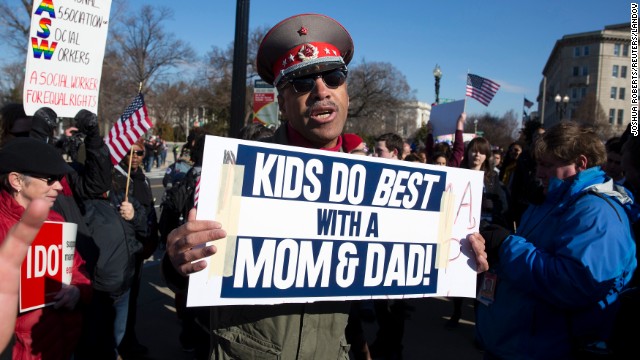
Again, another approach I see taken by Christian opponents of same-sex marriage is that heterosexual marriages are better for society, particularly for any children they may have, as this protester is expressing. For one thing, the underlying issue here is same-sex adoption, not same-sex marriage. But, again, even while this may be true (interestingly, even some gays agree) it's safe to say going through a divorce is at least as hard for kids as is having two moms or two dads who love each other and stay together, to say nothing of other myriad issues that affect kids today. If the welfare of children is the underlying motivation for protestors' stand against same-sex marriage and not merely a justification for it, there is some serious denial or tunnel vision going on in how they apply this value.

Conflating theological and political opposition to same-sex marriage is one underlying mistake I see in the above (unedited version of the) article. Authentic Christian faith and tolerance of same-sex marriage are tacitly assumed to be mutually exclusive. Any deviation from an unyielding stance of condemnation is "embracing, endorsing, and encouraging" homosexual behavior, becoming more concerned about not offending anyone than remaining faithful to God. But I would say that my arguments against the evangelical opposition to same-sex marriage come from the same motivation as Carter's post: not trying to tone down the gospel to "fit in" to modern society or not offend anyone, but to follow Christ and take scripture seriously.

The Example of Christ

How can this be so? Consider the life of Jesus. The Jews' expectation of the Messiah was a military-political revolutionary in the vein of Judas Maccabeus (who was believed by many Jews to be the Messiah until his death). But Jesus stubbornly defied everyone's expectations by saying virtually nothing about politics or social upheaval; this simply was not His mission. Indeed, in John 18:36 He says to Pilate, "My kingdom is not of this world. If it were, my servants would fight to prevent my arrest by the Jewish leaders. But now my kingdom is from another place." Jesus' concern was not political in nature, changing the conditions of the kingdoms of this world, it was incarnating a completely different kingdom that is not of this world at all, with any ensuing political change merely a side effect of the coming of the Kingdom of God. This is why I strongly question the automatic linkage Christians make between same-sex marriage being unbiblical and trying to make it illegal.

Again, who did Jesus associate with, besides His disciples? Tax collectors (like His disciple Matthew, Matthew 9:9, Mark 2:14), "sinners", (Matthew 11:19, Mark 2:15-17, Luke 15:1-2), Samaritans (John 4:4-42), and Gentiles (Matthew 15:22-28, Luke 7:1-10)--in general, the castoffs and outcasts of His society. It was the Pharisees, the "holy" men who claimed the moral high ground, for whom He reserved most of His scorn (see Matthew 23). Obviously there is much that Jesus could have condemned about the lives the people around Him were leading, yet in most cases He says nothing; He stays and eats with them and attracts them to His teaching. With Jesus, there is no hint of "you are a nasty tax collector who has perverted God's definition of charity and you had better repent before I'll accept you, and I'm going to keep reminding you of how bad you are until then".

Yet Jesus does not endlessly tolerate peoples' sin or treat it like it's no big deal. The difference is in the order in which He does things. With the Pharisees (and, I fear, with much of evangelicalism today), the order is "repent, clean up your abominable sin to some degree, and then God will love and accept you". Of course evangelicals will deny that this is how they are treating homosexuals, but I fear the consistent condemnations of their lifestyle as offensive to God, their unions as illegitimate, and the virtual anathematization of any Christians adopting a more tolerant stance sends them the message: "repent, adopt a life of celibacy, conform to the Biblical definition of love and marriage, and then you can be loved and accepted...maybe". Theological conservatives say your stance on gay marriage is a matter of accepting the truth of the gospel, but I am more concerned with whether we as Christians are seen more as representatives of an otherworldly kingdom or as homophobic bigots. (These two things don't have to, I would say shouldn't, coincide)

But the example of Christ tells a different story. Jesus loved and welcomed all sinners, repentant and nonrepentant. For Him, love--unconditional love--came before their repentance, not after. He was still concerned about their sin, but not in the narrow, behavior-based sense that leads Christians today to have "favorite sins" that they rail against, but their sin as a whole, their separation, alienation, and rebellion from Him. His solution to the problem of lost, wayward sinners was then to go to them and show His love to them, wherever they were. Only once they repented, once they turned to Him and decided for themselves to follow Him, could the process of cleaning up their lives begin. So, for example, with tax collectors, Jesus does not even mention their much-despised habit of collecting more than they were supposed to and pocketing the excess until they respond to Him with belief and ask, "Teacher, what should we do?" (Luke 3:12-13)

Brothers and sisters, gays are the "tax collectors" of our day. So whose example will we follow: that of the Pharisees, judging and condemning them from Biblical high ground, shutting the door to heaven in their faces (Matthew 23:13) by holding their sin between them and Christ, railing against the dust in their eyes while blind to the planks in our own? Or will we follow the example of Christ, striving after humility and harmony, modeling the love of God for the lost, and inviting them closer to Him?

Lastly, this doesn't really have anything to do with the rest of my post, but a few days ago I became aware of the existence of queer resistance to "marriage equality". Granted, this should be no comfort to evangelicals because many in this category oppose marriage altogether on the grounds that it is inherently unequal. Still, even though I disagree with this view even more strongly than I do with theological acceptance of same-sex marriage, I was too fascinated to be offended; it's interesting to see voices of dissent from within the "other side".

Wednesday, March 20, 2013

Taking a stand for marriage

The man said, "This is now bone of my bones and flesh of my flesh; she shall be called woman, for she was taken out of man." For this reason a man will leave his father and mother and be united to his wife, and they will become one flesh. Genesis 2:23-24

“But at the beginning of creation God ‘made them male and female.’‘For this reason a man will leave his father and mother and be united to his wife, and the two will become one flesh.’So they are no longer two, but one flesh.Therefore what God has joined together, let no one separate.” When they were in the house again, the disciples asked Jesus about this. He answered, “Anyone who divorces his wife and marries another woman commits adultery against her. And if she divorces her husband and marries another man, she commits adultery.” Mark 10:6-12

To the married I give this command (not I, but the Lord): A wife must not separate from her husband. But if she does, she must remain unmarried or else be reconciled to her husband. And a husband must not divorce his wife. 1 Corinthians 7:10-11

In Scripture, the creation of man and woman, and their one-flesh union as husband and wife, is the crowning achievement of God’s creation. In the transmission of life and the nurturing of children, men and women joined as spouses are given the great honor of being partners with God Himself. Marriage then, is the first institution of human society—indeed it is the institution on which all other human institutions have their foundation. In the Christian tradition we refer to marriage as “holy matrimony” to signal the fact that it is an institution ordained by God, and blessed by Christ in his participation at a wedding in Cana of Galilee. In the Bible, God Himself blesses and holds marriage in the highest esteem.

Vast human experience confirms that marriage is the original and most important institution for sustaining the health, education, and welfare of all persons in a society. Where marriage is honored, and where there is a flourishing marriage culture, everyone benefits—the spouses themselves, their children, the communities and societies in which they live. Where the marriage culture begins to erode, social pathologies of every sort quickly manifest themselves.

Unfortunately, we have witnessed over the course of the past several decades a serious erosion of the marriage culture in our own country. Perhaps the most telling—and alarming—indicator is the out-of-wedlock birth rate. Less than fifty years ago, it was under 5 percent. Today it is over 40 percent. Our society—and particularly its poorest and most vulnerable sectors, where the out of-wedlock birth rate is much higher even than the national average—is paying a huge price in delinquency, drug abuse, crime, incarceration, hopelessness, and despair. Other indicators are widespread non-marital sexual cohabitation and a devastatingly high rate of divorce.

We confess with sadness that Christians and our institutions have too often scandalously failed to uphold the institution of marriage and to model for the world the true meaning of marriage. Insofar as we have too easily embraced the culture of divorce and remained silent about social practices that undermine the dignity of marriage we repent, and call upon all Christians to do the same.

To strengthen families, we must stop glamorizing promiscuity and infidelity and restore among our people a sense of the profound beauty, mystery, and holiness of faithful marital love. We must reform ill-advised policies that contribute to the weakening of the institution of marriage, including the discredited idea of unilateral divorce. We must work in the legal, cultural, and religious domains to instill in young people a sound understanding of what marriage is, what it requires, and why it is worth the commitment and sacrifices that faithful spouses make.

The impulse to redefine marriage in order to recognize the validity of divorce and remarriage is a symptom, rather than the cause, of the erosion of the marriage culture. It reflects a loss of understanding of the meaning of marriage as embodied in our civil and religious law and in the philosophical tradition that contributed to shaping the law. Yet it is critical that the impulse be resisted, for yielding to it would mean abandoning the possibility of restoring a sound understanding of marriage and, with it, the hope of rebuilding a healthy marriage culture. It would lock into place the false and destructive belief that marriage is all about romance and other adult satisfactions, and not, in any intrinsic way, about procreation and the unique character and value of acts and relationships whose meaning is shaped by their aptness for the generation, promotion and protection of life. In spousal communion and the rearing of children (who, as gifts of God, are the fruit of their parents’ marital love), we discover the profound reasons for and benefits of the marriage covenant.

We acknowledge that there are those who are disposed towards divorce, just as there are those who are disposed towards other forms of immoral conduct. We have compassion for those so disposed; we respect them as human beings possessing profound, inherent, and equal dignity; and we pay tribute to the men and women who strive, often with little assistance, to resist the temptation to yield to desires that they, no less than we, regard as wayward. We stand with them, even when they falter. We, no less than they, are sinners who have fallen short of God’s intention for our lives. We, no less than they, are in constant need of God’s patience, love and forgiveness. We call on the entire Christian community to resist sexual immorality, and at the same time refrain from disdainful condemnation of those who yield to it. Our rejection of sin, though resolute, must never become the rejection of sinners. For every sinner, regardless of the sin, is loved by God, who seeks not our destruction but rather the conversion of our hearts. Jesus calls all who wander from the path of virtue to “a more excellent way.” As his disciples we will reach out in love to assist all who hear the call and wish to answer it.

We further acknowledge that there are sincere people who disagree with us, and with the teaching of the Bible and Christian tradition, on questions of sexual morality and the nature of marriage. Some who go through divorce no doubt regard their following unions as truly marital. They fail to understand, however, that marriage is not merely a human contract to be drawn up and dissolved at will, but a radical, comprehensive, multi-level sharing of life instituted by God as a reflection of His love for His church and sustained according to His will. The physical union of marriage is only the visible part of a deep, unique connection that spans every level of the human being. Human beings are not merely centers of consciousness or emotion, or minds, or spirits, inhabiting non-personal bodies. The human person is a dynamic unity of body, mind, and spirit. Marriage is what one man and one woman establish when, forsaking all others and pledging lifelong commitment, they found a sharing of life at every level of being—the biological, the emotional, the dispositional, the rational, the spiritual—on a commitment that is sealed, completed and actualized by loving sexual intercourse in which the spouses become one flesh, not in some merely metaphorical sense, but by fulfilling together the behavioral conditions of procreation.

That is why in the Christian tradition, and historically in Western law, consummated marriages are not dissoluble or annullable on the ground of infertility, even though the nature of the marital relationship is shaped and structured by its intrinsic orientation to the great good of procreation. We understand that many of our fellow citizens, including some Christians, believe that the historic definition of marriage as a lifelong commitment, for better or for worse, is a denial of civil rights. They wonder what to say in reply to the argument that asserts that no harm would be done to them or to anyone if the law of the community were to confer upon remarried men and women who are living together in a sexual partnership the status of being “married.” It would not, after all, affect their own marriages, would it? On inspection, however, the argument that laws governing one kind of marriage will not affect another cannot stand. Were it to prove anything, it would prove far too much: the assumption that the legal status of one set of marriage relationships affects no other would not only argue for marriage after divorce; it could be asserted with equal validity for polyamorous partnerships, polygamous households, even adult brothers, sisters, or brothers and sisters living in incestuous relationships. Should these, as a matter of equality or civil rights, be recognized as lawful marriages, and would they have no effects on other relationships? No. The truth is that marriage is not something abstract or neutral that the law may legitimately define and re-define to please those who are powerful and influential.

No one has a civil right to have a non-marital relationship treated as a marriage. Marriage is an objective reality—a covenantal union of husband and wife—that it is the duty of the law to recognize and support for the sake of justice and the common good. If it fails to do so, genuine social harms follow. First, the religious liberty of those for whom this is a matter of conscience is jeopardized. Second, the rights of parents are abused as family life and sex education programs in schools are used to teach children that an enlightened understanding recognizes as “marriages” sexual partnerships that many parents believe are intrinsically nonmarital and immoral. Third, the common good of civil society is damaged when the law itself, in its critical pedagogical function, becomes a tool for eroding a sound understanding of marriage on which the flourishing of the marriage culture in any society vitally depends. Sadly, we are today far from having a thriving marriage culture. But if we are to begin the critically important process of reforming our laws and mores to rebuild such a culture, the last thing we can afford to do is to re-define marriage in such a way as to embody in our laws a false proclamation about what marriage is.

And so it is out of love (not “animus”) and prudent concern for the common good (not “prejudice”), that we pledge to labor ceaselessly to preserve the definition of marriage as God-instituted and indissoluble and to rebuild the marriage culture. How could we, as Christians, do otherwise? The Bible teaches us that marriage is a central part of God’s creation covenant. Indeed, the union of husband and wife mirrors the bond between Christ and his church. And so just as Christ was willing, out of love, to give Himself up for the church in a complete sacrifice, we are willing, lovingly, to make whatever sacrifices are required of us for the sake of the inestimable treasure that is marriage.

The preceding was the section from the Manhattan Declaration on marriage, with the arguments against same-sex marriage edited to be about divorce. I had to change surprisingly little; over half the paragraphs needed no editing and only the fourth-from-last had to be extensively modified. (Note: The mention of divorce in paragraphs three and five is in the original declaration, not from my editing)

My objective in editing this declaration was not to show casual disregard for it by changing to to suit my whims, or to rail against the "abomination" of divorce. It was to show what the evangelical logic about gay marriage looks like when applied to another marital issue that, despite being much more clearly condemned by Jesus and the Biblical authors, receives comparatively little attention and debate today. Why are we more willing to accept and forgive Christians who divorce and remarry and honor their remarriages as valid and binding than to admit that the Biblical teaching about divorce is less than clear and has space for disagreement, instead of maintaining the tone of gentle condemnation towards homosexuals and Christians calling for tolerance?

Let me be clear on two things I am not saying. I am not arguing here that we should start treating divorcees the way we currently treat gays. In fact, I think the opposite is a much better idea. I am also not saying that the only alternative to crusading for traditional marriage is discarding what we believe about marriage as a "one flesh" union between a man and a woman and giving gay marriage our full theological affirmation. What I am getting at with this parallel is that for many Christians, myself included, our compassionate and accepting treatment of friends and family who have been through divorce shows that we really do understand how to "hate the sin but love the sinner", a phrase that is often thrown around in debates on gay marriage but is so often nothing but words.

Similarly with Christians who take different stances on marital issues than ourselves. As I discussed in my previous post, when Rob Bell "came out" in favor of gay marriage, there wasn't much surprise but there was much sadness (or muted vindication) that Bell had forsaken the true gospel and statements to the effect of excluding him from the realm of evangelical thought and discussion. When a pastor "comes out" in favor of a more tolerant position on divorce...oh, wait, there is no such thing because we don't make nearly a big enough deal about it to call a change in one's views "coming out" or a switch to another "camp" or "team". I propose that, by and large, the climate in American Christianity regarding divorce is, while not perfect, far healthier than the one regarding gay marriage.

Tuesday, March 19, 2013

Rob Bell Response

In the wake of the ever-controversial Rob Bell's "coming out" in favor of gay marriage, I've seen enough responses reminding orthodox Christians of God's plan for marriage, mourning his now-complete fall from sound doctrine, or even--dare I say it--gloating over his heresies becoming plain for all to see. When I clicked on this article on redletterchristians.com by Michael Kimpan, I was expecting more of the same. Happily, I was wrong.

RIP, Rob Bell

After a quick summary of some recent developments in the perennial "gay marriage" debate, Kimpan reminds us of Christians' role as bridge-builders, ambassadors of reconciliation (2 Corinthians 5:18-21), which is easily forgotten as cultural battle lines are drawn and Christians take up arms to defend the truth and "take every thought captive" (2 Corinthians 10:5) for Christ.

Tangent: I found it interesting how I just cited two different verses in the same book to support two different "Christian" stances toward gay marriage. Do we participate in Christ's ministry of reconciliation or take every thought captive? Yes. Trying to justify choosing one (presumably the one we like) over the other simply by proof-texting means that, to some extent, we are twisting God's word to suit our own desires and agenda. Of course, I was seemingly just doing this kind of proof-texting by implying that Christians should apply 2 Corinthians 5:18-21 but not 10:5 to the gay marriage debate. How does a Christian follow both of these verses at once in this situation? Should they? I don't think so. Sensitive issues between the church and the world like this are simply not the time to apply Paul's militaristic metaphor for the truth. (The section in 2 Corinthians 10 this passage is situated in is addressing discipline and doctrine within the church, not outside it, an important distinction)

Anyway, in two of his last paragraphs Kimpan hits the nail right on the head (emphasis the author's):
The litmus test of our faith in Christ is not whether or not we’re able to agree on political, cultural or religious secondary issues, nor (dare I say) even what it is our position is on such issues; rather, it is in our ability to love, even those with whom we may not agree. 
As the cultural shift happens (and it is happening) regarding LGBT issues right in front of us, I wonder how well we’ll do in elevating the conversation above the yes/no || right/wrong || win/lose || in/out || us/them || polarizing rhetoric that has so often shaped this conversation, and respond in a more thoughtful, Christ-like way?
I don't think most Christian who argue against gay marriage are being intentionally unloving; they are intentionally trying to love God and love their neighbors by defending "God's plan" for marriage and holding it high in a corrupt world. But defending the truth does not have to (should not) equate to the kind of "us-versus-them" dichotomy Kimpan describes above, let alone metaphorically beating people over the head with the truth and expecting them to embrace it. Christlike humility means walking the narrow path of holding on to what you believe while loving and building bridges with those you disagree with. It's not easy, but in our modern, pluralistic society it's more important than ever.