As the 2016 presidential election becomes harder to ignore, I realized to my surprise that so far I have been silent on an issue that is incredibly important to me and much more controversial than it should be. The time has come for me to firmly plant my flag concerning
the reality of climate change.
The fact of the matter is that the Earth is warming at an unprecedented rate, most of this warming is due to human activity, it is already having an increasingly negative effect on biodiversity and our ability to thrive, and it will have catastrophic consequences if we do not take action soon to reduce our production of greenhouse gases.
The science
The scientific basis for global warming is well-understood, based on physical principles that are beyond questioning, and supported by observation. The
greenhouse effect, the process by which atmospheric gases (primarily water vapor and carbon dioxide, but also methane and others) absorb and trap heat radiated by the earth, is entirely uncontroversial, supported by basic science and observation of the Earth as well as other worlds (especially Venus, where it is responsible for the lead-melting temperatures). Thus, as the concentrations of "greenhouse gases" in the atmosphere increases, we should expect them to retain more heat, producing a net atmospheric warming effect.
And this is exactly what we observe.
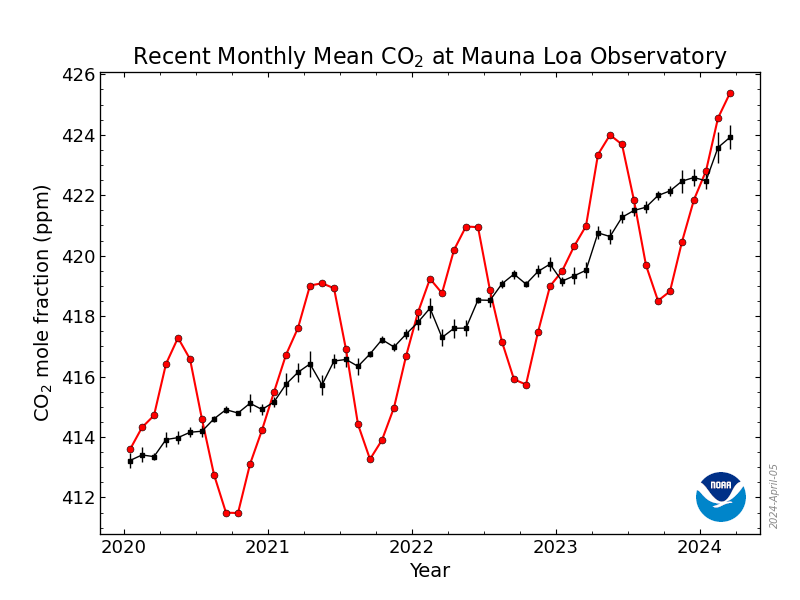
Recent measurements show that the concentration of carbon dioxide in the atmosphere is steadily increasing. (The red line is the raw measurements, the black line is after correction for seasonal variation)
Over a somewhat longer timescale, we see that it might actually be exponentially increasing.
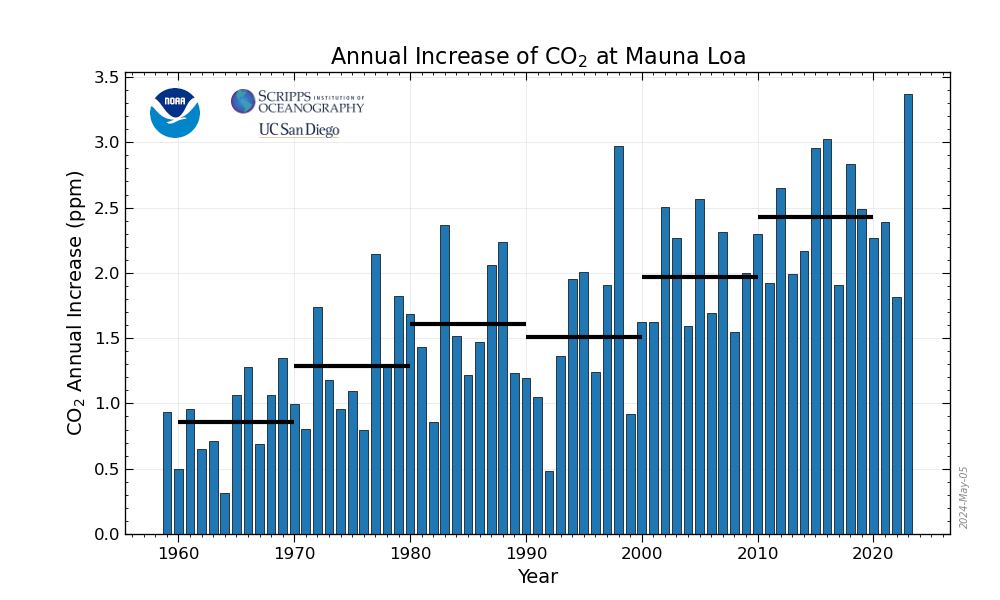
Lately, the growth rate of CO2 concentration has been about 2 ppm (parts per million) per year, or about 15 billion tons per year.
There is
abundant evidence that this change in atmospheric carbon is anthropogenic (manmade).
Human emissions of CO2 per year (see page 45 of that publication) are about 30 billion tons per year. This means that rather than producing a net emission of CO2, nature is in fact
absorbing about half of the CO2 we emit. Additionally, atmospheric oxygen levels are steadily decreasing, which is just what we'd expect if the excess CO2 is being produced by burning carbon (i.e. fossil fuels) rather than by being released from a natural reservoir.
Over a longer timescale, this plot shows the correlation between the current rise in atmospheric carbon and human industrialization, beginning in the 19th century. By far the most obvious conclusion is that atmospheric carbon levels are increasing because we're putting it there by the burning of carbon-based energy sources.
One more plot shows the range of natural variation of atmospheric CO2 levels over a much longer timescale, and the relative magnitude and suddenness of the recent increase. Yes, carbon levels have changed in the past, but the present increase is virtually unprecedented in both its size and rapidness—150 years is the blink of an eye in geologic terms, and in that time we have already matched the increase in carbon over the past 11,000 years since the last ice age. Recently, atmospheric carbon
reached 400 ppm—its highest level in the last
three million years.
If the greenhouse effect works, this increase in atmospheric carbon should produce an increase in global temperatures. And it does.
This plot shows five independent data sets of global surface or lower atmosphere temperature over the past 35 years. The second, smoother graph shows the data after removing the effects of the
El Niño Southern Oscillation,
solar variability, and
volcanic emissions (several of the common natural explanations given for global warming). After filtering out these natural variables, a clear trend toward warmer temperatures remains.
This change in observed global temperatures can be correlated with a
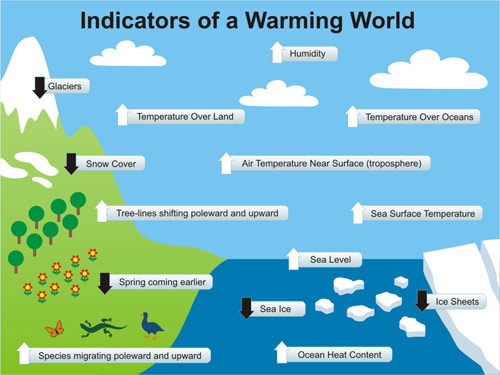
number of other variables, some of the most obvious of which are depicted below: receding glaciers and ice caps, rising sea levels and temperatures, changes in the migration and habitation of plant and animal species, and increasing humidity. Independently measuring and correlating all of these indicators considerably strengthens the case for a warming planet. And besides scientific measurements, the effects of global warming are already being felt around the world:
increased flooding in coastal cities,
record-breakingly hot months/summers/years/decades, and (in the past few years) the devastating
drought in California. The effects of climate change are felt perhaps nowhere as strongly as in Pacific island nations like
Tuvalu, the
Marshall Islands, and the
Maldives whose very existence is threatened by rising sea levels.
Again, this warming trend can be traced back to the previously mentioned manmade increase in atmospheric carbon levels by a
variety of means. The independence with which these indicators can be measured and correlated with each other makes the case for anthropogenic climate change much stronger than it would be if it were based on only one variable.
The danger
You may be asking, "so what?" Carbon levels and global temperatures have fluctuated widely in the past (as previously mentioned, our current level of atmospheric carbon was last reached 3 million years ago), so how do we know that the era of global warming will actually be worse rather than just different? Well, as also previously mentioned, the difference between manmade climate change and natural climate change is one of both scale and rate. An optimistic estimate of 2° C of warming will push global surface temperatures to a level not seen since the last time we had this much carbon in the atmosphere, the Pliocene era three million years ago. And if we keep producing carbon at anything like our current rate, this number will likely be higher. Most species alive today didn't even exist tens of millions of years ago when things were last this hot, so we can't expect them to be able to adapt.
Even more significant is the fact that while climate changes naturally over the course of thousands or tens of thousands of years (during which greenhouse gas emission and absorption remain roughly balanced at all times), manmade climate change is operative over just a few hundred years—orders of magnitude faster than the natural rate.
Past instances
in which atmospheric carbon levels and global temperatures changed
suddenly and in an imbalanced way (as they are doing today), due to large igneous provinces or other causes, almost always
resulted in mass extinction events—and it is very likely that our
actions are sending the Earth into another one, as they are producing the same symptoms by the same means. The stress we have placed on species and ecosystems through other means like pollution, habitat loss, overhunting/fishing, and the introduction of invasive species makes it even harder for them to adapt to manmade climate change as they have to natural climate shifts in the past.
This article explains these difficulties in more depth.
While warming temperatures may bring some positive effects, like improved agriculture and vegetation activity at higher latitudes and an ice-free
Northwest Passage, the
negative effects are expected to be far greater. These include unhappy things like decreased water supply and desertification (as in California), increased danger of heat stress, the growth of oxygen-poor zones in the ocean, extinction of numerous vulnerable species and the loss of biodiversity, and the displacement of hundreds of millions due to sea level rise. All of these things will carry catastrophic economic consequences for developing and developed nations alike. Still more troubling are effects like decline in global phytoplankton and the leakage of methane from formerly frozen areas that will create positive feedback, further intensifying the warming of our planet. In theory, if the planet warms enough to push the water vapor concentration in the atmosphere to a sufficient level, the feedback could become a self-sustaining loop that would turn the Earth into a second Venus (though we would likely already be doomed well before it got to this point).
The consensus
The scientific consensus on climate change is clear and unequivocal. A
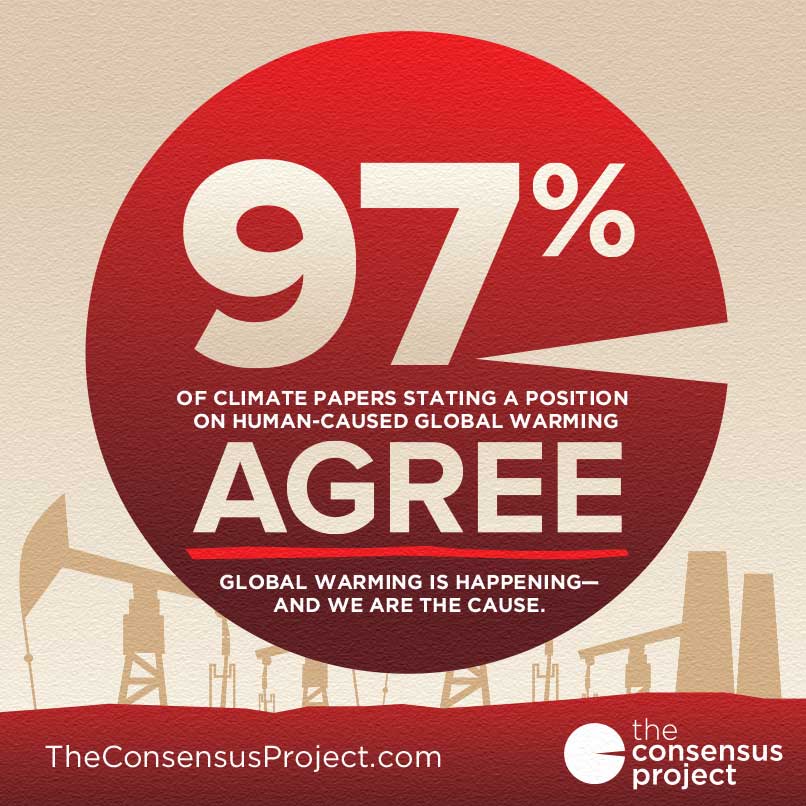
survey of peer-reviewed climate science papers found that 97% of the papers expressing a position explicitly affirm that anthropogenic climate change is real. If this figure seems surprisingly low, keep in mind that the 3% includes implicit (rather than explicit) endorsements, implicit rejections, and no opinions. Another,
similar survey which only counted explicit rejections of anthropogenic climate change found that 24 out of 13,950 articles reject global warming—just 0.17%. This consensus is even stronger (at least 98% explicitly affirming) in more recent papers.
In light of all this, it saddens me to see so many of our nation's leaders (and the people who voted for them) willfully ignore the scientific consensus in favor of their own fantasies about climate change: that it is not happening, that is it is not a problem, that it is not caused by us, that there is no consensus, or that there is no need for them to take action because "I'm not a scientist" (and, apparently, not willing to trust them either). Certainly the media, in its well-intentioned dedication to balance, is partly responsible for enabling this ignorance: it creates the illusion that climate change is a two-sided issue under discussion rather than a matter of scientific fact. But really there is no "debate" or "conversation" regarding the reality of climate change; there is only an overwhelming consensus and those who (all too often for political or ideological reasons) refuse to accept it.
As an analogy, consider the
fact that due to tidal acceleration, the Moon is moving away from the Earth at a rate of about 3.8 cm/year. This trend is not immediately or intuitively obvious to an observer, but it is well explained by basic physical principles and verifiable by multiple methods: studying ancient records of eclipses to establish the Moon's position in the past, gravitational data from satellite laser ranging, and simply bouncing light pulses off the retroreflectors left by the Apollo astronauts and measuring the return delay. Scientists are just as certain that anthropogenic climate change is happening as they are that the Moon is drifting away from the Earth. I have never heard anyone express doubt about the latter. Why is the former any different—because of its implications for how we live? Our own desires, interests, and preferences cannot change the truth of what we are doing to the climate.
The theology
My knowledge of the fragility and beauty of the Earth and our dependence on it, as well as my own experiences in nature, would be sufficient to instill in me a deep and abiding concern for environmental issues, especially anthropogenic global warming, dangerous as it is. But as a Christian, I have another, even stronger foundation for environmental concern and action.
In Genesis 1 God creates the heavens and the Earth (v. 1) and all the life on the Earth, declaring everything that he had made "very good" (v. 31). He also creates mankind in his image, to fill the Earth and subdue it and have dominion over nature. (v. 28) Does this mandate give us license to do as we please with the environment? No, for it must be considered along with the innate goodness of created nature and our role as God-appointed regents over it. If the creation is really good, and not "fallen"/evil or simply morally neutral raw material for our own designs, then by harming it we are harming God's handiwork. The image of God in man is not the only reason for human worth and dignity; simply being created at all conveys great worth and value. The mandate uses militaristic language ("subdue", "have dominion over") because of the present, frustrated state of the creation (cf. Rom 8:19-23), but this dominion always has as its intent wise, beneficent rule and redemption as God himself works, never exploitation or destruction.
The Psalms contain abundant examples of the value of creation as it reveals the glory of God. In Psalm 19 "the heavens are telling the glory of God" to the ends of the earth and the sun "like a strong man runs its course with joy". Psalm 33 praises God (through the Psalmist's ancient understanding of the cosmos) as the creator and ruler of the heavens, the earth, and the sea. Psalm 104 goes into considerably more detail, poetically describing the act of creation as well as God's ongoing governance of the created order, providing food for man and the animals; even the cycle of life and death is the occasion for praise. Psalms like these express what I have heard described as a
sacramental view of nature which Fr. Stephen Freeman
describes as the opposite of modern secularism, the reckoning of all the workings of the cosmos as a ceaseless act and a voiceless hymn of worship to their maker.
As an Orthodox Christian-to-be, I am happy to be part of a church which faithfully preserves and teaches this understanding of the cosmos. It is truly the basis for robust, authentic Christian environmentalism. As proof of this, one need look no further than the current ecumenical patriarch, Bartholomew. Like
Pope Francis, he is
deeply concerned about the human impact on the environment; unlike Pope Francis, he has already published a strongly-worded and very wise
encyclical which expresses a theological basis for caring for the creation much better than I can (and takes a strong stance on climate change, much like the one the Vatican is expected to take). Even if you haven't been reading all the links I've been posting thus far, take just a few minutes and read it
One other way Christian teaching can contribute to the conversation on climate change is in its abiding concern for the poor. It is an unhappy fact of global warming that the
nations most affected by it tend to be poor and developing (as well as very low in carbon emissions), while the nations least affected are predominately the wealthy nations responsible for causing it in the first place. It is a textbook
negative externality on a global scale, a terrible injustice. Prominent among the Christian's reasons for environmental concern should be the awareness of the possible unjust effects of his/her actions on the poor who stand to lose the most to climate change—their crops, their livelihoods, even their homes and their lives.
In light of all this, arguments fielded by Christians in opposition to environmentalism are revealed for the falsehoods they are. Since they seem to exist solely among laypeople and not among scientists or theologians, I will not attempt to state them in a clearer, better-supported form as I usually do. These are not carefully-considered theological responses with any kind of historical pedigree or arrived at after careful reflection; they are from-the-hip answers that use Christian-esque ideas to justify a false position arrived at due to other factors.
First, I have heard it argued that God, as creator, is sovereign over nature, and that man doesn't have the power to change it or thwart his plans. My first response is that this is simply factually false. Man evidently
does have the power to cause global-scale environmental changes because we are doing so and have already done so. This is simply undeniable, supported by reliable, repeatable observations; for instance, as shown above, we have demonstrably increased the carbon concentration of the atmosphere by about a third. Theological arguments can't falsify a scientific theory; only a scientific argument can. As Mark Noll explains in relation to young-Earth creationism in his book
The Scandal of the Evangelical Mind, authentic Christian thinking requires listening to both "books" of God's revelation: Scripture and creation, not using your interpretation of one to contradict what we can know through the other. To do so is, ironically, to
deny God as creator in order to confess him as sustainer of the creation.
Further, we know that God created us in his image as free, responsible beings with real moral agency and the ability to make real moral choices. This is implicit in all of the Bible's ethical commands, which wouldn't make sense otherwise, and has always been the teaching of the Orthodox Church. Sidestepping discussions of the exact nature or extent of this freedom, God's sovereignty obviously doesn't mean that he defends the integrity of his image in man by intervening to stop us from wronging or killing each other. Why then should we expect him to prevent us from sinning against the environment? There is no biblical support for such an idea, and plenty for the kind of Christian environmental ethic I sought to lay out above.
Additionally, this argument sidesteps the question of whether and how Christians are to care for the environment; it simply claims (without serious justification) that God will somehow restrain or prevent the negative consequences of our failing to do so, so there is no need to try. But if we really are appointed as stewards and even priests of the rest of the creation, then this argument is saying in effect that we should simply ignore this vocation because there was really no reason for God to give it to us in the first place. This is horribly irresponsible and dualistic, not to mention hubristic. "But who are you, O man, to talk back to God?" (Rom 9:20) By contrast, it is not hubristic at all to believe, on the basis of multiple independently measurable indicators, the sobering truth that human activity is having a major effect on the Earth's climate, which we have a mandate to care for. Rather, it is the beginning of humility and repentance.
The other argument I sometimes hear is similar to the first, but even worse. It is the sentiment that because Jesus is coming back to bring the old creation to an end and inaugurate the new, we don't have to be especially concerned about the environment. Similar to the previous argument, it basically states that we don't need to care about the effects of human activity on the environment because God will intervene to prevent them, in this case by returning to bring about the end of the world. In other words, it presumes that Jesus will return before climate change can begin to have catastrophic effects on future generations. But, in Jesus' own words, "watch therefore, for you know neither the
day nor the
hour." (Mat 25:13) Jesus was clear about few things relating to his return, but he was crystal clear about the fact that we can't know when it will be. (See also Mat 24:36,44,50; Mar 13:32; Luk 12:40,46; Acts 1:7) Like the first argument, it sidesteps any kind of teleological discussion of our appointed role as stewards of the creation, focusing only on why we will supposedly be spared from the consequences of scorning our calling.
Why not justify other corporate sins in this way? Why not support slavery, since Jesus will come back to break every chain? Why not selfishly exacerbate the suffering and poverty of people in developing countries (which, incidentally, is one of the effects of global warming), since Jesus will return to wipe every tear from their eyes? "And why not do evil that good may come?" (Rom 3:8) The return of Jesus and the last judgment, far from a cosmic reset button undoing our sins, will be a day of reckoning in which we will be called to account for all that we have done (Mat 25:31-46, Rom 2:6-8, 14:12, 2 Tim 4:1, 1 Pe 4:5, Rev 20:12). It is hard to imagine a greater folly than expecting the day in which everyone will be judged for what he has done to be the occasion for our escape from accountability for sins against the environment.
Edit: The sovereignty of God, invoked in the first counterargument, is relevant to discussions of the climate in another way. The Christian faith involves an unstoppable hope, based on the Incarnation, crucifixion, and resurrection of our Lord, that is sufficient to overcome even the grim certainty of death. Paul, describing this hope, says powerfully, "I am sure that neither death, nor life, nor angels, nor principalities, nor things present, nor things to come, nor powers, nor height, nor depth, nor anything else in all creation, will be able to separate us from the love of God in Christ Jesus our Lord." (Rom 8:38-39) So one implication of the sovereignty of God is that we are to remain hopeful and not despair no matter how bad things seem, since for many Christians they have seemed much worse. But not to fear is not to do nothing. Like any other issue incumbent on the Church, climate change demands a response, but that response should be out of hope, not fear or gloom.
What can we do?
In the face of these terrifying visions, and the continued politicized denial of climate change, especially by Republican leaders, it is very tempting (certainly for me) to simply despair of hope that anything can be done. At times like this it's very beneficial to rest and remind myself of some of the
reasons for hope that we can actually address the climate crisis. But if you grasp the magnitude of the problem and the need for broad and deep action to address it, then remaining a bystander stops looking like a suitable option. I will try to present ways I have found to take personal action against climate change. Most of them are not that hard!
First, you can reduce your
carbon footprint. Your carbon footprint is the sum of the carbon emissions caused by your actions and lifestyle, both directly (i.e. by driving or burning other fuels) and indirectly (e.g. by buying or using products that require carbon to produce or transport). Some ways to do this include:
- Use less heating and air conditioning in your home. If you are a homeowner, this might mean insulting your home better to avoid having to heat it as much or installing a "smart" thermostat that only regulates your home's temperature when people need it. If, like me, you rent an apartment, you can still leave your thermostat at a lower temperature in winter and rely more on fans and opening/shading windows than air conditioning in the summer.
- Minimize your energy usage. Ways to do this include using compact fluorescent bulbs for lighting (or, better yet, long-lasting and super-efficient LED bulbs), turning off lights when you leave a room, turning your computer off when not using it, and plugging devices that use power even when turned off (e.g. lots of electronics) into a power strip so you can fully de-power them when not using them. As previously mentioned, minimizing your use of heating and air conditioning also helps with this. If you are a homeowner, you can also try to install energy-efficient (e.g. Energy Star) appliances.
- Use less hot water; heating water takes a lot of energy. If possible, you can do this by installing more efficient shower heads/faucets/toilets. Homeowners can also turn their hot water temperature down and/or ensure that their water heater is well-insulated.
- The classic trifecta: reduce, reuse, recycle. This boils down to consuming and throwing away as little as possible. If you're unsure about what you can recycle, your city's web site should tell you. (Here is the one for Minneapolis as an example)
- Drive less or not at all. When possible, use alternate forms of transportation like walking, cycling, carpooling, or public transportation. This may not be easy, but besides the environmental benefits it will also save you money, especially if you are able to completely replace owning a car with other ways of getting around. I am almost through my third post-college year without a car and loving it. I spend $85 a month on my bus pass and a total of about $200 a year on parts and maintenance for my bike. Not only do I save a lot of money, I love not having to spend lots of time driving or (as is all too often the case) sitting in traffic. Once we are married, my fiancee Marissa and I plan to own one car between us, which should be more than sufficient for our needs. This option may require some bigger lifestyle modifications, but can be quite worth it and have a major impact on your carbon footprint.
- Eat less meat, especially red meat. Producing a given amount of calories of meat uses a lot more resources than producing the same amount of calories of plants. Even if you don't go fully vegetarian, reducing the amount of meat in your diet can make a sizable difference. Apparently minimizing your consumption of rice is also beneficial, since most rice is grown in methane-emitting paddies. Eating locally-grown food is also an obvious step (reducing fuel costs of transporting it), as is avoiding wasting food.
Second, you can offset your carbon footprint. This means supporting environmental projects that remove an amount of carbon from the atmosphere equal to the amount you put in. The cost of this is apparently just $15 per metric ton. The average carbon footprint of an American is 27 tons per year, which translates to an offset of $405, or just $33.75 per month. This is a surprisingly low price to pay to become "carbon neutral", and of course you can decrease it by lowering your footprint.
This handy site lets you estimate your carbon footprint and donate to offset it.
And third, you can take action beyond your individual/household's carbon footprint. You can support organizations that are helping to fight climate change and promote the welfare of the environment like
The Nature Conservancy, the
Environmental Defense Fund, or the
World Resources Institute. (The very useful website
Charity Navigator can help you find another organization to support if you like) Or you can join the public conversation addressing climate change by signing petitions, writing to your elected officials about your concerns, or simply by telling others about it to raise awareness, perhaps by sharing concise, persuasive resources on the web (hint hint). The strategy and tactics of dealing with global warming are much more complex subjects than the basic scientific facts. Once we are in agreement that anthropogenic climate change is real, there is plenty of room for diversity of opinion on what to do about it, how to balance short-term needs and economic realities with the long-term need not to cook the planet to death. My goal in shutting down climate change denial is not to end constructive conversation, but to make it possible and invite more people into it by showing the obscurantist, anti-science rhetoric of denial for what it is and calling us to rise above it. If we are to resolve the climate crisis, we need all the voices—and hands—we can get.