Pages

Showing posts with label Worship. Show all posts

Saturday, November 7, 2015

The First-Person Singular

In the post in my Journey to Orthodoxy series on worship, I mentioned briefly that contemporary worship often bears a resemblance to prayer or devotion. I feel ready to say at least a bit more about this observation now. What I meant by it can be summed up by the fact that a good deal of contemporary worship songs (I would guess a large majority of them, as well as some older hymns) are written from a first-person singular perspective.

This is not just a grammatical quirk. If we grant that contemporary worship is as intentionally designed as older forms of worship, then this trend indicates that some kind of blending of individual and corporate worship is taking place. Christians gather to worship God, ostensibly together, yet do so in words that belie their corporate setting. Is this not strange?

It is such individualized worship that I would argue resembles personal prayer more than corporate worship. In such worship people praise God, give thanksgiving and glory and honor to him, ask for his Spirit—but more as a multitude of individuals gathered together than as the one Church, one body. This gives rise to some other emphases that fit more naturally into an individual approach to worship than a corporate one, like the importance of making (or having made) a personal decision to follow Jesus or a concern for personal apprehension of the truths sung about: what has happened to/been done for me (in particular), what it means to me, how I feel about it, how I will respond to it.

These things are of course good and important. Faith has to be personal in order to change anything. But to me this focus on one's place before God, on looking to the purity of one's own faith and how the gospel can be further applied to it, is found more naturally in personal prayer and piety than in corporate worship. This is why I think such individualized expressions of worship more resemble the role private prayer plays in the Orthodox Church. (How ironic that many Protestants reject the kinds of prewritten prayers ubiquitous in Orthodoxy, but regularly sing worship songs that are nearly the same thing) I don't know enough to evaluate this difference; I'm just trying to point it out.

The late Fr. Thomas Hopko has recorded a helpful talk on the relationship between the Divine Liturgy (i.e. Orthodox worship) and personal prayer explaining how Orthodox differentiate between prayer and worship. I'll quote parts of it at length, as I think he clarifies the way Orthodox distinguish (and yet connect) the two much better than I could in my own inexperience.
The Divine Leitourgia is the action of the Church. It’s [an] ecclesial action; it’s a corporate, common action. That word “corporate” is very good, because “corpus” in Latin is “body.” It’s an action of the body of Christ. It is not an individual, personal activity of a bunch of people simply being gathered together. It is the realization and the actualization of the kingdom of God on earth in the Church which is also, then, an actualization or a realization of creation itself as God’s kingdom.
Then in the Church you have everything participating. You have light, you have smell, you have incense, you have all these physical properties [which] are there in this particular gathering. It’s very important to realize that when we’re speaking about worship in spirit and in truth, this is the total worship of all of creation in the Church of Christ, anticipating the coming kingdom of God, where everything will simply be worship. Everything will be holy Communion. In the age to come, everything will be worship, everything will be praise, everything will be thanksgiving, everything will be filled with truth and wisdom, knowledge, understanding, insight, and everything will be holy Communion. The very existence—life itself, existence as life—will be communion with the Father, through the Son, in the Holy Spirit, communion with the Father and the Son and the Holy Spirit, glorifying and worshiping God through the Son in the Spirit, and worshiping and glorifying God and the Son and the Holy Spirit. This is what is the Church, the Qahal, the Liturgy.
And then people will say, “Well, can’t you just go out into a field and pray, you know, pray where the sun is shining and the birds are singing and the flowers are blooming and the trees are shading and it’s just so gorgeous. You’d be alone there and you’d say your prayer. Can’t you just let God know what you want at any time? And didn’t the apostles say you have to pray without ceasing and be constant in prayer, pray literally without ever stopping? And don’t you pray in your heart? Isn’t it a personal matter when you pray? Isn’t it a kind of very intimate relation with God?” and so on.
The answer is: Sure, yeah, that’s right. That’s perfect, that’s true. And every Christian and every human being has to do that. Our life has to become prayer. The holy Fathers will say prayer is not just something that you do; prayer is something that you become.
However—and here’s the point for today—the Divine Liturgy is not a prayer service. And the Divine Liturgy is not a service where people come together to express their own personal private petitions together in a group. We’ll see that that’s part of it, but that’s not the essence of it at all. In fact, even in language, if you take ancient Christian writings—let’s say the writings for the first, I don’t know, millennium of the Christian history—the Liturgy was never even called prayer. Prayer was something you did in your cell, it was something you did in your room, it was something that you did in your heart, it was something that you did constantly, and everybody had to do it. It wasn’t that you simply went to church, which of course is a modern expression, “go to church.”
When we go to church, we do pray. We say prayers, we say litanies, we say, “Let us pray to the Lord.” We pay attention to the prayers; we say Amen to the prayers. Sure, there are prayers there, because the whole life of a creature has to be prayer. In the Liturgy, we have the various kinds of prayers. We have the prayer of asking, we have the prayer of praising, we have the prayer of thanking, we have the prayers of interceding and praying for one another, we have the prayers of letting known our needs to God—but that is one aspect of the gathering. It does not exhaust the whole meaning of the gathering at all, not at all.
Those are things that can be done alone, and should be done alone in one’s room, and they are things that even families or groups of Christians can do together when they meet. You could have a prayer group come together and say some prayers, intercede for each other. That’s not very traditional in Eastern Orthodox history, but there’s probably nothing wrong with it, as long as you’re not simply gathering together to inform God what he already knows and then to tell God what God ought to do about it. Fr. Alexander Schmemann used to quote his spiritual father, Archimandrite Cyprian Kern, who used to say, “Many people think that prayer is informing God what he already knows and then telling God what he ought to do about it.”
Well, that’s not prayer. Prayer is not naming it and claiming it, either. Prayer, in fact, does not even begin in one’s own words. If you follow the Scriptures, you learn to pray and you begin to say, as St. Anthony the Great said in the desert, using the words that God provided for his own glorification. And that means, fundamentally, the psalms, and then it means the Lord’s prayer, it means the doxology, it means the trisagion—the “holy, holy, holy.” These are prayers that are given to us that we repeat, by the Scriptures, by the Holy Spirit, by God’s will put into our mouth.
A person can definitely share with God what’s on their mind. We can tell God what we think. We can tell God what we want. We can make known our needs and our anxieties and so on to God. But we do not go to the Divine Liturgy for that purpose. In fact, we go to the Divine Liturgy to learn what we, not only ought to say to God when we talk to him, but we go to the Divine Liturgy and the Church’s liturgy generally to learn how we ought to think, to learn what our mind should be really on, what our heart should really desire. In that sense, the Church’s liturgy and the Divine Liturgy par excellence is a school of prayer. It’s a communal act in which we go to be shaped and to be formed as human beings and as Christians in that community where God himself is acting, teaching, preaching, offering, consecrating, blessing, and giving himself to us for holy Communion as we give ourselves to him for the sake of that very same holy Communion.
However, [a private prayer rule is] prayer, that’s evchē, that’s prosevchē; that’s not leitourgia. That’s not leitourgia. You could say it’s our personal leitourgia as what we do as members of the community in our lives with every breath every day of our life as we try to actualize in our everyday life what is given to our experience in the liturgical life, particularly when we gather and participate in the Divine Liturgy. You could even say that the personal pietistic prayer life of a Christian is the actualization individually in what is given in the Liturgy; it’s the actualization all the time in one’s own person to what is given to the entire community when it gathers at the church for the Lord to act at the Divine Liturgy of the Church.
The Divine Liturgy has all of the aspects brought together in perfection in the context of worship that simply constitute our human life generally at every moment of our life. That’s why I said earlier we could actually say that human life, according to Christianity, is to actualize every moment of every day with every breath that which we experience and actualize in the Church’s Divine Liturgy. That’s the connection between everyday life and the Church’s liturgy. We need the Divine Liturgy of the Church, behind closed doors, to have the experience of life and truth and reality in God, so we know how to live the rest of the time. And the rest of the time, we try to actualize it, we try to realize it, we try to put it into practice, from Liturgy to Liturgy.
According to Hopko, prayer is possible and good either individually or in a corporate setting, but worship (which includes and transcends prayer) is at its core corporate, the leitourgia (literally, "work of the people") of the body of Christ which permeates and transforms our individual lives, but does not originate there. Both are good and important, but there is a definite difference between them.

Friday, August 14, 2015

The All-Embracing Eucharist

After hearing some more recommendations of it, I recently (finally) started reading Alexander Schmemann's book, For the Life of the World. I'm deliberately going through it slowly to absorb as much of its depth as I can in my spiritual immaturity, but already in this first chapter these paragraphs jumped out at me. The context is Schemann's rejection of the "sacred-secular" divide that has become so ingrained in the modern world and his invitation to abide by the sacramental worldview held by the Orthodox Church.
To name a thing...is to bless God for it and in it. And in the Bible to bless God is not a "religious" or a "cultic" act, but the very way of life. God blessed the world, blessed man, blessed the seventh day (that is, time), and this mans that he filled all that exists with His love and goodness, made all this "very good." So the only natural (and not "supernatural") reaction of man, to whom God gave this blessed and sanctified world, is to bless God in return, to thank Him, to see the world as God sees it and—in this act of gratitude and adoration—to know, name, and possess the world. All rational, spiritual, and other qualities of man, distinguishing him from other creatures, have their focus and ultimate fulfillment in this capacity to bless God, to know, to speak, the meaning of the thirst and hunger that constitutes his life. ... The first, the basic definition of man is that he is the priest. He stands in the center of the world and unifies it in his act of blessing God, of both receiving the world from God and offering it to God—and by filling the world with his eucharist, he transforms his life, the one he receives from the world, into life with God, into communion with Him. The world was created as the "matter," the material of one all-embracing eucharist, and man was created as the priest of this cosmic sacrament.
Men understand all this instinctively if not rationally. Centuries of secularism have failed to transform eating into something strictly utilitarian. Food is still treated with reverence. A meal is still a rite—the last "natural sacrament" of family and friendship, of life that is more than "eating" and "drinking." To eat is still something more than to maintain bodily functions. People may not understand what that "something more" is, but they nonetheless desire to celebrate it. They are still hungry and thirsty for sacramental life.
Man was created from the start to serve as priest, as mediator between God and creation, experiencing all as sacrament, taking the things of this world and lifting them up to God in a perpetual eucharist. This does not preclude the existence of an ordained priesthood, but they serve as examples and symbols for us, not simply as surrogates; what they do in the liturgy, man was made to do in all of life in this world. This is just one of the ways in which the church, and the liturgy that takes place within it, is meant to be a microcosm of all creation, or at least of the way it was made to be, the way it will be.

Obviously this invites parallels with the Reformation doctrine of the "priesthood of all believers", which, as this interesting paper argues, was not originally about giving all Christians the right to do anything a priest could do, but about pulling down the rigid wall of class-like separation between the two stands (standings or walks of life) within the church, namely clergy and laity. Luther rightly attacked the Catholic distinction which arguably did compromise the unity of the church, but by confining his point to matters of church governance and focusing on the role and meaning of the priesthood within the church, he played right into the the divide between "sacred" and "secular", church and world, which Schmemann opposes.

I think Schmemann would say that the basic duty of a priest, then, is not to lead or to hold authority, but to give thanks, to celebrate the eucharist by taking all that we have been given by God and raising it up to him in blessing and thanksgiving, as the host is during each liturgy. It is to this task that we are being built up a holy priesthood (1 Pet 2:5). It is not much of a stretch to say that we are saved in order to serve as priests. I look forward to absorbing more of Schmemann's wisdom.

Tuesday, March 24, 2015

My Journey, Part 14: Worshipping with the Church

This is part 14 of my rebooted series on my journey from Evangelicalism to Eastern Orthodoxy. The full series can be found here:

1Back to the beginning
2Cracks appear
3Questions multiply
4Questioning the "gospel"
5The big question
6A better hermeneutic
7Explorations in epistemology
7.5Excursus on oversystematization
8Back to the gospel
9The new direction
10Ecclesiological foundations
11.1Sola scriptura
11.2The insufficiency of Scripture
11.25Addenda on sola scriptura
11.3Holy Tradition
12Bridging the cracks
13.1Orthodoxy and Genesis 1–3
13.2A Better Atonement (Against Penal Substitution)
13.3Faith Alone?
13.4The Colour and the Shape of the Gospel
14Worshipping with the Church
15Mary, Saints, Baptism, and Other Odds/Ends
16Looking Back, Coming Home

Unlike ecclesiology, Scripture, epistemology, and the gospel, the subject of worship was not one of the reasons why I chose to become Orthodox. Rather, it was an interesting surprise for me as I started to visit an Orthodox church service (called the divine liturgy) last year. So don't hear this post as an explanation of why I'm fed up with evangelical worship (though there are some Orthodox who are very critical of it), but as an explanation of why I have come to think Orthodox worship has more to offer and is at least worth seriously thinking about.

This isn't my priest, but still an amazing picture.
Suffice it to say that Orthodox worship is totally different from any other church I've experienced. The closest was the more traditional Lutheran church my mom grew up in, which we would visit sometimes, but even this was only a slight resemblance.

Impressions

I pretty quickly realized that Orthodox worship doesn't share the common evangelical concern for "user-friendliness" or "seeker sensitivity", for being as nonthreatening, welcoming, and accessible as possible to someone who has never set foot. The meaning of the actions performed and the words spoken is not always immediately obvious, which is a big shift for me. So much so that a 12-point article explaining some parts of worship is frequently shared with inquirers like myself. Having done my homework, I was excited and nervous for my first visit to a divine liturgy last May. I still didn't really know what to expect.

Upon entering the church, I was immediately hit by the rich smell of incense. I heard indistinct chanting coming from a distance. After being warmly greeted and handed a program, I made my way towards the main part of the church. I pretty quickly noticed people doing things I wasn't used to: bowing, crossing themselves, kissing icons (more on that later), and so on. I took a seat and tried to be as invisible as possible, taking everything in. I'll talk about my visual impressions of the cathedral later: for now, I'll focus on the order of worship, and what everyone was actually doing.

First and most obviously, there are no instruments in Orthodox worship; all of the music is sung or chanted a capella (some Greek churches have become fond of using the organ, which serves to make them sound less old-fashioned). And the music is not contemporary worship hits, or even the centuries-old hymns I'd come to associate with "traditional" church music, but ancient hymns written long before the Reformation and translated from Greek or Slavonic, with chanted melodies and none of the verse-chorus structure (or rhyme and rhythm) I was so used to. The normal liturgy used in Orthodox churches around the world was originally written by one of their most revered church fathers, St. John Chrysostom, over 1600 years ago (!), though it has had some revisions in the intervening centuries. Since I started to attend the divine liturgy, I have consequently viewed "old" Protestant hymns, even those written by Luther, quite differently.

The result is that the worship is simply off my scale of "traditional" or "contemporary". Rather, it feels completely and totally other to what I was used to—and I think that's a good thing. I genuinely appreciate how not just the general message but the actual style and content of the liturgy are not left open to individual churches' creative interpretation but are received and enjoyed as a treasure. I felt connected to the countless other Christians who shared in this same liturgy both around the world and into the early history of the Church. Additionally, there is much less of a distinction between "worship" from the rest of the liturgy; except for the sermon and a few other small parts of the liturgy, everything is sung or chanted. This makes it easy to see that worship is more than just singing.

I'll try to explain the theological and ecclesiological basis for these features of Orthodox worship as best I can.

Liturgical Worship: "According to the Pattern"

Orthodox don't believe that traditional worship is just a matter of personal preference (as is implicitly admitted in the multiple styles of service held in many Protestant churches). The reason for this is one of the central points of Orthodox theology of worship, which will be the basis for much to come: Orthodox view worship as "heaven on earth", the redemptive meeting of two worlds, where worshippers are "taken up to the heavenly places" (in Bishop Kallistos Ware's words, The Orthodox Church, 265) or, equally, heaven comes down to fill the church. During worship, Orthodox believe that the whole universal Church—not merely fellow believers elsewhere on earth, but all the saints throughout history, the angels, the Mother of God, and Christ himself—is mystically present, worshipping alongside the parishioners. The Greek root of the word "liturgy" means "work of [or for] the people"; it is our participation in the heavenly worship and in the work of redemption God is doing in and through us. This point is tremendously significant.

For this reason, Orthodox worship intentionally seeks to reflect heavenly worship in all its glory. When Vladimir, the prince of Kiev who converted to Christianity, sent representatives to Constantinople to see how eastern Christians worshipped, they reported, "We knew not whether we were in heaven or on earth, for surely there is no such splendour or beauty anywhere upon earth. We cannot describe it to you: only this we know, that God dwells there among humans, and that their service surpasses the worship of all other places. For we cannot forget that beauty." (Quoted in Ware 264) I have experienced and am already learning to appreciate that beauty for myself.

This is the reason for a lot of Orthodox worship practices that Protestants may find odd. Orthodox worship is informed by biblical depictions of the "pattern" set by worship in heaven which often go unnoticed in Protestant theology. It is not merely an imitation of the worship in heaven, it is a participation in heavenly worship. When the Eucharist is first brought out, the people sing a hymn beginning with "We who mystically represent the cherubim..."; the cherubim, that is, who surround God's heavenly throne and never cease to sing his praise. This article by an Orthodox convert from a Reformed background explains pretty thoroughly the ways in which Orthodox worship is based on the heavenly pattern. I will simply try to summarize:
  • Acts 7:44 and Hebrews 8:5, 9:23-24 speak of a heavenly pattern for Israelite worship given to Moses by God on Mount Sinai, in Exodus 25-31, which is repeatedly referred to as God is giving the specifications for the tabernacle. (Exo 25:8, 25:40, 26:30, 27:8) For the Israelites, worshipping God rightly meant conforming to his prescriptions for worship as well as having one's heart in the right place.
  • Orthodox worship (and the basic layout of an Orthodox church) is patterned after worship in the tabernacle and the temple of Solomon. It is also patterned after the biblical glimpses of heavenly worship such as in Isaiah 6 and Revelation 4-5. (This article gives more examples from Revelation of heavenly patterns for elements of the liturgy like altars, incense, candles, vestments, sacred writings, and prostration)
  • Specific elements of worship like vestments, incense, and images (more on this later) are also directly based on analogues in the Old Testament.
  • Malachi 1:11 predicts a universal worship of God (through incense) which is fulfilled by the Church.
  • Hebrews 13:10 refers to worship involving an altar.
  • Numerous verses (like Isa 61:4-6, 66:21; 1 Pet 2:5,9) refer to a continuing priesthood.
As I mentioned in the post about Holy Tradition, Tradition involves not just theological doctrines or writings, but also worship, prayers, and sacred images. The liturgy is a part of the rich, unbroken tapestry of Tradition. In fact, it is a major way in which the beliefs of the Church are preserved and expressed. The word "Orthodoxy" equivalently means both "right belief" and "right worship"; the two are closely analogous. The Orthodox Church is less prone to expressing its doctrines in authoritative encyclicals (as in the Catholic Church) or in numerous creeds, confessions, and statements of faith (besides the canons of the councils) as in Protestant denominations. Rather, much Orthodox theology is most clearly and truly expressed in prayer and worship. I think this is an important reason why it is more successful at bridging the gap between academic theology and the everyday life of the Church. The place of worship within Holy Tradition, its role as an aesthetically fitting and theologically sound expression of doctrine, and its nature as a participation in the heavenly worship, patterned after it, explain why Orthodox liturgy is so uniform and (to Protestant eyes) static. Worship is an expression of the heart and mind of the Church; to change one is to change the other.

So from an Orthodox perspective, it is not traditional, liturgical worship that is strange and in need of explanation, but contemporary worship. Orthodox worship is guided and shaped by its purpose of conforming to and partaking in the worship of heaven. But central to contemporary worship is an assumption not shared by liturgical churches: that the form (or "style") of worship is a matter of personal preference and a passive vehicle distinct and fully detachable from the content ("message") of worship. This results in worship that seeks to convey "timeless Christian truth" in a manner that is accessible, attractive, and engaging. Contemporary worship is also highly experiential; another motivation for pursuing a certain style of worship is to produce an appropriate feeling or attitude in the worshipper.

Brett McCracken, the author of Hipster Christianity, disagrees with the assumption that form and content are so cleanly separable. He argues (in a quintessentially Orthodox way) that the nature of the Incarnation speaks against this dichotomy; the gospel did not come to earth as a formless spiritual message to be packaged in a way determined by the culture and preferences of each recipient, but in the form of the God-man Jesus who lived in a specific time and place. He further argues with examples:
“Be Thou My Vision” is a different experience when sung a capella by a group of Christians in a house church than when performed by a loud, seven-piece worship band in an arena megachurch or on a tiny bar stage by a somber David Bazan. The Apostle’s Creed is a different thing when an individual silently reads it on a page than when a church stands and recites it corporately. The words may be the same, but different forms necessarily imbue them with slightly different meanings. There is plenty of truth in Marshall McLuhan’s famous adage “the medium is the message.” 
Given this, we must admit that the particular shape and style Christianity takes has some bearing on what people perceive it to mean. Does the gospel message conveyed in a glitzy American suburban megachurch equal that which is conveyed by the beleaguered churches of Iraq or Syria? Does the fact that a church meets in a bar, or a cathedral, or a gutted shopping mall, or someone’s living room, make no difference whatsoever in how the church’s faith is understood?
The form-content dichotomy is ultimately dualistic, in stark contrast to the thoroughly incarnational nature of  Christianity. So while contemporary worship is not entirely without value (oftentimes it more closely resembles corporate prayer and devotions), insofar as it is shaped by this dualism, I believe it falls short of the biblical vision of worship and that liturgical Orthodox worship, with its focus on partaking in the form (not just the message) of the worship in heaven and its joyous use of all five senses, is much more in keeping with the mystery of the Incarnation which is commemorated weekly in Orthodox churches around the world.

I also no longer believe that the purpose of worship is simply subjective, to meet our needs and preferences or to engender a certain feeling or experience in us. If form really is inseparable from content, if the truth of the faith is expressed not only through some disembodied "message" being conveyed but through the concrete, sensory details of the liturgy, then changing the style of worship is no longer merely a matter of opinion or producing the right attitude in us, but of Christian truth. If you would rather worship God with contemporary hymns to rock music than according to the heavenly pattern because you find the former more enjoyable or conducive to a "religious experience", what needs to be changed is not the worship style but your heart. We rightly shudder at the thought of changing the doctrines of the faith to suit ourselves; why should worship be any different?

About those Icons...

I am addressing the visual aspect of Orthodox worship separately because it is a major point of tension with Protestant Christians, especially those of a Reformed disposition. The incarnational nature of Orthodox worship is expressed in its adherence to the heavenly pattern: the incense, the vestments, the altar, the candles, and so on. But it is also reflected in the church itself, which is covered in and filled with hand-painted images (icons) of Jesus, Mary, other people from the Bible, and saints from the history of the church. Here is a picture of what the front of my church looks like.


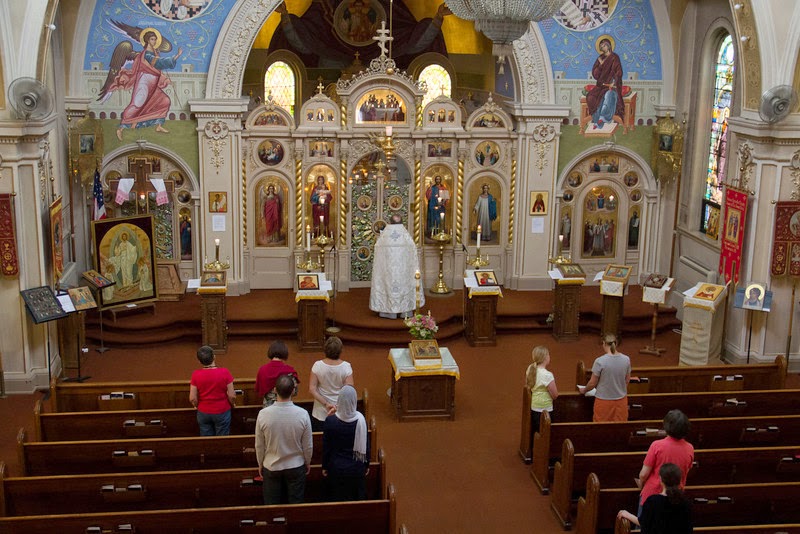
This one, taken from a different angle, shows something like what a worship service looks like, with all the decorations out (though not actually taken during the liturgy).


The differences from a typical Protestant church (traditional or contemporary) are pretty obvious. The walls, the windows, and even the ceiling are covered with images. Protestants, especially those of a more Puritan denominational background, may feel uneasy about this. Isn't this idolatry, the worship of manmade constructs of wood, paint, and gold leaf? Did God not command us not to make any images (Exo 20:4-5) but to worship him alone? I will first address concerns about the use of physical images in worship, then the misconception that Orthodox worship those images as idols.

As an initial point, the second commandment does not prohibit the use of all images in worship but the construction of pagan idols. The KJV/RSV translation "graven image" is highly misleading; the Hebrew word used here, pecel, basically means "idol" and its usage in this manner is evident throughout the Old Testament. The Greek word used in the Septuagint, eidolon, is even clearer. As well, the use of images can't be generally prohibited because God goes on to instruct the Israelites to build them for tabernacle (and later temple) worship. The ark of the covenant has two golden cherubim above it (Exo 25:17-22), and the curtain of the tabernacle also has images of cherubim (Exo 26:1, 31-33). Solomon made two giant cherubim for the inner sanctuary of the temple and carved more images onto the walls and doors of the temple (1 Kings 6:23-35, 2 Chr 3:10-14). The prophet Ezekiel, in his prophetic vision of the heavenly temple, again sees carved images on the walls. (Eze 41:15-26) In the Old Testament, at least, the use of images in worship, far from automatically constituting idolatry, is actually commanded by God and appears in depictions of heavenly worship. However, before Christ those images are simply of the created order, as a means of praising and honoring their creator by way of his handiwork.

Has the situation somehow changed in the New Testament and the Church age? Quite the opposite! The rationale for the prohibition against idols in Exodus 20:4-5, besides the need to set Israel apart from her pagan neighbors, was because God was spirit and bodiless, unable to be depicted in physical form, so any attempt to depict him could not be anything but idolatry. Well, not anymore. Through the Incarnation, God has taken a physical, flesh-and-blood body and graciously enabled himself to be depicted in images (though not, of course, in his divine essence). As I have already described, the Incarnation is hugely consequential for Orthodox theology. They take it as an authoritative divine declaration that matter as well as spirit is good and able to be redeemed, and so Orthodox worship with their bodies, with their five senses as well as in their spirits. John's refutation of the Gnostics in the beginning of his first epistle, that the incarnate Word is "That which was from the beginning, which we have heard, which we have seen with our eyes, which we have looked upon and touched with our hands", applies also to the puritanical logic which sees idolatry in physically manifested worship. Bishop Kallistos Ware writes:
God took a material body, thereby proving that matter can be redeemed: 'The Word made flesh has deified the flesh,' said John of Damascus. God has 'deified' matter, making it 'spirit-bearing'; and if flesh has become a vehicle of the Spirit, then so—though in a different way—can wood and paint. The Orthodox doctrine of icons is bound up with the Orthodox belief that the whole of God's creation, material as well as spiritual, is to be redeemed or glorified. (The Orthodox Church, 33-34)
Though the Incarnation of the Word of God is a truly unique event with cosmic significance, Orthodox also view it as a type for the deification (union with God) of all of creation, including his image-bearers. As St. Athanasius said, "God became man that we might become god." So the Incarnation is the basis for the use of icons in worship. They are made possible by the mystery of God taking on human flesh, and they serve as revelatory "windows to eternity", as eschatological glimpses of the new, deified creation bursting out from the old. Nicolas Zernov beautifully writes:
[Icons] were for the Russians not merely paintings. They were dynamic manifestations of man's spiritual power to redeem creation through beauty and art. The colors and lines of the [icons] were not meant to imitate nature; the artists aimed at demonstrating that men, animals, and plants, and the whole cosmos, could be rescued from their present state of degradation and restored to their proper "Image". The [icons] were pledges of a coming victory of a redeemed creation over the fallen one...The artistic perfection of an icon was not only a reflection of the celestial glory–it was a concrete example of matter restored to its original harmony and beauty, and serving as a vehicle of the Spirit. The icons were part of the transfigured cosmos. (quoted in The Orthodox Church, 34)
And lastly, I would be remiss if I didn't mention that icons are not a late corruption of worship, but have been in use since the early Church and were well established by the fourth century (besides the aforementioned use of images in pre-Christ Jewish worship).

Enough about the principle of using images in worship. Do Orthodox then worship images, since they kiss them, prostrate themselves before them? Absolutely not. This concern is much older than Protestantism; it was the rallying cry of the iconoclasts (icon-smashers) of the eighth and ninth centuries. They believed that to pay honor to a religious image was to worship it rather than the one true God, and thus to commit idolatry. To which Orthodox Christians responded that there is a real and important difference between honor or veneration and worship. This distinction was eventually dogmatized by the seventh ecumenical council in 787, which rejected the implicit dualism of the iconoclasts and continued to grasp and apply the profound theological implications of the Incarnation (as the sixth council did for monothelitism). St. John of Damascus was one of the leading defenders of icon veneration in this time. This article summarizes his thought on the issue as follows, tying it in with the previous point about the deification of material creation through the Incarnation:
The icon stands for something other than itself. An icon is a representation of a real sacred person or event, and is designed to lead us to it. An idol lacks this authentic symbolic character. Icons are based on the same principle as the theophanies of the Old Testament and the Incarnation of our Lord Jesus Christ. All spiritual revelations have to use material media. We honour the icons just as we honour the Gospel or the Cross. Things made by our own hands can be holy if they are set apart for the use of God. Through matter, they can lead us to the invisible God. We do not venerate the icons as God but only as filled with the energy and grace of God. The veneration of icons belongs to the tradition and many miracles are wrought through them. Hence, to depart from them is a sin. John of Damascus also quotes St. Basil the Great who said, 'The honour which is given to the icon passes over to the prototype.' The prototype honoured is, in the last analysis, God, as God created man in His own image.
In the case of icons of Jesus Christ, we do worship the one depicted through the icon, not of course worshipping the physical icon itself. In the case of other icons, we honor (or venerate) the one depicted and, therefore, worship the God who works wonderful things through them. The central point is that it is possible to distinguish between the icon and the person(s) it depicts without rejecting icons as worthless distractions from "true", purely spiritual worship, so that rather than becoming an object of worship the icon serves as a sort of physical conduit for our worship of God, the redeemer of all things, and our apprehension of his presence and his truth. As Jesus said, "He who has seen me has seen the Father" (Jhn 14:9); if Jesus' disciples could glimpse God through his human face, then why not through other material means as well? Ware summarizes more briefly: "When an Orthodox kisses an icon or prostrates himself before it, he is not guilty of idolatry. The icon is not an idol but a symbol; the veneration shown to images is directed, not towards stone, wood, and paint, but towards the person depicted." (32)

The concept of icons as symbolically representing a deeper reality is used in other ways as well. The Bible is called a "verbal icon" of God and is likewise venerated in worship services. Jesus himself, in his humanity, can be considered an icon (of sorts) of the Father, whom he represented to the people of Israel during his time on earth. And Orthodox believe that human beings are also living icons, since we bear the image of God. This helps explain how the Lord can say, "as you did it to one of the least of these my brethren, you did it to me. ... as you did it not to one of the least of these, you did it not to me." (Mat 25:40, 45)

The use of icons in Orthodox churches is also an application of the communion of saints, the Orthodox belief that earthly worship is a participation in heavenly worship and that the whole catholic Church is present. The presence of icons of the angels and saints from throughout the ages visibly affirms this. Ware writes:
The icons which fill the church serve as a point of meeting between heaven and earth. As each local congregation prays Sunday by Sunday, surrounded by the figures of Christ, the angels, and the saints, these visible images remind the faithful unceasingly of the invisible presence of the whole company of heaven at the Liturgy. The faithful can feel that the walls of the church open out upon eternity, and they are helped to realize that their Liturgy on earth is one and the same with the great Liturgy of heaven. The multitudinous icons express visibly the sense of 'heaven on earth.' (271-272)
And finally, icons can also serve in a teaching role. They say a picture is worth a thousand words; so icons are able to depict spiritual realities in an immediate and intuitive (not to mention visual) way that words of theology alone cannot. (This is also an advantage for children and, in former ages, illiterate people) For example, in the first image of my church you can somewhat see that a larger-than-life icon of Mary with arms outstretched in the hindmost part of the cathedral (technically called the "sanctuary"). Is this because Mary is more important than Jesus? No! Rather, because the sanctuary ("holy place") is where the scriptures (the Word) are kept, and where the elements of Jesus' body are prepared for the Eucharist, Mary is traditionally depicted in the sanctuary because, like it, she also acted as a physical vessel for Christ. This is one example of the symbolic, intricately interconnected way in which Orthodox iconography works. Icons depicting events in the life of Christ (such as his birth, death, and resurrection) are especially informative of the Orthodox faith.

Also, notice the ornate wall covered in icons (apparently made in Russia and shipped here over a century ago) partially separating the sanctuary from the rest of the cathedral; this is called the iconostasis. Is this a return to the curtain in the Jewish temple separating the Presence of God from everyone, which tore in two at Jesus' death (Mat 27:51)? No! The iconostasis has three doors which are usually kept open, allowing worshippers to see into the sanctuary; though worshippers aren't exactly free to go back there, there is little secrecy involved. Generally the two side doors are used for access into the sanctuary; when the center door is opened, closed, and used, it is for a symbolic purpose. When the scriptures are brought out through this door, it represents the divine inspiration that gave birth to them. When the elements are processed out through it, it is a weekly depiction of the cornerstone of Orthodox theology, the incarnation by which God became man and dwelt among us. Through Orthodox worship, the drama of the gospel narrative of redemption is reenacted weekly.

Though it wasn't one of the reasons I originally sought after a different kind of Christianity, Orthodox worship came as an answer to a journal entry I wrote a year before learning about the Orthodox Church, after visiting some beautiful Anglican churches in England.
God coming down to our level is only half the story. The other is Him bringing us up to His, and I see that in these magnificent churches, once the center of community life—all of life—in their villages. ... [My church] recognizes the danger of a sacred-secular divide and so does away with "sacred spaces" like Christchurch Cathedral, to try to pervade the everyday with the spiritual. But maybe all spaces are supposed to be sacred spaces. (2013-4-24)
I think that last statement describes the intent of the Incarnation: to transform human hearts, human bodies, human societies, the whole world, the cosmos into "sacred space". But this transformation has a definite starting point in the proclamation and practice of the gospel of Jesus Christ. In Lewisian terms, Orthodox churches are beachheads for the divine invasion and ongoing redemption of the material world.

Further Reading

Hipster Christianity, revisited
Orthodox Worship versus Contemporary Worship
Christian Worship or Pagan Worship
Let's Get Physical
Puritan Sacramentalism (by the ecumenically-minded Protestant Peter Leithart; the next three articles are Orthodox responses)

Wednesday, September 10, 2014

"Cool" Christianity and Form/Content Dualism

I'd like to give a quick shout-out to a recent article written by a blogger I follow, Brett McCracken, as a follow-up to his book Hipster Christianity.

McCracken's book wasn't specifically about the trend of "hipster" Christianity that we seem to hear so much about today (which my church simultaneously participates in and pokes fun at), but about the notion of "cool" Christianity in general. He examines the ways we try to make our timeless faith more "accessible", "seeker-oriented", "user-friendly", or "contemporary" by "repackaging" it in a different, culturally-appropriate style, ostensibly without changing the underlying gospel message. A sample summary of this approach that he gives goes, "What we’re doing is simply putting the gospel in different packaging and updating the style of its delivery [so] as to be relevant to a particular audience. The medium may be different and new, but the message remains the same."

McCracken doesn't think this approach to church is worse, just different, but tries to call attention to "the way form matters in the Christian life", the connection between style matter and manner that is forgotten all too often by "cool" Christians. It's something I'm concerned about and periodically bring up on my blog, but McCracken explains it much better.
Are the medium and the message really so detached that, no matter how an idea is packaged or presented, its meaning remains the same? With Hipster I wanted to challenge this notion and show how form matters: that perhaps the way Christianity is understood and appropriated is different when packaged in Helvetica, skinny jeans, and small batch whisky than when it’s packaged in robes, pews, and pleated khakis. Not that one is necessarily preferable to the other, mind you; just that they are different.
He makes a very insightful connection with the Incarnation that I hadn't thought of:
Christians of all people should grasp the inextricability of form and content. The Incarnation itself demonstrates it. The Word made flesh is content meeting form (John 1:1-18). The gospel is not some ethereal, conceptual “message” as much as it is an enfleshed reality and storied form. The gospel message is embedded within and derived from a medium: the medium of a man named Jesus, out of a nation named Israel, crucified in a place named Calvary.
He also alludes to some of the Christian artists of yesteryear to show what we stand to lose along with the connection between form and content. I agree with his comments on "Christian" media: when we turn the medium into nothing more than a container for the message, we lose sight of makes great art, art.
I think it’s naive for Christians to suggest that medium is something separate from message; they are intertwined. The architects of the great cathedrals in Christian history understood it; composers of sacred music like Handel and Berlioz and Tavener understood it. And yet contemporary evangelical Christians seem to have lost the inextricable connection between form and content. It’s one of the reasons, I think, why evangelical movies, music and artistic output have such a reputation for mediocrity. In privileging content over form, and caring about medium only insofar as it efficiently conveys a message, we’ve tiptoed down a Gnostic path of dualism that doesn’t really resonate with how embodied people live in this world.
Going into specifics, he identifies three values where the ideal of "cool" clashes with the Christian gospel: trendiness, exclusivity, and individualism. I really appreciated this part, as he shows how particular media and style are not content-free but carry their own values and assumptions which may or may not be conducive to the gospel.

Tuesday, March 11, 2014

Jesus, Friend of Sinners (Like Me)

On the way home last night, I heard the Casting Crowns song "Jesus, Friend of Sinners".  I'm not trying to single them out or say that the thoughts that followed were directed against them, this song was just what got me going. And, in fact, I wasn't really thinking about any of the lyrics, other than the title.

Of course we are aware of this picture of Jesus; we make much of it, and like Casting Crowns we find joy in the fact that Jesus seemed to prefer the company of "sinners" rather than the influential pious people who seemed to have it all together. And, of course, in His word God happily points out our sin, and so we know that as fallen, helpless sinners we, too, can find Jesus' love for us, making Paul's words our own: "Christ Jesus came into the world to save sinners, of whom I am the foremost." (1 Tim 1:15, ESV). It's safe to say that these two points, the depth of our sin and the magnitude of God's love for us in the midst of it, are cornerstones of the form of Christianity I find myself in. A common saying at my church is, "The most graceful thing you can know is how sinful you really are."

First of all, if you take the Bible seriously, you can't be the foremost of sinners, because Paul is. He said so himself. But more seriously, I'd like to point something out. Notice in the previous paragraph how many times I used first-person pronouns: "we", "us", "our". I tend to do this in lots of my posts, but it's a tendency that's far from specific to me. I think this is at least partially reflective of our western tendency to personalize and individualize our spirituality. You accept Jesus as your "personal Lord and Savior", you tell people about entering a "personal relationship with Jesus", and so on. It's pretty big right now.

Of course there is a danger (maybe even a certainty) of self-centeredness with this kind of thinking, which is why I tend to try to avoid this kind of "personal relationship" language. But when the song reminded me of how Jesus was the "friend of sinners", I realized another danger, which, in typical fashion, I will present in the form of a question: what if, by focusing on and emphasizing our own sinfulness and then taking comfort in the fact that Jesus befriended sinners, we are forgetting that everyone sins and is loved by God? In other words, we often hear that "Jesus loves sinners" and, in our modern personalizing way, mentally add: "like me." Which often shortens to, "Jesus loves people like me." As comforting as this is, we also need the challenge of mentally adding, "like those people", whoever "those people" are to you: the bus driver you can barely stand, the guy who asks you for money to buy soda every time he sees you, the man you look down on because you know he's going to a casino. (If you couldn't tell, those are all real people from my life, and I'm feeling pretty convicted about how I view them)

The really ironic part is how we take the designation of "sinner" that the Bible assigns us and turn it into almost a kind of privileged status by rejoicing in how "Jesus loves sinners like me", unaware that the whole point of passages of Scripture like, say, Romans 3 is not to show the depth of our sin (and therefore how much we have been loved and forgiven by God) but to utterly demolish any pretense we might field to gain a moral high ground over anyone else. We often call the kingdom of God, which Jesus frequently preached about, the "upside-down kingdom", and for good reason, but this doesn't mean that the standards for being a bigshot have been turned on their head. The implications go much deeper in His words, "If anyone would be first, he must be last of all and servant of all." (Mar 9:35)

Friday, October 25, 2013

Worship as Drunken Revelry; Faith as Music of the Heart

I set out to write another update of my thinking on the role of gender in the church, in light of some thought-provoking recent posts on the subject by Rachel Held Evans and Richard Beck. I'll get to that. I was rereading Ephesians 5 to this end, when suddenly verses 18-21, the part leading directly up to the controversial passage on women submitting, jumped out at me
And do not get drunk with wine, for that is debauchery, but be filled with the Spirit, addressing one another in psalms and hymns and spiritual songs, singing and making melody to the Lord with your heart, giving thanks always and for everything to God the Father in the name of our Lord Jesus Christ, submitting to one another out of reverence for Christ.
"Do not get drunk with wine"; or probably more generally "do not get drunk" okay, that's a simple command, easy, I can do that. (Except maybe when there are mixed drinks and my curious urge to sample everything kicks in) But the part after that had never really made sense to me: "but be filled with the Spirit, addressing one another in psalms and hymns and spiritual songs, singing and making melody to the Lord with your heart". It always gave me some odd, unnatural mental image of Christians going around singing spiritual ditties to each other instead of speaking, maybe holding candles or like The Sound of Music in church. It was honestly kind of creepy.

Matthew Henry's classic commentary helps point out how Paul is intentionally drawing parallels between his instructions for Christians and pagan festivals such as Bacchanalia, where revelers would get very drunk on wine and sing songs to Dionysus, the Greek god of wine and merrymaking. Henry says, "[Drunkenness] was a sin very frequent among the heathens; and particularly on occasion of the festivals of their gods, and more especially in their Bacchanalia: then they were wont to inflame themselves with wine, and all manner of inordinate lusts were consequent upon it...Drunkards are wont to sing obscene and profane songs. The heathens, in their Bacchanalia, used to sing hymns to Bacchus, whom they called the god of wine. Thus they expressed their joy; but the joy of Christians should express itself in songs of praise to their God."

This is interesting because you might expect Paul to try to distance himself as far as possible from the licentiousness of these drunken heathens. Instead, he describes how the spiritual life of Christians should mirror that of the pagans, but with the true God as the object of worship and the Holy Spirit as the intoxicant. The phrase "singing and making melody to the Lord with your heart" really jumped out at me. I realized I had been imagining Paul's instructions too literally, and with none of the pagan parallels. I think he is basically saying that we should live for and worship God like drunken pagans reveling and singing songs at a feast! (Or for a more modern example, Bavarians drinking and singing at Oktoberfest)

I will have many interesting meditations on this image of Christians adoring their Christ, but one thing that sticks out to me now is that there are few who take themselves less seriously than drunken revelers, even if they are taking their god very seriously! By "singing and making melody to the Lord with your heart", you worship the way you enjoy really good music (the kind with driving across the country to hear): with your mind, passions, soul, and body; not passively, or standing on the sidelines pontificating. Paul gives a very experiential and participatory picture of Christian spirituality that I find very compelling.

One objection answered: you may say, "This verse is all well and good, but we must not give in to anti-intellectualism and instead balance it with verses that tell us to 'be transformed by the renewing of your mind' (Rom 12:2), keep a close watch on our teaching (1 Tim 4:16), and so on." And I agree, but I would remind you that these letters were originally sent out piecemeal to specific individuals, churches, or regions, who could not have systemized the teaching of the whole New Testament in such a way. And so if you view verses such as Ephesians 5:18-21 that emphasize Christianity-as-experience as being in tension with verses that depict it more as teaching or doctrine (both are translated from the same Greek word, didaskalia) and that for this reason you need both, you imply that Paul gave the Ephesians an imbalanced and possibly dangerous subset of what Christianity is.

I am beginning to get over the anti-intellectualism I flirted with earlier this year as I am guided to a changed understanding of the role Christian theological study and teaching play. I was speaking to myself earlier when I said that Christian worship and practice (which I am convinced are the same thing) cannot be enjoyed "passively, or standing on the sidelines pontificating". Is it possible the intellectual side of Christianity that has become so prominent today to be part of this "drunken revelry"—our knowledge of God intricately tied in with our experience of God and practice of holiness? I think it must be.