Pages

Showing posts with label Life. Show all posts

Sunday, April 13, 2014

A Tribute to Louise

On Wednesday my grandma Louise died at the age of 91. She was my last and most cherished grandparent, and her passing left a hole in my heart and in those of the family and friends who gathered to remember her. At her visitation and funeral this weekend, I was abundantly reminded (and learned a few new things) about rich and compassionate a life she led. If you knew her in any capacity, you no doubt have fond memories of her constant, selfless concern for others, her priceless smile, or maybe her delicious oatmeal.

Whenever my family came out to Walnut Grove to visit, she would have a warm bed and a hand-knitted pair of slippers for us (as well as the aforementioned bowl of oatmeal in the morning). She would set the table with care for meals grand and small; each one was a time to grow closer and love each other as a family. She would help hide Easter eggs for the grandchildren to find, and give hints to us when we weren't sure where to look. When grandpa's health kept him from going to Christmas service, she and her children brought a Christmas pageant to him, put on by all of us, making all of the costumes we wore. These are only a few of the memories I have of her, and even they are only from the last 20 or so years of her life. Even when she got too frail to express her love for us in these ways, her graciousness and habit of putting others first made her the favorite in her assisted living community; several of her nurses showed up to her visitation.

So during the funeral yesterday, as her nephew was reading a eulogy that better expressed what I was trying to say, I realized not only how great a grandma she was, but how much of a role model. I wondered, "What if I did theology the way grandma kept her home?" Obviously it takes a lot of abstraction to transfer home economics to biblical studies, but still, her example puts flesh and blood on so many of the teachings of the Savior whom she loved. Some answers I can think of to this question:

I would seek to write about God in a way that illuminates peoples' hearts, minds, and spirits, not just satisfying my own private search for truth or impressing people with my insights.

I would show concern and compassion in my words for everyone, even if I disagree with them.

I wouldn't take myself too seriously. In fact, I wouldn't think much about myself at all.

I would try to know peoples' needs and bless them in ways they didn't even expect.

What about you? Who is someone in your life who has modeled Christlike character like my grandma Louise? What lessons can you learn from them to apply to your own life?

Friday, July 26, 2013

The Economics of Presence

Another year, another move. (I'm hoping I can go for more than a year without moving this time) I've moved from a studio apartment on the north side of downtown Minneapolis to a two-bedroom apartment on the southeast side, just two blocks from my church. So far I'm absolutely loving the location, the reduced rent, and having a roommate again. But possibly my favorite part has been the change of my internet-going habits the move brought about. When I moved into my previous apartment, I was able to set up my internet connectivity over the phone in about a day. This time, I had to schedule an appointment and spent a week without internet access leading up to it. (The technician who did the installation wasn't sure why I couldn't do it over the phone) My roommate could still get online on his smartphone, but since I don't have one I could only go online at work.

What surprised me is that this week without the internet was actually extremely enjoyable--so much so that my computer habits seem to have drastically changed. At my old apartment I would essentially have my computer in easy reach all the time because of the personal connection the internet seemed to promise. I was present halfway in whatever I was doing, and halfway in Facebook, and therefore not completely present in either. I felt, to borrow an analogy, like butter scraped over too much toast. Anxious for interaction with my solitary job and home, I found that the more I relied on social media, the more lonely I ended up feeling. This article in The Atlantic says, "In a world consumed by ever more novel modes of socializing, we have less and less actual society. We live in an accelerating contradiction: the more connected we become, the lonelier we are...transfixed by the glare of a screen, hungering for response." It sounds uncomfortably like how I used to spend many an unproductive evening.

With that habit broken by the scheduling of a cable company, I'm now able to be more fully present and attentive in whatever I'm doing, and strangely even though I don't multitask nearly as much, I feel like I have more time than I did before. (Or that time is higher-quality) I'm more concerned with what I am doing than on what I wish I could be doing. Having a roommate so my social interaction at home isn't all either online or planned out a week in advance also helps, but more than that it's just being able to focus, wonderfully and completely, on one thing in the here-and-now (instead of there-and-then) at a time.

Could we, as a society, be addicted to multitasking, to the art of technologically diffusing ourselves so as to be present everywhere and nowhere? I don't have a smartphone partly for this reason, but I don't imagine they help much. It makes me think of one of the names Jesus is given, "Immanuel" (Isaiah 7:14), which means "God with us". This declaration has much less punch in our "Jesus is my homeboy" culture than it must have for Isaiah's audience, much less the people who actually met Jesus. The unimaginably holy God who guided Israel out of Egypt and ruled over them, who they only approached (but not too close!) to make offerings while acutely aware of their own unholiness, was now coming to be with them. I, for one, am glad Jesus was always fully present and didn't interrupt His ministry or time with people every five minutes to check His Facebook, send a tweet, or carry on five text message conversations. (I'm also not sure He'd have the latest and greatest iPhone/Android/whatever, but that's a topic for another post)

Sunday, May 26, 2013

Speaking the truth in love after tragedies

As you're probably aware, a particularly nasty tornado hit near Oklahoma City on Monday. About tragedies like this, I would rather say nothing than something insensitive or canned, which unfortunately means I end up saying nothing. Depending on the circles you run in, you may also be aware that John Piper, did decide to say something, which has raised a rather disheartening commotion among some bloggers I greatly respect like Morgan Guyton and Rachel Held Evans. (Both posts and their subsequent follow-ups are still well worth a read) I'm going to speak like a fool for now (biblical precedent--2 Corinthians 11) and do some pontificating of my own on the situation.

Bloggers like the aforementioned two have used this incident as an occasion to question Piper's theology (knowledge of God) as cold, impersonal, and unloving to us wrath-deserving humans. Besides the fact that this instance actually doesn't point toward such a theology (Piper tweeted Job 1:19-20 which, while arguably insensitive, implies that the disaster was meant to inspire awe and fear in a God who is incomprehensibly larger than we, not that it was a manifestation of His wrath for sins), I'm not sure that theology as we usually think of it is the problem here.

Guyton in his post concludes that it is commendable and beneficial to try to see God's purposes in tragedies. However, we can't make others see for them, and trying to do so, as Piper does, can be cruel and damaging. "As a pastor, I do not give myself the authority to tell others how to interpret their tragedies. I can point them to the rich resources of God’s poetry in the Bible so that God can breathe into them the poem that fits." In other words, the main problem is not that commentators who are quick to ascribe divine purpose to tragedies are being insensitive, it is that they are appointing themselves as the mouthpiece of the Spirit and expecting Him to speak to listeners through their words. Obviously this is something a pastor should desire and pray for, but not something you can assume, especially in tragedies.

It's especially tricky when your words are a Bible verse, i.e. from "God's word". I can understand Piper's belief that a Bible verse would be an appropriate response for any situation, given that God's word is said to be a light for our feet and a lamp for our path (Psalm 119:105) and that all scripture is "breathed out by God and profitable for teaching, for reproof, for correction, and for training in righteousness" (2 Timothy 3:16). And yet, God's words can and have been misused to great harm after tragedies. Does this mean God's word has failed in these situations?
Remember the "truth trinity" I developed while thinking about what truth is (Jesus), and the follow-up exploration of the purpose of scripture (to encounter and know Christ as the apostles did). I think that for the Bible to truly function as "God's word", it isn't enough to just quote it, study it, or argue it. Isaiah 29:13 sets a precedent for this: "And the Lord said: "Because this people draw near with their mouth and honor me with their lips, while their hearts are far from me, and their fear of me is a commandment taught by men." In other words, it isn't enough to merely throw scripture around no matter how "correct" or "appropriate" it is. Our hearts also need to be in the right place--in fellowship with the living God, being reshaped to the likeness of Christ. Jesus may have promised that the world will hate us, but that is no excuse to misuse scripture.

This is what the Christian aphorism "speak the truth in love" (from Ephesians 4:15) comes from. This is often distorted to mean something like "We most fully love people by speaking the truth of the gospel to them", which can be used to justify an overspiritualized gospel that elevates teaching right doctrine over and against all other needs (see James 2:14-17), insensitive tweets after disasters, or even (I hesitate to go there) the deplorable speech of the Westboro Baptist Church. Paul's point is that speaking truth (even a Bible verse) is not automatically loving and does not mean that God is definitely using you as His mouthpiece. A mother who lost her son to a tornado probably doesn't want to know about how it was all part of God's sovereign plan; she would prefer some empathy, or even a punching bag. This preference is not simply dismissable as "sin blinding us to God's truth". It is human emotion, and trampling it with a singular focus on "bringing truth" is callous. Sometimes the most "Biblical" response to tragedy is to say nothing and instead simply mourn with those who mourn. (Romans 12:15)

The medium itself also matters. There is an enormous difference between working through Hebrews 12:9-11 while counseling someone one-on-one to work through their anger at God about the death of a loved one, and tweeting it after a much-publicized tragedy. The difference is that one is highly personal, the other is highly impersonal. I don't think exploring and applying God's truth is supposed to be isolated from modeling the love of Christ through relationships, which is kind of unavoidable in a tweet. This is also why I don't like internet arguments. Without any relationship to preserve, there are just endlessly clashing viewpoints and wounded pride.

Saturday, December 29, 2012

Four things children's ministry has taught me

For about eight months now I've been blessed (and challenged) with the opportunity to care for and teach two truly wonderful classes of preschoolers in Sunday School at my church. If this comes as a surprise to those of you who know me to be a generally quiet, serious, hyper-analytical INTJ type, know that I continue to be surprised by my love for children's ministry every week. Even though I am just about the only teacher with no formal education whatsoever in working with kids, even though I often feel like I have no idea what I'm doing, I always look forward to spending another Sunday morning with them.

This all reminds me of what Jesus had to say (that was recorded) about children in Mark 10:13-16:
And they were bringing children to him that he might touch them, and the disciples rebuked them. But when Jesus saw it, he was indignant and said to them, “Let the children come to me; do not hinder them, for to such belongs the kingdom of God. Truly, I say to you, whoever does not receive the kingdom of God like a child shall not enter it.” And he took them in his arms and blessed them, laying his hands on them.
 To simply read this passage and conclude something like, "Look how loving Jesus is, He welcomed and blessed the little children when his disciples were turning them away!" is insufficient. Jesus makes some really challenging (here italicized) statements. To such [those like little children] the kingdom of God belongs. And, in fact, only those who receive the kingdom of God like a child will attain it. Jesus seems to be saying that there is something about children that is worth taking note of and even imitating that is necessary for our life in Christ.

And here the idea of how the words of the Bible underdetermine its meaning comes into play. Jesus says that we have to be like children in our faith, but doesn't specify exactly how. What are we to make of His words, then? Of course He didn't mean we should be extremely selfish, throw tantrums whenever we don't get what we want, or be as simple as children in our thinking even in adulthood. We are told to have a childlike, not childish, faith. From my very limited ministry at Hope, here are some non-encompassing things I think kids "get" about life that adults tend to forget.

Kids know what they want.


This one sounds like a bit of a no-brainer. What I'm getting at is the common idea of kids being "innocent"--but of course, this isn't entirely true, as any parent (or maybe older sibling) can attest. What I mean is that kids (at least, the younger kids I work with) don't seem to have developed the complex web of hidden issues, conflicting desires, constraining obligations, or long-hidden afflictions that adults are so frequently burdened under. Everything is on (or near) the surface. If one of my students is having a bad day, they don't bury it or put on any masks; it shows in their faces, their actions, their reluctance to play with others. If he or she is happy and excited to be there, that is easy to tell as well. Kids are transparent with themselves and others in a way that adults are not, and I think that's just fantastic.

Kids know their limits. (And aren't afraid to ask for help)

This is probably especially true of younger kids, for whom there are still many things they can't do for themselves. What continues to make an impression on me is the candor they always have when asking for help.  For example, at ages 3 and 4, my students are still in various stages of learning to write their names. If they can write their name on whatever craft we're doing that day, they give it their best shot (and I always act impressed, because I always am). If they can't, they ask a teacher to do it--no shame or reluctance felt, or needed.

Our present culture places high values on personal responsibility and self-sufficiency, to the point where asking for help becomes unthinkable. People (myself included) can spend years trying to deal with their problems without telling another soul, thinking they can "handle it". Knowing when to ask for help is an extremely valuable skill to have, and kids are real pros at it.

Kids know how to trust.

This is partly hearsay and partly what I've seen from kids getting dropped off and picked up, but I believe 3 to 4 is right around the age when children see their dads as supermen who are all the coolest dads ever, can do no wrong, and serve as great sources of security. (And if something happens to break this trust--like an abusive or absent father--the effects can last a lifetime) Of course, they grow out of this as they realize that dads, like the rest of us, are only human, that they aren't perfect or all-powerful or (in many cases) the coolest people ever. The transition from seeing your dad as this almost mythical figure to seeing him as a peer is one that I'm still navigating, to a degree.

But part of the good news of Christianity is that we have another Father, one who really is perfect, all-powerful, and completely worthy of the trust we placed in our human fathers as children. This is easy to forget because His parenting style is more extreme than anything we get in human relationships: sometimes far harder and more difficult than anything we experienced with our human father, sometimes softer and more loving than anything we ever dreamed. Donald Miller describes the challenge of this in his book Father Fiction:
Another thing I noticed in Jesus's [the Lord's] prayer is that he submitted to God: "Thy Kingdom come, Thy will be done, on Earth as it is in Heaven," Jesus says. And I don't think Jesus was saying God was a control freak, trying to make himself feel powerful. He could do that by smashing atoms together if he wanted; rather, in asking us to submit it seemed to me Jesus was saying, Look, you are going to want to do things your way, but your way isn't the best for you. Trust me, I know what you need. Jesus said this outright in his lead-in to the prayer: he said our Father in heaven knows what we need before we even ask him.
God our Father in Heaven isn't always the father we want, but always the one we need if we are willing to submit our wants and trust Him. I think this trust, when lived out, will look surprisingly like a child's total trust in their dad.

Kids know how to accept grace.

Getting back to what I said about kids knowing their limits: our culture of self-sufficiency and responsibility also makes it very difficult to accept grace; that is, favor that we didn't earn and can't claim responsibility for in any way. Of course, it being the Christmas season, you might think that everyone just loves gifts, but even behind Christmas there can be a lot of obligation, of trying to "prove" to people that you love them by spending money on them. Our sense of guilt when we get a great gift from someone we didn't buy anything for or, on the flip side, the entitlement of convincing ourselves that we "deserved" that gift somehow and were right to receive it, both go to show the real difficulty we have in accepting true grace.

You get the pattern; I think dealing with grace is something we tend to forget how to do as we get older. Of course kids are susceptible to entitlement (becoming "spoiled"), but I don't think that's where they start off. Kids are used to being provided for simply because they can't provide for themselves. Now that I'm an adult I always feel a bit awkward when I go out to eat with my parents and they pick up the bill, but when I was younger this was just business as usual. When we realize that there are things we can never provide or earn for ourselves--like justification of our lives before God--the correct response is childlike faith, not shame at not being able to earn them or attempting to justify our receiving them. No matter how mature, rich, or powerful we become in life, we are always going to be like needy children before Almighty God.

One last thing I've been learning that doesn't fit into the "Kids know _____" rubric is the difficulty of trusting God with the spiritual development of others. When I look back at my own life, I see how no one person, not even my parents, could have steered me onto the path God has led me down to knowing Him. While this does take some of the pressure off teaching Sunday school, it's also humbling to know how little a difference I can make on my own, and believing that God can make something real and powerful out of my meager contributions to these kids' lives has helped build my own trust in Him.

At this point I'm a bit pessimistic about asking for comments and discussions on my posts, but of course my picture of "receiving the kingdom of God like a child" is far from complete. So I simply leave you with the question; what does "childlike faith" mean to you?

Friday, December 28, 2012

Announcement

As of today, I have officially been accepted to the Center for Graduate Studies at Northwestern College to pursue a MATS (Master of Arts in Theological Studies) with an emphasis in biblical studies! Starting next summer, God willing, I will be taking classes in spiritual formation, biblical hermeneutics, and studying the scriptures in the original Greek and Hebrew! Needless to say, I am unbelievably excited about this opportunity and see it as an answer to a lot of prayer and heretofore unfulfilled desire for depth in my theology. (As opposed to the breadth in my Old Testament survey class that focused on the "30,000 foot view") To explain more of my reasons for applying to this program, here is one of the essays I wrote while applying, minus the paragraph about why I chose Northwestern in particular.


The idea of pursuing a graduate degree in theology came to me very suddenly one day at work, and I knew it was worth following up on because I felt even more excited about it than I had been about getting my current job at Seagate. I had previously only considered graduate school in a similar field to my undergraduate degree (computer science), but as I thought about a master's degree in theology it made even more sense than these options. I simply feel called to pursue it in a way that I have never felt called before.

In addition, I am learning that I have a passion for deeply studying scripture and growing in understanding of the things of God. Attending a secular university, I pursued this interest largely through my blog, where I practiced my writing skills by investigating various topics of theology and scripture. More recently I have been taking a survey course on the Old Testament at my church, which, while satisfying, only highlighted my need to understand and apply God's word more deeply. I can think of no more thorough way to do this than a graduate degree. There is plenty of free Christian training and instruction out there, but I don't just want to be taught the Bible, I want to be able to study it myself and teach it to benefit others.

Less clear than my calling to pursue this degree is what I would do with it. I currently have no specific plans to use it in my career, but I do have some dreams for how I want to use the gifts God has entrusted to me to serve the church. I want to help people who struggle with doubt as I do and have. I want to make more of a difference in my small group and in the Sunday school class I teach. Most of all, I want to learn and demonstrate how to use the Bible to draw together the body of Christ rather than divide it, as the Bible is unfortunately used to do. Wherever God takes my life from here, I know that having the solid foundation provided by these studies will be good and beneficial. Since I have no specific career aspirations using a MATS, the process of studying the Bible and theology more deeply is more important to me than the destination.

Friday, August 31, 2012

t3h LOLzorz

Last night, for a friend's birthday, I attended the first ever Internet Cat Video Film Festival at the Walker Art Center. Yes, internet cat videos are apparently an established enough art form to draw thousands of people to watch them outdoors for almost the length of a feature film. As I am a firmly established cat hater, a part of my soul died last night. A few of them were pretty funny.

When I got there around 7, it was already pretty surreal. At least a thousand people were already sitting on blankets all over the hill next to the Walker. Some people were wearing cat ears; some had brought their cats. There were stands selling food, T-shirts, and souvenirs by the building; also one calling itself the "Death Metal Drawing Club". (I saw nothing at the stand that made that name make any sense) A local band (also in cat headgear) was playing music on the stage. It was a pretty nice amphitheater, all for watching crazy cat videos.

People kept coming to the hill and I sat and talked with friends as they arrived until about 8:30, by which time they had put up a screen where the band was and an announcer gave a brief introduction. After a few quick ads from the main sponsor, Animal Planet, we were off.

The videos were organized into categories: the obvious "Comedy", but also ones like "Drama", "Musical", "Foreign", and "Documentary". It was basically like a YouTube cat video binge only you got to enjoy it with thousands of other people, which more than made up for the smallness of the screen from our distance. I probably laughed and "Aww"ed less than anyone there, but some of them were legitimately pretty good, particularly the peoples' choice winner, the melancholy faux-French "Henri 2 Paw de Deux", and a nightmarish/brilliant animated video, "Kitty City".

So, there you have it. Life imitates internet memes.

Thursday, August 2, 2012

All the Internets


On Wednesday I finally began moving out of my near-campus apartment to a lovely studio in downtown Minneapolis, a two-and-a-half-mile move that will cut my daily commute by about half an hour each way. (The laws of geometry get jumbled up when you commute by bus) As I'm not using any of my precious vacation days on this, moving all of my things over should take the rest of today, to say nothing of cleaning my half of my old place!

In other news, I am still in the process of getting internet service at my new place, a maze of phone menus, hold times, and conflicting information all from the same company. I hope to get it figured out tonight after getting home, but apparently it took two weeks for one of my coworkers so I'm not too hopeful. Luckily, I will be living a few blocks from Minneapolis Central Library which has free wi-fi.

The point is, I spent last night and this morning without any internet access, which doesn't even sound that bad when I write it now. I didn't go into withdrawal shock or anything, but sitting around kind of bored I realized how much of what I do is dependent on the internet. (Of course, I hadn't brought any books or other distractions over yet, but still) I guess I thought since I don't have a smart phone I had escaped the urge to always be "connected", but it's still a pretty ingrained habit when I'm at home. I think sometimes I even see the world in my computer as deeper and richer than the real world. (Being a CSci graduate doesn't help with this)

Of course, I realize that this isn't necessarily a bad thing. It seems like the internet is so vast and consumable (tied into our consumer culture) that it's easy to see spending time on it as an end in itself rather than as a means for something else that's only been around for about 20 years, like planning events with friends or ordering things. Even when I've studied how it works and know it's a bunch of servers connected by a web of data routers and built on a stack of increasingly complex protocols (try pulling that out next time someone calls it a "series of tubes"), I find myself falling into this frequently.

I'd encourage you to think (or even comment!) about ways you think the internet has influenced your everyday life and habits. In situations where you were forced offline for a while, did you react better than I did?

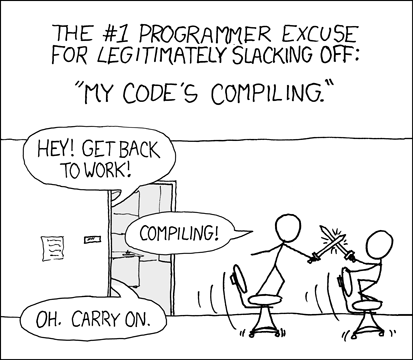
Oh, and if you are wondering why I'm blogging at work (besides the fact that, at the moment, I can't blog at home), I'll answer with another xkcd:


(Or, since Python is interpreted, I'm running a capacity test on my program and writing while monitoring its memory usage)

Theology update: my outline on Calvinism, Arminianism, God's sovereign election, and providence is over 2,000 words and six pages; I think I'm almost ready to start writing. Expect at least ten posts out of all of this thinking, and thanks for your patience.

Sunday, June 17, 2012

Life Update

It's kind of a thing for some bloggers to post updates on their lives (particularly my friends who are getting involved in vocational ministry). Though I did so for Summer Project, I haven't since Spring Break several months ago and I feel like now would be a pretty good time with all the transitions in my life.

So, for starters, I have indeed finished college summa cum laude at the University of Minnesota. (Not graduated--I haven't graduated until I'm holding my diploma in my hands) My honors thesis was pretty stressful, but I managed to finish writing it well in advance and present it to my readers. It feels amazing to be totally done with it. Then I had three weeks of absolutely nothing after commencement my last finals, during which I blogged a lot (as you may have noticed) and played possibly too much Skyrim.

Also, my roommates moved out and I have been greatly enjoying having the whole four-person apartment to myself. Given that I'm such an introvert, I've really been enjoying the whole living alone thing. Having the apartment be totally static except for what I do in it is a blessing and a curse--but mostly a blessing. And it's so clean all the time! Unfortunately, I don't have long to enjoy it for the below reasons.

My church, Hope Community Church, is at a pretty exciting time this summer. For one, our worship pastor is supervising the recording of an album of some of our favorite songs to sing in church. The music is one of my favorite parts about Hope; Tim really likes playing old Christian hymns set to our electric type of electro-folk rock. I guess growing up I never connected too much with the musical style of the old hymns at my home church, and the style at Hope really breathes new life into them and helps me to enjoy the truth and beauty of the lyrics as they were meant to be enjoyed. Anyway, I got the opportunity to visit the studio where they're recording it last week, and it seems to be in great hands! I can't wait to hear it.

But that was just an aside. The really exciting thing is that we are going multi-site...sort of. Due to our uncontrollably exploding attendance, we are planning on moving some of our services into the building next door, Augustana Lutheran (now "Hope East"). We've already raised enough money to buy the building outright (praise God!) and this summer are in the process of renovating it to start using it in the fall. So I'm helping with this two or three days a week. So far we've just been doing demolition--knocking out walls and tearing up flooring, which has been fun but exhausting. Soon we'll start painting!

I've also been teaching Sunday School for preschoolers for a few months now. All of the other regular teachers have other summer commitments so now I am the head teacher of around twelve adorable and wonderful 3-to-4-year-olds, which I never would have believed a year ago. Sometimes I feel like I have no idea what I'm doing (which hopefully is normal) and I keep praying that I would make an impact in their lives.

So that's pretty much my whole life right now...oh, right, the elephant in the blog. My career. I am two weeks into my employment with Seagate Technology! I've rejoined the Failure Analysis team I worked with last summer doing more software stuff; we're kind of like a forensics team for hard drives and I will be writing and maintaining software tools to help them slog through all the data they gather. It's a great job, I get to do something I enjoy and put my degree to good use. I have a great team and manager, and the pay is...well, excellent. God has blessed me in huge ways with this job.

So why do I have so little time at home? In addition to the eight hours at work every day, I spend at least three hours on the bus as well. I am part of the minority of American adults who do not own a car. Which isn't too unusual for a twenty-something with the increasing sway of the "green" movement, except that my job is almost 30 kilometers away. Despite this, I have no desire to get a car or move to Shakopee (which would force me to get a car).

For most of my life, up to early this year, my plan was to get a car that doesn't run on fossil fuels. And it looked like the technology was just in time to let me achieve this dream. But I decided to put off getting one for a while, partly to let my credit score improve/save enough money, but also just to see how it went, Then, as I saw how possible living without a car was, I decided to just forgo it altogether.

I have several reasons for not wanting a car. With the construction and parking insanity around campus, a car has become to me more of a liability than an asset. I didn't want the hassle and expense of paying for gas (if my car used it), insurance, maintenance, etc., not to mention the actual car. But most of all, I really just don't like driving, especially in traffic. Every time I slow to a crawl with a sea of brake lights in front of me, I feel like there are too many cars on the roads already and that by getting one I would become part of the problem. And, of course, as you may see in my previous post on transportation biking is far more efficient.

Luckily, thanks to Metro Transit I can get from my apartment to work with about a quarter mile of walking. It just takes forever, giving me all the time in the world to read or think on the bus. And I have plenty of thinking to do about where God has put me. Since I'm spending the majority of my waking hours at work or commuting, how do I live a life of faithfulness to God in that context? How do I keep building relationships now that I'm out of school? How do I effectively love the kids in my Sunday School and train them in the way they should go? How do I, Lord willing, begin to seek a wife? I'd appreciate prayer on any of these things.

Monday, April 16, 2012

Story

The theme for my church's Spring Retreat this year is Story--my story, your story, and how God has been behind them all. To get us excited for it (and maybe for talking points when we're there), Hopestars are encouraged to "tweet" their story in 140 characters or less. I've never been a twitter (tweeter?), so my official story will consist of a link to this post. I'll probably never be fully satisfied with my story. (After all, it will never be complete) My last telling was pretty good, though maybe a bit too introverted and focused specifically on last December.

For most of my life, my mission statement would have gone something like this: "To get as many good things for myself as possible, without negatively affecting anyone else." Having grown up in a "Christian home", I called myself a follower of Jesus since I was old enough to start thinking independently about my faith, but really this was how I lived. Personal advancement, and later peace of mind, became idols to me. There were several problems with this way of life. The first was that it was fundamentally selfish, revolving around self-gratification. But the clause about "not hurting anyone else" blinded me to this fact and made me think I was a decently good, moral person. So my selfishness grew, hidden under a veneer of benevolence.

The second problems was that since I was living according to this self-imposed standard, I became self-righteous. When I was living up to it (which was usually the case), I felt fine, but when I failed, it really messed me up. I was willing to forgive others, but not myself. The despair I felt when I didn't meet my own expectations was still selfish in an "Oh, poor me" kind of way.

And finally, I started to internalize the difference between what I said I was (a good Christian) and how I lived (for myself). Even as I began paying more attention to my faith and relationship with God, I found it hard to see how to live it out because I had become used to doing things without thinking over the reasons.

But it was in college, when many people lose their faith, that God thankfully found me. For the past few years God has been pushing the simple but critical truth of the gospel further into every corner of my life. It shakes and topples the old laws that controlled how I lived. In the place of my arbitrary and selfish code of morality, I have the perfect example of Jesus. When I inevitably fail to fully live up to it, I don't despair because I know that I am unconditionally loved and forgiven by the only One whose view of me matters. I've been able to see my old idols for what they were and subordinate them to God's calling.

The thing that's motivated the most external change in me has been the growing notion that the things I do matter; they aren't just for my own sake, but determine how I represent God on earth and build His kingdom one fragment at a time. In this way the gospel fulfilled the need that lay beneath my old, selfish ways of living: the need to feel "right" or justified with the way I'm "supposed" to be and live, once invented by myself but now shown to me by God. If I'm inventing my own purpose for life, there is no real or transcendent significance, but with God, it's all gloriously real and meaningful.

My life isn't perfect by any stretch of the imagination. The fact that I once believed myself to be a Christian while remaining totally lost stands as a stern warning to remain authentic with God, myself, and others. One of the great challenges of the Christian life is remaining faithful even in the reality of constant doubt, reminding myself daily of what I believe and why, of convincing (sometimes forcing) myself to believe that the gospel really is that good. Because it is.

Monday, January 23, 2012

God's Will and Mine

Lots of Christians put a lot of stock in learning to "discern God's will". Part of making God the ruler of your life is submitting your situations and decisions to His lordship. And this is great; it takes a lot of humility and trust to entrust your life to someone else, but God is supremely capable. I'm not exactly writing about that. One thing I don't see any of these teachers, pastors, Christian motivational speakers, etc. mentioning is that God doesn't have a specific will for every single decision you make. Or maybe He does, but He's not going to tell you. Let me explain. Sometimes when I'm praying about an upcoming decision to God (like my recent decision of which job offer to accept), I get no response, except a sense of "you decide". It's always scary when God does this--tell me to make a decision I'm asking Him about--but also reassuring, as it means I'm up to the task and there is no wrong answer. After all, God doesn't want to produce automata who blindly follow His will--He wants children who freely choose to obey and follow Him. God telling me to make these decisions is a precursor to the total freedom in Christ we'll have in heaven--where God doesn't have to tell us what to do, but out of love we honor Him with our lives anyway.

Saturday, January 14, 2012

Why I Am A Christian

My more astute readers might have noticed that whereas I used to have to apologize for the sheer density of my posts on faith, I've only done two in the past month in a half. The first, early in the morning of December 1st, was a brief and rather enigmatic parable contrasting outward appearances to inner natures--the differences between the two and the masks we put on. The second, a few days later, unpacked the concept of justification as the undeserved imputation of God's perfect righteousness as explained by Tim Keller. And then--nothing, except politics, Christmas-related stuff, and games I've been playing.

The truth is that for the whole month of December 2011 (and two days into this year), I've been fighting for my faith with unanswered questions of need, meaning, and practice. I've gone through existential depression and deeply questioned God, the church, and myself. Having come out of the worst of that and more secure in my faith than ever before, I think I might finally be ready to bring my testimony to a workable state. It's far more introspective and philosophical than the previous drafts, which assures me that it's really mine. Dave, my discipler and great buddy from Milwaukee, once said that I'm more of an internal processor; it's how God has made me, and it's how He is drawing me to Himself. Here it goes.

I was raised by loving Christian parents who prayed with me often and brought me to church. Looking back on my childhood I can recognize some times when I really experienced God, but these had no lasting impact on me; I preferred to pursue books, video games, and increasingly in middle school, academic success. I was very secure in all of these things and never feared losing my ability to find endless contentment in them, so I felt I had little need for something deeper in my life. I don't miss those days because I had no idea how much more there was to life. As C.S. Lewis wrote, "We are far too easily pleased."

As I got older and relationships became increasingly important to me, I began seeking God as a means to success in them, to get the love and acceptance I wanted or for comfort when the unstable things I poured my life into failed me. Through all of this and into my sophomore year of college I somehow maintained the absurdity of believing in God as the "Lord of my life" but living self-centeredly and reducing Him to the role of assistant.

At a fall retreat with Cru (then Campus Crusade for Christ) I made the conscious decision to trust God to lead me rather than leading my own life selfishly, which had led to despair and disaster from pursuing the impossibility of perfecting my own life. Looking back, this was the start of the positive trajectory my life has been on since. I admitted to God that I couldn't run my life on my own. As I began living this decision out, in 2010 I went on a summer mission trip where I saw God use me to do amazing inner-city ministry and had some of the best community of my life with my "project friends", who became like a second family to me.

Starting on summer project and continuing through 2011, I wrote about seven or eight drafts of my testimony, but it always felt incomplete--as if God still had chapters of it left to write. Obviously it won't be completely done until the day I die, but it didn't seem to have the mark of transformation to it like the others I heard on project. This didn't worry me nearly as much as it should have. I continued optimistically in my growing faith, continuing to be taught and getting more involved with my church in 2011.

But as fall of my senior year of college went by, I seemed to be stagnating. Rather than boldly living out my faith as I was called to, I was increasingly focusing on not getting dragged back by distractions, reminiscing on how great the past was, and my increasingly intellectual posts on this blog. Until one night at my small group when God started wrecking my life. (As it was then)

It started when I realized the circularity of having the main "point" of living as a Christian be to introduce others to Jesus--the Great Commission (as I'd come to believe on one level or another from Cru). This made it seem like some kind of benign virus that spreads and spreads, but doesn't do anything. The truth was I'd been overly focused on the external results of Christianity--when I felt like I was having a successful ministry I had peace of mind, and when I wasn't doing as much, I felt bad, like I needed to shape up, pray more, have more faith. I was trusting God to help me live a "Christian" life, but that life, the result, was my ultimate goal, not what God Himself had to offer.

I felt a hollowness inside me, a disconnect between my inner man and my exterior lifestyle. I'd been meeting my fundamental, then-unidentified needs with the same kinds of things I had been years ago when I treated God as an assistant, and trusting Him with surface-level things related to living as a Christian (which would certainly be considered "good" things) because those were what I thought mattered to me. I hadn't made the internal connection between who I knew I was in Christ and how I lived. I realized how I lived was motivated a great deal by pressure I felt to "fit in" with my believer friends and a desire not to feel guilty for not producing the same kinds of ministry results they did--after all, couldn't I do anything through Him who gives me strength?

The next step, then, was figuring out what my deepest need actually was and how God fulfilled that instead of my "need" to live as a Christian (which was largely because of what I'd been told and had told myself for years). At the same time I was confused about what the ultimate "point" or goal of my faith was. I was tired of the overly simplistic, Sunday-school answers to these questions I'd been hearing and repeating for years--answers that sounded great in the abstract but were of no use to me in this crisis. I had never sincerely asked these questions of need and essential meaning before and they burned constantly on my soul. Next to finding true answers to these questions, nothing else seemed to matter. I spent my Christmas break in a mental fog as I wrestled with them.

After some reading and thinking, I concluded that my deepest need was for my life to have meaning, or significance--I needed to matter, as I think we all do. This meaning or significance couldn't come from some arbitrary material thing or process, for as Kierkegaard argued, what's to stop me from later picking something else as my source of life? No, I was sure it was nowhere to be found in the material universe, but had to come from an eternal source--by my relationship with God. Furthermore, it couldn't depend on anything I did; the prospect of failing to make my own life meaningful couldn't be an option, because it was inevitable that I would continue to fail. I'd admitted years ago that I couldn't run my life without God, but I now truly believed it, and it was initially very discouraging.

So I began to slide into an existential depression. Even with all my previous theological study, I struggled not to believe that my life was meaningless because all of my individual actions were meaningless because "only God matters". Lost in confusion, the truths that had used to seem so clear-cut to me were now a tangled haze of paradoxes. I remember for a few days facing the clear decision of whether to keep seeking God at all. I understood how many hardened atheists are made--by coming to this question and answering it in the negative. I was tempted to reject the doctrine and the teaching as ridiculous, incomprehensible, and start over.

Ironically, my avid studies of Christian apologetics from back before I was really even earnest about my faith helped save me. Denying the existence of God has never been an option for me, even in this time of extreme doubt. I knew, undeniably, that looking for the answers to my questions anywhere except in Christianity was a waste of time. For the first time in my life, I had actually, freely decided on my own to follow God, even when doing so seemed like a ridiculous prospect. (I had faced a similar decision on summer project, but the pressure imposed by the ministry and Christian community I was engrossed in cut my struggle short and I applied a sort of "band-aid" fix)

For a few days after that decision, nothing seemed to happen; the confusion continued. It didn't matter to me; I'd made my choice. Then, within minutes, I felt the haze lift and knew it was God responding just as I'd hoped He would. Suddenly it all made sense. The ultimate question of meaning was already answered by what God did, not by me. The gospel I'd studied and told to others so many times seemed to come alive. That despite all the times I pushed God aside and disobeyed Him, He somehow still loved me, died for me--that the sin that separated me from God was gone and I was somehow declared righteous--that I was adopted as His son--it was almost too good to believe. My nagging questions were silenced by the glory of the gospel.

That was almost two weeks ago; I'm still working out the ramifications of this glorious news on how I live. But I know this: a religion, worldview, or other belief system that says you matter because of what you do or how you live is a lie; either you delude yourself into thinking you are living up to its standards and become prideful, or you realize you can never measure up to its demands and fall into despair. My life is justified because of who I am in Christ, not by anything I do. I have to remind myself of why I am a Christian every day or else I quickly fall back into trying to "keep up" with the spiritual life of those around me and feeling guilty for not doing more.

The problem with focusing on results, or "fruits of the Spirit" in Christian-speak, is that next to God's standard of perfection, no amount is ever enough, and you will inevitably be discouraged or even crushed by your failure to measure up. The joy of the gospel is that God loves you in the midst of your imperfections, loves you enough to die for you, and will walk with you until your joy in Him is complete.

Monday, May 9, 2011

Plans

Today I was feeling rather aimless (I only have one final tomorrow) and at one point found myself consciously thinking, "What can I do for God today?" Normally I'd have been pleased with how I was thinking about God more and more frequently, but I realized that I was thinking about Him out of habit, not unlike the way a business owner would think of a partnership: in terms of what I could being to the table, and (perhaps subconsciously) what I could get in return. I realized that we should be so close in our relationship to God that we spontaneously do things for His glory out of love, not because we systematically set out to from the beginning. I've been re-reading Desiring God recently and I think the inspiration came from that. As Piper writes, "God is most glorified in us when we are most satisfied in Him." Our goal as Christians is to maximize God's glory by maximizing the joy and fulfillment we find in Him, not in anything He gives. In our other relationships, we aren't nice to the other person out of any sense of "ought"-ness; it's (hopefully) because we care about them and want what's best for them.

After further reflection, I realized that I've still largely been letting my own plans set the direction of my life; part of my plans is carrying out God's plans. This might have shaken me not long ago, but I'm getting used to finding hiccups in my relationship with God like this; it would be more cause for worry if I didn't have these realizations a few times a year! Bringing it out in the open shows how ridiculous it is; God says "As the heavens are higher than the earth, so are my ways higher than your ways and my thoughts than your thoughts." (Isaiah 55:9) We shouldn't simply incorporate God's plans into ours, or deny our plans for God's "higher calling"; we should be be so close to God that there is no difference between our plans and His! Jesus described how close He was to His Father: "I tell you the truth, the Son can do nothing by himself; he can do only what he sees the Father doing, because whatever the Father does the Son also does." (John 5:19) I picture a kid playing "follow the leader" behind his dad, imitating whatever he does. The fan just blew my Bible to Ephesians 5:1, where Paul tells us to be "imitators of God". When you say you're a "follower of Christ", just how literally did you mean it? Because the answer is apparently "not enough".

If I'm sounding preachy, know that 99% of my preaching is directed at myself, because I need it the most. I just hope it gets you thinking about what it means to be a Christian.

Wednesday, March 16, 2011

Sacrifice


Sorry if starting my post with a comic is all cliche and such, but I'm home for break this week and saw it in the paper this morning. It reminded me of a topic I've been meaning to blag about lately...

As many of you may know, it's Lent season, the 40 days (I think) before Easter. This time of year I'm always hearing about various things my friends are giving up for Lent--sweets, favorite foods, Facebook (a popular one these days), even spending money. My family has never followed this tradition (we're from a Presbyterian background), and personally I'd never understood it. As the comic demonstrates, it often seems forced--sort of a 'oh, it's Lent again; what am I giving up this year?' mentality. I've also been baffled by people who give up vices for Lent--if you realize it's a vice, it's rather inconsistent to give it up for 40 days, then go right back, isn't it? If you feel you need to give something up, why wait until Lent? Of course, this is all my outsider's perspective; I'd love to hear from others on their reasons for observing it.

Anyway, rather than conduct a survey or something, I acted on a calling and tried giving up something I enjoy. Last Wednesday night (which I'm pretty sure was Ash Wednesday), I shut down my my iPod Touch (which I consider my second brain and is usually attached to my belt) and  tucked it in the back of my desk drawer. Since I'd recently lost my 80GB model (see my previous post on materialism), I was now iPod-less. And this right before a half-hour walk to Bible study.

The walk was actually pretty nice. I didn't notice how much time walking around gives for thinking until I got rid of musical distractions. (I still wear my headphones as earmuffs) And without the constant possibility of checking Facebook/E-mail or playing games wherever I am, I've been more able to focus on more important things. I wasn't planning on giving my second brain up for all 40 days, but I might just see how long I can keep it going.

More than a loss of distraction, though, shelving my iPod reinforced the lesson that losing my other iPod (it's already starting to seem ridiculous that I had two iPods) had taught me. You don't know just how attached you are to something until it's gone. Temporarily giving up something that isn't necessarily harmful lets you test what's really important to you. Far from feeling like I've done my 'Lenten duty' for the year, I'm beginning to think about what else I could give up!

Are you too attached to anything? Are you sure? There's an easy way to find out.

Monday, November 1, 2010

This Semester

Well, I guess I haven't posted anything on my blog in almost two months. What a crazy semester it's been! It's about time I posted an update.

So, this semester I decided to take 19 credits. Since I took 20 pretty easily next semester, I figured I should be able to handle this along with my job and being vice president of Middlebrook Hall. What I failed to realize was that, whereas I only took one class in my major last semester, I decided to get caught up this semester by taking four. Three of which turned out to be incredibly difficult. Big mistake.

So the upshot was that about a week ago, I was involved in two major group projects and a complicated programming assignment, and falling behind on them all. This semester has been humbling. School has been challenging in the past, but it wasn't until this semester that I actually discovered the limits of how much I could do. I've been used to always having enough time to get A's in all my classes and have plenty of time for fun stuff and a social life. This semester I literally haven't had time to do everything and have had to make sacrifices. At once point I think I barely had a free moment for an entire week. This is extremely mentally taxing.

The biggest single factor of this, I realized, was my algorithms class, which is taught by a professor who seems to think that failing (at the current rate) over half his class is a good teaching method. Apparently he could get investigated for that, especially since it's a required course. One can only hope. Every programming assignment for this class took over 30 hours of solid work and consumed multiple entire weekends. With so much other scheduled stuff with 19 credits and two group projects, my schedule filled up alarmingly quickly.

Long story short, I dropped that class and have been much happier and less stressed ever since. Without that massive time drain, even my two group projects seem less intimidating and with some effort I'm getting back on track. (With my classes, at least; my social life is still struggling...but hey, I always get plenty of sleep, so two out of three, right?) All this leads me to an important lesson this semester taught me: Know and respect your limits. Even if you don't think you have limits, you do, and I don't envy the time that shows them to you.

The other thing that has made this semester so crazy is the realization that, despite my major being in computer science, my passion lies elsewhere. Namely in technical theater, a subject I discovered almost by accident more than halfway through high school. Let me explain what I mean by passion: increasingly through my career as a CSci major at the U of Minnesota, I've felt somehow different than other CSci majors, like I'm behind them in terms of my knowledge and skills. I readily learned what they taught us in class, but I could never figure out how to apply anything to practical programs. I was kind of embarrassed that my roommate this year, who is a mechanical engineering major, knows a good deal more about Unix and general programming than I do!

Then my algorithms professor (the very same one) made a comment after our first programming assignment that made everything clear. He basically said that we were expected to have taught ourselves the programming skills necessary to do the assignment--presumably for no reason other than curiosity and our interest in the subject. I realized that this was also probably how my peers had gained so much more practical knowledge than I had--while I was spending my free time reading or playing games, they were hacking.

I had mistaken being good at computer science (or just being a diligent learner and logical thinker) for having a passion for it. I easily comprehended what I was learning in my classes, but I had no motivation to go beyond what I was being taught. I didn't notice this in my introductory-type classes, but by junior year it's become undeniable.

By a weird coincidence, the morning I was starting to write this, I saw an article on the Magic: The Gathering website (which I still frequent, despite no longer playing) about "the power of passion." In it, lead designer Mark Rosewater said this:
If You Want to Be Happy, then Make What You Do Something that Makes You Happy.
While this might sound simplistic, I believe one of the greatest causes of unhappiness is a lack of understanding of this life lesson. Many people are unhappy simply because they do not prioritize doing things that make them happy. They chase things they think can bring them happiness (money, fame, etc.) rather than focus on the actual things that make them happy.
The truth of Mark's words speaks for itself. Given a lucrative job as a software developer or a position as an electrician in a local theater that pays half as much, I know which one I'd pick. Money can't buy happiness. So my second lesson is sort of a rehashing of Mark's lesson: Do what you love, not what you're good at. (If you love what you're good at, lucky you.) This applies especially to high school students preparing to enter college, a period in which I made many decisions that I'm not seeing the effects of. Unfortunately, it's too late for me to change majors, so I have to force myself to stick to it until I graduate.

So that's my big update post about how this semester is going. Starting next time, back to the random musings on God and which brand of detergent is best and such.

Friday, June 4, 2010

I'm On A Boat!

Last Tuesday, I had the opportunity to work on theater in just about the coolest location imaginable: on a boat! The U of MN runs a showboat docked at Harriet Island in St. Paul that is gearing up for a run of shows this summer. I cannot stress enough that it's a THEATER ON A BOAT.
Okay, it's more of a barge than a boat. Apparently the old showboat would actually cruise up and down the river during shows, but it burned down in a welding accident in 2000, and the new one is permanently docked. Inside is an impressive, if slightly small, theater by any standards,
(Note: it was many times messier and filled with tech junk when I was working on it) Luckily, all the lights had already been hung (they use the biggest ladder I've ever seen, named Big Bertha, to hang the lights visible in the picture) last week, so my work consisted largely of connecting everything. Despite five enormous cables running from the dock to the ship, there weren't nearly enough dimmers, and there was much electrical work to be done twofering (or three-fering) lights into circuits so everything could have power. I also ran smaller DMX signal cable to carry instructions to intelligent instruments.

Plugging stuff in sounds easy enough, and normally it would be, but apparently the fly system of the showboat isn't as sophisticated as the one in Rarig (theater building), so the bars everything hung on couldn't be lowered. Meaning I got to access everything in one of these.
The Genie aerial work platform is basically a portable elevator that lets you reach heights of up to 14 meters (which is terrifying). Luckily in the small showboat theater I only had to go up 4 or so meters, which isn't too bad. For stability, the Genie has four outriggers for stability. Every time I wanted to go up, I had to tighten all the outriggers to the ground, then climb into the basket to ascend. To move the Genie, all four outriggers had to be loosened so it could roll around. Multiply this by having to make dozens of ascents to work on various points on a bar and it can take all morning.

When I was up in the air, I would be plugging in lights and running the cables along the bar to where they were supposed to go. For the first semester of my techiehood, I learned to keep cables from sagging by coiling them around the bar. Just when this habit was ingrained, we got a new tech director who, like all the other ones I've had since, advocated tying the cables to bars. Switching over has been hard, especially since tying makes adding or removing individual cables much more time-consuming. Even worse is the unspeakable horror of trying to plug something in, only to need just a few more inches of cable. If the theater would get one-foot, or even six-inch extension cables, I would use them all.

Just when I thought I was done, the power splitter that was supposed to be powering a dimmer box and the strobe cannon (which is even more awesome than it sounds) was revealed to be nonoperational. After taking the whole thing apart, I concluded it needed a new plug, which would have to be brought from Rarig center.

But first, it was lunchtime. We piled into one of the lighting interns' amazing puke-green van and headed into downtown St. Paul, where after giving an impromptu tour of the city he brought us to a an amazing hot dog place. I was the only one not to have a dog of some kind. After lunch, we returned to the boat, while the lighting director went to Rarig to get more stuff. Meanwhile, we went to the booth to patch in the lights we'd connected. Up there, I discovered the showboat had an old friend of mine: the timeless Colortran Innovator, bane of MA techies everywhere.
 
Being highly experienced with the board, I offered to work on it, but instead read off light assignments as the intern on the board explained in detail why the numbering system the designer used was ridiculous. The channel numbers she'd assigned lights to were ridiculously spread out--the numbers for maybe 50 or so lights went up to the mid 300s, and the old board almost didn't have enough channels to accommodate everything.

After this, we had nothing else to do until the lighting director returned with more stuff, so of course we began playing Text Twist on his computer. Word games have never appealed to me much, so I explored the boat. The front entry area was quite nice, with high ceilings, elegant furnishings, and a grand staircase to the second level, which had a dining area and two(!?) bars.


Eventually the lighting director returned and told us to take a break after we'd been wasting time for at least half an hour. That got laughs out of all of us. After carrying some stuff in, I got to work replacing the plug. This went fairly smoothly; the old one was already not the original, having been installed only for a bad connection to melt and fuse the whole thing into a mess. I had to cut the whole thing off, strip the wires, and install the new, nicer plug farther upcord. After installing the whole thing, with a total of eight screws, I discovered I'd left part of the old plug on the cord. My first instinct, of course, was to break it off by smashing it with a wrench.

Unfortunately, I was later told that it was made of impact-proof plastic (a fast to which I can attest), so I just left it on as a special feature and put the splitter back onto the bar. After that we kind of ran out of work and all I remember of the rest of the day is stumping my fellow techies at 20 questions (with 'time') and being presented with some paperwork for getting paid for the day, which I'm still wondering if I did correctly. Like every day of tech, it was an adventure, and I'm sad that I'll be in Milwaukee for the debut. But it apparently has a ridiculously long run, from June 18th to August 28th, which should be time enough for anyone to see it. Get on the boat!

Sunday, May 16, 2010

Summer Project!

Well, summer is officially here; I had my last final yesterday afternoon and am all unpacked at home. These days, though, it's hard for me to know what to think about summer. Like any kid, I used to be ecstatic about summer as a time to play with friends and celebrate our freedom from the tyranny of schoolwork. This summer most of my friends seem to be out of town and I'm honestly struggling to figure out what to do with no schoolwork, but I fear not, because I know what I'm doing with this summer!

From June 11th to August 7th, I'll be on a missional project in inner city Milwaukee, sharing the gospel and helping people. There are a lot of blanks to fill in as to how I'll be filling 8 or so weeks, but I'm excited to have God work through me like never before. Summer projects are pretty big with Campus Crusade for Christ and are constantly described as truly life-changing experiences. So while I'm nervous about the challenges I'll face, I'm pretty excited for the whole life-changing part.

So before you ask what I'll be doing with my summer, hopefully by some miraculous stroke of luck you will read my blog and learn that I shall be in Milwaukee! Sadly, the project leadership is pretty adamant about me staying for the whole thing; one of the hard parts of the project is all the stuff I'll miss, including my family's yearly vacation to Maine and my old Bible study leader and dear friend's wedding. I'm trusting it will be worth it.

More meditations are likely to come as I spend time preparing for this undertaking.

Wednesday, May 12, 2010

On the Wild Ride

Ever since my first semester of college, I've greatly enjoyed biking around the city, and the advantage that living in a centralized location like the University of Minnesota gives me to this. Back home in the 'burbs, biking is a constant struggle of avoiding cars and navigating a maze of city streets to find the least painful way to where you want to go. It's not too far from college to my house, but it's tough going, as I have to cross two freeways. Minneapolis, on the other hand, is a veritable hub of bike trails, and from it I can bike just about anywhere in the city. I hope to live somewhere on the bike network someday.

A word about how I bike: I don't just go for bike rides, I go for bike adventures. I set out with my trusty bike map of the city, a full water bottle, and some goal in mind. If I get lost, I just get to see more of the city! I like to bike the Grand Rounds, a circuit of Minneapolis about 35 miles in length which goes through pretty much all the scenic parts of the city.

But as lengthy and fun as that is, since not long after I came to the U I've been planning and hoping for something even bigger: biking to, and around, Lake Minnetonka, a sizable body of water in the far southwestern suburbs of Minneapolis. The route I've had planned since freshman year looks something like this.
It's kind of hard to see on this small size (click the picture to enlarge), but the red line is my route. My dorm is near the red dot marking downtown Minneapolis on the right, and my house is in the lower right corner; I drew a scale into the lower left corner. Needless to say, it was an epic, wild ride.

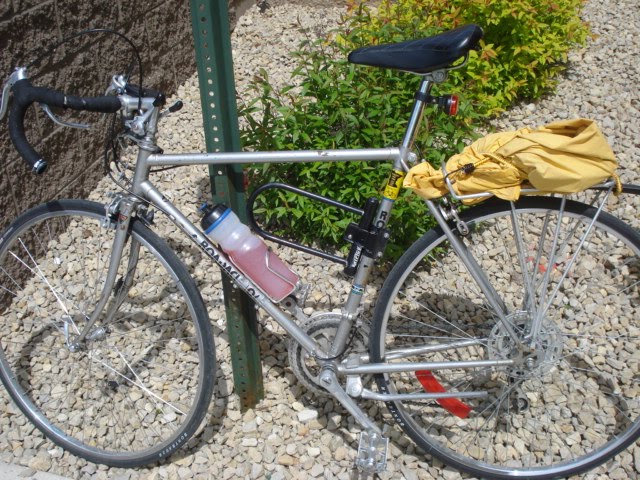
I spent days preparing for the ride, fixing the various problems my 30-year-old bike was having, procuring all the supplies I'd need, and waiting for a break in the monotonously cold, wet weather we'd been having. 60-degree temperatures and "mostly sunny" conditions were forecast for Sunday, May 9, so off I went. Luckily, my church has night services, so I didn't have to miss that. I got up early Sunday morning, got ready, and packed my bike. Note the water bottle filled with Powerade. That stuff is like high-octane fuel for humans. Helmeted and bundled up for the chilly morning, I set off, saying hi to the people waiting to go to my church.

And so it began. I biked through the neighborhood of my dorm, past the Riverside Plaza apartments to the bike trail along the light rail line--a handy way to get through southeastern Minneapolis. This soon took me to the Sabo bike bridge, which leads to the Greenway. I'm sad more people don't know about the Greenway; it leads straight across the city just north of Lake Street and is a very efficient way to get around (in the daytime, at least).
Several miles of pedaling later, I was past the city portion of the Greenway, which lets out around Lake Calhoun. If you keep following it, which I did, it leads out to Hopkins and beyond. Hopkins happens to be where my dentist is; it's good to know I could bike there in a dental emergency.


From Hopkins, I got on a mostly gravel trail. Others might be worried about subjecting their road bikes to crushed limestone, but my bike is in fact a mountain bike, having graduated to mountain bike status after I rode it 8 or so miles on a mountain bike trail in the Minnesota Valley, which drew many stares. The trail slowed me down slightly, but I didn't have much trouble. Soon it left suburban Hopkins and continued into some extremely pleasant forests, making for great picture taking.
After some scenic riding, I made it to the closest corner of Lake Minnetonka, Carson's Bay. I'd come this far once before, but I'd turned back immediately and gone home. Not today. I continued on the gravel trail and after another mile or so, I saw this.

All this time, I'd mostly been biking past houses; due to all the waterfront property, I didn't get many glimpses of the lake like this one. Even though it would be expensive and troublesome, I think it would be simply amazing to live on the lake. I biked through downtown Excelsior, then went through what amounted to a ribbon of forest through more lake towns. This continued until I got to a park on the far side of the lake.  I was saddened that I'd never seen this undiscovered treasure before; it was nice to bike through some open space after corridors of forest for miles.

Then it was a few more miles on county roads (a deserted one with no shoulder, and a busy one with a nice wide shoulder, which was less scary) before I got to the little town of St. Bonifacius, population 1873, the most remote place I've ever biked to. It was quite a nice place with a definite historic small town feel to it. I ate lunch there in a Subway that I later learned had been built where an old creamery had been. After restocking my bike with red Powerade, I was off again! More great biking through nature ensued, but before long I hit civilization again.

Luckily some of this civilization was in the form of Minnetonka Beach, probably the nicest neighborhood I have ever seen. (Not a good place to have a medical emergency, though, due to the speed bumps on the roads. So, if you're rich and healthy, live in Minnetonka Beach!)


I was treated to a few more views of the lake before leaving it behind. More biking (a common theme here) ensued until I reached familiar territory: the Grand Rounds! More specifically, Theodore Wirth Park, my favorite portion of the Grand Rounds.

I was in the home stretch now. I'd biked this way numerous times before, and soon Minneapolis was in sight. I rejoined the Greenway where I'd gone off to Hopkins, then biked the last few miles back home.

The final distance is in kilometers, but that's still pretty far--67 miles. Exhausting? Yes. Worthwhile? Yes. Epic? Definitely.