Pages

Monday, June 3, 2013

Biblical Adventures in Botany and Inerrancy

Mark 4:30-32 reads (with emphasis added):
And he said, “With what can we compare the kingdom of God, or what parable shall we use for it? It is like a grain of mustard seed, which, when sown on the ground, is the smallest of all the seeds on earth, yet when it is sown it grows up and becomes larger than all the garden plants and puts out large branches, so that the birds of the air can make nests in its shade.”
And similarly, Matthew 13:31-32:
He put another parable before them, saying, “The kingdom of heaven is like a grain of mustard seed that a man took and sowed in his field. It is the smallest of all seeds, but when it has grown it is larger than all the garden plants and becomes a tree, so that the birds of the air come and make nests in its branches.”
For size reference, this is a mustard seed:
Pretty small, huh? I should probably mention the orchid seed, shown here on a penny:
Here is a side-by-side comparison of both seeds on a penny:
Did Jesus just lie? Or does this prove that He was not God but a mere man, ignorant of modern botany?

Biblical Inerrancy

Wayne Grudem's landmark systematic theology defines inerrancy thus (emphasis the author's):
[In the previous chapter] it was argued that all the words in the Bible are God's words, and that therefore to disbelieve or disobey any word in Scripture is to disbelieve or disobey God. [2 Timothy 3:16, 2 Peter 1:21, etc.] It was argued further that the Bible clearly teaches that God cannot lie or speak falsely (2 Sam. 7:28, Titus 1:2, Heb. 6:18). Therefore all the words in scripture are claimed to be completely true and without error in any part (Num. 23:19, Pss. 12:6, 119:89, 96; Prov. 30:5, Matt. 24:35). God's words are, in fact, the ultimate standard of truth (John 17:17)...with evidence like this we are now in a position to define biblical inerrancy: The inerrancy of Scripture means that Scripture in the original manuscripts does not affirm anything that is contrary to fact. This definition focuses on the question of truthfulness and falsehood in the language of Scripture. The definition in simple terms just means that the Bible always tells the truth, and that it always tells the truth concerning everything it talks about. This definition does not mean that the Bible tells us every fact  there is to know about any one subject, but it affirms that what it does say about any subject is true.
The Chicago Statement on Biblical Inerrancy summarizes itself:
1. God, who is Himself Truth and speaks truth only, has inspired Holy Scripture in order thereby to reveal Himself to lost mankind through Jesus Christ as Creator and Lord, Redeemer and Judge. Holy Scripture is God's witness to Himself.
2. Holy Scripture, being God's own Word, written by men prepared and superintended by His Spirit, is of infallible divine authority in all matters upon which it touches: It is to be believed, as God's instruction, in all that it affirms; obeyed, as God's command, in all that it requires; embraced, as God's pledge, in all that it promises.
3. The Holy Spirit, Scripture's divine Author, both authenticates it to us by His inward witness and opens our minds to understand its meaning.
4. Being wholly and verbally God-given, Scripture is without error or fault in all its teaching, no less in what it states about God's acts in creation, about the events of world history, and about its own literary origins under God, than in its witness to God's saving grace in individual lives.
5. The authority of Scripture is inescapably impaired if this total divine inerrancy is in any way limited or disregarded, or made relative to a view of truth contrary to the Bible's own; and such lapses bring serious loss to both the individual and the Church.
Albert Mohler, the president of the Southern Baptist Theological Seminary, describes inerrancy on his blog:
The affirmation of biblical inerrancy is nothing more, and nothing less, than the affirmation of the Bible’s total truthfulness and trustworthiness. The assertion of the Bible’s inerrancy — that the Bible is “free from all falsehood or mistake” — is an essential safeguard for the Bible’s authority as the very Word of God in written form. The reason for this should be clear: to affirm anything short of inerrancy is to allow that the Bible does contain falsehoods or mistakes.
Biblical inerrancy remains a strong theological presence in modern evangelicalism and fundamentalism, especially in the United States.

Possible Responses to Matthew 13:31-32 and Mark 4:30-32

Obviously, reconciling this belief about the truth of the Bible with these passages about the sizes of mustard seeds is not a trivial matter. I am not sure whether I would have been troubled by this passage if I had been presented with the seed size comparison when I held my earlier, hyper-logical view of Scripture, but I can try to guess at the most probable and logical answers an inerrantist might field when confronted by this tension:

  • Ask whether an orchid seed falls under the category defined by the Greek word translated as "seed", σπερμα.
  • Assert that mustard seeds in first-century Israel were smaller than the ones we have today, or that orchid seeds were larger.
  • Admit that the ESV text contains a factual error, but argue that this error was not present in the original manuscripts and was inadvertently introduced by a translator or scribe.
  • Accuse me of "proof-texting" and say that a complex and weighty doctrine like inerrancy can't be conclusively disproven by a single verse.
  • Accuse me of faking the images, or otherwise affirm that the Bible is correct and any other evidence is false, even if it isn't presently clear how.

Counter-responses

To the first answer, σπερμα is used in the Bible to refer to either 1) generic seed, the kind sown in a field or 2) someone's offspring or descendants. It is difficult to conceive of a meaning for σπερμα (in common, nontechnical Greek, mind you) broad enough to incorporate both of these but narrow enough to exclude orchid seeds, which are much more similar to wheat seed than human descendants.

The second is difficult to prove conclusively since any first-century mustard or orchid seeds have likely germinated and died by now, but it is rather ad hoc and difficult to believe that such a change in the seeds of these plants could have taken place in less than 2,000 years and the burden of proof certainly falls on anyone who would claim otherwise. The microscopic size of the orchid seed is actually an integral part of its method for reproduction, due to the fact that it lacks endosperm (literally "inside-seed"), the part of a seed that provides nutrients to allow it to begin growing, relying instead on symbiotic relationships with fungi to complete their lifecycles, and it would be quite significant for the orchid seed to evolve into such a different form since then.

The third is very difficult to hold to given that the assertion is present in both Matthew and Mark, which would both have to have been corrupted in the same way from some similar but inerrant form, and the same parable is also likely mentioned in Luke 13:19. According to my 28th-edition Nestle-Aland textform, the biggest relevant known textual dispute in these verses concerns the grammatical form of "has grown" in Matthew, and of "grain" in Mark. Not much room for disagreement here.

It is true that I am trying to show that belief in Biblical inerrancy is unjustifiable with a single Bible passage, a practice which I would count as "proof-texting" and which I try to avoid doing. But the thing about inerrancy is that by making such a strong, sweeping claim about the nature of the Bible's statements, it makes just this sort of proof-texting possible. To allow for meaningful conversation, I am arguing under the assumptions of the view I am trying to speak to, not my own. And inerrancy is, in fact, able to stand or fall on a single verse like this because the strength of the claims it makes also makes it very fragile. See the last point of the Chicago Statement: "The authority of Scripture is inescapably impaired if this total divine inerrancy is in any way limited or disregarded," which presumably includes the finding of a single counterexample that definitively violates it, in the same way that finding a single rock levitating in midair for no discernible reason would call the theory of gravity as we know it into question.

Accusing me of faking the images would be unjust (and, may I say, unchristlike), since I didn't (Matthew 5:37). (In fairness, I did simulate the last one) And, of course, this charge would fall apart as soon as one did any research into the (public) sources I used, unless they are also all faked. Continuing to believe that the mustard seed is the smallest of all seeds in the face of clear evidence to the contrary (such as a display of actual orchid and mustard seeds side-by-side) would be downright conspiratorial and raise the question of what, if any, evidence is required to get you to change your mind.

A high-maintenance doctrine

Of course, to the inerrantist this stubborn persistence in the "truth" is not only reasonable, but commanded by God; as Grudem argues, "all the words in the Bible are God's words, and that therefore to disbelieve or disobey any word in Scripture is to disbelieve or disobey God." The Bible, God's revealed word, says that the mustard seed is the smallest seed on earth, so that's what they believe. This is troubling for a number of reasons. As I have previously argued, this way of allowing the words of the Bible to "trump" all other information assumes a hierarchical, premodern view of truth (remember that Jesus is the Truth) that casts the Bible as the only reliable source of information we have, and all other truth claims, even what we plainly see with our own eyes, as suspicious and aimed to deceive us. David writes that we are intended to learn about the nature of God from His creation: "The heavens declare the glory of God, and the sky above proclaims his handiwork."

This placing of spiritual knowledge over empirical knowledge, in turn, has the effect of situating the inerrantist in a very dualistic, "two-storey" universe. The Bible is God's truth over and against the claims of this fallen world, and no dialogue or meaningful connection is possible between them. The truths of the Bible are believed in isolation from experience, reason, or any other possible qualifiers to them. This casts serious doubt on how God made us. Our very perception and reasoning abilities, rather than being part of our being made in His image, testaments to His handiwork, and gifts to allow us to appreciate and steward His creation, become suspect and unreliable, with our faith (blinded by being deprived of its companions reason and perception) our only trustworthy guide to living as Christians. And so the Bible becomes our book of science, cosmology, biology, and botany, over and against the fallen claims of "this world". The task of the Christian is to simply believe, without questioning, the revealed truths of God and not the lies of the world.

In the Mohler post, I found another quote relating to a book by Michael Licona that questions whether the earthquake and resurrections that are documented in Matthew 27:51-54 actually happened and specifically points out the absurdity of the implied inference that the saints who were raised waited in their tombs doing nothing until His resurrection. Mohler says, "First of all, if we ever accept the fact that we are to explain what anyone in the Bible was doing when the Bible does not tell us, we enter into a trap of interpretive catastrophe. We are accountable for what the Bible tells us, not what it does not." The text itself says, notably, "And many bodies of the saints who had fallen asleep were raised, and coming out of the tombs after his resurrection they went into the holy city and appeared to many." The implication that the saints were raised when Jesus died and came from their tombs after He rose is manifest, but Mohler says that we aren't supposed to make it but instead to disconnect our belief in the pure and true words of the Bible from whatever relation they may have with the rest of reality. In other words, we are expected to suppress our critical reasoning whenever it would lead us to question scripture. This suppression of doubt and disconnection of spiritual truth from the rest of life is, as I have experienced, not healthy.

Peter Enns describes inerrancy as a "high-maintenance doctrine" in that significant time and resources must be expended to maintain its accuracy in the face of clashes with reality as in Matthew 13:32. In fact, I am convinced that maintaining inerrancy is counterproductive to an authentic Christian witness. It destroys rather than creates dialogue with nonbelievers and leads to unnecessary divisions with other Christians who dare to be so audacious as to trust their God-given eyesight and say that orchid seeds are smaller than mustard seeds. What remains of the dialogue between inerrantists and the "world" is inevitably shifted from the central "point" of Jesus and the Gospel to peripheral points of friction like the age of the earth, the relative sizes of seeds, or whether Adam and Eve had bellybuttons (let alone existed); the Bible is expected to speak to these issues just as much as it does to the person and work of God, and not only that but to speak a truer word than any number of the "empty claims" made by people specifically studying these things in the 2,000 years since.

A context-free Bible?

And after all, inerrancy is simply not a very high view of scripture, despite its ardent claims to the contrary. Rather than being taken at face value, the Biblical text is twisted, the simple meanings of its words complicated, hidden subtextual information added, or its integrity questioned in order to defend the integrity of inerrancy. In my own journey I have found an abundance of other examples of this kind of twisting that has to take place to defend the unambiguous truth and logical coherency of Scripture. As I became aware of just how much of my own preconceptions and biases I was reading into the text in order to maintain this view, I lost faith in it--and would have lost faith in God, had I not been able to dissociate the two.

Inerrancy forgets or willfully disregards the role of the reader-interpreter in the Bible by considering it to be "God's own words", "wholly and verbally God-given", implying that it is as direct a form of communication as God speaking audibly and individually to us. Unlike our merely human words, though, God's statements are expected to be free of context or any trace of relativization to limit their scope. I simply don't think this is how communication works. In fact, I don't even think this is the default way inerrantists approach the Bible.

For example, we, almost without thinking, interpret language like "the vault of heaven" (Job 22:14), "the four corners of the earth" (Isaiah 11:12), or "in heaven and on earth and under the earth" (Philippians 2:10) (or also "the waters under the earth", Exodus 20:4) to fit into our modern cosmology as "poetic language". By doing this we are automatically recontextualizing these statements from speaking about a premodern cosmos where the solid sky is supported by four great mountains and the earth's land sits on top of a subterranean ocean to our modern one in a way that flies in the face of inerrancy's insistence on God's words being eternally true and context-free. Similarly with David praising God for "knitting him together in his mother's womb" (Psalm 139:13), which came from a culture with virtually no knowledge of human embryology as we have today but which we read as speaking to our modern understanding of gestation. I have found that I am better able to appreciate the premodern context the Bible is situated in by recognizing it for what it is and how it is different than my own.

For another clear example of ancient cosmology espoused by the Bible, see Revelation 8:10: "The third angel blew his trumpet, and a great star fell from heaven, blazing like a torch, and it fell on a third of the rivers and on the springs of water." From what we now know of cosmology, we know that a star could not fall to the earth in such a way as to affect only a third of the rivers and springs; the earth would fall into the star, be engulfed in thermonuclear fire, and eventually be reduced to its component elements. We read "star" to be a meteorite without thinking about it, but the Greek used is simply αστερ, aster; John likely saw little distinction between "stars" that stayed in the sky and "stars" that fell to earth.

A Theopneustos Scripture

How do we move past such an unhealthy view toward Scripture and reality? For starters, by taking Matthew 13:31-32 and Mark 4:30-32 at face value and reading them like first-century hearers rather than twenty-first century ones: Jesus really is saying that the mustard seed is the smallest seed on earth. The mustard seed was likely the smallest commonly known seed at that time, so Jesus, a human situated in a particular human context trying to make a point not about plant biology but about the kingdom of heaven, used it for His parable rather than the "correct" plant His audience wouldn't have known about. (Also, the orchid doesn't grow that large anyway) This explanation is simple and intuitive, not suspicious like the evasions inerrancy must field to fit this text into its system. It recognizes the contextualized nature of both the Bible and of us, its readers and tries to bridge the gap between contexts.

This introduces the general principle referred to by Denis Lamoreux as the "message-incident principle": that we are to "separate not conflate" the infallible theological message of the Bible from its culturally contextualized incident, which may work in ancient views of cosmology, biology, etc. that we now know to be inaccurate. Inerrancy completely conflates the message and incident of any given part of scripture and argues that their indivisibility is an essential part of the Bible's being God's true and authoritative word. As I think I have satisfactorily established, there is at least one definitive counterexample to this claim, and many likely others. Recognizing the existence of this principle is essential for having a constructive conversation with other Christians or non-Christians about evolution, Biblical violence, or the Bible's treatment of slavery and gender.

2 Timothy 3:16 is frequently fielded to show how Scripture is "God's own words" and therefore incapable of speaking any falsehood: "All Scripture is breathed out by God and profitable for teaching, for reproof, for correction, and for training in righteousness." In other words, all Scripture is inspired by the Spirit and therefore wholly true. You know what else says the Bible is God-breathed? Humans. Finite, fallible humans. "Then the LORD God formed the man of dust from the ground and breathed into his nostrils the breath of life, and the man became a living creature." (Genesis 2:7) Just as Jesus had all the perfection of God in a limited, aging, ordinary human body, so the Bible is the infallible truths of God conveyed by, or perhaps "breathed into", ordinary, fallible human words. Just as God can work with or through imperfect people, so He can speak through the Bible we have, not just the Bible inerrancy claims we have.

Thursday, May 30, 2013

Analogies of Faith

In which St. Patrick, trying to explain the Trinity to some simple Irish peasants, runs into difficulty:


In case you're like me and don't like pausing your music to watch videos: St. Patrick presents multiple analogies to describe the doctrine of the Trinity, each of which is promptly shot down for being tantamount to  heresy.
  • The Trinity is like the three different phases of water, which are all the same substance: Modalism (Sabellianism); God is all three persons simultaneously.
  • The Trinity is like the Sun, a star that also produces light and heat: Arianism; it makes the Son and Spirit out to be creations of God.
  • The Trinity is like the leaves of a clover: Partialism (tritheism); the persons of the Trinity are not three parts of a whole.
  • The Trinity is like a man who is a husband, father, and employee: Modalism again.
  • The Trinity is like an apple with three layers: Partialism again.
Finally, exasperated, St. Patrick breaks out a highly technical and theological definition of the Trinity, which satisfies the peasants. The video highlights a difficulty I see in discussing theology, especially pertaining to loftier subjects like the Trinity: our language just doesn't seem up to the task. We can speak in terms of human analogies or we can define/import more abstract, technical terms like "procession" (more on that below), perichoresis and hypostasis to try to get our point across better.

But neither of these options is quite suitable. As the video aptly shows, human analogies for spiritual realities always seem to carry baggage that can make them inaccurate and misleading. I don't think this is just because we need better analogies: rather, it's because we're attempting to describe something metaphysical (meta, the Greek prefix meaning "beyond") by analogy with something physical. This is no small task. Could it be that something like the Trinity is so other to our own physical reality that every analogy we make inevitably falls short of describing it in some way?

Using more technical "theobabble" doesn't work much better. We can describe the Trinity as "a hypostatic union in perichoresis" and clarify that "the Son is begotten of the Father while the Spirit proceeds from Him", but what on earth (or in heaven) does that mean for anyone who hasn't been through seminary? It's more confusing than trying to wrap my head around group theory! Even if these terms are based on Biblical language, it becomes hard to believe that we're recapturing the original meaning of the Bible by using them and not constructing something new.

The Trinity highlights the fact that the connection made by words between our understanding and concepts is not always clear or simple. There seems to be a wide gulf between our ability to understand and the true nature of God that words cannot bridge for us. Either we define them on our side and make analogy after analogy only to have them all fall short, or we define them on the far side and make doctrinally "true" statements about God while struggling to understand (much less apply) what they mean. This gap in understanding is, I think, what is meant in theology by a "mystery". Not a wall beyond which we aren't allowed to ask questions or follow implications, or where what seems wrong to our most sanctified understanding is actually right to God, but simply the limitations of our own capacity to understand.

The Filioque

For a more concrete example of this dilemma, I'll use the debate over the Filioque as a case study of sorts. For those unaware, the Filioque is a short clause in the Nicene Creed stating that the Spirit proceeds from the Son as well as from the Father. It may sound innocuous, but believe it or not, this phrase is one of the primary causes of the division between the Catholic and Eastern Orthodox churches. I'll try to (greatly) simplify the history of the conflict.

In more detail, the conflict has to do with the translation of the Nicene Creed from Greek to Latin. The original Greek creed stated at the first ecumenical council of Nicaea in 325 simply ended with Καὶ εἰς τὸ Πνεῦμα τὸ Ἅγιον, "and in the Holy Spirit". The second council at Constantinople in 381 confirmed the Nicene Creed, but changed the ending to speak of the Holy Spirit as ἐκ τοῦ Πατρὸς ἐκπορευόμενον, "from the Father proceeding". This has scriptural support in John 15:26 which speaks of the Holy Spirit as "the Helper...the Spirit of truth, who proceeds from the Father". The third council at Ephesus in 431 quoted the 325 version of the creed and declared anathema anyone who tried to change it. Nonetheless, the 381 creed was adopted into the liturgy of the eastern church, and later a Latin variant into the western church. The fourth council at Chalcedon in 451 quoted the 381 creed and treated both versions as valid, and despite being anathematized, the 381 version became the standard throughout the church.

That is all background. Over time, councils and church fathers began to write about the Spirit as proceeding from the Son as well as from the Father, or from the Father through the Son. So Tertullian, at the beginning of the third century, writes of the Trinity:
As if in this way also one were not All, in that All are of One, by unity (that is) of substance; while the mystery of the dispensation is still guarded, which distributes the Unity into a Trinity, placing in their order the three Persons—the Father, the Son, and the Holy Ghost: three, however, not in condition, but in degree; not in substance, but in form; not in power, but in aspect; yet of one substance, and of one condition, and of one power, inasmuch as He is one God, from whom these degrees and forms and aspects are reckoned, under the name of the Father, and of the Son, and of the Holy Ghost.
This is a prime example of what I mean by abstract theological speech: the members of the Trinity are said to be three in degree, form, and aspect, but one in substance, condition, and power It is far from clear what this is supposed to mean, or how these words are supposed to be contrasted with each other when, say, form, aspect, and substance are normally considered to be near-synonyms. And, in more length, he describes the Spirit as emanating from the Father through the Son like the fruit from the roots through the tree:
This will be the prolation, taught by the truth, the guardian of the Unity, wherein we declare that the Son is a prolation from the Father, without being separated from Him.  For God sent forth the Word, as the Paraclete also declares, just as the root puts forth the tree, and the fountain the river, and the sun the ray. For these are προβολαίor emanations, of the substances from which they proceed. I should not hesitate, indeed, to call the tree the son or offspring of the root, and the river of the fountain, and the ray of the sun; because every original source is a parent, and everything which issues from the origin is an offspring.  Much more is (this true of) the Word of God, who has actually received as His own peculiar designation the name of Son. But still the tree is not severed from the root, nor the river from the fountain, nor the ray from the sun; nor, indeed, is the Word separated from God.  Following, therefore, the form of these analogies, I confess that I call God and His Word—the Father and His Son—two. For the root and the tree are distinctly two things, but correlatively joined; the fountain and the river are also two forms, but indivisible; so likewise the sun and the ray are two forms, but coherent ones. Everything which proceeds from something else must needs be second to that from which it proceeds, without being on that account separated.  Where, however, there is a second, there must be two; and where there is a third, there must be three. Now the Spirit indeed is third from God and the Son; just as the fruit of the tree is third from the root, or as the stream out of the river is third from the fountain, or as the apex of the ray is third from the sun. Nothing, however, is alien from that original source whence it derives its own properties.  In like manner the Trinity, flowing down from the Father through intertwined and connected steps, does not at all disturb the Monarchy whilst it at the same time guards the state of the Economy.
Gregory Nazianzen clarifies (if that word is here appropriate) that the Son is generated from the Father while the Spirit proceeds from the Father:
The Father is Father, and is Unoriginate, for He is of no one; the Son is Son, and is not unoriginate, for He is of the Father. But if you take the word Origin in a temporal sense, He too is Unoriginate, for He is the Maker of Time, and is not subject to Time. The Holy Ghost is truly Spirit, coming forth from the Father indeed, but not after the manner of the Son, for it is not by Generation but by Procession (since I must coin a word for the sake of clearness); for neither did the Father cease to be Unbegotten because of His begetting something, nor the Son to be begotten because He is of the Unbegotten (how could that be?), nor is the Spirit changed into Father or Son because He proceeds, or because He is God—though the ungodly do not believe it.
Over time, this generated tension between the western and eastern churches. This was underscored by the different implications of the Latin verb procedere and the Greek εκπορευεσθαι in their respective versions of the Nicene Creed. Both translate to "to proceed", but the Greek verb had come to mean the Spirit's unique form of being immediately from the Father while the Latin verb had no such connotations. This controversy came somewhat to a head around 860 when Patriarch Photius declared that the Spirit proceeds from the Father alone, which was a new statement at the time. Nonetheless, the eastern church rallied around this statement, while the western church held that the Spirit proceeds from the Father and or through the Son.

The disagreement continues to this day; the Roman Catholic church holds that "The Holy Spirit, the third person of the Trinity, is God, one and equal with the Father and the Son, of the same substance and also of the same nature... Yet he is not called the Spirit of the Father alone,... but the Spirit of both the Father and the Son." (Catechism 245) It accommodates the eastern view by explaining that "By confessing the Spirit as he 'who proceeds from the Father', it affirms that he comes from the Father through the Son...for the eternal order of the divine persons in their consubstantial communion implies that the Father, as "the principle without principle", is the first origin of the Spirit, but also that as Father of the only Son, he is, with the Son, the single principle from which the Holy Spirit proceeds." (Catechism 248)

Meanwhile, the Orthodox church is split between rigorists who continue to hold to Photius' strict statement that the Spirit proceeds from the Father alone, and more liberal theologians who are open to the Spirit proceeding at least from the Father through the Son. The doctrine of the OCA states that "The Son is born from the Father, and the Spirit proceeds from the Father—both in the same timeless and eternal action of the Father’s own being."

So we have three different views on the origin of the Spirit: the western view that He proceeds "from the Father and the Son", the accommodation to the eastern view that He proceeds "from the Father through the Son", and the rigorist eastern view that He proceeds "from the Father alone". Each of these statements is speaking of a spiritual reality (the origin of the Holy Spirit) through a spatial analogy, which I have brilliantly represented below:
In literal spatial terms (think plumbing), these three modes of being are obviously incompatible. Of course, the relationship of the Father, Son, and Spirit is not directly analogous to plumbing setups. But no matter how much we insist on a precise, technical meaning for "proceeds" in this case that actualizes this distinction, the fact remains that its meaning is conceptually very hard to grasp in the mind, so our cognition about the relationship of the Trinity often slips back into the analogical thinking connoted by words like "through", "alone", and "proceeds". There seems to be no escape from analogy in theological thinking to some greener pasture beyond where we are able to directly speak and think about spiritual truths like physical objects, at least not in a subject as lofty as the Trinity.

For an example, let me use my imagination to give another direction in which the Filioque debate could (feasibly, I think) have gone. Suppose the Catholic church further split on the question of whether the Spirit proceeds from the Father and Son together, or separately. Again, each of these possibilities translates analogically into a simple flow chart:

I don't think this distinction is unreasonably finer than some of the ones made in the church father quotes above. And yet it is quite a wall-banger: what on earth (or in heaven) does it really mean for the Spirit to proceed from the Father and Son together or separately? And what difference does it make for Christian faith and practice? The fact that each of these possibilities is based on a simple, easily distinguished spatial analogy belies the fact that they are conceptually very hard to grasp and distinguish clearly--this last example especially, but also the three real positions regarding the Filioque. By trying to look beyond the analogies to the "real nature of things" being signified, they lead us ultimately to places our minds are unable to follow and our minds, needing to latch onto something to reason about, fall back to thinking in terms of the spatial analogy.

I am growing increasingly suspicious of attempts to "peer behind the curtain" of the mystery of the Trinity--again, not to access understanding that is forbidden for some reason, but understanding of the spiritual nature of God that is simply beyond us. We cannot define or analogize our way into this understanding. Let me propose something that may be radical or obvious: despite being inspired by the Spirit while writing it, John did not have some kind of amazingly precise, transcendent understanding of the origin of that Spirit while he was writing John 15:26. In other words, he was in the same boat that we find ourselves in, trying to grasp at sublime things of heaven with earthly analogies that always seem to fall somewhat short. His statement was true, but incomplete.

If this is the case, we don't need to discern the exact, technical theological meaning of ἐκπορεύεται; we instead simply believe that John was speaking about the Spirit analogically using the everyday speech of his time. Does this mean our best bet for practically understanding, say, the Trinity is heretical analogies like the ones St. Patrick tried? I think so, as long as you realize the limitations of the analogy--what it does and does not connote. The water analogy is accurate in its depiction of the Trinity as three manifestations of the same basic substance, but falls short in that they aren't simultaneous. The Sun analogy is accurate in its depiction of the Father as (in some mysterious way) the source of the Son and Spirit, but falls short in that He did not "create" them. And so on. Better an imperfect/incomplete analogy that gives us some understanding than attempts to speak precisely that give us none.

Addendum

In a helpful AMA (Ask Me Anything) session on r/Christianity, I learned that the reason for the church split over the filioque was not so much a matter Trinitarian theology as of ecclesiology. The clause was added to the Latin version of the Nicene Creed without an ecumenical council, which the eastern churches refused to accept. The western churches retorted that the Pope did have the authority to do it, and papal supremacy remains one of the biggest disagreements between the churches today.

Sunday, May 26, 2013

New Testament Final Paper

The following is the final paper for the New Testament class I took at my church, in which I write about four things I've learned from studying the whole New Testament this semester.

Having arrived at the end of a survey of the entire Bible, I can look back with genuine amazement at all that God has done in me this past year. I wouldn't have expected my first school year out of school to be the most influential to my thinking! He has used my reading, study, and discussion to transform my view of Him and His word. Where I was drowning in questions before, now my questions either have found answers or faded away into relative unimportance. I have learned to treasure the Bible as the story of God as told by His people rather than merely the foundation for a theological system. Praise God for being my teacher throughout  this year (and for giving me some great human discussion leaders as well)!

The most basic way my Biblical understanding has changed was a consequence of starting to do the weekly reading in Greek with John. This turned out to be surprisingly doable, despite my never having studied Greek before, due to picking up the alphabet as a former math major, knowing words from English roots and Greek word studies in books and sermons, and having the word-for-word ESV translation in parallel. Still, though I could make quite a bit of sense of the Greek text, it was painstakingly slow progress. Because of this, I realized I'd been reading the Bible too fast for nearly my whole life. Having to stumble through every word rather than flying over sentences I thought I "knew" forced me to focus on the text intensely and has really turned reading the New Testament (especially the writings on John) into a joy again.

For example, in John 7 I was struck by the prideful motivations of the Pharisees in dismissing Jesus as a "sinner" for healing the man born blind on the Sabbath and realized how easy it is for us to be like the Pharisees even without being legalists where salvation is concerned. Or in John 6, where Jesus delivers an increasingly bizarre sermon, I found myself following the mood of the incredulous crowd asking, "Jesus, what are you saying?" I also realized how much reflection and thought John had put into his gospel. It is much less of a "slice of Jesus' life" perspective than any of the synoptics. John's recollections of Jesus, filtered through a lifetime changed by love, are colored by his intimate love for his Savior and friend. He structures everything to make his point about Jesus' divinity as the Son of God and Son of Man, and intersperses plenty of his own comments and explanations. It's analogous to how I hear a new richness to old music when I listen with better headphones.

And besides all this, reading the Bible in Greek has also had the expected effect of allowing me to peer "behind the curtain" of translation to get at the original text. Even with my knowledge fuzzy as it is, I can start to pick up on things that get lost in translation. For example, Greek has multiple words for concepts English has only a single word for, like "time", "know", or "love". Given how much our language affects and shapes our thinking, I can't help but wonder how much of our confusing "knowing Jesus" as a purely intellectual venture or "loving Jesus" as a purely emotional feel-good experience is a result of the language we have at our disposal. The everyday language ("Koine" means "common") also reminds me that terms like "faith", "love", or "life" are not supposed to be technical or ultra-spiritual terms; they mean just what we would intuitively expect them to mean.

Perhaps the biggest change God has done in me this past year is in how I view and think about scripture. The difference in this regard between now and last September is like night and day. As I started studying the Old Testament, I held a view of the Bible that mirrored my highly intellectual, logical nature. I saw it roughly as a testimony from God to us about who He is, what His plan for the world is, and how we can know Him. The nature of this testimony was very propositional; i.e. it could be broken down into basic truths that were then combined into the edifice of truth I knew as "theology". I expected this edifice to perfectly mirror the nature of God in that it could have no tensions or contradictions in it, and every verse in the Bible (even the difficult ones) had to fit into it like pieces in a jigsaw puzzle. I saw imperfect theology as an attempt to assemble this puzzle that didn't use all the pieces. The catchphrase "scripture interprets scripture" became roughly synonymous with allowing each verse to speak for itself (using scripture to clarify, not subjugate, other scripture) in its factual contribution to the completed puzzle.

The only problem with this view of the Bible is, as Matt Chandler would say, the Bible. During my survey of the Old Testament my scriptural paradigm developed fractures that turned into gaping cracks, and eventually it broke apart entirely. I grew increasingly suspicious of how I had to keep twisting the plain words of scripture to get this verse or that to fit in. And on a higher level, the tension I saw between the Testaments was becoming undeniable. Finally I admitted that God's word did seem to have tensions, even contradictions in it. My paradigm of scripture was so bound up with my view of God that, for a while, admitting this seemed tantamount to losing my faith. In reality, by waiting for God to reveal Himself in the ruins of the systems I'd built to try to understand Him, I was learning what faith is really about. This semester, I've been putting the pieces back together in a new way that ditches the puzzle metaphor altogether.

So how do I now see the Bible? It's more like I don't see it--or I consider it a window through which to see God, especially through Jesus. By trying to rationalize and systematize the truths of scripture I was making an idol out of God's words while forsaking the true Word that came into the world. Seeing as the early church was preserved not by the gospel-as-scripture (which hadn't been written or collected into canon yet), but by the gospel-as-knowledge-of-Jesus, I have concluded that the purpose of the Bible is not simply to teach Christians what to believe but to allow us to continue to experience and know (personally) Jesus even two thousand years later. This is what John states as the purpose of his gospel in John 20:31: "But these are written that you may believe that Jesus is the Messiah, the Son of God, and that by believing you may have life in his name."

This has led me to a much richer and more nuanced understanding of the Bible. I see it less as a repository of unformed systematic theology and more as a story about God breaking into the world, a book that, like Jesus, is fully divine and fully human at the same time. This means I read it expecting divine truth clothed in human culture and context (as it must be to be impactful for us), not existing in an abstract spiritual vacuum. I appreciate Biblical theology's emphasis on narrative and progression of revelation over propositional truths. I see scriptural tensions and apparent contradictions not as reasons to fear that Christianity is irrational but as evidence that it transcends the bounds of mere rationality and my own limited perspective of things.

And, most amazingly, I find that I no longer have doubts about the Bible, not because God has answered them all but because He has revealed Himself as the ultimate answer. The only way to truly get rid of my doubts was to accept them and allow God to lead me through them. As an INTP, I've realized the need to arrive at a "big picture" of the Gospel that really resonates with me rather than just being handed to me, that I can connect practically with every situation I face in life. I truly feel called to help other people to see God through questions and doubts the way He has helped me and I hope that the Master of Arts on theology I'm about to pursue will help me do to so.

This new, more holistic perspective of scripture has all kinds of applications. If we view the Bible not as nothing but pure spiritual truth and universal instructions but as originating from specific contexts, the question of how to apply it to our lives becomes less simple. Yes, "All Scripture is God-breathed and is useful for teaching, rebuking, correcting and training in righteousness" (2 Timothy 3:16), but no Christian today thinks Paul's command to bring his cloak and scrolls (4:13) applies to us as it did to Timothy. Yet John Piper, preaching a sermon on the end of 2 Timothy, has still managed to learn something of the warmth of Paul and Timothy's relationship from this verse.

That is an extremely simple example of the role of context in Biblical hermeneutics, where it's obvious that our application of a verse is context-sensitive. Or consider Paul's instructions for churches to "greet one another with a holy kiss" (Romans 16:16, 1 Corinthians 16:20, 2 Corinthians 13:12, 1 Thessalonians 5:26). Again, no one has a problem believing this directive is culturally contextualized, that a kiss means something very different today than in the first century, and that we can now take from it that we should greet others in the church warmly, perhaps with a holy handshake or fist-bump.

But dealing with cultural context in the New Testament is not always so easy. Consider some of the more controversial of Paul's instructions regarding men and women in 1 Timothy 2:11-15, 1 Corinthians 14:34-35,  or 1 Corinthians 11:1-16. These have been the source of much contention regarding the rights of women in church as the question continues to be debated: just how much do these verses apply to the modern, American church? Paul doesn't make the original context of these commands or whatever rationale he may have had clear, and so we are left to guess at the context. His support of his points with the creation order indicates that there may be more universal principles behind them.

Or consider a different example, Paul's tirade about the Corinthians' abuse of the Lord's supper in 1 Corinthians 11:17-34. As I learned when we preached through 1 Corinthians, the big issue was that the administration of communion, which was supposed to be a time for the church to come together in love and to remember the sacrificial death of the Lord Jesus, had instead become a time of class segregation and elitism, as "one person remains hungry and another gets drunk." (11:21) I used to think that because Hope doesn't practice communion as a full meal, these verses simply didn't apply to my situation at all, and took his later command in verses 27 and 28 to examine oneself as meaning you had to pray and confess your sins before taking communion, as I still tend to do.

But if we look at the situation behind Paul's instructions and stop interpreting them in such a specific way, we see Paul's desire for the Corinthian church to be the kind of egalitarian community seen in Acts 4:32-35 where the categories people use to place themselves over others become irrelevant, or the strength of the symbolism he sees in the bread and the wine and his desire to fight for it to be reflected in the believers' conduct. Behind the specific misconduct of the Corinthians, these principles are just as applicable today as they were in the first century.

This context-sensitive way of looking at scripture can be confusing if you're accustomed to interpreting Biblical commands more literally. Where is the line, you may ask? What's to stop us from using context to apply the Bible in whatever way we want? I would ask, what is the rationale behind Paul's reprimand of the Corinthians' communion practices, or teachings on the role of men and women in the church? Orderly, loving worship, or more generally, the health of the body of Christ, the Church. The ultimate motive in my interpretation of scripture is (hopefully) not my own theological whims or even adherence to a "correct" method but my desire to be conformed to the image of Christ.

One interesting change in my thinking has been in how I treat concepts like salvation, love, grace, glory, wrath, or sin. I think in our western culture we're used to thinking of these things as abstract things or even numerical quantities that somehow have substance independent of God or us and that can be created, destroyed, and transacted almost like money. And many verses allow this kind of reading: God gives us love (1 John 3:1), we deserve to receive wrath but instead receive mercy (Romans 11:30), when we believe we obtain salvation (1 Thessalonians 5:9), by our disobedience we store up sin and wrath (Romans 2:5) for ourselves, an abundance of grace and peace are ours (2 Peter 1:2), the atonement exchanges our sin for Jesus' righteousness, God strengthens us out of His glorious riches (Ephesians 3:16), or trying to get the maximum amount of glory possible for God (the glory of God is never referred to in this quantitative fashion). I refer to this kind of thinking as "spiritual objects".

But though this is what the (English) wording of the Bible sounds like to us, I don't think this is the picture it paints of love, grace, sin, or anything else, but rather a preconception we bring into our reading. My support for this point is not a convenient verse that clears up all our modern philosophical confusion but the mere fact that I see the glory of God's plan of redemption more clearly by reading the Bible in this way. I'm learning to see God's love not as an invisible quantity that He amasses in some kind of spiritual storehouse and gives us but as something He does, or is, or creates in us. The accumulation of sin is not like the increase of a monetary debt but increasing disunion and dissimilarity between us and God, the tragic breaking of intimacy.

This small shift in my reading has already had surprisingly wide effects on my faith. Instead of praying to receive intangible spiritual abstractions and feeling frustrated, I'm learning to see how God "shows up" in and through my life. Things I do like teach Sunday School stop seeming like merely something I enjoy doing and hope it "counts" toward an abstract notion of God's glory; instead I'm able to see my love for my kids as an (imperfect) reflection of His love for me that He is nonetheless pleased with, just as I'm genuinely pleased with my kids' less-than-perfect attempts to write their names. Adopting more tangible, personal definitions of love, mercy, grace, etc. has allowed me to joyfully see God better through these things and better connect the Gospel to my everyday life.

Finally, I have realized not only the truth but both the sheer scope of the Gospel. In evangelical Christianity I often see the Gospel being presented in a very individualistic, personal way, as in the KGP (Knowing God Personally) booklet used by Cru. The message is, "God loves you, has a wonderful plan for your life, and wants a personal relationship with you." True, but in our emphasis on God's loving and personal nature let's not forget His majesty and sovereignty over all creation. At the same time, the Bible tells us, we have been selected by God to know and be known by Him (Ephesians 1:4), and yet he invites us into a plan no smaller than the total renewal of all created things (Romans 8:21). The personal side of the Gospel invites us closer to relationship with our loving Father, and the grandiose side draws our eyes further to the amazing plan He has for all of us. I know of no better part of scripture that describes the scale of Gospel redemption than Revelation 21:1-5:

Then I saw a new heaven and a new earth, for the first heaven and the first earth had passed away, and the sea was no more. And I saw the holy city, new Jerusalem, coming down out of heaven from God, prepared as a bride adorned for her husband. And I heard a loud voice from the throne saying, “Behold, the dwelling place of God is with man. He will dwell with them, and they will be his people, and God himself will be with them as their God. He will wipe away every tear from their eyes, and death shall be no more, neither shall there be mourning, nor crying, nor pain anymore, for the former things have passed away.” And he who was seated on the throne said, “Behold, I am making all things new.” Also he said, “Write this down, for these words are trustworthy and true.”

There is the personal part, the promise of God coming to live with us of which God in the flesh, Emmanuel, "God with us" was as much a preview as the Mosaic covenant was of Jesus: “Behold, the dwelling place of God is with man. He will dwell with them, and they will be his people, and God himself will be with them as their God." But along with that comes a new heaven and a new earth, as God says, "Behold, I am making all things new." I don't believe this means God is going to destroy the heavens and the earth and then create new ones, which would call into question the point of doing so much in them to begin with. My favorite Christian blogger Morgan Guyton points out that in verse 24 "the kings of the earth will bring their glory into it", when according to a literal interpretation all of the kings of the earth have been destroyed by this point, along with the earth itself, several times over. If God is going to hit the reset button on the entire universe, our task of being good stewards over creation is pointless.

Instead, the story I see is God's redemption extending to every corner of creation (except those people and angels who tragically exclude themselves from it), so broadly and fully that the result of its completion can be described as "a new heaven and a new earth". It's like the book A New Husband by Friday, which claims to be not a guide to rapid divorce and remarriage but to changing your husband so he's like a new man within a week. (Whether this is possible is beyond the scope of this paper) This has had the effect of driving me to seek a view of God that makes sense of my whole life and makes visible the broken nature and hope for restoration of everything in it. Relating to the previous point, it's another step away from a purely abstract spirituality towards one that is just as grounded in the everyday things of life as Jesus Himself was.

This semester has been a time of a huge amount of change and growth in my relationship with God and the scripture, and looking back I'm honestly amazed at all He's done. It's a reminder to me of the power and importance of regularly confronting myself with scripture, not simply as part of a routine or "discipline" (which often means a routine) but because I feel a need to be filled that it is able to meet, just like needing to eat every day. "Man shall not live by bread alone, but by every word that comes from the mouth of God." (Matthew 4:4) As I start studying theology and Biblical Greek, I hope to continue increasing my love for the word of God and the Word of God behind it.

Speaking the truth in love after tragedies

As you're probably aware, a particularly nasty tornado hit near Oklahoma City on Monday. About tragedies like this, I would rather say nothing than something insensitive or canned, which unfortunately means I end up saying nothing. Depending on the circles you run in, you may also be aware that John Piper, did decide to say something, which has raised a rather disheartening commotion among some bloggers I greatly respect like Morgan Guyton and Rachel Held Evans. (Both posts and their subsequent follow-ups are still well worth a read) I'm going to speak like a fool for now (biblical precedent--2 Corinthians 11) and do some pontificating of my own on the situation.

Bloggers like the aforementioned two have used this incident as an occasion to question Piper's theology (knowledge of God) as cold, impersonal, and unloving to us wrath-deserving humans. Besides the fact that this instance actually doesn't point toward such a theology (Piper tweeted Job 1:19-20 which, while arguably insensitive, implies that the disaster was meant to inspire awe and fear in a God who is incomprehensibly larger than we, not that it was a manifestation of His wrath for sins), I'm not sure that theology as we usually think of it is the problem here.

Guyton in his post concludes that it is commendable and beneficial to try to see God's purposes in tragedies. However, we can't make others see for them, and trying to do so, as Piper does, can be cruel and damaging. "As a pastor, I do not give myself the authority to tell others how to interpret their tragedies. I can point them to the rich resources of God’s poetry in the Bible so that God can breathe into them the poem that fits." In other words, the main problem is not that commentators who are quick to ascribe divine purpose to tragedies are being insensitive, it is that they are appointing themselves as the mouthpiece of the Spirit and expecting Him to speak to listeners through their words. Obviously this is something a pastor should desire and pray for, but not something you can assume, especially in tragedies.

It's especially tricky when your words are a Bible verse, i.e. from "God's word". I can understand Piper's belief that a Bible verse would be an appropriate response for any situation, given that God's word is said to be a light for our feet and a lamp for our path (Psalm 119:105) and that all scripture is "breathed out by God and profitable for teaching, for reproof, for correction, and for training in righteousness" (2 Timothy 3:16). And yet, God's words can and have been misused to great harm after tragedies. Does this mean God's word has failed in these situations?
Remember the "truth trinity" I developed while thinking about what truth is (Jesus), and the follow-up exploration of the purpose of scripture (to encounter and know Christ as the apostles did). I think that for the Bible to truly function as "God's word", it isn't enough to just quote it, study it, or argue it. Isaiah 29:13 sets a precedent for this: "And the Lord said: "Because this people draw near with their mouth and honor me with their lips, while their hearts are far from me, and their fear of me is a commandment taught by men." In other words, it isn't enough to merely throw scripture around no matter how "correct" or "appropriate" it is. Our hearts also need to be in the right place--in fellowship with the living God, being reshaped to the likeness of Christ. Jesus may have promised that the world will hate us, but that is no excuse to misuse scripture.

This is what the Christian aphorism "speak the truth in love" (from Ephesians 4:15) comes from. This is often distorted to mean something like "We most fully love people by speaking the truth of the gospel to them", which can be used to justify an overspiritualized gospel that elevates teaching right doctrine over and against all other needs (see James 2:14-17), insensitive tweets after disasters, or even (I hesitate to go there) the deplorable speech of the Westboro Baptist Church. Paul's point is that speaking truth (even a Bible verse) is not automatically loving and does not mean that God is definitely using you as His mouthpiece. A mother who lost her son to a tornado probably doesn't want to know about how it was all part of God's sovereign plan; she would prefer some empathy, or even a punching bag. This preference is not simply dismissable as "sin blinding us to God's truth". It is human emotion, and trampling it with a singular focus on "bringing truth" is callous. Sometimes the most "Biblical" response to tragedy is to say nothing and instead simply mourn with those who mourn. (Romans 12:15)

The medium itself also matters. There is an enormous difference between working through Hebrews 12:9-11 while counseling someone one-on-one to work through their anger at God about the death of a loved one, and tweeting it after a much-publicized tragedy. The difference is that one is highly personal, the other is highly impersonal. I don't think exploring and applying God's truth is supposed to be isolated from modeling the love of Christ through relationships, which is kind of unavoidable in a tweet. This is also why I don't like internet arguments. Without any relationship to preserve, there are just endlessly clashing viewpoints and wounded pride.

Thursday, May 23, 2013

Irony in Spain

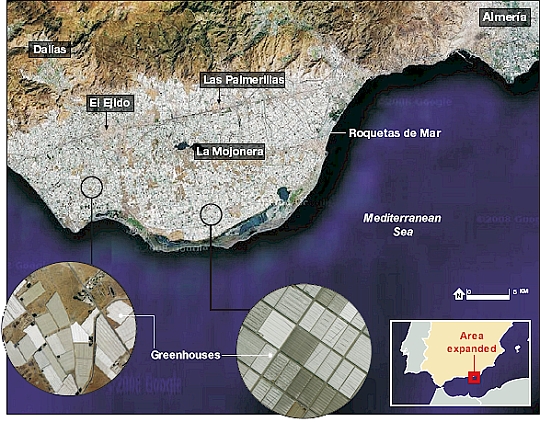
This has nothing to do with theology. Apparently the region of Almeria in southern Spain has been experiencing a "reverse greenhouse effect", a decrease in average temperature of 0.3° C per decade, due to--wait for it--greenhouses.

No, those aren't just unusually white-colored fields.
So many rudimentary plastic greenhouses have been erected to grow fruits and vegetables that the albedo (reflectivity) of the region has increased by 9%, reflecting enough sunlight back into space to decrease the temperature.

Just wanted to share.

Tuesday, May 21, 2013

Orthodoxy as a Process

Is it better to ask questions or find answers? This beautiful and thought-provoking comic about this question is work a read. Seriously, read it.

Scott McKnight recently wrote a nice new post on his blog titled, "Orthodoxy was a Process". In it he describes the development of thought about Christ's divinity in the early church, which underscores the fact that Christians haven't always believed the fully developed "orthodox" doctrine of the Trinity. His thesis is roughly this:
All theology, in the sense of orthodoxy or dogmatics or systematics, is a process. It’s an experimental expression to put into words what one thinks the Bible teaches in words that make sense in a new context. This also means no articulation is infallible or absolute or final. Which is not to say theology isn’t true, but it’s not final truth.
A risk of seeking "orthodoxy" in the church is that once a doctrine is declared orthodox by the Pope, reformers, leading theologians of the denomination, or what have you, it can often be considered (especially by people unaware of how it was arrived at in the first place) to be a complete, final articulation of spiritual truth that exactly captures how it really is "up there". Seeking greater understanding of this area of theology beyond the orthodox doctrine thus becomes discouraged, or even forbidden as heresy; the focus shifts to passing on the orthodox belief and proclaiming the message.

I see this a lot in many circles of evangelical Christianity. The "gospel" has been clearly articulated in four easy points; we know what it is, and our responsibility now is go "go and make disciples" (Matthew 28:19), passing on the truth we have learned to others who will be able to continue proclaiming it (2 Timothy 2:2). (Wow, I just used the key verses of Cru and Navigators in a single sentence) Not that exploring the wider meaning and implications of the gospel is really discouraged, but presenting the gospel in such a distilled, "this is what the Bible says about salvation" way risks disconnecting hearers from the process by which the doctrine was developed and by which they must develop an internal understanding of the gospel.
Analogy time: this helpful video explains how the standard PEMDAS rule order of operations is an overly simplified and even misleading representation of how mathematics works: "Focusing on the order of operations can lead to ambiguity and obscures the real, underlying, and often beautiful mathematics." Blindly following the rule you were taught in school not only hides the beauty and complexity of the mathematical operations, it can lead you to incorrect answers on problems like  6 - 3 + 1. It concludes that "while the order of operations isn't technically wrong, because most of the time it'll give you the standard answer, it's morally wrong, because it turns humans into robots."
A similar danger exists in theology. When we teach the doctrine of, say, the trinity as a Biblical argument in support of a diagram like the one above, we are teaching people to accept and believe a paradox (or mystery) that seems counterintuitive but is supposed to describe the very nature of God. By distilling the beautifully complex nature of God to bare, propositional facts and ignoring all the tension in the Bible and in church history about the trinity, we get theological robots who are able to effortlessly rattle off how the Father is not the Son is not the Spirit but all three are one God and the references to back it up, but are unable to draw any further conclusions or connect this doctrine meaningfully to their lives because it's a paradox/mystery beyond our comprehension, after all, and besides, you don't question orthodoxy, you just believe it because it's The Truth.

McKnight's post is a nice reminder of how previous generations of Christians have wrestled with understanding the nature of God. Justin Martyr articulated a Christian attempt to resolve the Platonic concept of logos with the God of the Bible; he thus portrayed Jesus as the divine logos, subordinate to the Father, by which the world was created. The result was largely a two-God theology depicting a a transcendent  immaterial Father and a subordinate logos involved in the earthy matter of creation. Certainly this is incompatible with how we understand the trinity today, and yet "logos Christology was never considered heresy; it was considered inadequate."

All theology (knowledge of, not just about, God) is incomplete; some of it is bad. Because we now know God only in part (1 Corinthians 13:12), all theology falls into one of these two camps. There is no complete, perfect theology to be found among people who are incomplete and imperfect at their best. In his letters Paul writes incomplete theology and warns against bad theology; he definitely considered his own knowledge of Christ to be a work in continual progress:
I want to know Christ—yes, to know the power of his resurrection and participation in his sufferings, becoming like him in his death, and so, somehow, attaining to the resurrection from the dead.
Not that I have already obtained all this, or have already arrived at my goal, but I press on to take hold of that for which Christ Jesus took hold of me. Brothers and sisters, I do not consider myself yet to have taken hold of it. But one thing I do: Forgetting what is behind and straining toward what is ahead, I press on toward the goal to win the prize for which God has called me heavenward in Christ Jesus. (Philippians 3:10-14)
An application of this idea of orthodoxy-as-process is in the ever-continuing debate over the nature of predestination and salvation, which I see most clearly between Calvinism and Arminianism. I think the line where healthy discussion becomes unhealthy division over this issue is when either side presents its view as "the" complete teaching of scripture, the final word on the matter, the conclusion of the search for the mind of God in predestination, and all opposing views as therefore unbiblical. (This is probably my bias showing, but I see this especially being done by Calvinists who speak as though Romans 9 or some other Pauline text is absolutely conclusive)

When I first started my series on providence to tackle this debate, as much as I might have denied it I really was of this mindset. I dreamed of finding the One True Soteriology that brilliantly explained all the Biblical evidence marshaled by both sides and ended the debate by silencing them in mute agreement. But if this orthodoxy-as-a-process idea is to be believed, then this dream was the epitome of hubris. Maybe we should expect the conversation to continue and no final conclusion to be reached this side of heaven. Of course we will (and should) reach conclusions when we do theology, but these conclusions are only outcroppings and resting points on the mountains of God (or of Aslan in C.S. Lewis' metaphor); we should not presume to have reached the peak itself.

On this blog, I've found that I tend to look back on all my posts from more than about a year ago (like the providence series) and think, "How naive and foolish I was then!" Maybe in another year or two I'll think so about this post. This comes with the adventure of an ever-changing, ever-growing theology. And just as we ought to be humble and encouraging to people at different points on this journey, I'm learning to accept my old posts as looks back at where I was in the past and reminders of where God has brought me.

Monday, May 20, 2013

In the day that you eat of it...

A quick note on a Genesis question I have had and that you might not even know you had. Genesis 2:17-18 reads:
And the LORD God commanded the man, saying, “You may surely eat of every tree of the garden, but of the tree of the knowledge of good and evil you shall not eat, for in the day that you eat of it you shall surely die.”
You know the story: Adam and Eve do eat the fruit, and then...don't die that day? Does this mean God lied to them, and the serpent was only guilty of correcting His lie? I've heard (and used) a number of responses. Some commentators focus on His mercy in letting them live--but this basically says of the lie, "it's no big deal, God can lie as long as He's merciful about it". Others, eager to fit the narrative into the evangelical narrative of salvation by grace through faith, interpret it as meaning spiritual death as separation from fellowship with God--nevermind that this dimension of death is not clearly seen until the New Testament. (And that it seems very likely that Genesis was supposed to explain the phenomenon of physical death) But there is a better way.

The Hebrew word translating to "in the day" is yowm, the same word used to give the "days" of creation in Genesis 1, which takes a variety of other temporal meanings throughout the OT including by not limited to a general "age" or period of time. (e.g. the "day of the Lord", which is really a new era of history) Because no two languages correspond exactly in their lexicons, yowm, while most often translated "day", should not be assumed to always have the same meaning as our English word "day"; we need to allow for a more flexible definition to account for the translational ambiguity.

Of course, lest you think Hebrew is just a sloppy language, the relationship can go the other way; for instance, Greek has two main words for "time", chronos, meaning a more specific length of time or specific point of occurrence and kairos, meaning an age or season similar to yowm. Now imagine a fictional first-century Greek person somehow listening to "Turn! Turn! Turn!" by the Byrds (nevermind that it it itself based on Ecclesiastes translated from Hebrew), assuming every instance of "time" meant chronos, and doing an intensive study to determine what the exact times to be born, die, plant, reap, etc. the song is talking about are. This person would be missing the point.

Or, of course, Biblical Greek has two words for "love": agape, meaning selfless love in the pattern of God's love for us, and philos, meaning love between friends, both contrasted with eros, meaning romantic love. I think a lot of the modern evangelical confusion with overly emotional spirituality and "Jesus is my boyfriend" songs comes from the fact that these three drastically different concepts are translated to the same word in English. Suppose a Greek individual, reading an English translation of 1 Corinthians 13, insisted on reading "love" only as eros love.

So, in this understanding, Adam's eating the fruit can be seen as inaugurating a new era in history in which people die. While I no longer believe this is literally/historically true (see my posts on the Fall), I think it's exactly what the text is saying in context--no trickery or double speech on God's part.